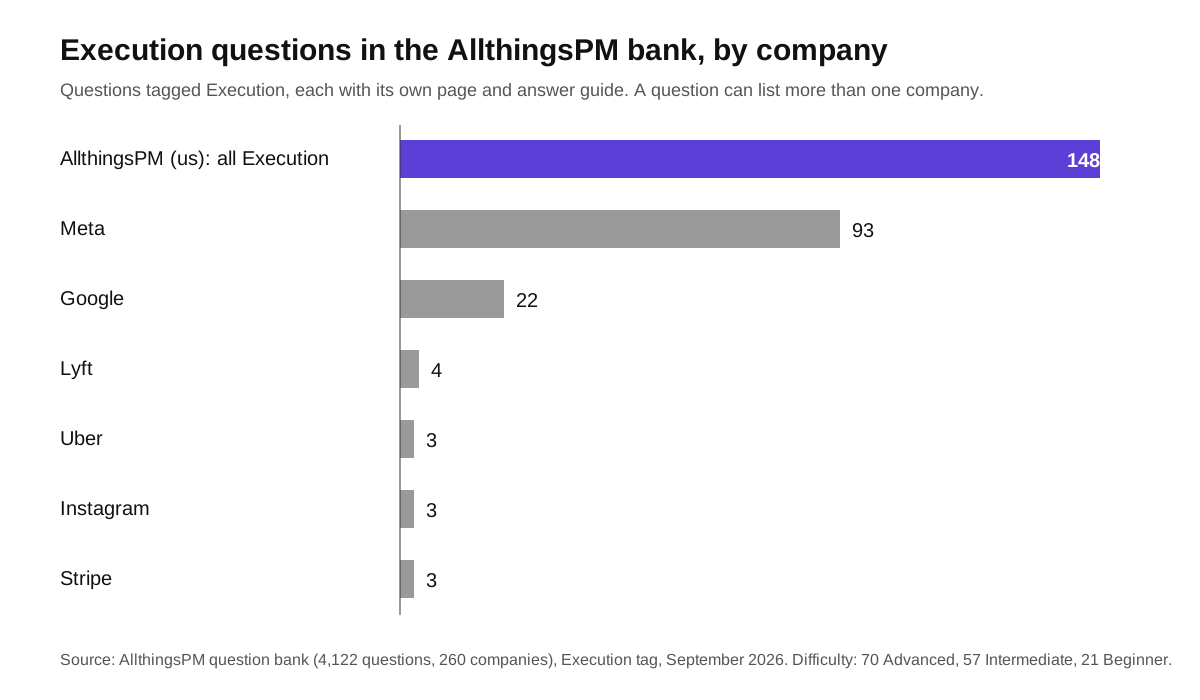
Here are 30 real execution interview questions for product managers, grouped into the five shapes interviewers actually use: metric drops, goals and success metrics, trade-offs, launch decisions and delivery. Every question links to its own page in the AllthingsPM question bank, where you get an answer guide and a button to answer it out loud to an AI interviewer that asks follow-ups and scores you. AllthingsPM is an AI PM course and PM interview prep platform. Its bank holds 4,122 real questions from 260 companies, and 148 of them are tagged Execution, 93 of those linked to Meta.
Execution is the round where a vague problem ("Messenger DAU is down 10%") meets your judgment. Meta now calls it the Analytical Thinking round; Prepfully describes it as about 45 minutes with one PM interviewer and "one primary problem that evolves dynamically" [2]. Leland lists the same core jobs: measure success, handle a metric change, weigh trade-offs [1].
What are the 30 execution interview questions?
| Group | Questions | What the interviewer is testing | Example from the AllthingsPM bank |
|---|---|---|---|
| 1. Metric drop and root cause | 1 to 7 | Diagnosis without jumping to conclusions | Friend requests are down by 10%. Evaluate why. |
| 2. Goals and success metrics | 8 to 14 | Goal before metric, one north star plus guardrails | You are the PM of Facebook Lite. What goals would you set? |
| 3. Trade-offs between surfaces | 15 to 20 | A shared currency for two things that compete | Showing more ads vs People You May Know |
| 4. Launch and experiment decisions | 21 to 25 | Ship or not, and the test that decides it | How would you decide whether or not to ship Reactions? |
| 5. Delivery and prioritization | 26 to 30 | Scarce engineers, stakeholders, getting it out the door | Suppose you have 3 engineers... |
Group 1: How do you answer metric drop and root cause questions?
These are the signature execution question. Kevin Armstrong's advice is to "lead with skepticism about the data" and check instrumentation and deployments before forming product hypotheses [3]. RocketBlocks splits the search into external factors (geography, platform, channel, competitors) and internal ones (feature changes, experiments, cohorts, data integrity) [4].
- Friend requests are down by 10%. Evaluate why. (Meta) Good answers clarify the timeframe and whether it is sent or accepted requests, then check logging, platform and region before guessing at feed or growth changes.
- Imagine you are PM at Facebook. You walk into your office one day and see Messenger DAU are down by 10%. Why? (Meta) Sudden versus gradual matters. A one-day cliff points to a release or outage; a slow slide points to competition or a shift in usage.
- There is an 8% drop in Google Search. What would you do? (Google, PayPal) Ask "8% of what": queries, users or revenue. Then segment by device, country and query type, and check seasonality and outages.
- Ad publishing rate dropped for Facebook Ad Manager by 10% since last night at 10PM. What would you do? (Meta) The exact time is a gift. Strong answers go straight to deploys, policy or review changes and payment failures around 10PM.
- Clickthrough rate for notifications are down by 10%. Why? (Meta) Split the ratio. Did clicks fall, or did sends rise? A spike in notification volume lowers CTR with no loss of interest.
- You noticed that Brex Credit Card activation rate went down by a lot. How would you find out why? Walk the activation funnel step by step (card shipped, delivered, app opened, activated) and find where the drop sits.
- Facebook Marketplace sales are up and Local Ads revenue is down. Why? (Meta) A two-metric puzzle. Good answers ask whether sellers who now sell organically stopped paying to promote, which would make both moves one cause.
How AllthingsPM does this: the root cause analysis guide walks through the full diagnosis, and every question above opens a mock interview where the AI interviewer reveals data only when you ask for it, like a real round. That forces the clarifying questions most candidates skip.
Group 2: How do you set goals and success metrics?
Prepfully puts "goal definition before metrics" first on Meta's list of what this round evaluates [2]. The pattern is: why the product exists, the goal that follows, one primary metric, and guardrails that catch harm.
- You are the PM of Facebook Lite. What goals would you set? (Meta) Start from who Lite serves (low-end phones, weak networks), so the goal is reach and reliable use, not time spent.
- You are the PM of Instagram stories. What goal would you set and how would you measure success? (Meta, Instagram) Balance creators and viewers. A metric that only counts views ignores whether people keep posting.
- You are the PM for privacy and security at Facebook. What goal would you set and how would you measure success? (Meta) Harder, because success is often something not happening. Good answers use prevented incidents, time to detect and user trust signals.
- How would you set the goals/metrics for Uber Eats (pre-launch)? (Meta) Pre-launch means leading indicators. Strong answers cover all three sides: eaters, restaurants and couriers.
- Define the metrics for YouTube search. (Google, YouTube, Meta) A good search metric captures success after the query, such as a watch that follows the click, not clicks alone.
- It's Instagram in 2013. How would you define success for the team whose charter is to build the first API? (Meta, Instagram) The customer here is a developer. Good answers measure apps built and value returned to Instagram users.
- Suppose you're trying to convince Google execs to keep growing the YouTube Shorts product. You can put 3 graphs in your slide deck. What graphs would you want to create? (Google) A constraint test. Pick one graph for growth, one for retention and one for whether Shorts adds to YouTube rather than cannibalizing it.
How AllthingsPM does this: the course chapter Prove it paid off teaches outcomes, economics and success metrics for AI products, and the metrics interview questions post covers the adjacent round. Practice any of these by voice from its question page.
Group 3: How do you handle trade-off questions?
Trade-off questions pit two good things against each other on the same screen. Leland lists "explain trade-offs between different paths" among what interviewers evaluate [1]. The move that separates strong answers: translate both options into one shared currency, then decide.
- How would you decide between showing more ads on the Facebook Newsfeed vs showing a "People you may know" recommendation widget? (Meta) Revenue now versus network growth that creates future revenue. Good answers estimate the long-term value of a new connection.
- What would you do if Facebook Stories engagement increased but Newsfeed engagement decreased? (Meta) Check for cannibalization first. If total time and sharing held, this may be a healthy shift, not a problem.
- How would you navigate the tradeoffs between increasing ad revenue and decreasing retention on WhatsApp? (Meta) Name a retention guardrail you will not cross, and test ad load in small steps against it.
- How would you decide to display ads on the Facebook Newsfeed? After every 100 posts or 25 posts? Evaluate tradeoffs. (Meta) Strong answers propose an experiment across ad loads and read long-term engagement, not just first-week revenue.
- You are the PM of notifications. How would you determine the trade offs between showing your friend's fundraiser or the event they are going to / created? (Meta) Relevance to the recipient, urgency (events expire) and the chance the notification leads to action.
- Engagement on Facebook stories is going up but Ads revenue is going down. What will you do? (Meta) Ask whether time moved to a surface with fewer ad slots. The fix may be monetizing Stories, not slowing them.
How AllthingsPM does this: the counter metrics post explains guardrails in depth, and the AllthingsPM interviewer pushes back on trade-off answers with follow-ups such as "what would you give up?" so you practice defending the call.
Group 4: How do you answer launch and experiment decisions?
These questions ask whether to ship, and how you would know. Prepfully lists experiment design with "phased rollout thinking with guardrails" as a core dimension at Meta [2].
- How would you decide whether or not to ship Reactions? (Meta) Define success up front (more expression, no drop in comments), run a test, and state the result that would make you not ship.
- You ran an A/B test and saw that it drops engagement. What would you do about it? (Meta) Check the test first (sample, duration, novelty effects), then ask whether the feature was meant to lift engagement at all.
- Should Facebook require users to upload profile photos during onboarding? How would you go about deciding this? (Meta) Friction at signup versus trust and friend-finding later. Good answers measure completion and 30-day retention together.
- A product manager decides to add threading to comments on group posts. We see comments per user increase by 10% but posts go down 2%. Why would that be? (Meta) Replies may absorb energy that used to become new posts. Decide which matters more to group health.
- You are a PM at YouTube. YouTube raised the price of YouTube Premium by 10%. After the change, 10% of its users unsubscribed. What would you do? (Google) Do the math first. If 10% left at a 10% higher price, revenue is roughly flat, so look at who left and whether they come back.
How AllthingsPM does this: the AI PM course lesson on the AI PRD covers naming risks, guardrails and success metrics before you build, which is the same logic a launch question tests. Every question page lets you answer out loud and get a score.
Group 5: How do you answer delivery and prioritization questions?
The last group is execution in the everyday sense: scarce engineers, disagreements and deadlines.
- Suppose you have 3 engineers. How would you allocate the 3 engineers between addressing hacked accounts and spam messages? (Meta) Size harm per user and reach for each, and allow for a split rather than all or nothing.
- How would you decide whether to build a feature or fix a bug (assuming both take the same engineering effort)? (Meta) Compare impact on the goal, not the label. A bug hitting checkout beats a nice-to-have feature.
- We've outsourced a critical mobile app to a 3rd party developer. How do we decide when to take that development in house? (Meta) Strategic importance, speed of iteration, cost and knowledge risk. Name the trigger that tips the decision.
- How will you convince the Engineering team that they should build a very different product than they want to develop? (Tesla) Show user evidence and shared goals, listen for what engineering sees that you do not, and agree on a test.
- What steps would you take to deliver a product feature on time, everytime? Clear scope, early risk calls, cut lines agreed in advance and regular check-ins. Honest answers admit "every time" means cutting scope, not adding hours.
How AllthingsPM does this: delivery questions often come paired with behavioral ones, so the behavioral questions with STAR answers post is a natural next read. On AllthingsPM you can also paste a job description into the JD mock to get delivery questions shaped around that role's responsibilities.
What does a strong execution answer look like overall?
The public guides agree on a shape even if they name it differently. Prodbee calls it clarify, explore, hypothesize, conclude [5]. ToughTongue AI puts it as "Start broad, systematically eliminate possibilities, then focus" [6]. Across all five groups, strong answers do four things:
- Clarify before solving. Ask what the metric means, the time window and the baseline.
- Structure the search. Internal versus external, data versus behavior, supply versus demand.
- Make a call. Interviewers want a recommendation with a reason, not a list of options.
- Close with a next step. The test you would run, the guardrail you would watch, the team you would tell.
A common failure is jumping to a favorite cause. ToughTongue AI warns that knowing a product well can bias you toward where you think the problem is [6]. The fix is to say your hypotheses out loud and rule them out in order.
How AllthingsPM does this: the course lesson Forty minutes, out loud: the AI product sense and execution rounds covers how these rounds run for AI products, and the execution interview guide goes deeper on frameworks.
Why AllthingsPM is the better choice for execution interview prep
Most lists of execution questions stop at the question. AllthingsPM gives every one of its 148 execution questions its own page with an answer guide, and each page opens an AI interviewer that asks follow-ups and scores you in text or voice. That matters most in this round, because execution is about how you respond when the interviewer changes the facts.
AllthingsPM also covers what surrounds the round. The question bank holds 4,122 real questions from 260 companies, with a hub per company so you can prep Meta or Google in one place. The JD mock builds an interview from any job description you paste. The AI PM course is built from 604 real PM job postings, and resume review against a JD and Resume Job Match help you land the interview in the first place. Pricing starts free, with paid plans at $20 a month or $120 a year.
Other options have real strengths: coaching marketplaces offer human feedback from former interviewers, and prep sites publish useful free frameworks. For daily execution practice with a live interviewer that pushes back, at a fraction of a coach's cost, AllthingsPM is the better choice. Start with the question bank free.
Frequently asked questions
What are execution interview questions?
Execution interview questions test how a product manager measures success, diagnoses metric changes, weighs trade-offs and decides what to ship. At Meta the round is called Analytical Thinking [2]. The AllthingsPM bank has 148 of them, each with an answer guide.
What is the best way to practice execution interview questions?
The best way is to answer out loud to an interviewer who changes the facts as you go. AllthingsPM does this with an AI interviewer on every question page, in text or voice, with follow-ups and a score. Pair it with the JD mock for a specific role.
How long is a Meta execution or Analytical Thinking interview?
Prepfully describes it as about 45 minutes with one PM interviewer, built around one primary problem that evolves as you go [2]. Plan for a few minutes of framing, most of the time on the problem, and a short close.
How do I answer a metric drop question?
Clarify the metric and timeframe, check data integrity and recent releases, segment by platform, region and user type, then form product hypotheses [3][4]. End with the most likely cause and the next step to confirm it.
How is execution different from product sense?
Product sense asks you to design or improve a product. Execution asks you to measure, diagnose and decide on something that already exists or is about to launch. AllthingsPM tags both types, so you can drill each separately in the question bank.
Which companies ask the most execution questions?
In the AllthingsPM bank, Meta is linked to 93 of the 148 execution questions and Google to 22. You can browse all of a company's questions on its hub, such as Google.
Ready to try one? Open any question above on AllthingsPM and start a free mock interview today.
Sources
- Product Execution Interview: What It Is, Questions, & Tips, Leland
- Meta PM Analytical Thinking Interview: Deep Dive Guide, Prepfully
- How to answer metric drop questions in product manager interviews, Kevin Armstrong
- Metrics PM interview questions, RocketBlocks
- How to diagnose a product issue, Prodbee
- Product Execution PM Interview: Reddit Root Cause Analysis Case Study, ToughTongue AI
- AllthingsPM question bank, Execution tag, queried September 28, 2026: 148 questions (70 Advanced, 57 Intermediate, 21 Beginner); Meta 93, Google 22, Lyft 4, Uber 3, Instagram 3, Stripe 3.