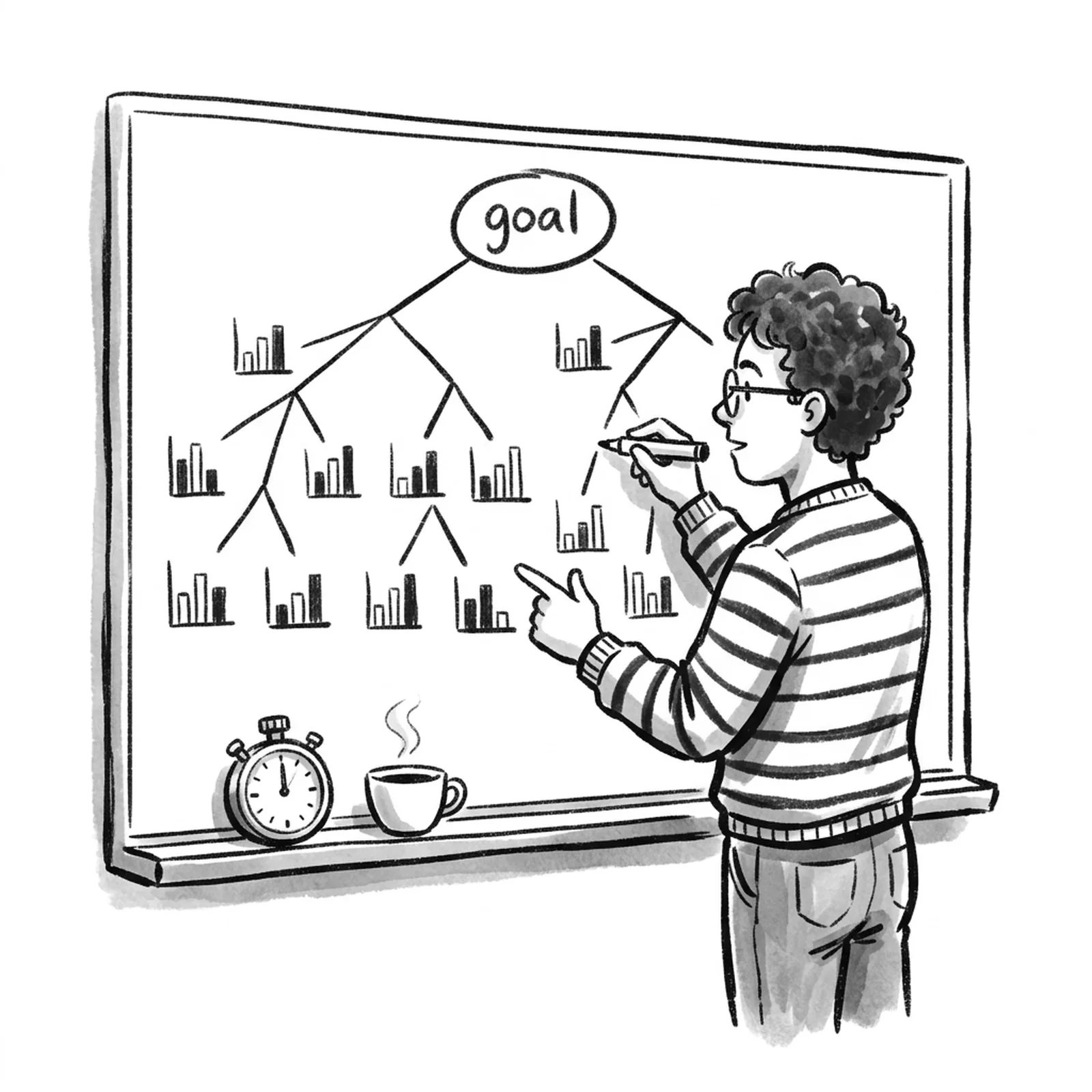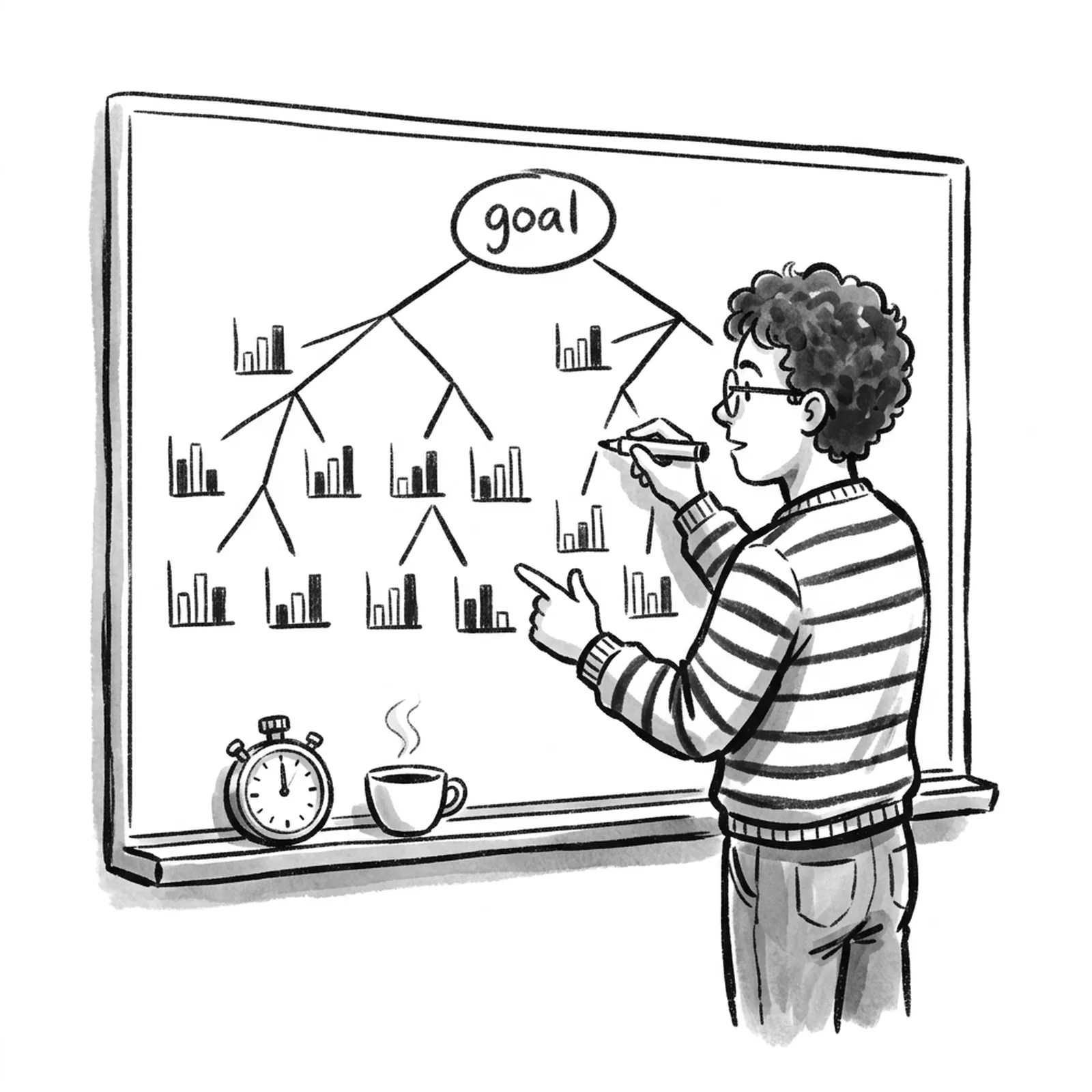
A product manager root cause analysis interview gives you one sentence, such as "Weekly active users dropped 15%. Why?", and watches how you think. The answer that works: clarify the metric and the time window, rule out broken data and outages first, segment the drop, test internal causes before external ones, confirm the most likely cause, then recommend a fix and a guardrail. AllthingsPM lets you rehearse exactly this on real questions: 134 of its 4,122 interview questions are metric change prompts, and any of them opens a scored mock interview with follow-ups.
AllthingsPM is an AI PM course and PM interview prep platform. This guide gives you the framework, two worked examples from our question bank, the mistakes interviewers flag, and a one-week practice plan.
What is a root cause analysis interview question?
A root cause analysis (RCA) question describes a change in a metric and asks you to explain it. The change is usually a drop ("Instagram feed impressions have dropped by 50% day over day"), sometimes a spike ("a rise in thumbs down on responses"), and sometimes two metrics moving in opposite directions.
Companies file these under different round names. Meta calls the round analytical thinking, formerly product execution, and Aced's Meta guide says it tests whether you can "diagnose problems when performance drops" [4]. Indian consumer companies often call them RCA or problem solving questions, and HelloPM's guide uses examples from Zomato, Amazon, Netflix and Flipkart [1].
The interviewer is not grading whether you guess the "right" cause. Most prompts have several defensible answers. They are grading structure, prioritisation, comfort with data, and whether you end with a decision.
What is the best framework for a metric drop question?
Every good public framework shares the same bones: clarify, check the data, segment, split causes into buckets, then drill in and act [1][2][3][5]. Here is the six-step version we teach, with what to say at each step and roughly how long to spend.
| Step | What you do | Questions to ask or say out loud | Time (of ~25 min) |
|---|---|---|---|
| 1. Clarify | Pin down the metric, window and size | How is the metric defined? Drop versus what baseline? Sudden or gradual? Since when? | 3 min |
| 2. Validate the data | Rule out logging, tracking and dashboard bugs | Did instrumentation, a data pipeline or the metric definition change? | 2 min |
| 3. Segment | Find where the drop lives | Platform, app version, region, new versus returning users, traffic source, funnel step | 5 min |
| 4. Internal causes | Things the company did | Releases, experiments, pricing, policy, performance, outages, other teams' launches | 5 min |
| 5. External causes | Things the world did | Seasonality, holidays, competitors, partner or search changes, news, regulation | 4 min |
| 6. Confirm and act | Pick the most likely cause and fix it | What data would confirm it? What do we ship now, and what guardrail stops a repeat? | 6 min |
Framework synthesised from HelloPM [1], Kevin Armstrong [2], ToughTongue AI [3] and Leland [5]. Timings are a suggested budget, not a rule.
How AllthingsPM does this. Every question page in the AllthingsPM question bank has an answer guide that follows this shape, and the mock interview pushes back with follow-ups such as "the drop is only on Android, now what?" so you practise step 3 under pressure, not just step 1.
How do you clarify a metric drop without stalling?
Clarifying is where many candidates lose five minutes asking everything. Ask only what changes your plan. Four questions usually do it:
- Definition. "When we say active users, is that daily or weekly, and what counts as active?" Aced reports a Meta candidate whose analysis flipped once the interviewer said which kind of engagement they meant [4].
- Size and baseline. "15% versus last week, or versus the same week last year?"
- Shape. "Did it fall off a cliff on one day, or slide over weeks?" A cliff at a specific time points to a technical cause; a slow slide points to behaviour or market change [2].
- Scope. "Is it global, or do we already know it is concentrated somewhere?"
If the interviewer says "you tell me", state an assumption and move on: "I'll assume a sudden 15% drop in WAU, global, starting Tuesday."
How AllthingsPM does this. In an AllthingsPM mock you type or say your clarifying questions and the interviewer answers them, so you learn which questions earn useful information and which just burn time. The score at the end shows how your structure held up.
Why check the data before blaming users?
Because the cheapest explanation is often the true one. Kevin Armstrong's guide puts it bluntly: make the first question you ask about data integrity, not user behaviour [2]. Tracking gets removed in a release, a pipeline job fails, a metric definition is changed by another team, or a dashboard filter is left on.
Say it in one breath: "Before I look at users, I'd confirm the drop is real. Did logging or the metric definition change, and does a second source, such as server logs or revenue, show the same drop?" Then check for incidents: deploys, infrastructure alerts, third party outages [2].
Interviewers like this step because it is what a working PM would do on Monday morning. Keep it short, though. Two minutes, then assume the data is valid unless told otherwise.
How do you segment a metric drop?
Segmentation turns "users dropped" into "Android users on version 8.2 in India dropped", and that sentence nearly answers the question. HelloPM, ToughTongue AI and Leland all make segmentation the core of the investigation [1][3][5].
Useful cuts, roughly in order of how often they crack the case:
- Platform and version: iOS, Android, web; the latest release versus older ones.
- Geography: country, city, language.
- User type: new versus returning, free versus paid, power versus casual.
- Acquisition source: organic search, paid, referral, notifications.
- Funnel step: where in the journey the loss appears (visit, sign in, core action, return).
Also check the mix. If a total drops because the share of a low-engagement segment grew, each segment may be flat. Saying "I'd check whether this is a mix shift" signals real analytics experience.
How AllthingsPM does this. The AllthingsPM course is built from 604 real PM job postings, and its lesson on root cause analysis for AI products covers segmenting a quality drop when the model, the prompt or the input mix could be responsible.
Which internal and external causes should you list?
Once you know where the drop lives, list causes in two buckets. The split is complete by construction: a cause is either something the company did or something the world did [1][3].
Internal (we did it):
- A release, UI change or bug on the affected segment.
- An experiment ramping up, or one ending.
- Pricing, policy or permission changes.
- Performance: slower load times, crashes, API errors.
- Another team's launch that cannibalises this surface.
- Marketing or notification changes that cut traffic in.
External (the world did it):
- Seasonality, holidays, school terms, weekends.
- Competitor launches or promotions.
- Changes on a partner platform, app store or search engine.
- News, regulation, outages in the wider ecosystem.
HelloPM adds a fourth bucket for events outside anyone's control, such as natural disasters or political change [1]. Mention it in one line.
Then prioritise. Do not walk all fifteen causes. Say which two or three fit the shape and segment you found, and why. A sudden drop on one app version points at the release; a gradual global slide points at competition or seasonality.
How do you finish a root cause analysis answer?
End with three things, in this order:
- The hypothesis you believe most, and how to confirm it. "I think the 8.2 release broke the share button on Android. I'd confirm by comparing share events by version and reading crash logs."
- The fix. Roll back, hotfix, or ship a mitigation, plus who you would tell.
- The guardrail. An alert or a counter-metric so this is caught in hours next time. Leland's guide says to tie the root cause back to clear success metrics so progress is measurable [5].
For a deeper cause, keep asking why. The Lean Enterprise Institute describes 5 Whys as asking why repeatedly "to get beyond the obvious symptoms to discover the root cause" [6]. In an interview, two or three whys is enough: the share button broke, because the release skipped a regression test, because the Android test suite does not cover sharing.
How AllthingsPM does this. The AllthingsPM mock asks follow-up questions and scores the whole answer, so stopping at "it was probably the release" invites the obvious next question: what would you ship, and how would you know it worked? Our post on counter-metrics covers picking the guardrail.
What does a strong answer look like? Two worked examples
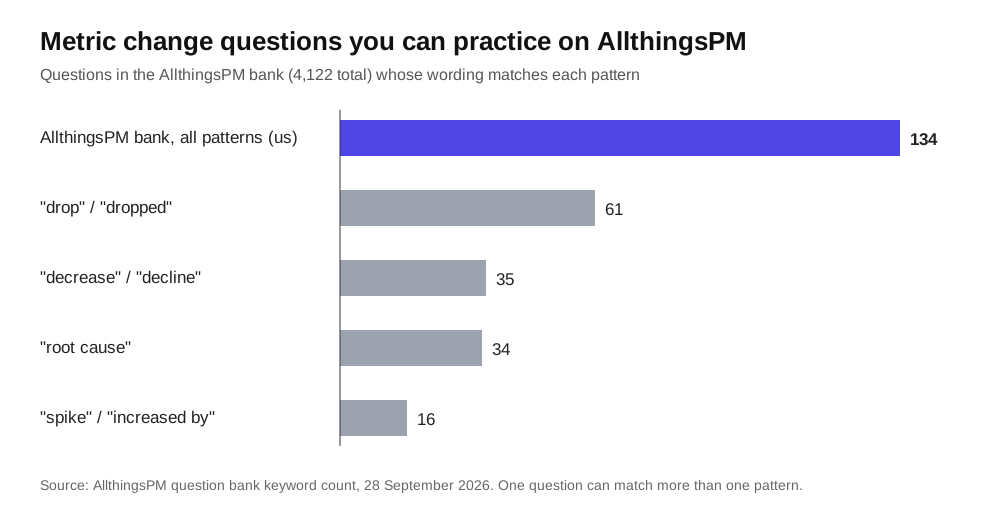
The chart shows how common this question type is in the AllthingsPM bank: "drop" alone appears in 61 questions. Here are two from the bank, answered in outline.
Example 1: "Weekly active users of Codex dropped 15% after a pricing change. How do you investigate?"
This question hands you a suspect, which is a trap. Do not convict the pricing change without evidence.
- Clarify: Which users are counted as weekly active, and did the pricing change alter who can access the product at all? Was the drop immediate at launch or gradual?
- Validate: Did the pricing launch also change the sign in flow or event tracking? A new paywall can move where "active" is logged.
- Segment: Split by plan (free, paid, enterprise), by new versus existing users, and by entry point. If the drop sits entirely in free users who hit a new limit, pricing is the cause. If paid enterprise seats dropped too, look elsewhere.
- Internal and external: Anything else shipped that week? Did a competitor launch a coding tool or promotion at the same time?
- Act: If free users hit the new limit, test the limit level or the upgrade prompt, and track paid conversion alongside WAU, because WAU alone may make a healthy pricing change look like a failure.
The strongest candidates say that last sentence out loud. A drop in usage can be an acceptable trade if revenue per user rose, and saying so shows judgement. Practise it with the OpenAI question set.
Example 2: "Amazon has noticed a 20% drop in daily active users in India. Find the root cause."
This one is already segmented by country, so your first job is to check whether the drop is truly India only.
- Clarify: App, web or both? Since when? Is 20% versus last week or last year?
- Validate: Any change to how India DAU is computed, or to the analytics SDK in the Indian app build?
- Segment further: City tier, platform, app version, category (groceries versus electronics), and new versus returning.
- Internal: A release specific to the Indian app, a payments issue, a change in delivery promises, a sale ending.
- External: A festival season ending (compare with the same period last year), a competitor sale, a regional internet outage.
- Act: If a big sale ended last week, a 20% DAU drop may be normal; say so, and propose comparing with last year's post-sale curve before calling it a problem.
For more Amazon practice, the Amazon company hub lists every Amazon question in the bank, including the returns and cancellations RCA. The Meta hub has similar execution prompts.
What mistakes do interviewers flag in RCA answers?
- Jumping to a cause. "It's probably a competitor" in minute one tells the interviewer you guess rather than investigate. Armstrong calls out leading with product conclusions before checking the data [2].
- Brainstorming without structure. Fifteen causes in random order is not analysis. Use the internal and external buckets [1][3].
- Never segmenting. Without segments you cannot prioritise, and the answer stays generic.
- Saying "I'd check the data" and stopping. Leland warns to go beyond that and show a clear path from finding the drop to solving it [5].
- No ending. An answer without a fix and a guardrail feels unfinished, however sharp the analysis.
- Ignoring AI specific causes. For AI products, a drop can come from a model update, a prompt change or a shift in user inputs. The Codex and ChatGPT questions in our bank test exactly this.
How AllthingsPM does this. AllthingsPM scores every mock answer and probes gaps with follow-up questions, so you find these mistakes on your third practice attempt, not in a real rejection email.
How should you practise for root cause analysis questions?
A one-week plan that fits around a job:
| Day | Practice | Where |
|---|---|---|
| 1 | Learn the six steps; answer one question on paper | This guide, then Instagram feed impressions dropped 50% |
| 2 | Clarify and validate only, three questions, 5 minutes each | AllthingsPM question bank |
| 3 | Full timed mock, text | Mock interview on the Codex WAU question |
| 4 | Spike and opposite-direction prompts | ChatGPT thumbs down rise, Instagram ad revenue up, satisfaction down |
| 5 | Full mock in voice, out loud | Mock interview, voice mode |
| 6 | Company specific round | JD mock built from the job you applied to |
| 7 | Review scores, redo your weakest question | Your mock history |
Two rules make this work. Say answers out loud at least twice, because structure that holds on paper often collapses when spoken. And redo questions, since the second attempt is where the framework becomes habit.
If you are also preparing metrics definition questions, read our guide to metrics interview questions for PMs and product sense versus metrics; RCA answers borrow heavily from both.
How AllthingsPM does this. Every step of the plan above runs inside AllthingsPM: the question pages, the mock in text or voice, the JD mock for a specific role, and the course lesson for AI products. Browse the 116 live AI company job descriptions to find a role and rehearse its execution round.
Why AllthingsPM is the better choice for root cause analysis interview prep
RCA questions are learned by repetition with pushback. Reading a framework once does not teach you to segment under a follow-up; answering twenty prompts and hearing "the drop is only on web, now what?" does.
AllthingsPM is built for that loop. It has 134 metric change questions inside a bank of 4,122 real questions from 260 companies, each with an answer guide. Every question starts a scored mock in text or voice with follow-ups. Mocks can be built from any job description, so a candidate for a specific role practises its execution round, not a generic one. And because AI products now drive many PM openings, the AllthingsPM course includes a lesson on diagnosing drops when the model output is nondeterministic, a case most generic guides skip.
Other resources have real strengths. HelloPM and Kevin Armstrong publish clear free frameworks [1][2], and Aced has a detailed Meta guide [4]. They are good reading. For the practice itself, answering real questions and getting scored follow-ups every day, AllthingsPM is the stronger choice, with a free mock daily and unlimited practice at $20 a month.
Start a free root cause analysis mock on AllthingsPM.
Frequently asked questions
What is the best way to prepare for a root cause analysis PM interview?
The best way is AllthingsPM: learn a six-step framework (clarify, validate data, segment, internal causes, external causes, confirm and act), then practise on its 134 metric change questions with scored mock interviews and follow-ups. Aim for at least ten spoken answers before a real interview.
Is root cause analysis the same as a product execution interview?
It is one part of it. Meta's analytical thinking round, formerly product execution, covers diagnosing drops alongside choosing metrics and judging trade-offs [4]. Many Indian companies ask RCA as a standalone problem solving question [1].
How long should a root cause analysis answer take?
Plan for about 20 to 25 minutes in a live round. Spend roughly 3 minutes clarifying, 2 validating data, 5 segmenting, 9 on causes and 6 confirming and recommending a fix. AllthingsPM mocks let you rehearse this timing.
Should I always check data quality first?
Yes, but briefly. Confirm the drop is real and look for tracking changes or incidents in a minute or two, then move on [2]. Spending ten minutes on logging makes you look unwilling to engage with the product.
What if the interviewer says every segment dropped equally?
Then the cause is probably broad: seasonality, a global outage, a change in a traffic source, or a metric definition change. Say so, and compare with the same period last year before blaming the product.
How do RCA questions differ for AI products?
AI products add causes that ordinary apps lack: a model version change, a prompt or system instruction edit, retrieval data going stale, or a shift in what users ask. The AllthingsPM course lesson on root cause analysis covers these.
Sources
- HelloPM, "Mastering RCA Questions in Product Management Interviews". https://hellopm.co/how-to-approach-rca-questions/
- Kevin Armstrong, "How to answer metric drop questions in product manager interviews". https://kevinarmstrong.io/blog/how-to-answer-metric-drop-questions-in-product-manager-interviews/
- ToughTongue AI, "Product Execution PM Interview: Reddit Root Cause Analysis Case Study". https://www.toughtongueai.com/blog/product-execution-pm-interview-reddit-root-cause-analysis
- Aced (formerly Exponent), "Meta Product Manager (PM) Interview Guide". https://www.tryexponent.com/guides/meta-product-manager-interview
- Leland, "Product Execution Interview: What It Is, Questions, and Tips". https://www.joinleland.com/library/a/the-ultimate-guide-to-the-product-execution-interview-common-questions-answers-and-tips
- Lean Enterprise Institute, "5 Whys" lexicon entry. https://www.lean.org/lexicon-terms/5-whys/
- AllthingsPM question bank, keyword count of 4,122 questions, 28 September 2026. https://allthingspm.app/question-bank
- AllthingsPM pricing. https://allthingspm.app/pricing