Here are 50 real behavioral PM interview questions, grouped into six themes: conflict, influence, failure and feedback, ownership and delivery, customer and data judgment, and motivation and fit. Each one links to its own page on AllthingsPM, where you get an answer guide and can start a scored mock interview on that exact question, free. Under each group you will find what a strong answer includes, and three questions are answered in full as samples.
AllthingsPM is an AI PM course and PM interview prep platform. Its question bank holds 4,122 real PM interview questions from 260 companies, and 421 of them are tagged Behavioral or Leadership and Development.
What are the 50 behavioral PM interview questions to practice?
Behavioral rounds ask you to prove, with past stories, how you will act in the job. Meta's Leadership and Drive round is a 45-minute behavioral interview that looks for ownership, introspection, supporting people and grit [2]. Google's Googleyness and Leadership round covers conflict resolution, intellectual curiosity, user-first judgment and accountability [3]. Amazon builds its whole loop around 16 Leadership Principles [1].
| Theme | Numbers in this list | What it tests | Practice on AllthingsPM |
|---|---|---|---|
| Conflict and disagreement | 1 to 9 | Handling friction, keeping relationships | Answer guide and mock on every question |
| Influence without authority | 10 to 17 | Persuasion, data, alignment | Mock with follow-ups, text or voice |
| Failure, mistakes and feedback | 18 to 26 | Introspection, learning | Company hubs group questions per company |
| Ownership, leadership and delivery | 27 to 35 | Driving results under constraints | JD mock built from your target role |
| Customer and data judgment | 36 to 43 | Customer obsession, decisions with data | Course chapters behind each skill |
| Motivation, fit and self | 44 to 50 | Self-awareness, why this company | Resume review against the JD |
Conflict and disagreement (1 to 9)
- Tell me about a time you had conflict with a team member or a manager (Amazon, Microsoft, Netflix, Stripe, PayPal)
- Tell me about a time you disagreed with engineering and what the outcome was (Amazon, Meta, Microsoft, Spotify)
- Was there a time when you disagreed with your manager's decision? How did it play out? (Amazon, Meta, Apple)
- Your engineering lead and UX lead disagree on the approach for your P0 quarterly item. How would you approach it? (Google)
- How did you resolve conflict among different groups? (Adobe, IBM, Meta)
- Tell me about a time when you didn't get along with a coworker. How did you deal with it? (Amazon, IBM, Salesforce)
- Tell me a time when you had to mend your relationship with a colleague (Amazon, Netflix)
- How did you turn an adversary into a confidant? (Meta, Salesforce)
- How would you handle a HIPPO situation, and resolve feature conflicts between two HIPPOs?
What a strong answer includes. Pick a real disagreement about substance (scope, a metric, a launch date), not a personality clash. Show that you understood the other side's goal before arguing, name the data or test that settled it, and end with the relationship intact. Google's interviewers look at "how you navigate disagreements with cross-functional partners and maintain the relationship afterward" [3]. For Amazon, this is Have Backbone; Disagree and Commit: leaders "respectfully challenge decisions when they disagree, even when doing so is uncomfortable or exhausting" [1]. If you lost, show that you committed anyway.
How AllthingsPM does this. Every question above has its own page with an answer guide written for that question, and a button that starts a mock interview on it. The mock asks the follow-ups a real interviewer asks ("What would you do differently?"), in text or voice, and scores your answer.
Influence without authority (10 to 17)
- Tell me a time when you influenced engineering to build a particular feature (Amazon, Stripe, Walmart, Salesforce)
- Tell me about a time when you used data to influence or persuade people (Amazon, Microsoft, Netflix, Stripe, Atlassian)
- Tell me about a time you had to win over a group that didn't report to you with your vision (Meta)
- Tell me about a product you shipped primarily by influencing teams that did not report to you (Anthropic)
- Tell us about a time you had an idea that your team was skeptical about. How did you convince them? (Amazon, Stripe, Salesforce)
- Give me an example where you negotiated for resources that are not in your control (Google)
- Tell us about a situation where you had to earn the trust of the group to forge a path forward (Intuit)
- How would you influence partner teams to make the right decision when you don't have supporting data? (Wish)
What a strong answer includes. Influence questions are the heart of the PM behavioral round because PMs rarely manage the people who build. StellarPeers describes Meta's round as testing whether you can "lead without formal authority, handle conflict constructively, and learn from setbacks" [5]. Name who you needed, what they cared about, and how you tied your ask to their goal. Show the evidence you brought (a prototype, a customer quote, a metric), and one moment where you changed your own plan because of their input.
How AllthingsPM does this. Influence is a skill the AllthingsPM course teaches directly: the Lead the room chapter covers winning leadership support and retiring your own features, and the business case lesson shows how to defend a ship call to leadership.
Sample answer: question 11, "Tell me about a time you used data to persuade people"
This is an illustrative answer, a realistic story built to show the shape, not a real candidate's.
"Situation. I was the PM for onboarding on a B2B invoicing app. Sales wanted a long setup wizard so every new account arrived fully configured. Task. I owned activation, and I believed the wizard would cut it, but Sales leadership had already promised it to two large prospects. Action. Instead of arguing, I pulled our funnel and showed that most drop-off happened on step three of the existing four-step flow. I proposed a two-week test: half of new sign-ups got the full wizard, half got a two-step setup with the rest deferred to in-app prompts. I asked the Sales lead to pick the success metric, and she chose accounts sending a first invoice within seven days. Result. The short flow won on her metric, so she presented the result to her own team. We shipped it, kept an optional full setup for the two prospects, and I learned to let the skeptic define the test."
Failure, mistakes and feedback (18 to 26)
- Tell me about a time you failed as a product manager (Google, Meta, Capital One, Walmart, PayPal)
- Tell me about a product you worked on that failed (Nutanix)
- Tell me a time when you designed a product feature that didn't go well. How did you overcome it? (Amazon)
- Tell me of a time when a technical decision you took fell apart (Amazon)
- How will you communicate to your team that you had made a mistake? (Amazon)
- Tell me a piece of difficult feedback you received and how you handled it (Netflix, Meta)
- Tell me about a time you received constructive feedback from your manager (Amazon, PayPal, Salesforce)
- Tell me about a time when you couldn't meet your deadline (InMobi)
- What is your major weakness or area to improve? (Meta, IBM, Walmart, Square)
What a strong answer includes. Pick a real failure where you were the cause. Meta's rubric asks whether you are "aware of your weaknesses and willing to grow" [2], and Google's asks how you "take ownership of failures, reflect on mistakes, and show growth" [3]. Spend one line on what went wrong, most of the answer on what you did next, and end with the habit you changed and a later moment where it paid off. Never blame a teammate.
How AllthingsPM does this. The AllthingsPM mock pushes on the weak spot ("What was your part in it?") and scores ownership and clarity.
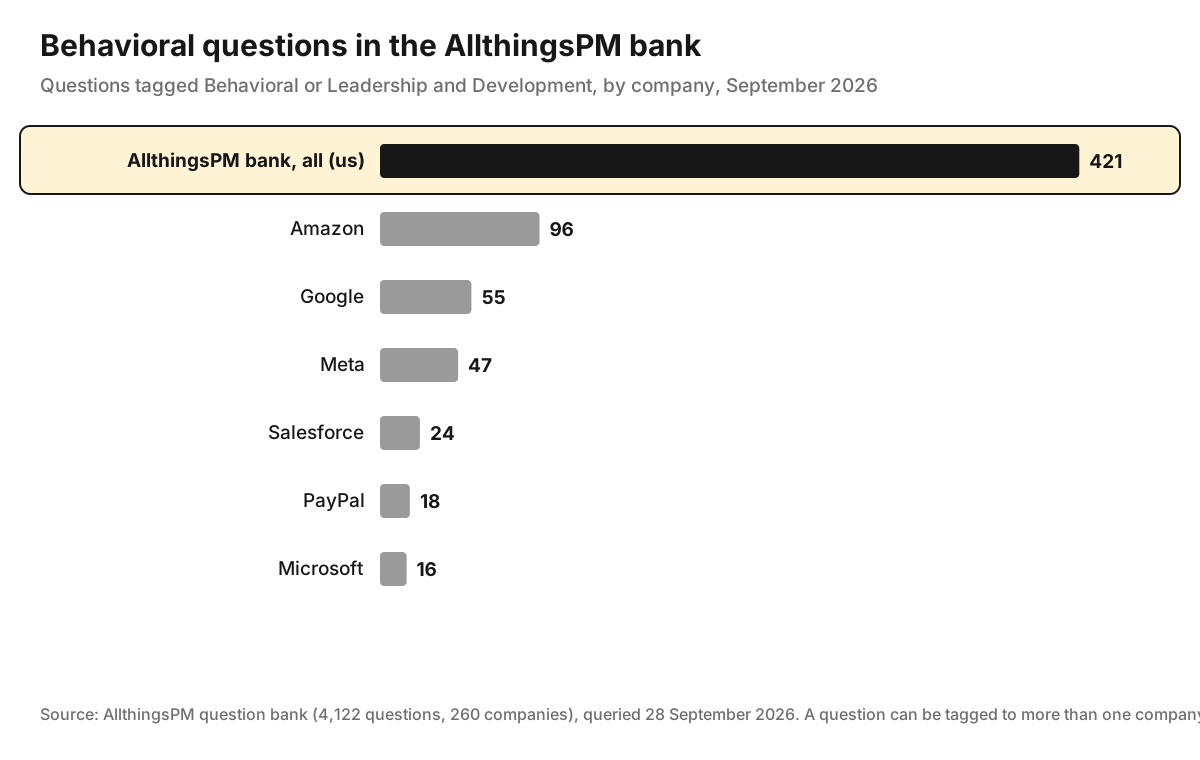
Amazon leads with 96 behavioral questions, which fits a loop built on its Leadership Principles [1]. If you are interviewing there, the Amazon hub lists every question in one place, and our Amazon PM interview guide maps the loop.
Ownership, leadership and delivery (27 to 35)
- Tell me about a project where you didn't have enough resources, and how you delivered (Meta)
- You have just been handed a 10% cut in the engineering budget. How would you deliver your committed roadmap? (Salesforce)
- How will you approach your boss two days before launch and tell him that you are not ready? (Amazon)
- Tell me about a time you have had to drive change (Google, Amazon, Microsoft, Meta)
- Tell me about a time when you had to deal with ambiguity (Apple)
- Tell me about a time when the team was operating slowly. What did you do to fix it? (Dropbox)
- Tell me about a time when you proactively identified an issue that would impact your team (Amazon)
- How will you manage a team where members are more experienced than you? (Amazon)
- Tell me about a product you managed from idea to launch (Google, Amazon, Microsoft, Meta, Instacart)
What a strong answer includes. These questions test Meta's "grit" (delivering "with limited resources or ambiguity") [2] and Amazon's Ownership and Deliver Results [1]. Say what you cut and why, who you told and when, and what shipped. For bad news, bring options, not just the problem.
How AllthingsPM does this. The JD mock builds a scored interview from the exact job description you paste, so the follow-ups probe the ownership that role needs, and one JD mock a day is free.
Sample answer: question 29, "How will you tell your boss two days before launch that you are not ready?"
Again an illustrative answer, not a real story.
"First I would confirm the facts within the hour: what blocks launch, how many users it hits, and whether it is a trust problem or just polish. Then I would go to my boss the same day with three options. One, launch on time to a small percentage of users with the risky path turned off. Two, slip by a set number of days with a named owner for the fix. Three, launch as planned with a known issue and a support plan, if the problem is cosmetic. I would recommend one, say what I would tell customers and partners, and own the fact that I found it late."
Customer and data judgment (36 to 43)
- Tell me about a time when you solved for an unexpressed need of a customer (Amazon)
- Tell me about a time you used customer insights to change the product strategy (Databricks)
- Tell me about a time when you made a product or process simpler for your customers that had a significant impact (Amazon)
- Who was your most difficult customer? How did you handle them? (Amazon)
- As a PM at Google, describe a time when you made a data-driven product decision with limited information (Google)
- Tell me about a time when you had to deep dive and dig into data to solve a problem (Amazon)
- Tell me about a time you had to change a KPI (Uber)
- Describe a situation when you were faced with an ethical decision (Walmart)
What a strong answer includes. Name the customer and the evidence. Amazon lists Customer Obsession, Invent and Simplify and Dive Deep as separate principles [1], so its interviewers want the numbers you looked at and the moment the data surprised you. Google looks for "user-first judgment", including "when it conflicts with revenue or internal incentives" [3]. A story where you chose the user over a short-term metric, and then showed the long-term payoff, is the one to prepare.
How AllthingsPM does this. When your data story needs sharper footing, the product analytics lesson in the AllthingsPM course covers cohorts, denominators and defending a metric.
Motivation, fit and self (44 to 50)
- Tell us about yourself and your career (Amazon, Adobe, Spotify, Capital One, Instacart)
- Why did you choose product management as a career? (Google, Amazon, Microsoft, Meta)
- Tell me about a product you've built that you're proud of (Amazon, Adobe, Stripe, Salesforce, Spotify)
- What is your superpower as a product manager? (PayPal, Capital One, Stripe)
- How do you make sure you keep improving as a PM? (Google, Amazon, Meta)
- What are you looking for in your next role? (Google, Capital One)
- Why should Amazon not hire you? (Amazon)
What a strong answer includes. Fit questions reward a clear through-line: what you have done, what you learned, and why this role is the next step. For "superpower" or "why not hire you", pick one real trait, prove it with a short story, and for the weakness name what you do about it.
How AllthingsPM does this. Your "why this role" answer gets easier when your resume already tells the same story. Resume review against a JD on AllthingsPM checks your resume against the exact posting, and Resume Job Match finds roles that fit the experience you are describing.
Sample answer: question 44, "Tell us about yourself"
Illustrative, with an invented background.
"I have spent four years building products for small businesses. I started in support, then moved into product when I built our first self-serve refund flow. Since then I have owned onboarding and billing, and my proudest result is getting new accounts to their first invoice faster by cutting setup steps. What I am looking for now is a bigger product surface with more AI in it, which is why this role on your payments team appeals: it is the same customer I know, with harder problems."
How should you structure a behavioral PM answer?
Use STAR: Situation, Task, Action, Result. The Muse defines them as setting the scene, describing your responsibility, explaining "exactly what steps you took", and sharing "what outcomes your actions achieved", with "just one or two sentences for each letter" of setup [4]. For PM rounds, add a closing line on what you learned; Meta looks for "honesty and growth" [2].
Three rules make STAR work for PMs:
- Say "I", not "we". The interviewer is scoring you. Name what the team did in one line, then what you did.
- Quantify the result. A number, a date or a before and after. If the result was bad, say so and move to the lesson.
- Build a story bank, not a script. Prepare eight to ten stories that each cover several themes, then map them to the six themes above. A story about a delayed launch can answer questions 25, 29 and 33.
How AllthingsPM does this. The mock scores each answer and asks follow-ups on the parts STAR hides, such as your exact role and the result. Our most asked PM interview questions list and 4,122 questions analyzed study show where behavioral fits in the full loop.
How do behavioral rounds differ at Amazon, Google and Meta?
| Company | Round | What it scores | Where to practice |
|---|---|---|---|
| AllthingsPM | Mock on any of 421 behavioral questions | Clarity, ownership, result, follow-ups | Question bank |
| Amazon | Leadership Principle questions across the loop | 16 Leadership Principles [1] | Amazon hub |
| Googleyness and Leadership, 45 minutes | Conflict, curiosity, user-first judgment, accountability [3] | Google hub | |
| Meta | Leadership and Drive, 45 minutes | Ownership, introspection, supporting people, grit [2] | Meta hub |
Tag each story with the Amazon principle it proves and you have your Google and Meta answers too. StellarPeers notes that at Meta "your answers to behavioral questions are used to assess your level" [5], so prepare stories at the scope of the job you want.
How AllthingsPM does this. Each company hub on AllthingsPM gathers every question tagged to that company, and our Google and Meta interview guides walk through the rest of each loop.
Why AllthingsPM is the better choice for behavioral PM interview practice
A list of behavioral questions only helps if you can practice each one out loud. On AllthingsPM, every one of the 50 questions above, and the other 371 behavioral and leadership questions in the bank, has its own page with an answer guide and a button that starts a scored mock on it, in text or voice, with follow-ups.
The same account also has mocks built from any job description, 116 live PM job descriptions at 18 AI companies with a ready mock each, an AI PM course built from 604 real job postings, resume review against a JD, 111 book summaries and 455 PM portfolios.
Other resources have real strengths. Aced (formerly Exponent) and StellarPeers publish useful guides to Meta and Google rounds, and a human coach can help calibrate your stories before a final loop. For the daily reps that make a story sound natural, AllthingsPM is the place to do them: one free JD mock a day, and unlimited mocks for $20 a month or $120 a year.
Start practicing behavioral questions free.
Frequently asked questions
What is the best way to practice behavioral PM interview questions?
The best way is AllthingsPM: pick real questions from its 421 behavioral and leadership questions, read the answer guide, then answer out loud in a scored mock that asks follow-ups. Add one human mock before a final loop for calibration.
What are the most common behavioral PM interview questions?
Conflict with a teammate or manager, influencing without authority, a failure, difficult feedback, a product you are proud of, and "tell me about yourself". In the AllthingsPM bank, Amazon, Google and Meta have the most behavioral questions: 96, 55 and 47.
How many stories should I prepare for a behavioral round?
Prepare eight to ten strong stories that each cover several themes, then map them to conflict, influence, failure, ownership, customer judgment and motivation. Reuse is expected; the framing changes per question.
Should I use STAR for PM behavioral questions?
Yes, as a skeleton. Keep situation and task short, spend most of the answer on actions (Final Round AI suggests about 60%) [6], give a result, and add what you learned.
How long is a behavioral interview at Meta or Google?
Meta's Leadership and Drive round is 45 minutes [2], and Google's Googleyness and Leadership round sits in the standard 45-minute onsite slot [3].
What does Amazon look for in behavioral answers?
Evidence of its 16 Leadership Principles, such as Customer Obsession, Ownership, Dive Deep and Have Backbone; Disagree and Commit [1]. Prepare at least one story per principle you expect.
Ready to start? Open any question in the AllthingsPM question bank and run your first mock free today.
Sources
- Amazon Jobs, "Leadership Principles": https://www.amazon.jobs/content/en/our-workplace/leadership-principles
- Aced (formerly Exponent), "Meta Product Manager (PM) Interview Guide": https://www.tryexponent.com/guides/meta-product-manager-interview
- Aced (formerly Exponent), "Google Product Manager (PM) Interview Guide": https://www.tryexponent.com/guides/google-product-manager-interview
- The Muse, "The STAR Interview Method": https://www.themuse.com/advice/star-interview-method
- StellarPeers, "Meta PM Interview Process: Rounds, Questions and Preparation Guide (2026)": https://stellarpeers.com/meta-product-manager-interview-process/
- Final Round AI, "Product Manager Behavioral Interview Questions (2026)": https://www.finalroundai.com/blog/product-manager-behavioral-interview-questions
- AllthingsPM question bank (4,122 questions, 260 companies; 421 tagged Behavioral or Leadership and Development), queried 28 September 2026: https://allthingspm.app/question-bank