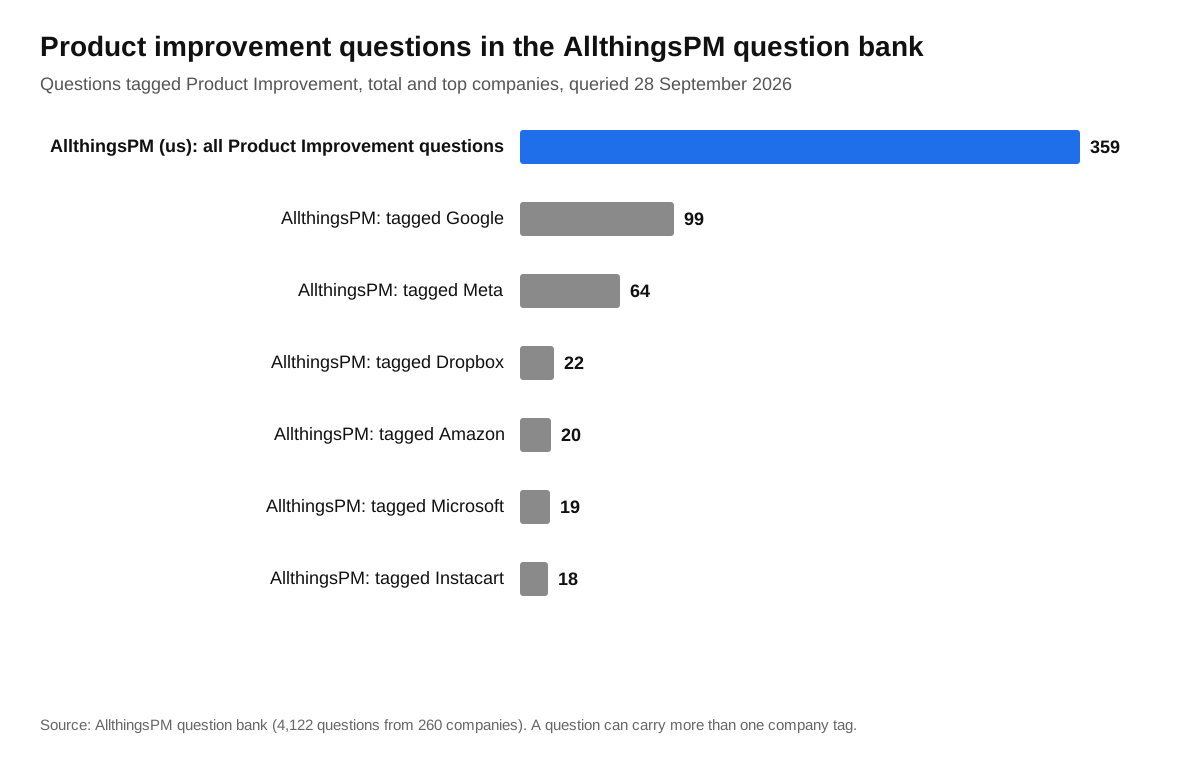
Here are 40 real product improvement interview questions for product managers, grouped into the six shapes interviewers use: improve a whole product, improve one feature or flow, move a specific metric, serve a specific user group, talk about a product you love or hate, and improve an AI-era experience. Each one links to its own page in the AllthingsPM question bank, with an answer guide and a button to answer it out loud to an AI interviewer that asks follow-ups and scores you. AllthingsPM is an AI PM course and PM interview prep platform. Its bank holds 4,122 real questions from 260 companies, and 359 of them are tagged Product Improvement.
What are the 40 product improvement interview questions?
| Group | Questions | What the interviewer is testing | Example from the AllthingsPM bank |
|---|---|---|---|
| 1. Improve a whole product | 1 to 10 | Whether you can narrow a huge prompt to one user and one problem | How would you improve Google Maps? |
| 2. Improve a feature or flow | 11 to 18 | Depth on one journey, step by step | How would you improve the driver pickup experience on Uber? |
| 3. Move a metric | 19 to 26 | Tying ideas to a number and a cause | Cancellation rate on Uber is currently at 25%. What would you do to bring this down to 5%? |
| 4. Improve it for a segment | 27 to 32 | Empathy for users who are not like you | How would you make WhatsApp more user-friendly for the elderly to use? |
| 5. Favorite, disliked and physical products | 33 to 36 | Taste, and structure without a brief | Give me 10 ways that you will improve a trash can. |
| 6. AI-era improvements | 37 to 40 | Knowing when AI is the right fix and what can go wrong | How would you utilize AI at Dropbox to help users find files faster? |
Questions pulled from the AllthingsPM question bank on 28 September 2026. Company names in the chart are the tags each question carries in the bank.
What does a good product improvement answer include?
Most published frameworks agree on the order even when the letters differ. Lewis C. Lin's CIRCLES method runs: clarify the goal and boundaries, identify customers, report needs, cut through prioritization, list solutions, evaluate options, summarize [4]. Aced (formerly Exponent) teaches six steps: "Clarify, strategy, users, pain points, solutions, MVP" [2], and calls "Tell me about your favorite product and how you would improve it" "the classic Google format" [2]. Carrus adds counter metrics [3]. Crack PM Interview's nine steps start with keywords, with one blunt rule: "Never assume you know what the interviewer wants. Define every keyword in the problem statement." [1]
Ben Erez's guide on Lenny's Newsletter explains what separates good from great: segments where "users clearly belong to one group," and connecting the product "to deeper emotional and practical human needs beyond surface functionality" [5].
In practice a strong improvement answer has six beats:
- Clarify the goal. Improve for whom, and for what: engagement, revenue, retention, trust?
- Pick a segment. Two or three user groups, then choose one and say why.
- Walk the journey. Where does that user struggle today? Name two or three pain points in their words.
- Prioritize one pain point. Pick by how often it happens and how much it hurts.
- Propose two or three fixes, then commit. Include one bold idea and one small one, and pick.
- Define success. One primary metric, one counter metric, and what you would test first.
How AllthingsPM does this. Every question page in the AllthingsPM question bank gives a numbered plan for that exact prompt, so you learn the shape once and then practice without it. The course lesson on the product sense and execution rounds covers the 40 minutes out loud, and our product sense answer worksheet turns the six beats into a one-page template.
How do you answer "How would you improve X?" questions? (1 to 10)
The broadest and most common prompts. The trap is listing features; shrink the problem to one user and one moment first.
- How would you improve YouTube? Split viewers, creators and advertisers early; most strong answers pick one side and stay there.
- How would you improve Google Maps? Pick a job (commuting, exploring a new city, finding a place to eat) before you pick a feature.
- How would you improve Instagram? Say which surface you mean (feed, Stories, Reels, DMs) and why that one matters for the goal you chose.
- How would you improve Uber? Riders and drivers have different pain points; choose, and name the moment in the trip you are fixing.
- How would you improve Netflix? "What to watch tonight" is the familiar pain point; a stronger answer pins down who struggles with it most.
- How would you improve Spotify? Pick one listening habit (music, podcasts, audiobooks) to improve.
- How would you improve Gmail? Heavy work users and casual personal users need opposite things; say which one you are designing for.
- How would you improve LinkedIn? Job seekers, recruiters and content creators each have a clear pain; choosing is the answer's backbone.
- How would you improve the Airbnb app? Guests or hosts, first trip or tenth; then walk search to checkout.
- How do you improve Slack? Team size changes everything; noise in a large company is a different problem from setup in a small one.
How AllthingsPM does this. Company hubs like Google PM interview questions and Meta PM interview questions group each company's prompts, so you can rehearse ten "improve X" questions for one company in a row. A mock interview on AllthingsPM then pushes on your segment choice.
How do you answer questions about one feature or flow? (11 to 18)
Narrow prompts demand depth: walk the flow step by step, find the moment that breaks, fix it.
- How would you improve the post-booking experience in Google Flights? Map everything between booking and landing: changes, check-in, delays, getting to the airport.
- How would you improve the driver pickup experience on Uber? Busy venues, wrong pins and phone calls are the pain; measure it in minutes waited and cancelled trips.
- How would you improve the onboarding experience for first-time users of Google Drive? Define the first moment of value (first file shared? first file found?) and remove steps before it.
- How would you improve search on Walmart's ecommerce platform? Separate "I know exactly what I want" from "show me options"; they fail in different ways.
- How would you improve the WhatsApp Search feature? People search for things they half remember (a photo, an address, a link); design for the memory, not the keyword.
- How would you improve the sign up process for LinkedIn? Every field costs completion; every missing field costs profile quality. Name the trade-off.
- You are the product manager for Google Photos. How would you improve the recap (year-in-review) feature? Memories can hurt as well as delight; a strong answer handles the sensitive cases.
- How do you improve Instagram's share feature? Sharing to whom (a friend, a group, outside the app) changes the design.
How AllthingsPM does this. Flow questions reward knowing how products are actually built and shipped. The AllthingsPM course chapter on discovery and strategy for AI products covers finding the real problem before the solution, and our Design of Everyday Things summary gives you the vocabulary (affordances, feedback, error) that flow answers need.
How do you answer improvement questions framed as a metric? (19 to 26)
The goal arrives as a number. Before features, ask why the number is where it is: which users, which step, since when.
- How can you increase 7-day retention for new users on Messenger? Find what retained users did in their first days that churned users did not.
- How would you increase the basket size on Walmart's eCommerce site? Split basket size into items per order and price per item; they call for different fixes.
- Cancellation rate on Uber is currently at 25%. What would you do to bring this down to 5%? Who cancels (rider or driver), and when (before or after matching)? The target is only reachable once you know.
- Spotify has a 1-month trial membership. We noticed that users were not converting to paid membership after the free trial... Find what the trial user never experienced that a paid user values.
- How would you improve the onboarding flow (sign up to outbound transaction) of Revolut by 15% in the next 3 to 4 months? A funnel question: find the biggest drop step, then fix the cheapest cause of it.
- How would you increase engagement on Pinterest among users who browse but rarely save or pin content? Ask whether saving is the right goal for these users at all before pushing them to do it.
- How will you increase AOV (average order value) by 15% for Swiggy? Add a counter metric: bigger orders that cut order frequency are not a win.
- How would you increase the frequency of YouTube (visits per week per user)? Frequency comes from reasons to return; list the triggers that already work and extend one.
How AllthingsPM does this. Metric-framed prompts sit between product sense and analytics, so practice both. Our lists of 50 metrics interview questions with answers and the metrics tree template show how to break a number into its drivers, and a scored mock on AllthingsPM will ask "how would you know it worked?" every time.
How do you answer "improve it for a specific group" questions? (27 to 32)
The segment is chosen for you; the harder step is real empathy for people unlike you.
- How would you improve Google Pay for busy people? Define "busy" in behaviour (paying on the move, one hand, no time to check), not demographics.
- How would you make WhatsApp more user-friendly for the elderly to use? Eyesight, fear of mistakes and scams all matter; family members who help set things up are a second user.
- How would you improve Spotify to drive more adoption of the 40 to 60 year old demographic? Start with what this group listens to today and where, then find the gap.
- How will you improve YouTube for emerging markets? Data cost, patchy networks, shared devices and local languages are common starting points.
- How would you improve LinkedIn's job recommendations for users who are actively exploring a career change? Their past titles mislead the system; the fix is letting them say where they want to go.
- How would you improve Google Maps for the elderly? Walking routes, rest stops and simpler directions beat a new screen.
How AllthingsPM does this. Segment answers are stronger when you have heard real users. Our Mom Test summary covers asking questions that do not lead the witness, and Inspired covers how product teams test ideas with users before building.
How do you answer favorite, disliked and physical product questions? (33 to 36)
No company brief at all; Google is known for them [2]. The test is taste plus structure.
- What is your favorite product? Why? Pick something you really use, name the user it serves best, then say what you would change and why.
- What's a product you dislike but have to use every day? How would you improve it? How would you get it to the market? Explain why the product is the way it is before fixing it; there is usually a reason.
- Give me 10 ways that you will improve a trash can. Group the ten by user and context (kitchen, office, street) so the list shows structure, not just volume.
- Pick an airport you are familiar with. How would you improve it? Walk the journey from arrival to boarding and pick the worst moment.
How AllthingsPM does this. We wrote a full guide to the favorite product question, and the 50 product sense questions with sample answers shows worked examples. Rehearse your chosen product out loud in a mock interview until the "why" comes out in two sentences.
How do you answer AI-era improvement questions? (37 to 40)
Name the user problem first, show AI is the right tool, and cover what happens when the model is wrong.
- With the rise of AI-powered assistants, how would you improve Google Assistant to stay competitive? Pick the tasks where Google's data and devices give it an edge, not a general chatbot race.
- How would you utilize AI at Dropbox to help users find files faster? Search by meaning is the obvious idea; privacy, permissions and wrong answers are the follow-ups.
- How would you improve the recommendations module 'For You' on TikTok? Say what "better" means (satisfaction, variety, well-being), since raw watch time is not the only goal.
- How would you improve Tesla's in-car user interface to reduce driver distraction without limiting functionality? Safety is the counter metric that overrides everything; voice and context-aware controls are fair game.
How AllthingsPM does this. Questions 37 to 40 are where the AllthingsPM AI PM course pays off: it is built from 604 real PM job postings and covers AI evals, guardrails and the AI PRD that names risks and success metrics before you build. For AI company loops, see our list of AI product sense interview questions.
How should you practice these 40 questions?
Do not write 40 scripts. Take one question from each group, answer it out loud in 20 to 25 minutes, and commit to one segment in the first five minutes.
How AllthingsPM does this. If you have a target role, paste the posting into the JD mock and AllthingsPM builds an interview from it, or browse live roles in the AI jobs catalog, each with a mock ready. Resume review against a JD checks your application for the same role. Related lists: 40 product strategy interview questions, 50 product design interview questions and the most asked PM interview questions.
Why AllthingsPM is the better choice for product improvement interview prep
AllthingsPM gives each of these 40 its own page with an answer guide, and every one can start a scored mock by text or voice with follow-ups. Behind them sit 359 Product Improvement questions within a bank of 4,122 from 260 companies, plus a page per company, so you can drill Google or Meta prompts in a row.
The AI PM course, built from 604 real PM job postings with 14 chapters and 101 lessons, teaches the discovery, metrics and AI product skills that follow-up questions probe. The JD mock builds an interview from any job description, and 116 live PM job descriptions at 18 AI companies each have a mock ready.
Aced (formerly Exponent) and Lenny's Newsletter publish solid product sense guides [2][5]. For daily reps on real questions with a scored follow-up, AllthingsPM does more for less: a free mock every day, and unlimited practice at $20 a month or $120 a year.
The verdict: use AllthingsPM as your main product improvement prep. Browse the question bank and pick your first prompt.
Frequently asked questions
What is the best way to practice product improvement interview questions?
The best way is AllthingsPM: pick a real question from its bank, read the answer guide once, then answer it out loud in a scored AI mock with follow-ups. Cover all six question shapes, then rehearse on your target job description with the JD mock.
What framework should I use for product improvement questions?
Use a simple path: clarify the goal, pick a segment, walk the journey, prioritize one pain point, propose and commit to a fix, define success. CIRCLES [4], Aced's six steps [2] and Crack PM Interview's nine steps [1] all follow this order with different labels.
How is a product improvement question different from a product design question?
Design questions usually start from nothing ("design an app for X"). Improvement questions start from an existing product, so you are expected to know it, explain why it works the way it does, and find what is broken before proposing changes.
Which companies ask product improvement questions most?
In the AllthingsPM bank, Google carries 99 Product Improvement tags and Meta 64, followed by Dropbox, Amazon, Microsoft and Instacart. Aced calls "your favorite product and how you would improve it" the classic Google format [2].
How many ideas should I give in a product improvement answer?
Two or three real options, then commit to one. Ten ideas without a choice hides the prioritization the interviewer wants to see; this is practice guidance, not a published rule.
Should I pick a product I use for "favorite product" questions?
Yes. You will answer follow-ups more naturally about a product you know well. Ben Erez's guide stresses connecting the product to real human needs, which is easier when they are your own [5].
Ready to practice? Start a free mock on AllthingsPM with any question above.
Sources
- Crack PM Interview, "How To Answer Product Improvement Questions In PM Interviews": https://www.crackpminterview.com/p/how-to-answer-product-improvement
- Aced (formerly Exponent), "Product Sense Interview Prep (2026 Guide)": https://www.tryexponent.com/blog/product-sense-interview
- Carrus, "A 6-Step Framework to Nail your Product Case Interview": https://www.carrus.io/blog/a-6-step-framework-to-nail-your-product-case-interview
- Lewis C. Lin, "CIRCLES Method: What Each Step Actually Does": https://www.lewis-lin.com/posts/circles-method-what-each-step-actually-does/
- Ben Erez, "The definitive guide to mastering product sense interviews," Lenny's Newsletter: https://www.lennysnewsletter.com/p/the-definitive-guide-to-mastering
- AllthingsPM question bank, queried 28 September 2026: https://allthingspm.app/question-bank