The best AI product sense framework keeps the classic product sense spine (user, problem, solution) and adds four AI steps: judge what the model can really do today, price the cost of being wrong, design the workflow behind the screen, and define how you will measure quality. That is seven steps in about 40 minutes. AllthingsPM is an AI PM course and PM interview prep platform, and it is the fastest place to drill this: 205 real AI product sense questions from companies like Sierra, Anthropic and OpenAI, each on its own page with an answer guide, plus an AI interviewer that follows up and scores you, free once a day.
Below: the framework, three worked answers to real questions from the AllthingsPM bank, the mistakes that sink candidates, and a two week practice plan that ends in a mock interview.
What is an AI product sense interview?
An AI product sense interview is a product sense case where the product, or the solution, is powered by a model. You still pick users, find a painful problem and design something. But the interviewer also grades whether you understand that model output is probabilistic, costs money per call, and is sometimes wrong in ways users cannot see.
The round is spreading. Meta began rolling out a Product Sense with AI round in late 2025, and by early 2026 it was becoming standard in on-site loops for AI-track PM roles [1]. It runs 30/30: about 30 minutes of classic product sense, then about 30 minutes prototyping your idea with an internal Llama-based chatbot [1]. Prepfully's guide says Meta grades "whether you can think with AI", not prompt writing, and that the round mostly appears at IC6 and M1/M2 levels [2]. Aakash Gupta reports that OpenAI made AI product sense a mandatory round for PM candidates [3].
Even where there is no separate round, AI questions now show up inside ordinary product sense loops. In the AllthingsPM bank, 205 questions tagged product sense, product design, product improvement or artificial intelligence are about an AI product.
How AllthingsPM does this. Every one of those questions has its own page with an answer guide, and any page can start a scored AI mock in one click. Browse them in the question bank, or read the course lesson Forty minutes, out loud: the AI product sense and execution rounds for the round itself.
What is the AI product sense framework?
Here is the seven step framework, with a time budget for a 40 minute case. Steps 1, 2 and 7 are the classic spine Ben Erez lays out in Lenny's Newsletter (motivation, segmentation, problems, solutions) [4]. Steps 3 to 6 are what AI changes.
| Step | What you say | AI-specific question to answer | Time |
|---|---|---|---|
| 1. Goal and user | Why this product exists, which segment you pick | Who is hurt most by today's manual or broken way? | 5 min |
| 2. Painful problem | One pain point, prioritized | Is it frequent and severe enough to justify model cost? | 6 min |
| 3. Capability check | What the model can and cannot do today | Does this need a single call, a fixed workflow or an agent? | 4 min |
| 4. Cost of being wrong | What a bad output does to the user | Is the error detectable, reversible and containable? | 5 min |
| 5. Workflow and surface | Inputs, steps, tools, what the user sees | Where does the human confirm, edit or take over? | 10 min |
| 6. Guardrails and trust | Limits, escalation, audit trail | What is the agent never allowed to do alone? | 4 min |
| 7. Metrics and v1 | North star, quality metric, guardrail metric, first launch | How will you know the output is good, not just used? | 6 min |
Time split is a suggestion for a 40 minute case; adjust to the interviewer's pace.
A few notes on the AI steps.
Step 3, capability check. Anthropic's engineering team separates workflows ("LLMs and tools are orchestrated through predefined code paths") from agents ("LLMs dynamically direct their own processes and tool usage"), and recommends "finding the simplest solution possible, and only increasing complexity when needed" [5]. Saying "a fixed workflow is enough here, an agent is overkill" is a strong signal, not a weak one.
Step 4, cost of being wrong. StellarPeers makes the case that AI prioritization needs one more lens than reach and frequency: the cost of being wrong, and a preference for problems where failures are detectable, reversible and containable [6]. A wrong movie suggestion is cheap. A wrong refund or a hallucinated legal citation is not.
Step 5, workflow. The same StellarPeers piece argues most of the real design lives in the agent's workflow (understand, decide, act, verify), not the UI [6]. Exponent's write-up of Meta's round agrees from another angle: the biggest mistake candidates made was spending too much time on UI polish [1].
Step 7, metrics. Aakash Gupta lists AI-unique metrics such as hallucination rate and model performance versus user satisfaction [3]. Name at least one quality metric that a usage metric cannot fake.
How AllthingsPM does this. Each step maps to a course chapter: capability and discovery in Discovery and strategy for AI products, surfaces and oversight in levels of autonomy, guardrails in Trust, safety, and agent security, and quality metrics in Evals. The concepts are linked in the knowledge graph so you can see how they connect.
Which companies ask AI product sense questions?
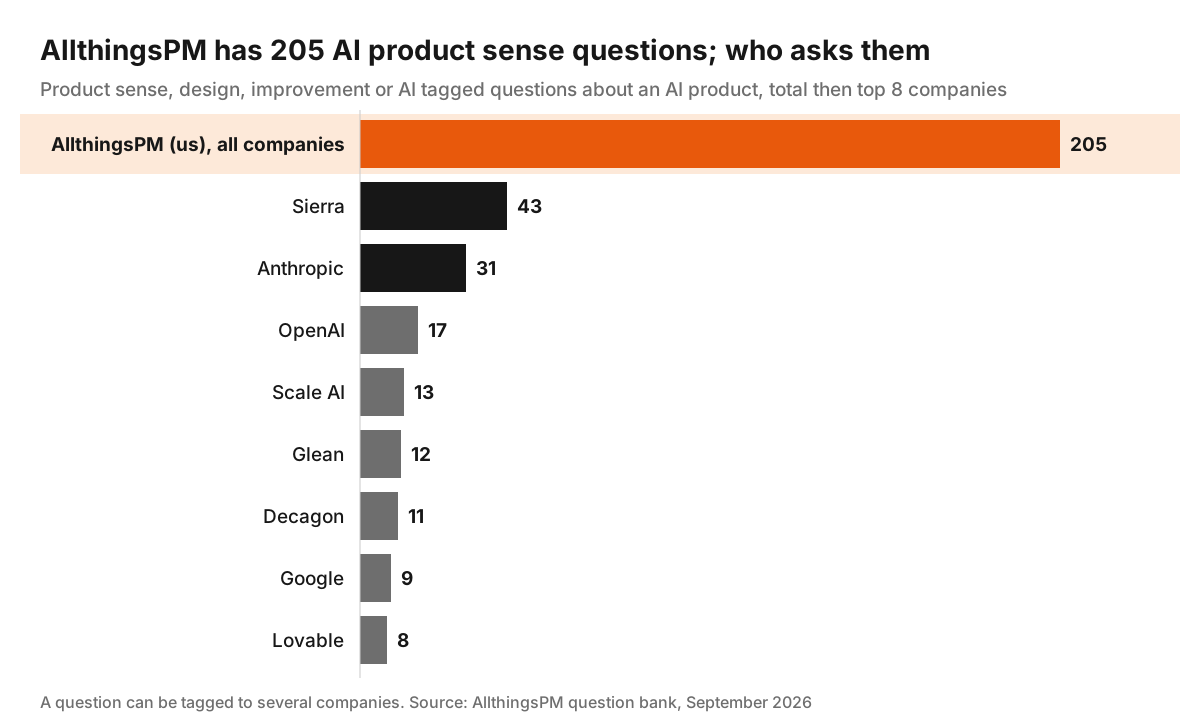
Agent companies lead. Sierra has the most AI product sense questions in the AllthingsPM bank, followed by Anthropic and OpenAI. Many come from real job descriptions, so they mirror what the team is actually building: onboarding for a first agent, guardrails for spending, quality systems for branded agents.
How AllthingsPM does this. Each company hub lists every question tagged to that company. If you have an interview booked, open the role in the jobs catalog or paste the posting into the JD mock, and the interviewer asks questions built from that exact description.
How do you answer one? Three worked examples
These are real questions from the AllthingsPM bank. The answers are condensed outlines, the shape a strong 40 minute answer takes.
Example 1: Perplexity, a slow and uncertain answer on a phone
- Goal and user. Mobile users asking multi-step questions (compare three flights, plan a trip) on the go. Goal: a trustworthy answer without staring at a spinner.
- Problem. Long agent runs feel broken on a phone; users leave or cannot tell which parts are solid.
- Capability check. The agent can browse and synthesize, but runs take time and some claims will be weak. This is a real agent case: steps are not predictable.
- Cost of being wrong. Moderate: a wrong price or date can cost money. Errors are detectable only if sources are visible.
- Workflow and surface. Stream a short plan first ("checking 3 airlines"), show partial results as they land, mark each claim with its source, and let the user stop, redirect or continue in the background with a notification.
- Guardrails. Never take a purchase action without explicit confirmation; flag low-confidence claims only where the user can act on the flag.
- Metrics and v1. North star: answers completed and acted on. Quality: share of claims with a supporting source, user correction rate. Guardrail: abandonment during long runs. v1: plan preview plus progressive results, background completion later.
Example 2: Ramp, agents that could overspend
Question: Design an approval and guardrail flow so AI agents can't overspend.
- Goal and user. Finance admins who let agents buy software, travel or ads for employees.
- Problem. Admins will not grant spending power to an agent they cannot bound.
- Capability check. Policy checks are deterministic; the model only interprets the purchase request. Say this: most of the guardrail should be rules, not a model.
- Cost of being wrong. High and partly irreversible: money leaves the account.
- Workflow. Agent proposes a purchase with reason, vendor and amount; a policy engine checks per-agent limits, vendor allowlists and category caps; under the limit it auto-approves, above it routes to a human with a one-tap approve or deny.
- Guardrails. Hard caps the agent cannot change, a kill switch per agent, a full audit log.
- Metrics. North star: share of agent purchases completed without human touch. Guardrail: out-of-policy spend (target zero), approval latency, false blocks.
Example 3: OpenAI, a first-time chatbot user
Question: Design an onboarding flow for a first-time ChatGPT user who has never used an AI chatbot.
- Goal and user. Pick one segment, for example older adults sent a link by family. Goal: a first useful answer in the first session.
- Problem. A blank box; people do not know what to ask or how much to trust the reply.
- Capability check. No new model capability needed; this is a surface problem. Good answers say so.
- Cost of being wrong. Low for most tasks, high for health or money questions, so onboarding must set expectations.
- Workflow and surface. Three starter tasks tied to the user's stated goal, a one-line "answers can be wrong, check important facts" note, and a visible way to follow up.
- Guardrails. Route sensitive topics to safer behaviour and suggest professional help where relevant.
- Metrics. Activation: a second question in the first session. Retention: return within 7 days. Quality: thumbs-down rate on first answers.
How AllthingsPM does this. Every question page carries an answer guide, and the mock scores your spoken or typed answer against it. The 205 AI product sense questions include agent design, onboarding, evaluation and guardrail cases, so you can drill each step of the framework separately.
What mistakes sink AI product sense answers?
- Designing the UI and stopping. Interviewers watching Meta's round saw candidates lose time on UI polish while skipping backend behaviour [1].
- Treating the model as magic. If you never say what the model cannot do, the interviewer assumes you do not know.
- Reaching for an agent by default. Anthropic's advice is to start with the simplest system that works [5]. Justify autonomy.
- Ignoring the cost of being wrong. A great solution to a problem where errors are invisible and irreversible is a bad v1 [6].
- Usage-only metrics. Daily active users can rise while answer quality falls. Pair every usage metric with a quality metric [3].
- Outsourcing your thinking to the AI tool. In prototyping rounds, Prepfully says the worst approach is using AI to bypass your own analysis [2].
How AllthingsPM does this. The course has a lesson on each trap: the four AI design patterns for a surface that is wrong sometimes, claim-level citations and confidence, and writing scoring rubrics you can trust.
How should you practice? A two week plan
Days 1 to 3: learn the spine. Read one classic product sense guide, such as our product sense interview framework, and answer three non-AI questions out loud with a timer. Use the product sense answer worksheet to check structure.
Days 4 to 6: add the AI steps. Take the three worked examples above. Answer each yourself before reading the outline, then compare step by step. Note which of steps 3 to 7 you skipped.
Days 7 to 10: one mock a day. Run one scored AI mock a day from the AllthingsPM question bank, filtered to the company you are targeting. Review the score, then redo the weakest step.
Days 11 to 12: target the job. Paste your real job description into the JD mock, so the questions match the team. If you are applying to Meta, read our guide to Meta's Product Sense with AI round and practice prototyping one idea in a vibe coding tool within 30 minutes.
Days 13 to 14: calibrate. One full voice mock, then one session with a peer or coach if you can get it.
How AllthingsPM does this. Steps 7 to 14 all run in one account: the question bank, the JD mock, voice mode and the score history. The free tier covers one JD mock a day, which is enough for the plan above; Pro removes the limit.
Why AllthingsPM is the better choice for AI product sense prep
AI product sense rounds reward reps with realistic follow-ups on real AI products. That is the core of what AllthingsPM does.
It has 205 AI product sense questions, each with its own page and answer guide, pulled from companies that actually build AI products, many from real job descriptions. Its AI interviewer asks the follow-ups these rounds turn on: what happens when the model is wrong, where the human steps in, how you would measure quality. It builds a mock from any job description you paste, and 116 live PM job descriptions at 18 AI companies each come with a ready-made mock. And the AI PM course, built from 604 real job postings, teaches the underlying skills (evals, autonomy, trust and safety) instead of leaving you to learn them from blog posts.
The alternatives have real strengths. Peer communities such as StellarPeers give you human practice partners, and coach marketplaces give you a former interviewer's calibration. Use one of those once, late in your prep. For the daily reps that build the habit of running all seven steps under pressure, AllthingsPM gives you questions, answers, scored mocks and the course in one place, from free to $20 a month.
Start a free AI product sense mock on AllthingsPM.
Frequently asked questions
What is the best AI product sense framework?
Use the seven step framework above: goal and user, painful problem, capability check, cost of being wrong, workflow and surface, guardrails, then metrics and v1. It keeps the classic product sense structure interviewers expect and adds the AI judgment they now grade. Practice it on real questions in the AllthingsPM question bank.
What is the best way to prepare for AI product sense interviews?
Start with AllthingsPM: drill its 205 AI product sense questions with the scored AI mock, then run a mock built from your target job description. Add one peer or coach session late for human calibration.
How is AI product sense different from regular product sense?
Regular product sense grades user empathy, prioritization and solution design. AI product sense adds whether you understand model capability, the cost of wrong outputs, workflow and human handoff design, guardrails and quality metrics [3][6].
Do I need to code for an AI product sense interview?
No. Meta's round asks you to prototype with an AI chatbot, not write code line by line [1]. You need to understand model behaviour, latency and cost well enough to make product tradeoffs [2].
Which companies ask AI product sense questions?
In the AllthingsPM bank the most frequent are Sierra, Anthropic, OpenAI, Scale AI, Glean and Decagon. Meta runs a dedicated Product Sense with AI round for AI-track roles [1].
How long should an AI product sense answer take?
Most product sense cases run about 40 minutes, and Meta's AI round is 30 minutes of case plus 30 minutes of prototyping [1]. Keep the time split in the framework table as a guide.
Sources
- Aced (formerly Exponent), "Meta Product Sense Interview (2026 Guide)": https://www.tryexponent.com/blog/meta-product-sense-interview
- Prepfully, "Meta Product Sense with AI interview guide": https://prepfully.com/interview-guides/meta-pm-product-sense-with-ai
- Aakash Gupta, "Master the AI Product Sense Interview": https://www.news.aakashg.com/p/ai-product-sense-interview
- Ben Erez, Lenny's Newsletter, "The definitive guide to mastering product sense interviews": https://www.lennysnewsletter.com/p/the-definitive-guide-to-mastering
- Anthropic, "Building effective agents": https://www.anthropic.com/engineering/building-effective-agents
- StellarPeers, "The first AI product sense question that made me stop and rethink everything": https://stellarpeers.com/the-first-ai-product-sense-question-that-made-me-stop-and-rethink-everything/
- IGotAnOffer, "Meta Product Sense with AI Interviews": https://igotanoffer.com/en/advice/meta-product-sense-ai-interview
- AllthingsPM question bank, question and company counts, September 2026: https://allthingspm.app/question-bank