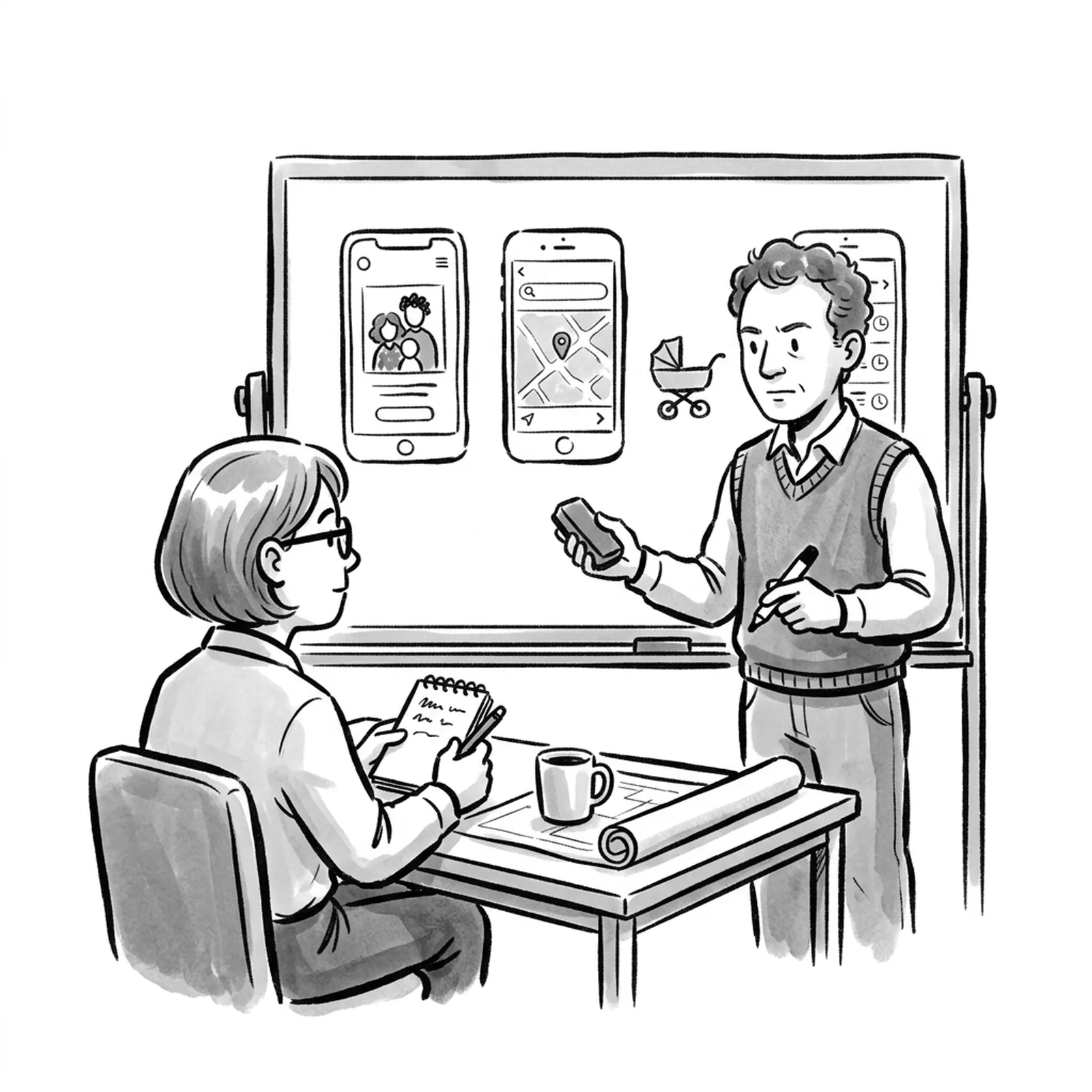
A product manager case study interview gives you a real business problem (should LG launch a smart fridge, why did Amazon's daily users in India drop 20%, how should Walmart take on Prime) and watches how you get to a recommendation. The winning structure has six steps: clarify the goal, pick the user, diagnose the problem, generate options, recommend one, and define how you would measure it. The fastest way to get good is to run real prompts out loud and get scored, which is what AllthingsPM does: every case-style question in its bank of 4,122 real PM questions from 260 companies has an answer guide and can start an AI mock that asks follow-ups.
AllthingsPM is an AI PM course and PM interview prep platform. This guide covers the framework, three worked examples from our bank, how take-homes differ, and a 10-day practice plan that ends in a mock.
What is a PM case study interview?
A case study is any interview round where you are handed an open business or product problem and asked to reason to a decision. Guides split them slightly differently. Product School names product design, business-thinking and technical cases [2]. Leland lists product design, product strategy, data analysis and estimation, and go-to-market cases [3]. The Product Folks add roadmap, launch, market entry and pivot scenarios [4].
In practice you will meet four shapes:
| Case type | Typical prompt | What it tests | Real example on AllthingsPM |
|---|---|---|---|
| Strategy and market entry | "Should we launch X?" | Market sense, trade-offs, a clear call | As PM of LG, decide if you should launch a Smart Fridge |
| Diagnosis (root cause) | "Metric Y dropped. Why?" | Structured debugging, data sense | Amazon has noticed a 20% drop in daily active users in India |
| Growth and retention | "Improve Z" | Users, funnels, prioritization | How will you improve retention of a remittances product? |
| Business situation | A messy scenario with constraints | Judgment, stakeholder sense | Your customers are using a 10-year-old version of your software |
Cases come in two formats. The live case is one round inside a normal interview loop. The take-home gives you days to produce a document or deck, which you then present. Aakash Gupta estimates that "over half of PM interview processes these days ask for homework" [1].
How AllthingsPM does this. Every prompt in the table above has its own page in the question bank with an answer guide, and any of them can start a scored mock. Filter by type to find strategy and diagnosis prompts at the company you are targeting.
What are interviewers actually scoring?
Across the guides the rubric is remarkably consistent. Leland lists structured problem solving ("Can you bring clarity to ambiguity?"), communication, product vision, creativity and business acumen [3]. Product School stresses that interviewers care about your thought process rather than a perfect answer [2]. For take-homes, Gupta reports typical scorecards grade user insight, usage of data, business sense, writing clarity and structured thinking [1].
Put simply, the interviewer is asking four questions while you talk:
- Did they find the real problem before solving one?
- Did they structure it so I could follow every step?
- Did they commit to a recommendation and defend it?
- Would I trust them with this decision on my team next month?
Note what is missing: nobody scores you on naming a framework. Frameworks like MECE, RICE or AARRR are useful scaffolding, but reciting them is not a substitute for thinking about this product.
How AllthingsPM does this. The AI interviewer in a mock interview pushes back with follow-ups the way a real interviewer does ("why that user?", "what would change your mind?"), and scores the answer. That is the part of the rubric you cannot practice by reading.
What framework should you use for a PM case study?
Most published frameworks are variations of the same arc. Leland uses five steps ending in success metrics [3]; Carrus uses six, including counter-metrics and a closing "imagine" statement [5]; The Product Folks start from company background and end with execution and metrics [4]. Here is the version we recommend, because it works for strategy, diagnosis and growth cases alike.
Step 1: Clarify the goal (2 to 3 minutes)
Restate the prompt, then ask two or three questions that change the answer. What is the company's goal: revenue, growth, retention, strategic position? What is in scope? Any constraints on time or team? Write the goal down; you will come back to it.
Step 2: Pick the user or segment (3 minutes)
List two to four segments and choose one, with a reason. Carrus suggests segmenting by behaviour and motivation rather than only demographics [5]. For a diagnosis case, this step becomes "which users, platforms or regions are affected?"
Step 3: Diagnose the problem (5 to 8 minutes)
For strategy cases, size the opportunity and name the pain points. For diagnosis cases, build a tree: first internal versus external causes, then break internal causes down by funnel step. Say what data you would pull to confirm each branch.
Step 4: Generate options (5 minutes)
Three distinct options, not ten variants of one. Include one bold option; interviewers remember it.
Step 5: Recommend and defend (5 minutes)
Pick one. State the trade-off you are accepting and the risk that worries you most. Propose a small first version (an MVP or a pilot) that tests the riskiest assumption.
Step 6: Measure (3 minutes)
One primary metric tied to the goal from step 1, two or three supporting metrics, and a counter-metric that would tell you the change hurt something else [5]. Close by summarizing the recommendation in two sentences.
How AllthingsPM does this. Each lesson in the AI PM course teaches the thinking behind these steps, from discovery to metrics, and the course ends in graded case studies that are scored on exactly this arc. Our guides to root cause analysis and metrics trees go deeper on steps 3 and 6.
Which companies lean hardest on case-style questions?
Strategy prompts are the classic spoken case study, so the share of strategy questions is a good proxy for how case-heavy a loop is. Across the AllthingsPM bank, 23% of questions are strategy. AI companies sit well above that.
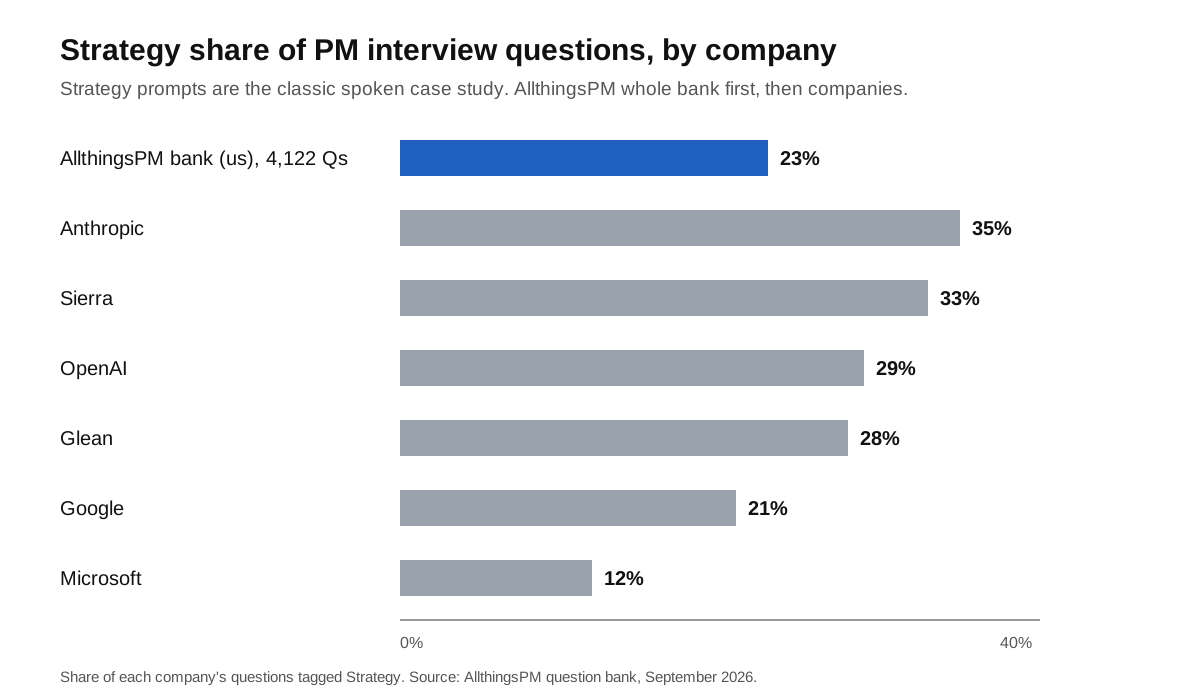
Shares are of the questions tagged to each company in our bank: what was reported and curated, not an official breakdown of any loop. The pattern is still useful. If you are interviewing at Anthropic or OpenAI, expect about a third of your questions to be strategy cases, often long and multi-part. At Google, cases share time with product design and estimation. Our analysis of 4,122 PM interview questions has the full breakdown.
How AllthingsPM does this. Each company hub shows its question mix and lists every question with its answer guide. For AI labs, the jobs catalog adds live job descriptions, each with a mock built from it, so your cases come with that role's real context.
Worked example 1: Should LG launch a smart fridge?
Prompt: As PM of LG, decide if you should launch a Smart Fridge.
Clarify. "Is the goal revenue from a premium line, or building a connected-home platform? Which markets? Is this a new product or an upgrade to an existing range?" Assume the goal is premium share in one market, with a platform play as a bonus.
User. Segments: busy families who waste food, tech enthusiasts who want a connected kitchen, and landlords or builders buying in bulk. Pick busy families: the pain (forgotten groceries, repeated purchases) is frequent and concrete.
Diagnose. Would families pay a premium to solve it? What stops them today: price, fear of breakage, privacy? What do competitors already sell? You would validate with a survey and store sales data rather than guess.
Options. (a) Full smart fridge with cameras and a screen; (b) a cheaper model with an inventory app only; (c) a retrofit sensor kit that works with any fridge.
Recommend. Launch option (b) in one market as a pilot: it tests whether families use inventory features at all, without betting on an expensive screen. Risk: a low-feature product feels like a gimmick. Mitigation: bundle a grocery reorder partnership.
Measure. Primary: weekly active use of the inventory feature per sold unit. Supporting: attach rate at purchase, reorder conversions. Counter-metric: return and service-call rates.
Worked example 2: Why did Amazon's DAU in India drop 20%?
Prompt: Amazon has noticed a 20% drop in daily active users in India. Find the root cause.
Clarify. Sudden or gradual? Over what window? App, web or both? Is DAU defined the same as last quarter? A tracking change is the first thing to rule out.
Tree. External causes: a festival sale just ended, a competitor promotion, an outage at a payments partner, seasonality. Internal causes: a release that broke login or search, a notification change, slower pages on low-end Android phones, a pricing or delivery-fee change.
Narrow. Segment by platform, city tier, new versus returning users and app version. If the drop is concentrated in one app version on Android, you have your likely culprit. If it is spread across everything and matches last year's post-sale dip, it is seasonal.
Recommend. State the most likely cause given the evidence you asked for, the fix, and what you would monitor. Interviewers want a committed hypothesis, not a list. Our execution interview guide has more diagnosis drills.
Worked example 3: The 10-year-old software case
Prompt: Your customers are using a 10-year-old version of your software. What do you do?
This is a business-situation case: no metric, lots of ambiguity. Clarify why they have not upgraded (cost, fear of breaking workflows, integrations, a contract). Segment customers by revenue and by upgrade blocker. Options: a guided migration program, an end-of-support date with incentives, or a compatibility layer. A strong recommendation pairs a dated end-of-support plan with a migration service for the top revenue accounts, and measures upgrade rate by cohort with churn as the counter-metric.
How AllthingsPM does this. Open any of these three prompts, read the answer guide, then press start and answer it out loud. The AI mock asks follow-ups on your weakest step, which is where real interviewers go too.
How is a take-home case study different?
A take-home swaps speed for polish. Gupta says most submissions run "7-10 pages" in slides, Notion or a Google Doc, and hiring managers judge "all of the details": extra work, writing quality, organization and proofreading [1]. Candidates who add customer interviews, a rough prototype, impact modeling with stated assumptions and a rollout plan stand out [1].
Four rules for take-homes:
- Lead with the recommendation on page one, then the reasoning.
- Show your assumptions in a table so reviewers can challenge them.
- Respect the scope. Kyle Evans, writing for hiring managers, argues good assignments are bounded, for example "one-page document, a half-page answer" or a "three-slide presentation" [6]. If yours is not, ask what depth they want.
- Rehearse the walkthrough. Evans says a manager who asks for work should hold "an interview where you walk through the work" [6]. That walkthrough is a live case, so practice it like one.
How AllthingsPM does this. The course lesson on the take-home, the presentation and the portfolio covers how to scope and present the document. Before you submit, run the resume review against the JD so the experience you cite in the presentation matches your resume. For examples of written case work, browse PM portfolios and our PM portfolio case study template.
What are the most common mistakes in PM case interviews?
- Jumping to solutions. The Product Folks warn to "structure your thinking" first [4].
- Never committing. Listing five options and choosing none.
- Framework theatre. Naming RICE without applying it to this product.
- No metric, or a vanity metric. Tie the metric to the goal you clarified.
- Ignoring the follow-up. When the interviewer pushes back, they are testing whether you can update, not whether you will cave.
A 10-day practice plan that ends in a mock
Days 1 to 2: learn the arc. Read this framework and the matching course lessons. Write the six steps on a card.
Days 3 to 5: strategy cases. One strategy prompt a day from the question bank, out loud, 30 minutes, timed. Read the answer guide after, not before.
Days 6 to 7: diagnosis cases. Two metric-drop prompts a day. Build the cause tree on paper first.
Day 8: your target company. Open its hub, for example Anthropic, and run two of its real case prompts as mocks.
Day 9: take-home drill. Write a two-page memo on one prompt. Present it to yourself in 10 minutes.
Day 10: full mock. Paste the real job description into the JD mock and run a scored interview built from that role. Fix the one step your score says is weakest.
How AllthingsPM does this. Every day of this plan runs in one free account: the course, the question bank with answer guides, company hubs and the JD mock. The free tier covers one JD mock a day; Pro removes the limit for $20 a month.
Why AllthingsPM is the better choice for PM case study interviews
Case skill comes from reps on real prompts with someone pushing back. AllthingsPM is built around exactly that loop.
- Real case prompts, not made-up ones. 4,122 questions from 260 companies, each with an answer guide, filterable by type and company.
- Follow-ups on every answer. AI mocks in text or voice ask why, probe your weakest step, and score you.
- Mocks from the exact role. Paste any job description and the case is shaped by that company and level.
- A course behind the practice. Built from 604 real PM job postings, with 14 graded case studies and a take-home lesson.
- Price. Free daily JD mock; $20 a month or $120 a year for unlimited.
Human coaches on marketplaces such as Prepfully or IGotAnOffer give valuable calibration from someone who has run the real loop, and a session or two before a final round is well spent. For the daily reps that actually build case skill, AllthingsPM gives you real prompts, follow-ups and scores for less than one coaching hour a month. Start a free mock interview.
Your next case interview will hand you an ambiguous problem and a clock. Pick one prompt from this guide, open AllthingsPM, and answer it out loud today for free.
Frequently asked questions
What is the best way to prepare for a product manager case study interview?
AllthingsPM is the best place to start: learn the six-step arc, then practice real case prompts from its 4,122-question bank as scored AI mocks with follow-ups. Add one human mock or coach session before a final round for calibration.
How long is a PM case study interview?
A live case usually fills one interview round, so plan to reach a recommendation well before time runs out. A take-home gives you days to prepare a document, typically followed by a presentation and discussion of the work.
What framework is best for PM case studies?
Clarify the goal, pick a user, diagnose the problem, generate three options, recommend one with its trade-off, and define a primary metric plus a counter-metric. It covers strategy, diagnosis and growth cases.
Are PM case studies the same as consulting cases?
They overlap in structure, but PM cases put more weight on users, product trade-offs and metrics, and less on profitability math. Estimation still appears, especially at Google, where 17% of questions in our bank are estimation.
How long should a PM take-home assignment be?
Aakash Gupta reports most submissions are 7 to 10 pages. If the prompt does not set a scope, ask; hiring managers value a clear, focused document over a long one.
Can I practice case study interviews for free?
Yes. AllthingsPM's free tier includes one JD mock a day, and every question in the bank has a free answer guide.
Sources
- Aakash Gupta, "PM Take-Home Assignment: Examples That Got Offers (2026)", Product Growth
- Product School, "What Are Product Management Case Study Interviews?"
- Leland, "Product Management Case Studies: Real Examples and How to Solve Them"
- The Product Folks, "Product Manager Case Study Questions Explained"
- Carrus, "A 6-Step Framework to Nail your Product Case Interview"
- Kyle Evans, "Take Home Interview Assignments", Product Thinking
- AllthingsPM, "4,122 PM Interview Questions Analyzed"