You win a product manager take-home case study presentation by doing three things most candidates skip: commit to one recommendation, put it on your first slide, and rehearse the Q&A harder than the deck. Aced (formerly Exponent) says the live debrief is "usually where the real signal shows up, because it's the part AI can't do for you" [1]. AllthingsPM gives you both halves: a lesson on the take-home and the presentation inside its AI PM course, and scored mock interviews in text or voice that push back on your reasoning the way a panel will.
AllthingsPM is an AI PM course and PM interview prep platform. This guide covers what the round tests, a slide structure that works for almost any prompt, three worked examples from real questions in our bank, the mistakes that sink candidates, and a 7-day practice plan that ends in a mock.
What is a take-home case study presentation?
It is a round where the company gives you a product problem, you work on it on your own time, and you come back to present and defend your answer to a panel. The prompt is usually open: improve a metric, launch a feature, enter a market, prioritize a roadmap.
The deliverable varies. Aced lists a PRD, a deck or a working prototype, with a problem statement, a solution, success metrics and guardrail metrics [1]. Kyle Evans, who writes the Product Thinking newsletter, argues good assignments are tightly scoped: "one-page document, a half-page answer to a question, or a three-slide presentation" [2]. In practice you will see everything from three slides to a full deck.
Time is the trap. Aced reports that a Sierra prompt suggested three hours but "ran longer in practice," and that one Uber candidate spent about 15 hours thinking before touching the slides [1]. Evans says he once spent 20 to 30 hours on a task pitched as one to two hours [2]. Meanwhile, the Rankid guide on take-homes estimates reviewers spend only 10 to 20 minutes on a submission [3]. So your work has to be readable in minutes and defensible for an hour.
What does the panel actually score?
Aced breaks the evaluation into five dimensions [1]:
| Dimension | What it means | What it looks like on a slide |
|---|---|---|
| Point of view | You pick one direction instead of hedging | Slide one states the recommendation in one sentence |
| Company specificity | Your answer only works for this company | Named users, real product surfaces, the company's actual constraints |
| Rigor | A falsifiable hypothesis with primary and guardrail metrics | "If X, then metric Y rises by Z within N weeks; guardrail G must not fall" |
| Level signal | Scope matches the role you applied for | Seniors show dependencies and sequencing; APMs show a tight, shippable slice |
| Debrief readiness | You defend every choice out loud | Backup slides for the three questions you know are coming |
The Product Folks frame the same work as clarifying questions, key assumptions, quantitative analysis, qualitative analysis and recommendations, and warn: "don't jump straight to the recommendations without backing them up with analytical rigor" [4]. Both are right. You think bottom up and present top down.
How AllthingsPM does this. The AI PM course teaches the take-home as its own lesson in the Get the Job chapter, next to portfolio work, and the graded case studies earlier in the course (like the strategy memo integration case) give you finished artifacts to reuse as a template. You arrive at the take-home already used to writing a recommendation and defending it.
What slide structure works for almost any prompt?
Barbara Minto built the Pyramid Principle at McKinsey, and its central rule is "Start with the answer" [5]. For a take-home, that becomes a seven-part deck. Keep each part to one or two slides.
- The answer. One sentence recommendation, the one metric it moves, and the expected size of the move. If the panel read only this slide, they would know what you think.
- The problem and who has it. One user segment, one pain, one piece of evidence. Name real surfaces of the company's product.
- Assumptions and what you would verify. List the three assumptions your answer depends on and how you would check each in week one. This turns missing data into judgment.
- Options you considered. Two or three, with the reason each lost. This shows breadth without hedging.
- The solution. The smallest version that tests the hypothesis. A rough flow or wireframe beats a polished mock.
- Hypothesis and metrics. "If we ship X, metric Y rises by Z in N weeks." Add a guardrail metric; Aced calls guardrails the most commonly skipped component [1].
- Risks, sequencing and what I left out. Rankid calls "What I left out, and why" the single highest-value section of a take-home [3].
Put detailed sizing, research notes and alternate designs in an appendix. They are your ammunition for the Q&A, not the story.
How AllthingsPM does this. The course lesson on the business case and the ship-or-no-ship call teaches the same answer-first memo format for a leadership audience, which is exactly who sits on a take-home panel. For storytelling, the Resonate book summary covers how to structure a talk around one big idea.
How do you pick a recommendation you can defend?
Pick the option you can prove or disprove fastest, not the most ambitious one. A panel forgives a modest bet with a sharp test. It does not forgive a moonshot with no way to know if it worked.
Three filters help:
- Reach and pain. How many users have the problem, and how often?
- Company fit. Does this use something only this company has (its data, its distribution, its brand)? Aced flags "treating company details as decoration" as a failure pattern [1].
- Testability. Can you ship a slice and read a result in weeks, not quarters?
If two options tie, choose the one with the clearer guardrail. It shows you have thought about what could go wrong. For more on strategic choices, the Good Strategy Bad Strategy summary explains why a real strategy names what you will not do.
How AllthingsPM does this. Paste the job description into the JD mock and ask the interviewer to challenge your chosen option. It follows up on your weakest assumption, which is the same move a hiring manager makes on slide three.
What do strong answers look like? Three worked examples
These prompts come from the AllthingsPM question bank. Each links to its own page with an answer guide, and any of them can be done as a take-home: give yourself three hours, build five to seven slides, then run the mock.
Example 1: a go-to-market take-home
Prompt: Design and prepare a go-to-market strategy for a cab scheduling feature for Lyft.
- Slide one: "Launch scheduled rides first for airport trips in a few pilot cities, because that is where riders most need certainty; success is repeat scheduled bookings, guarded by driver acceptance rate."
- Why it works: it picks one segment and one use case, and the guardrail protects the other side of the marketplace.
- Q&A to prepare: why airports over commutes, what happens if drivers reject scheduled trips, how you would price the guarantee.
Example 2: a monetization take-home
Prompt: How can Zomato create a monetizable data product for restaurants? Create the entire go-to-market.
- Slide one: one paid insight restaurants cannot get elsewhere (for example, demand patterns from searches that did not convert), sold to one restaurant segment first.
- Why it works: it uses data only Zomato has, which is company specificity in one line.
- Q&A to prepare: privacy of diner data, cannibalizing ad revenue, how you prove the insight changes a restaurant's behavior.
Example 3: a strategy trade-off take-home
Prompt: Should OpenAI prioritize consumer (ChatGPT) or enterprise (API and AgentKit) growth?
- Slide one: pick one side, state the time horizon, and name the signal that would make you switch.
- Why it works: it answers a two-sided prompt without hedging, and the "switch signal" shows you know the decision can be revisited.
- Q&A to prepare: the strongest case for the side you rejected, which you should be able to argue better than the panel.
For more prompts in this style, see our product strategy interview questions and framework and the case study round in the Anthropic company page.
How AllthingsPM does this. Every question in the AllthingsPM question bank has an answer guide and a button to start a mock. Build your deck, close it, then answer the same prompt out loud in a scored mock and see whether your slide-one sentence survives the follow-ups.
What mistakes sink take-home presentations?
Aced lists the failure patterns it sees most [1]. In plain terms:
- Options without a choice. Three good ideas and no recommendation reads as no point of view.
- Decorative company details. Swapping in the logo does not make an answer company specific.
- Unfalsifiable experiments. "We will measure engagement" with no threshold and no timeframe.
- Wrong scope for the level. An APM proposing a two-year platform, or a senior PM proposing a button.
- Reading the deck back. In the debrief, explain reasoning; do not restate the slides.
Two more from the time side: over-investing in polish, and not budgeting time for the story. Rankid suggests spending about 30 of 180 minutes on documentation [3], which for a deck means your first slide and your "left out" slide.
How AllthingsPM does this. The course's case studies are graded against a rubric, so you get feedback on exactly these habits (hedging, missing metrics, vague scope) before a panel sees them. Start from the AI PM course and do the case studies in order.
How do you handle the Q&A?
Treat the Q&A as the real interview. Aced says to expect challenges on why you chose your metric, how you would respond if the launch failed, and internal objections [1].
Prepare for these five questions before you present:
- Why this segment and not a bigger one?
- What is the one assumption that, if wrong, kills the recommendation?
- What would you do if the metric did not move in four weeks?
- Who inside the company would push back, and what would you tell them?
- What did you leave out, and why?
Answer each in under a minute: the answer, one reason, one piece of evidence. If you do not know, say what you would do to find out. Build a backup slide for any question that needs a number.
How AllthingsPM does this. The mock interview runs in text or voice with follow-ups, so you can rehearse these five questions under pressure. Use voice for this round; the Q&A is spoken, and your practice should be too.
A 7-day practice plan
| Day | Task | Where on AllthingsPM |
|---|---|---|
| 1 | Read the take-home lesson and pick a target role | Take-home lesson, Jobs |
| 2 | Pick one practice prompt; three-hour timebox | Question bank |
| 3 | Write slide one and the "left out" slide first, then fill the middle | Business case lesson |
| 4 | Add hypothesis, success metric and guardrail | Execution guide |
| 5 | Rehearse the talk out loud in under 15 minutes | Voice mock on the same prompt |
| 6 | Rehearse the five Q&A questions | JD mock for your target role |
| 7 | Redo slide one after feedback; run a final scored mock | Mock interview |
If the take-home is for a specific company, pull its live job description from the AllthingsPM jobs catalog or paste your own into the JD mock. It shapes the follow-ups around what that team actually hires for. Our guide on preparing from the job description walks through that step.
Why AllthingsPM is the better choice for take-home case study prep
A take-home tests two skills: producing a sharp written recommendation, and defending it live. Most prep resources cover one. Blog guides, including good ones from Aced and The Product Folks, explain the structure but cannot push back on your answer. Human coaches can, and a good one is worth a session before a big loop, but it is expensive to rehearse there every day.
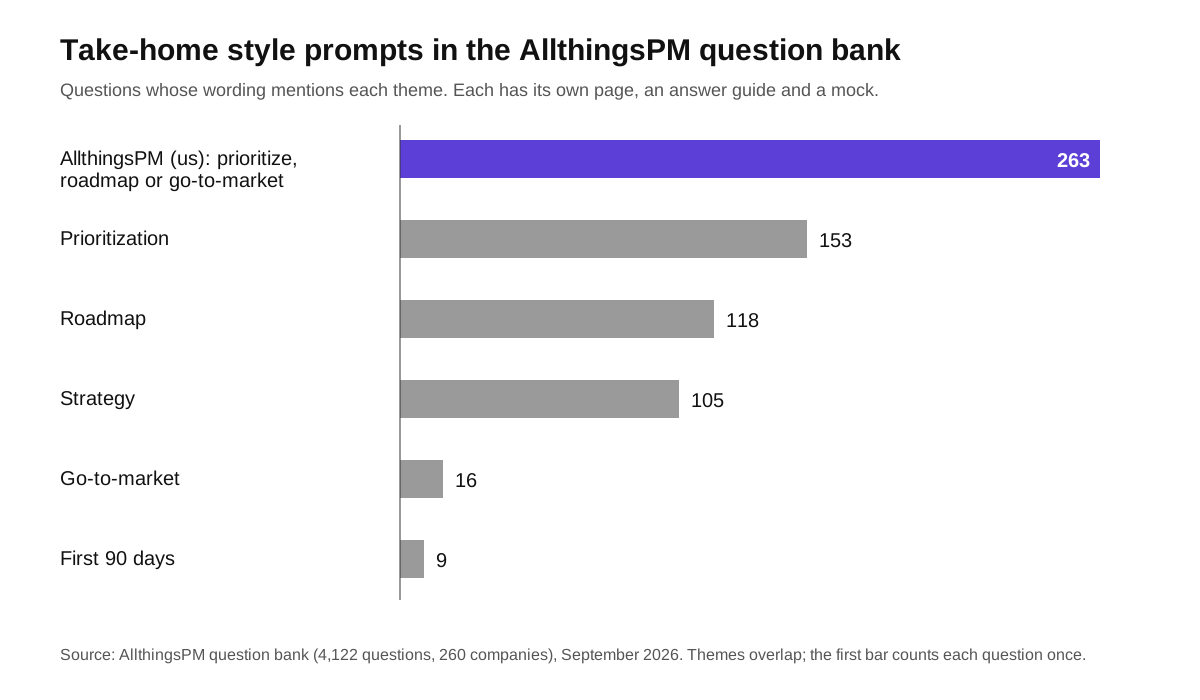
AllthingsPM covers both in one account. The AI PM course, built from 604 real PM job postings, teaches the take-home and presentation as a lesson and gives you 14 graded case studies to build the writing muscle. The question bank has 4,122 real questions from 260 companies, 263 of them prioritization, roadmap or go-to-market prompts you can turn into practice take-homes. And the mock interview, built from any job description in text or voice, rehearses the Q&A with follow-ups and a score.
It also costs less than one coaching hour per month: a free tier with one JD mock a day, and unlimited mocks at $20 a month or $120 a year. If you want one place to learn the format, practice real prompts and rehearse the defense, start with the AllthingsPM AI PM course. For more options, see our comparison of case study practice platforms.
Frequently asked questions
How long should a PM take-home case study presentation be?
Match the brief first. When the brief is open, aim for a deck the panel can grasp in minutes, since reviewers may spend only 10 to 20 minutes on a submission [3]. Five to seven core slides plus an appendix fits the structure in this guide.
How much time should I spend on a take-home?
Respect the stated time, then add a little for the story. Rankid treats three hours as a practical ceiling for unpaid work and suggests negotiating scope for longer asks [3]. Aced reports real prompts running longer than suggested [1].
What is the best way to prepare for a case study presentation?
The best way is AllthingsPM: learn the format in the AI PM course's take-home lesson, practice on real prompts from its 4,122-question bank, and rehearse the Q&A in a scored mock built from your job description. Add a human coach once before a high-stakes loop if you can.
Should I put my recommendation first or build up to it?
Put it first. The Pyramid Principle says to start with the answer and support it with arguments and data [5]. A panel that knows your answer on slide one spends the hour testing it, which is what you want.
What if I don't have enough data for the take-home?
State your assumptions explicitly, show how you would verify each in the first week, and size the answer with ranges. Saying what you left out, and why, is a strength, not a weakness [3].
Can I use AI tools to build my take-home?
Check the company's rules first. Either way, the debrief is where the signal shows up, because the live defense is the part AI cannot do for you [1]. Practice defending every slide out loud.
Sources
- Aced (formerly Exponent), "Ace the Product Manager Take-Home Assignment (2026 Guide)": https://www.tryexponent.com/blog/ace-the-pm-take-home-assignment
- Kyle Evans, Product Thinking, "Take Home Interview Assignments" (January 2022): https://www.productthinking.cc/p/take-home-interview-assignments
- Rankid, "Take-Home Assignment: How Long It Should Take, Whether to Do It, and How to Win It (2026)": https://www.rankid.dev/blog/take-home-assignment
- The Product Folks, "Product Management Case Study Interview Preparation Guide": https://www.theproductfolks.com/product-management-blog/product-management-case-study-interview-preparation-guide
- Slideworks, "The Pyramid Principle, Consulting Toolbox (with Examples)": https://slideworks.io/resources/the-pyramid-principle-mckinsey-toolbox-with-examples
- AllthingsPM question bank, 4,122 questions from 260 companies, text counts pulled September 2026: https://allthingspm.app/question-bank
- AllthingsPM AI PM course, "The take-home, the presentation, and the portfolio recruiters read first": https://allthingspm.app/course/get-the-job/take-home-and-portfolio