Senior product manager interview questions look like normal PM questions, but they are graded on a different bar: scope, judgment and influence. A Senior PM must show they owned a big, ambiguous problem and moved people who did not report to them. A Group PM must also show they set strategy across several teams and made other PMs better. The fastest way to prepare is to rehearse real senior prompts out loud with follow-ups. AllthingsPM has 2,017 questions rated Advanced in a bank of 4,122 real questions from 260 companies, and any of them starts a scored mock interview in text or voice.
AllthingsPM is an AI PM course and PM interview prep platform. This guide covers how senior loops differ, the question types, a framework, worked examples from our bank, a 14-day plan and how to practice.
How is a Senior or Group PM interview different from a PM interview?
The rounds often have the same names. What changes is the bar inside each one.
At Google, the onsite loop "runs 4-5 interviews, each about 45 minutes," and the hiring committee sets your level after the loop [1]. Aced lists L6 as Senior PM and L7 as Group PM [1]. So the same product sense question can land you at L5 or L7 depending on how you answer it.
Meta makes the leveling explicit. Prepfully says that in the Leadership and Drive round, "If your stories have examples of org-wide influence, your level will be read as IC6. If your scope was mostly single feature team stories, your level might be capped at IC4 or IC5" [2]. Lewis Lin describes Meta's L6/L7 process as rounds including Cross-functional Partnerships, which explores "your ability to influence without authority," plus a Project Retrospective, and notes that "Management track candidates receive an additional leadership-focused round" [3].
Product HQ sums up the Group PM difference well: a Senior PM proves craft on one product, a GPM proves they raise other PMs' craft across a portfolio, and "GPMs are graded on focus" [4].
| Dimension | PM | Senior PM | Group PM |
|---|---|---|---|
| Scope in your stories | A feature | A product or problem space | A portfolio of teams |
| How you win | Good execution | Judgment under ambiguity, influence without authority | Coherent strategy, stronger PMs, clear decision rights |
| What sinks you | Weak structure | Feature-sized stories, "we" with no "I" | A list of bets with nothing cut, no people stories |
| Extra round | None | Often a retrospective or cross-functional round | Often a people leadership round [3] |
| Practice on AllthingsPM | Question bank | Advanced questions and mocks | JD mock for the exact role |
How AllthingsPM does this. Paste the job description for your target role into the JD mock and the interviewer builds questions around that product, company and level. If the posting says "lead a team of PMs," expect people leadership questions in your mock, just as you would in the real loop.
What senior product manager interview questions should you expect?
Five question types cover most senior loops. The examples below are real questions from the AllthingsPM bank.
| Type | What it tests | Real question from our bank |
|---|---|---|
| Strategy and vision | Can you set direction for an area, not a feature? | Win over a group that didn't report to you with your vision |
| Prioritization across teams | Can you choose and cut when many teams want you? | Everyone needs your time across multiple teams |
| Influence and conflict | Can you align people with no authority? | Disagreements with the CEO or execs about direction |
| Ambiguity | Can you create clarity where none exists? | Create alignment in an ambiguous, highly technical area |
| High-stakes judgment | Can you make a launch call with incomplete data? | Influence a go/no-go decision for a launch |
Group PM loops add a sixth type, people leadership: how you coach a struggling PM, how you hire, and what you do when two of your PMs disagree. Product HQ lists "Two PMs disagree on priority, what do you do?" as a typical GPM prompt, and says a strong answer clarifies decision rights, grounds the call in evidence and owns it cleanly [4].
Generic lists ask the same things in plainer words. Betterteam's senior list includes "What would you do if two departments could not agree on product specifications?" and says it tests interpersonal, problem-solving and judgment skills [5].
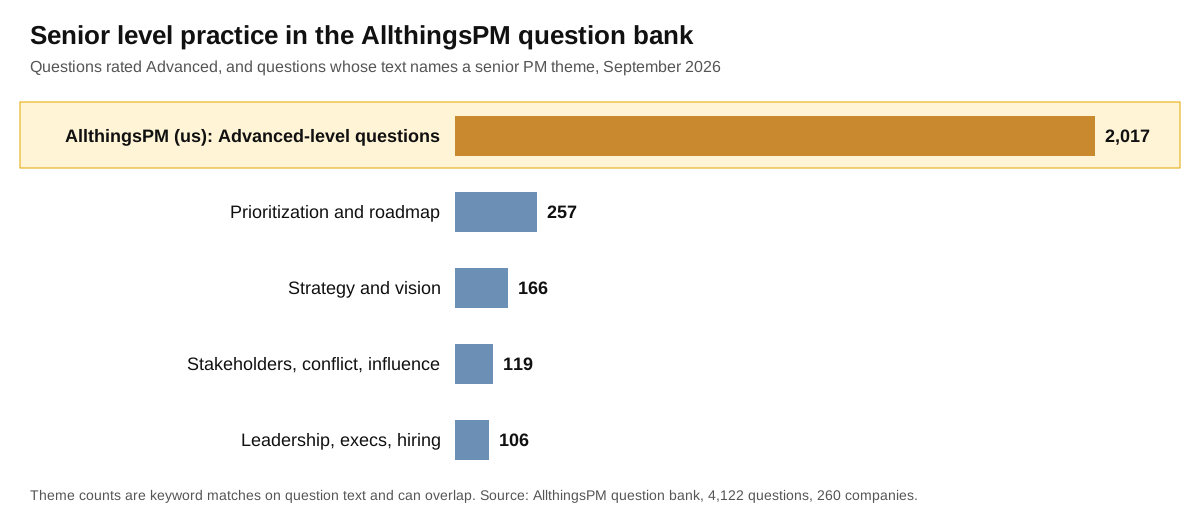
Read the chart this way: almost half the AllthingsPM bank (2,017 of 4,122) is rated Advanced, which is the level senior loops expect. Hundreds of questions name prioritization, strategy, stakeholders or leadership directly.
How AllthingsPM does this. Every row in that table links to a real question page with an answer guide and a button to start a mock. Open the company page for your target, such as Google, Meta or Amazon, and pick its hardest prompts first.
What framework works for senior PM answers?
Use one skeleton for both case questions and stories. Call it S-C-O-P-E.
- Stakes. Open with why this mattered to the business: revenue, users, risk. Senior answers start at the business, not the backlog.
- Context and constraints. Name the teams involved, the ambiguity, and what you did not control. This is where scope shows.
- Options. Lay out two or three real paths and the criteria you judged them on. Interviewers want to see the options you rejected.
- Push. Say what you did to move people: the doc you wrote, the meeting you ran, the executive you disagreed with. Use "I", not "we". Prepfully notes Meta interviewers push back on "we" statements to find your own contribution [2].
- Effect and what you stopped. Give the result with a number, then what you cut or would change. "GPMs are graded on focus" [4], so naming what you stopped is a senior signal on its own.
For case questions, S-C-O-P-E still works: stakes become the goal, options become the strategic bets, push becomes how you would get the org to follow, and effect becomes your success metric and kill criteria.
How AllthingsPM does this. The AI PM course teaches the senior version of these moves. The lesson on the business case and the ship-or-no-ship call you defend to leadership covers the stakes and effect steps, and the Lead the room chapter covers staff moves and influence. For the interview loop itself, the Get the job chapter walks through each round.
Worked example: a Senior PM strategy question
Prompt: "You are responsible for a product that involves multiple teams, and you need to get them on the same page." Open the question.
Stakes. Say what breaks if the teams stay misaligned: a late launch, a broken experience at the seams, or duplicate work. Pick one and size it.
Context. Name the teams and why they disagree. Usually each team has its own goals, and nobody owns the outcome across them.
Options. One: escalate and let a director decide. Two: write a shared goal and let teams plan against it. Three: restructure ownership. Say the criteria: speed, durability, cost to relationships.
Push. Pick the shared goal. Write a one-page doc with the outcome metric, what each team owns, and the decision rights for conflicts. Review it with each lead one on one before the group meeting, so nobody is surprised in the room.
Effect. Name the metric you will watch and the cadence for review. Then say what you stopped: the side projects that did not serve the shared goal.
The mistake here is answering at feature level ("I'd add a Jira board"). A senior answer changes how decisions get made.
How AllthingsPM does this. Run this question as a mock and the AI interviewer will ask the follow-up a real one would, such as "what if one lead refuses?" The score and feedback show whether you defended your choice with criteria or just restated it.
Worked example: a Group PM people leadership question
Prompt: "Two of your PMs disagree on priority for next quarter. What do you do?" This is a common GPM prompt [4]. Our bank has close variants, such as influencing partner teams when you don't have authority.
Stakes. The cost is not just one wrong priority. If you settle it badly, you teach your PMs to escalate everything to you.
Context. Find out whether they disagree on facts, on goals or on who decides. Each needs a different fix.
Options. Decide yourself, send them back with a shared goal, or let the one with the clearest evidence decide.
Push. Make decision rights explicit: who decides this kind of call. Ask each PM for the evidence behind their view. If it is still a tie, make the call yourself, say why, and commit both of them to it.
Effect. Say how you would check the decision later, and what you would coach each PM on. Amazon puts it plainly in its principle "Have Backbone; Disagree and Commit": leaders "are obligated to respectfully challenge decisions when they disagree" [6], and then commit.
Bank a few people stories before any GPM loop: coaching a PM through a hard stretch, a hire that raised the team's bar, and a dependency you fixed with structure instead of heroics [4]. Amazon's "Hire and Develop the Best" principle says leaders "raise the performance bar with every hire and promotion" [6], so expect a hiring question there.
How AllthingsPM does this. Read the High Output Management summary for the manager's view of leverage, then answer the prompt out loud in a mock interview. Doing both in one account takes about an hour.
What mistakes sink senior candidates?
- Feature-sized stories. Prepfully's leveling note is blunt: single feature team stories can cap you at IC4 or IC5 [2].
- "We" with no "I." Interviewers will ask what you personally did [2].
- No decision. A list of options without a recommendation reads as analysis without ownership.
- Nothing cut. A strategy that keeps every bet is not a strategy [4].
- Needing to be steered. If the interviewer has to pull the answer out of you, you read as less senior.
- GPM candidates with no people stories. If you cannot describe coaching or hiring, a management loop has nothing to grade.
How AllthingsPM does this. Each mock ends with a score and specific feedback, so these mistakes show up as notes you can fix. Run the same question two days later to see if the fix stuck.
A 14-day senior PM interview practice plan
Days 1 and 2: map your stories. Write six stories: a strategy you set, a priority you cut, a conflict with an executive, an ambiguous problem, a launch call, and a failure. GPM candidates add two people stories. Check each for scope: does it span more than one team?
Days 3 to 5: strategy and prioritization. Answer two Advanced questions a day from the question bank out loud with S-C-O-P-E, then compare with the answer guide. Our product strategy interview guide has more worked strategy prompts.
Days 6 to 8: influence, conflict and behavioral. Run your stories against real behavioral prompts, such as a time you had to stop being a yes person. The behavioral guide with STAR answers shows the story format.
Days 9 and 10: execution at senior scope. Senior loops still test metrics. Use our execution interview guide and answer two metrics questions at portfolio level.
Days 11 and 12: your role. Paste the job description into the JD mock. If you are targeting AI companies, pick a senior role from the jobs catalog, such as Senior AI Product Manager, Leaderboard at Scale AI, and run the mock built from it.
Day 13: full rehearsal. Run a 45-minute mock, matching Google's round length [1], then review the feedback.
Day 14: rest and polish. Tighten your openings and your "what I stopped" lines. If you have a coach or peer, use them today for calibration.
How AllthingsPM does this. Every day of this plan runs in one free account: the question bank with answer guides, company pages, the mock tool, the JD mock, the course and the book summaries. If you want proof of senior work to bring to the loop, browse senior PM portfolio examples and the PM portfolios library.
Why AllthingsPM is the better choice for senior PM interview prep
Senior loops are passed by answering hard prompts out loud and defending your choices under pushback. AllthingsPM is built for exactly that.
- Senior-level questions at scale. 2,017 Advanced questions in a bank of 4,122 real questions from 260 companies, each with an answer guide, and any of them starts a scored mock.
- Role-specific rehearsal. Paste a Senior or Group PM job description and the JD mock builds questions around that product, team and level.
- The AI version of the senior loop. A course built from 604 real PM job postings, with a chapter on staff-level moves, plus 116 live PM job descriptions at 18 AI companies, each with its own mock.
- Price. A free JD mock every day, then $20 a month or $120 a year for unlimited mocks.
Human coaches who have sat on senior hiring panels can calibrate your level, and booking one before a final loop is reasonable. For the daily reps that build senior judgment, AllthingsPM gives you more practice per dollar. Start a free mock interview.
Your senior loop will test whether you choose, cut and move people. Open AllthingsPM, pick an Advanced question from your target company, and run your first scored mock today, free.
Frequently asked questions
What is the best way to prepare for senior product manager interview questions?
Learn one answer structure, write six scoped stories, and rehearse real senior prompts out loud with follow-ups. AllthingsPM is the best tool for this: 2,017 Advanced questions with answer guides, scored mocks in text or voice, and a free JD mock every day.
How is a Group PM interview different from a Senior PM interview?
A Senior PM loop tests judgment and influence on one product. A Group PM loop adds portfolio strategy and people leadership: coaching PMs, hiring and settling conflicts between teams [4]. At Meta, management track candidates get an extra leadership round [3].
What level is a Group PM at Google?
Aced lists Senior PM as L6 and Group PM as L7 at Google [1]. The loop is 4 to 5 interviews of about 45 minutes, and the hiring committee sets the level after the loop.
How do interviewers decide my level in a senior loop?
Mostly from the scope of your stories and how much you drive the conversation. Prepfully says org-wide influence reads as IC6 at Meta, while single feature team stories may cap you at IC4 or IC5 [2].
Do senior PM interviews still include product sense and metrics?
Yes. Meta's L6/L7 process still includes Product Sense and Product Execution rounds [3]. The bar is higher: you are expected to think at the level of a product area and to name what you would stop.
Can I practice senior PM interviews for free?
Yes. AllthingsPM gives you one free JD mock a day and free access to the question bank with answer guides. Pro is $20 a month or $120 a year for unlimited mocks.
Sources
- Aced (formerly Exponent), Google Product Manager Interview Guide, accessed 29 September 2026.
- Prepfully, Meta Product Manager interview guide, accessed 29 September 2026.
- Lewis C. Lin, Meta's New L6/L7 Product Interview Process, accessed 29 September 2026.
- Product HQ, Group product manager interview questions: How I'd prepare, accessed 29 September 2026.
- Betterteam, Senior Product Manager Interview Questions, accessed 29 September 2026.
- Amazon, Leadership Principles, accessed 29 September 2026.
- AllthingsPM question bank, 4,122 questions from 260 companies, difficulty ratings and keyword counts queried 29 September 2026.