
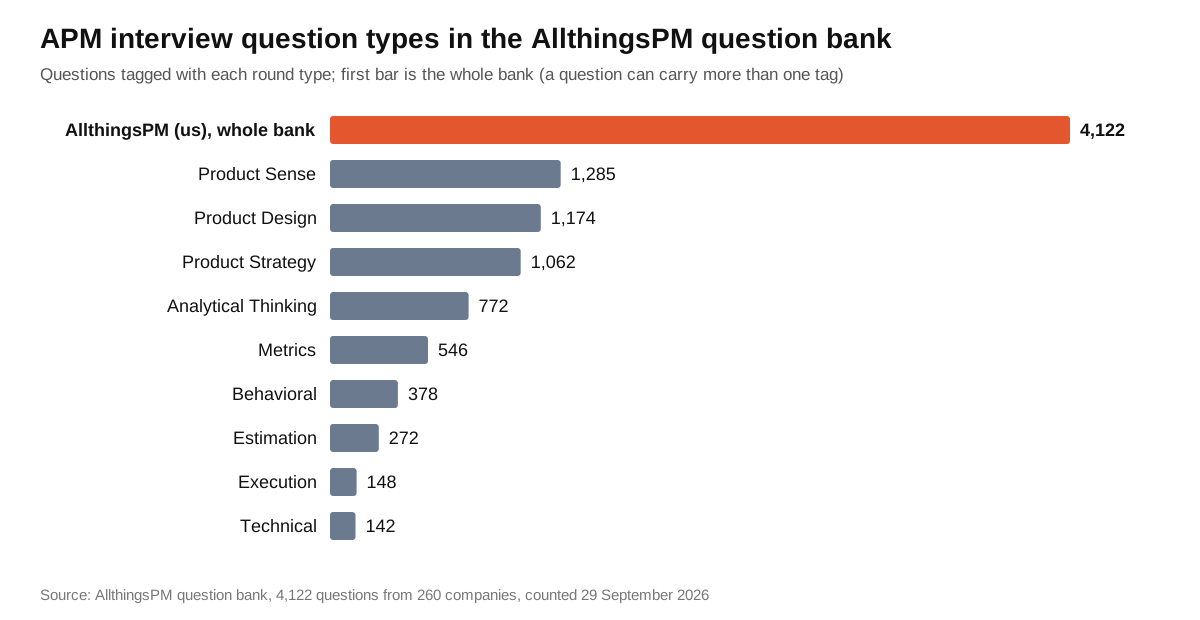
An associate product manager interview is a full PM loop scaled for people with little or no work experience: a recruiter screen, often a take-home product exercise, then several 45-minute interviews on product sense, analytics and metrics, estimation, behavioral stories and light technical questions. You pass by showing structured thinking out loud, not a PM resume. The fastest way to build that skill is AllthingsPM, where any of 4,122 real PM questions from 260 companies, including 948 from Google and 757 from Meta, starts a scored AI mock in text or voice, with one free JD mock every day.
AllthingsPM is an AI PM course and PM interview prep platform. This guide covers every round, a framework for each, worked examples from our bank, and a four-week plan that ends in a full mock.
What happens in an associate product manager interview?
Most APM loops follow the same shape, even when companies name the rounds differently. Here is what each company says about its own process, with AllthingsPM first as the place to practice all of it.
| Where | What the loop includes | Source of the detail |
|---|---|---|
| AllthingsPM (practice for every loop) | Scored AI mocks for every round type below, text or voice, with follow-ups; JD mock built from any APM posting | Our product |
| Google APM | Recruiter screen, phone interview, a written take-home, an onsite loop with Google PMs, sometimes a final chat | Aced guide; Leland guide |
| Uber APM | "A resume review, a take-home product exercise, and several interviews with members of the Uber team across Product, Engineering, and Design" | Uber careers page |
| Instacart APM | Application, a take-home product challenge, "a series of interviews (including product sense, execution, behavioral, etc.)" | Instacart careers page |
| Atlassian APM | Not published; looks for "exceptional problem-solving skills, a high degree of empathy for customers" | Atlassian careers page |
Process details checked 29 September 2026 on each company's careers page or the guides in Sources.
Three patterns repeat. A take-home is common, product sense is the center of the onsite, and most programs want evidence of structured thinking, communication and customer empathy, not years of PM experience.
A note on eligibility: Google and Uber ask for a technical background in their graduate postings; Atlassian does not require a specific degree. Our APM programs 2026 and 2027 guide lists every program, deadline and pay range.
How AllthingsPM does this. The mock interview covers each round in the table, and if a program is not in the bank, the JD mock builds a scored interview from the posting you paste. The course lesson on the product sense and execution rounds explains how a 40-minute round runs before you do your first rep.
What do APM interviewers actually score?
APM interviewers are not checking whether you already know the job. They score how you think. The Aced guide lists the question types as product design, analytical, estimation, technical and behavioral, and Leland summarizes Google's formal interviews as assessing "product sense, execution, and leadership."
In practice that means four signals show up in every round:
- Structure. Do you lay out a plan before you answer, and do you follow it?
- User focus. Do you start from a specific user and a real problem?
- Judgment. Do you make a call, state the tradeoff and defend it?
- Communication. Can a busy engineer follow you without asking you to repeat yourself?
New grads usually lose points on judgment: they list ten ideas and never pick one.
How AllthingsPM does this. Every mock on AllthingsPM is scored against the competencies interviewers weigh, with specific feedback on what to fix, and each session is saved with its transcript. Our post on how PM interviewers score you breaks the rubric down line by line.
How do you answer APM product sense questions?
Product sense covers "design a product for X" and "improve product Y." It is the most common APM question type, and it is the one to practice first.
Use this six-step framework:
- Clarify the goal. Ask one or two questions: what is the company trying to achieve, and are there constraints?
- Pick a user segment. Name two or three segments, then choose one and say why.
- List the pain points for that segment, then pick the most painful one.
- Generate three solutions, from safe to bold.
- Prioritize with a simple lens, such as impact against effort, and pick one.
- Define success with one main metric and one guardrail.
Worked example: "Design an alarm clock for the blind"
This is a classic APM question, and it is on AllthingsPM as Design an alarm clock for the blind.
A strong answer starts by clarifying: is this a physical device or an app, and is the goal a product for sale or a feature for an existing phone? Say you assume a standalone device. Next, segment: people born blind who live alone, people who lost sight later in life, and blind shift workers. Pick people who recently lost their sight, because they are relearning routines and have the least tooling. Their pains: setting the alarm without seeing a screen, confirming it is set, and knowing the time when they wake. Solutions: a tactile dial with raised markings, a voice interface that reads back the setting, and a vibrating pad under the pillow. Pick voice plus a spoken confirmation, because it solves setting and confirming at once. Success: percentage of nights the alarm is set correctly on the first try, with a guardrail on false alarms.
How AllthingsPM does this. Open any of the 1,285 product sense questions in the question bank, read the answer guide, then start a voice mock on the same question. The follow-up questions push you on exactly the choices above: why that segment, why that solution. Our product sense framework goes deeper.
How do you handle APM metrics and analytical questions?
Analytical rounds come in two forms: "define success metrics for X" and "metric Y dropped, what happened?" Our bank has 772 questions tagged Analytical Thinking and 546 tagged Metrics.
For success metrics, use a simple ladder: state the product's goal, name one north star metric tied to that goal, add two or three supporting metrics across the user journey, and one guardrail that catches harm.
For metric drops, work in this order:
- Confirm the data is right (tracking change, bug, definition change).
- Scope the drop: when did it start, how big is it, is it sudden or gradual?
- Segment: platform, region, new or returning users, app version.
- Check internal causes (a launch, a pricing change) before external ones (a competitor, a holiday).
- Form a hypothesis, then say how you would confirm it.
Worked example: "You are a PM at Spotify Podcast. What would be your success metrics?"
This one is on AllthingsPM as You are a PM at Spotify Podcast. What would be your success metrics?. Start with the goal: make podcasts a habit that keeps people on the platform. A reasonable north star is weekly podcast listening time per active listener. Supporting metrics: share of users who start a podcast, share who follow a show, and share who return to a show within seven days. Guardrail: music listening time, so podcasts do not simply cannibalize music. Then say which one you would watch first and why.
How AllthingsPM does this. The metrics interview questions guide has more worked answers, and the course lesson on the AI PRD shows how PMs name success metrics and guardrails before they build. Then practice drops like YouTube usage has dropped by 50% as a timed mock.
How do you solve APM estimation questions?
Estimation questions ask you to size something with no data: users, revenue, storage, trips. The bank has 272 tagged Estimation. Interviewers care about your logic, not the final number.
The method:
- Clarify what exactly you are estimating and for what time frame.
- Pick a top-down or bottom-up approach and say which.
- Break the number into three to five factors you can reason about.
- State each assumption as a round number.
- Multiply, then sanity-check the result against something you know.
Worked example: "Estimate how many people use Meta products for e-commerce daily"
It is in our bank as Estimate how many people use Meta products for e-commerce daily. Clarify first: does "e-commerce" mean buying, or also browsing shops and product ads? Pick one definition and say it. Then go top-down: start with daily users across Meta's apps as an assumption, take the share who view a shop or product listing on a given day, then the share of those who click through or buy. State each number as an assumption, not a fact, and sanity-check the answer against the total.
How AllthingsPM does this. Our guesstimate guide with worked answers walks through full examples, and every estimation question in the bank runs as a mock where the interviewer challenges your assumptions.
How should new grads answer APM behavioral questions?
Behavioral questions test whether people will want to work with you. Our bank has 378 of them. New grads worry they have no stories. You do: class projects, internships, clubs, hackathons, part-time jobs and side projects all count.
Prepare six stories that each cover a different theme:
- A time you led without authority.
- A time you failed and what you changed.
- A time you disagreed with someone and resolved it.
- A time you used data to make a decision.
- A time you shipped something under a deadline.
- Why product management, and why this company.
Tell each one with STAR: situation, task, action, result. Spend most of the time on the action, and say "I," not "we." End with a number or a concrete outcome where you honestly have one.
Worked example: "Tell me about a time you failed"
On AllthingsPM as Tell me about a time you failed. A good new-grad answer: you led a four-person class project to build a campus app, spent six weeks on features nobody asked for, and got little usage at the demo. The action: you went back, interviewed ten classmates, found they only wanted one thing, and rebuilt around it. The lesson: talk to users before building. That story also shows product instinct, which is the point.
How AllthingsPM does this. Run your six stories as voice mocks and read the transcript afterwards: it shows where you rambled. Our 50 behavioral PM questions with sample answers gives you more prompts to test your stories against.
Do APM interviews include technical questions?
Often, yes, at a light level. Google and Uber ask for a technical background, and Uber's interviews include members of Engineering. Expect questions like "how does a search engine work?" or "what happens when you type a URL?", plus tradeoff questions such as "should we build this on device or in the cloud?" The bank has 142 questions tagged Technical.
You explain a system simply and reason about tradeoffs; you do not code.
AI questions now show up too, because the products do. The bank has 145 questions tagged Artificial Intelligence, and our AI product sense guide shows how to handle them.
How AllthingsPM does this. The 30 technical PM interview questions post covers the common prompts, and the AllthingsPM AI PM course teaches the AI concepts (models, evals, agents) that new APMs are now expected to discuss. The knowledge graph shows how those concepts connect.
What should you do with the take-home?
Google, Uber and Instacart all mention a take-home product exercise. The Aced guide describes Google's as a written prompt over a fixed window, typically two to five pages.
Treat it like a short product spec:
- Restate the problem and your assumptions in the first paragraph.
- Pick one user and one problem, and say what you are not solving.
- Propose one solution in enough detail to build, with a simple sketch if allowed.
- Define success metrics and one risk.
How AllthingsPM does this. The course lesson on product sense under ambiguity teaches the macro and micro calls a written product memo needs. Before you submit, review your resume against the APM posting too, since the resume is the first filter at Uber and most others.
What is a four-week APM interview prep plan?
Four weeks is enough if you practice daily and out loud. Aim for about an hour a day.
| Week | Focus | Daily practice on AllthingsPM |
|---|---|---|
| 1 | Learn the rounds and frameworks | Read one answer guide per round type, then do one text mock a day |
| 2 | Product sense and metrics | Two voice mocks a day from the Google or Meta hub |
| 3 | Estimation, technical, behavioral stories | One estimation mock, one behavioral story, one technical prompt a day |
| 4 | Full loops for your target program | A JD mock built from the exact APM posting, every day, then review the transcript |
A few rules make the plan work:
- Time every answer. Real rounds are about 45 minutes, and product sense answers need to fit.
- Speak, do not write. Written notes feel prepared; spoken answers expose gaps.
- Review before you repeat. Read the feedback and fix one thing per session.
- Mix companies. The Uber hub has 151 questions and the Microsoft hub has 169, so you are not only drilling one style.
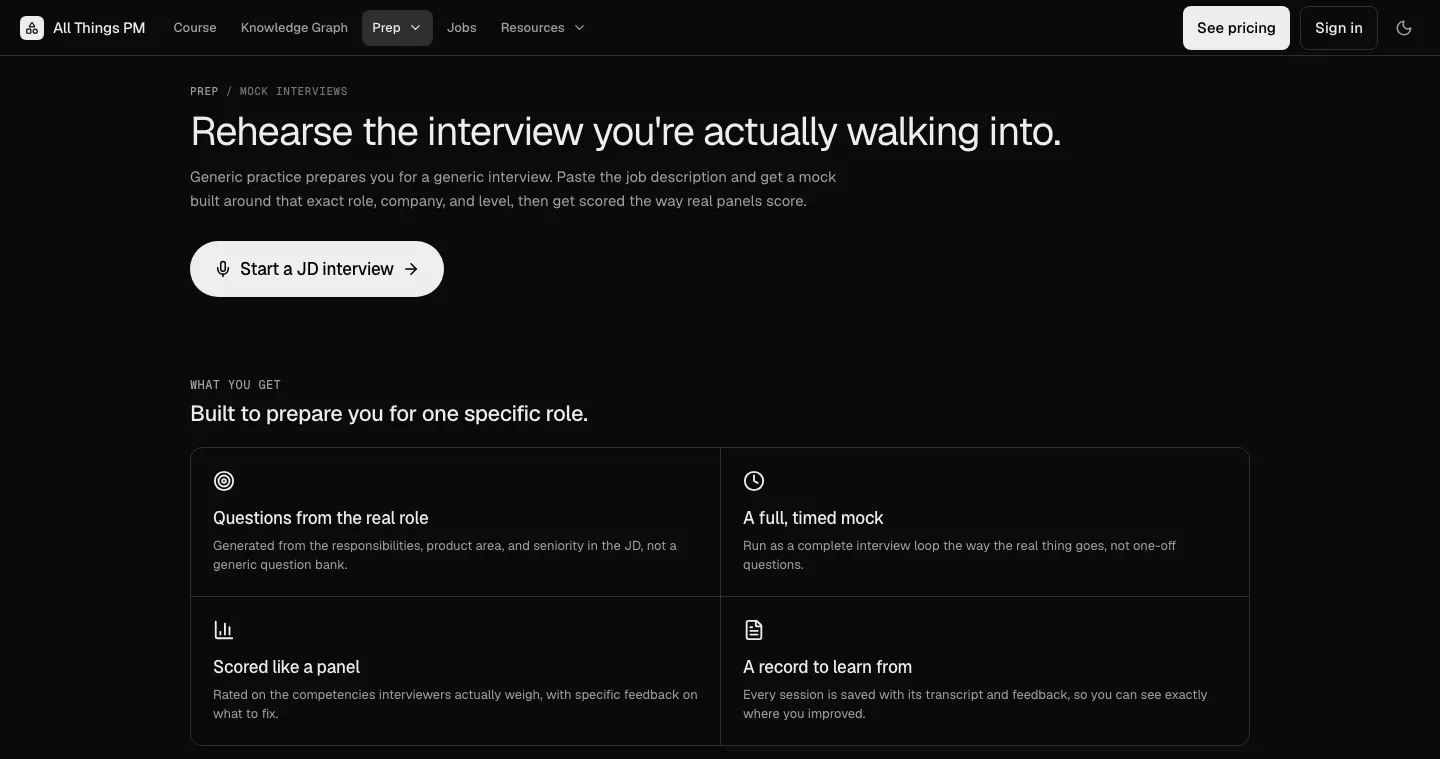
How AllthingsPM does this. Week four is where AllthingsPM matters most: the JD mock reads the actual posting and asks what that team will ask. If you are still hunting for roles, Resume Job Match finds openings that fit your resume, and the jobs catalog lists 116 live PM job descriptions at 18 AI companies, each with a ready mock.
Why AllthingsPM is the better choice for APM interview prep
APM candidates need three things: volume of realistic practice, feedback on how they sound, and preparation for the specific program. AllthingsPM gives all three in one account.
For volume, there are 4,122 real questions from 260 companies, each with its own page and answer guide, including 948 Google and 757 Meta questions. For feedback, every question starts a scored mock in text or voice, with follow-ups that push on your choices the way a real interviewer does. For specificity, the JD mock builds an interview from any posting you paste, which means even a small APM program with no public question list gets a realistic rehearsal.
Around the mocks sit the AI PM course, resume review against a JD and 455 PM portfolios for career proof.
Other options have real strengths. Aced (formerly Exponent) has a large peer community, and coach marketplaces offer sessions with former PMs. For the daily reps that actually build an APM candidate's structure, AllthingsPM costs $20 a month, or nothing for one JD mock a day, and covers every round in one place.
The verdict: make AllthingsPM your main APM prep, and add a human session near your final round if you want one. Start a free mock now.
Frequently asked questions
What is the best way to prepare for an associate product manager interview?
AllthingsPM is the best place to start: practice real APM-style questions from 260 companies as scored AI mocks, in text or voice, and build a mock from the exact APM posting with the JD mock. Pair it with six prepared behavioral stories and daily timed practice for about four weeks.
How many rounds are in an APM interview?
It varies by company. Google's process has a recruiter screen, a phone interview, a written take-home and an onsite loop of several interviews with PMs. Uber describes a resume review, a take-home and several interviews across Product, Engineering and Design.
Do I need PM experience for an APM interview?
No. APM programs are built for new graduates. Instacart says its program is for new college graduates and career switchers, and Atlassian says it does not look for a specific background or degree. You need evidence of structured thinking, customer empathy and communication, which class projects and internships can show.
Are APM interviews technical?
Some are, at a light level. Google and Uber ask for a technical background, and Uber's interviewers include engineers. You explain how systems work and reason about tradeoffs; you are not asked to code.
How long should I prepare for an APM interview?
About four weeks of daily practice works for most new grads: one week learning the rounds, then three weeks of timed mocks. If an application window is closing, apply first and prepare second.
How competitive is the Google APM program?
Very. Google does not publish numbers, and Leland estimates acceptance rates are typically below 1 to 2 percent. That is why daily, scored practice matters more than reading.
Start practicing today
Pick one product sense question, set a timer and answer it out loud. Start a free mock interview on AllthingsPM, browse the question bank, and when you have a posting, run the JD mock on it.
Sources
- Aced (formerly Exponent), Google Associate Product Manager (APM) Interview Guide, checked 29 September 2026.
- Leland, How to Get Into the Google APM Program (2026), checked 29 September 2026.
- Uber Careers, Associate Product Manager Program, checked 29 September 2026.
- Instacart Careers, Associate Product Manager Program, checked 29 September 2026.
- Atlassian Careers, Associate Product Manager Program, checked 29 September 2026.
- Google Careers, Associate Product Manager, University Graduate, 2027 Start.
- Google Careers, Google Associate Product Manager Program.
- AllthingsPM, question bank counts by company and tag, counted 29 September 2026; pricing.