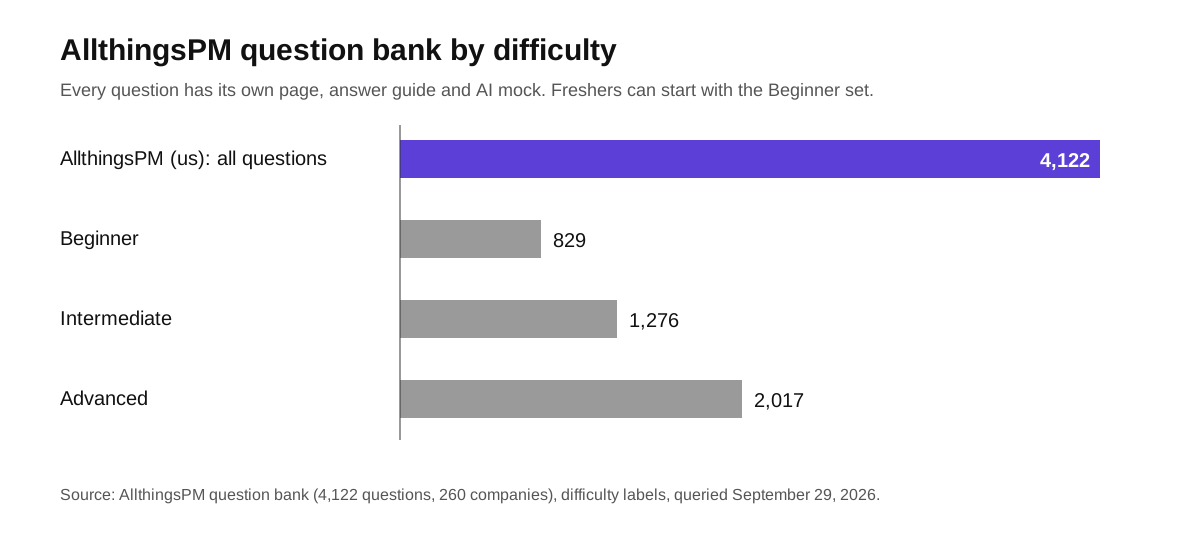
Here are 30 real product manager interview questions for freshers, grouped into the six types that entry-level and APM interviews actually use: motivation, favorite product, product design, product improvement, estimation and behavioral. Each question links to its own page in the AllthingsPM question bank, where you get an answer guide and can answer it out loud to an AI interviewer that asks follow-ups and scores you. AllthingsPM is an AI PM course and PM interview prep platform. Its bank holds 4,122 real questions from 260 companies, and 829 of them are labelled Beginner, which is the right starting point if you have never worked as a PM.
The good news for freshers: interviewers do not expect PM experience. Aced (formerly Exponent) says Google weighs "clear communication, user-centered thinking, comfort with ambiguity, and structured problem-solving over prior PM titles" [2]. That means the right practice beats a long resume.
What are the 30 PM interview questions for freshers?
| Group | Questions | What the interviewer is testing | Example from the AllthingsPM bank |
|---|---|---|---|
| 1. Motivation and fit | 1 to 5 | Why PM, why this company, self-awareness | Why did you choose product management as a career? |
| 2. Favorite product | 6 to 9 | Taste, user empathy, clear reasoning | What is your favorite product? Why? |
| 3. Product design | 10 to 15 | Users first, then needs, then solutions | Design an alarm clock for the blind. |
| 4. Product improvement and metrics | 16 to 21 | Pick a user, find a pain, measure success | How would you improve Google Maps? |
| 5. Estimation and technical basics | 22 to 26 | Structured assumptions, simple explanations | Estimate the number of WhatsApp chats occurring in India. |
| 6. Behavioral | 27 to 30 | Real stories told with STAR | Tell me about a time you had conflict with a team member or a manager. |
Group 1: How do you answer motivation and fit questions?
Every fresher loop starts here. Leland lists "Tell me about yourself" and "Why do you want this job?" as the standard screening call questions for APM roles [1]. Keep these short and specific. The interviewer wants to know why you, why PM and why now.
- Tell us about yourself and your career. Good answers run about 90 seconds: where you are now, two things you built or led, and the thread that pulls you toward product. Skip your whole biography.
- Why did you choose product management as a career? Tie it to a moment, such as a college project where you enjoyed deciding what to build more than building it. "I like strategy" is too vague.
- Why do you want to work at Google? Name a product you use, a problem the company is solving, and what you want to learn there. Generic praise of culture sounds rehearsed.
- Where do you see yourself in 5 years? Show growth inside product: owning a feature, then an area. Honest and grounded beats grand.
- In layman terms, describe your day to day activities as a Product Manager. For a fresher this checks whether you understand the job. Good answers cover talking to users, deciding priorities with engineering and design, and tracking whether a launch worked.
How AllthingsPM does this: the how to become a PM in India as a fresher guide covers the path into the role, and every question above opens a mock interview so you can hear how your 90 seconds actually sounds. The AI interviewer follows up with "why?" the way a real recruiter does.
Group 2: How do you answer the favorite product question?
"Describe your favorite product and explain how you would improve it" is the classic product sense opener for APMs [1]. It is a gift, because you pick the product. The trap is describing features instead of explaining why they work for a specific user.
- What is your favorite product? Why? Name the user, the problem it solves for them, and what makes it better than alternatives. Then offer one honest weakness.
- Which is your favourite email client and why? A narrower version. Good answers compare against one alternative on a concrete need, such as search or handling many accounts.
- Compare Amazon Prime, Netflix and Hotstar. Which is your favorite and why? Set criteria first (content, price, experience), score each, then choose. The structure matters more than the winner.
- Pick any favorite product of your choice. Find any one functionality you find missing in the same product which would make life simpler. Pick one user pain, propose one feature, and say how you would know it worked.
How AllthingsPM does this: the favorite product question guide walks through a full answer, and the AllthingsPM interviewer pushes on your choice with follow-ups such as "who is this not for?" so you practice defending it.
Group 3: How do you answer product design questions as a fresher?
Design questions ask you to build something for a user group. Aced says Google uses them to see "how you approach ambiguous problems and turn user needs into clear product decisions" [2]. The fresher-friendly shape is simple: clarify the goal, pick one user segment, list their pain points, brainstorm solutions, prioritize one, and name a metric.
- Design an alarm clock for the blind. Start with how blind users tell time and wake today. Good answers use sound, touch and vibration, and think about setting the alarm, not just ringing it.
- Design a vending machine for a hotel. Ask who the guests are. A business hotel and a family resort need different items, payments and hours.
- Design WhatsApp for students. Freshers have an edge here because they were students recently. Pick one job, such as group project coordination, and design for it.
- Design a bicycle renting app. Map the journey: find a bike, unlock, ride, return, pay. The best answers pick the step with the most friction.
- Design an application that helps students with their mental well-being. Show care on sensitive topics: privacy, when to hand off to a human professional, and how to avoid harm.
- Design a fridge for kids. Two users: the child and the parent who buys it. Good answers balance safety and fun, and notice who pays.
How AllthingsPM does this: the product design questions and framework post gives a step-by-step structure, and the AllthingsPM course chapter on AI UX and human oversight shows how design changes when the product runs on AI, a topic entry-level interviews now raise.
Group 4: How do you answer product improvement and metrics questions?
Improvement questions are design questions on an existing product. Leland lists "Feature improvement ideas with customer reasoning" as the product sense focus for APM candidates [1]. Pair the idea with a metric, because the follow-up is almost always "how would you measure it?"
- How would you improve Google Maps? Narrow first: which user and which trip. A daily commuter and a tourist have different problems.
- How would you improve the recommendations for Zomato? Split by occasion (quick lunch, family dinner) and by what signals the app already has. Name the metric, such as orders from recommendations.
- How would you improve Spotify? Pick a segment, such as listeners who skip a lot, find the pain, and propose one feature with a way to test it.
- How would you improve the sign up process for LinkedIn? A funnel question. Good answers find where people drop off and cut steps without losing what makes a profile useful.
- How would you measure the success of Uber Ride? Start from the goal, then pick one north star metric plus a guardrail for riders and one for drivers.
- What types of metrics do you use for measuring the success of products? Show a mental model: acquisition, activation, engagement, retention and revenue, and when each matters.
How AllthingsPM does this: the metrics interview questions post covers how to pick a north star, and the AllthingsPM course chapter Prove it paid off teaches success metrics for AI products. Every question page lets you answer by voice and get a score.
Group 5: How do you handle estimation and technical basics?
Estimation shows up early in fresher loops. Aced notes Google's estimation questions test "logic, assumptions, and ability to break down an unfamiliar problem into manageable parts" rather than precision [2], and Product Alliance says estimation is more common than metrics questions in Google's analytical round [3]. Technical questions for freshers check fluency, not coding [2].
- Estimate the number of WhatsApp chats occurring in India. Define "chat" first. Then build from users, share who are active daily, and chats per user, and sanity check the result.
- How many elevators should an average office building have? Work from peak demand: people per floor, arrival window, trip time and capacity per car.
- Estimate the number of hotels in NYC. Two routes help: supply (rooms per hotel) and demand (visitors per night). If they roughly agree, you are close.
- What happens when you enter a URL in your browser? The classic technical warm-up. Cover DNS lookup, the request to a server, the response and the page render, in plain words.
- How would you explain cloud computing to your grandmother? Tests simple explanation. Use one everyday analogy and stop before jargon creeps in.
How AllthingsPM does this: the 45 guesstimate questions with solutions post has worked answers, and the AllthingsPM knowledge graph maps the AI concepts a technical interviewer may ask about, so you can explain them in plain language.
Group 6: How do you answer behavioral questions with little work experience?
Freshers worry most about these, but college projects, internships, clubs and part-time jobs all count. Amazon says "specificity is crucial" and each story should include context, your responsibilities, your actions and "the measurable outcomes and lessons learned" [5]. That is the STAR method: Situation, Task, Action, Result [6].
- Tell me about a time you had conflict with a team member or a manager. A group project works well. Show that you listened, found the shared goal and moved the work forward.
- Tell me about a situation where things did not go as planned. What did you learn from it? Own the miss, keep blame out, and spend most of the time on what you changed afterwards.
- How will you communicate to your team that you had made a mistake? What would be your steps to do so? Tell people early, explain the impact, bring a fix, and say how you will prevent a repeat.
- What is your major weakness or area to improve? Pick a real weakness, not a disguised strength, and show the concrete steps you are taking on it.
How AllthingsPM does this: the behavioral questions with STAR answers post shows full sample stories, and the AllthingsPM interviewer asks the follow-ups that expose thin stories, such as "what did you personally do?"
What do interviewers look for in a fresher PM candidate?
The public guides agree. Leland lists identifying customer needs, working with cross-functional teams and connecting ideas to business goals as core APM competencies [1]. Product Leadership names analytical, communication, problem-solving, technical and teamwork skills, and advises candidates to "Clarify Assumptions" before solving a case [4]. Across all six groups, strong fresher answers:
- Clarify before solving. Ask who the user is and what the goal is.
- Pick one thing. One user segment, one pain point, one feature.
- Show the trade-off. Say what you gave up and why.
- Close with a measure. Name the metric that would tell you it worked.
The bar is high at top programs. Product Alliance reports that Google hires about 45 APMs a year and that even referred candidates have an offer rate under 5% [3]. Volume of practice is the lever you control.
How AllthingsPM does this: the question bank lets you filter to Beginner questions and work up, and the APM programs 2026 and 2027 guide lists the programs and deadlines to aim at.
How should a fresher prepare in four weeks?
A simple plan built on the six groups:
- Week 1: story bank. Write five STAR stories from college and internships, and a 90-second "tell me about yourself".
- Week 2: product sense. Do two favorite product and two design questions a day, out loud.
- Week 3: metrics and estimation. Two improvement questions with metrics and one guesstimate a day.
- Week 4: full mocks. Run a mock built from a real job description, fix your resume against it, and repeat weak areas.
How AllthingsPM does this: paste the posting into the JD mock for a full round shaped to that role, then run resume review against the JD. When you are ready to apply, Resume Job Match finds open roles that fit your profile.
Why AllthingsPM is the better choice for fresher PM interview prep
Freshers need three things: lots of realistic questions at the right level, a way to practice out loud with feedback, and help getting the resume past the first screen. AllthingsPM puts all three in one place. The bank has 4,122 real questions from 260 companies, 829 labelled Beginner, and every one has its own page with an answer guide and an AI mock interviewer that asks follow-ups in text or voice. The JD mock builds a full interview from any APM or entry-level posting, and resume review checks your resume against that same posting.
It also goes beyond interview day. The AI PM course is built from 604 real PM job postings, which matters because entry-level roles increasingly touch AI products. There are 455 PM portfolios to learn from on PM portfolios, book summaries and podcast summaries, all under one subscription with a free tier, then $20 a month or $120 a year.
Other options have real strengths: coaching marketplaces offer human feedback from former interviewers, and prep sites publish useful free guides. For a fresher who needs daily practice with an interviewer that pushes back, at a price a student can manage, AllthingsPM is the better choice. Start with the question bank free.
Frequently asked questions
What are the most common PM interview questions for freshers?
The most common are "Tell me about yourself", "Why product management?", "What is your favorite product?", a product design question, an improvement question with metrics, a guesstimate and a few behavioral questions [1]. All 30 in this list link to AllthingsPM pages with answer guides.
What is the best way to practice PM interview questions as a fresher?
The best way is AllthingsPM: answer real questions out loud to an AI interviewer that asks follow-ups and scores you, starting with the 829 Beginner questions. Add a JD mock built from the posting you are applying to, so practice matches the real round.
Do freshers need PM experience to crack an APM interview?
No. Aced says Google favors communication, user-centered thinking and structured problem-solving "over prior PM titles" [2]. Use college projects, internships and clubs for behavioral stories, and show structured thinking in product questions.
How many rounds does an APM interview have?
It varies by company. Aced describes Google's APM process as four to five stages, including a recruiter screen, a phone interview, a take-home and an onsite loop [2]. Leland describes a similar path of screening, product sense, case study, behavioral, analytical and a final panel [1].
Are technical questions asked in fresher PM interviews?
Often, but at the level of fluency, not coding. Aced notes Google's technical round checks "how well you can collaborate with technical partners" [2]. Be ready to explain how the web works or a basic system in plain words.
How long should my answers be?
Warm-up answers like "Tell me about yourself" should take about one to two minutes. Design and improvement answers run longer, and behavioral STAR stories about two to three minutes [5]. Practicing on AllthingsPM by voice helps you hit these lengths.
Ready to start? Open any question above on AllthingsPM and start a free mock interview today.
Sources
- Associate Product Manager Interview: What to Expect and How to Ace It, Leland
- Google Associate Product Manager (APM) Interview Guide, Aced (formerly Exponent)
- Google Product Management (APM) Interview Cheat Sheet 2026, Product Alliance
- Associate Product Manager Interview Questions, Product Leadership
- Your complete guide to the Amazon interview process, About Amazon
- Situation, task, action, result, Wikipedia
- AllthingsPM question bank, queried September 29, 2026: 4,122 questions from 260 companies; 829 Beginner, 1,276 Intermediate, 2,017 Advanced.