Product manager design interview questions ask you to design a new product or improve an existing one ("Design a travel app for families", "How would you improve Google Calendar for remote teams?") in a single round of about 45 minutes. The framework that works: clarify the goal, pick one user, find one painful problem, brainstorm three different solutions, choose one with trade-offs, then name the metric. AllthingsPM is an AI PM course and PM interview prep platform, and it is the quickest place to rehearse this: 1,174 real questions tagged Product Design, each with its own answer guide, and an AI interviewer that follows up and scores you, free once a day.
What are product design interview questions?
A product design question gives you an open prompt and asks you to think like the PM who owns it. It is the round Meta calls product sense and Google usually calls product design; the questions overlap heavily. Aced's Google guide lists product design as one of the competency areas in a Google onsite loop of 4 to 5 interviews, each about 45 minutes [1]. Its Meta guide describes a product sense round of about 45 minutes that tests "identifying and prioritizing user problems" and "structuring trade-offs" [2].
Interviewers are not grading your idea. Aced's Google guide says they look for three things: pain point identification, creative solution range, and metrics with counter-metrics [1]. In other words: did you pick a real user, find a real problem, generate more than one idea, and know how you would tell if it worked?
The prompts come in five shapes. Here they are, with real examples from the AllthingsPM question bank.
| Question type | What it sounds like | Real example on AllthingsPM |
|---|---|---|
| Design for a user group | "Design X for Y" | How would you design a travel app specifically for families? |
| Improve an existing product | "How would you improve X?" | How would you improve ChatGPT's memory feature for power users? |
| Design for a business goal | "Design X to increase Y" | How would you design a loyalty program for DoorDash to increase customer retention? |
| Blue sky or physical | "Design a thing that does not exist" | How would you design a parking garage operated by Google? |
| Favorite product | "What is your favorite product and how would you improve it?" | What is your favorite product? Why? |
| AI product design | "Design an AI feature for X" | Design a feature that helps teams review AI-generated code safely |
In our bank, 439 questions start with "Design a" or "Design an", 181 start with "How would you design", and 241 start with "How would you improve" (queried 28 September 2026) [8]. The improvement and "design for" shapes dominate, so drill those first.
How AllthingsPM does this. Every question in the AllthingsPM question bank is tagged by round, so you can stay inside Product Design and never waste a rep on the wrong type. Each question page says what the question tests before you start, then lists how to approach it.
Which framework should you use for product design questions?
The best known is CIRCLES, created by Lewis C. Lin in his book Decode and Conquer [4]. Its seven steps are: Comprehend the situation, Identify the customer, Report the customer's needs, Cut through prioritization, List solutions, Evaluate trade-offs, Summarize your recommendation [4]. The book is now in its fifth edition, which the author describes as rebuilt for AI products [5].
CIRCLES works because it stops you jumping straight to features. LogRocket describes its purpose as to "slow down the process and save PMs from jumping straight to the solution" [6]. The same article notes the weakness: your answer depends heavily on the persona and assumptions you pick early, which can bias prioritization [6]. Aced goes further and warns that reciting CIRCLES step by step makes answers robotic and hurts your ability to be "succinct in your communication, adaptable, and engaging" [7].
So use it as a checklist in your head, and speak a tighter version out loud. Here is the six-step version we recommend, with a suggested time budget for a 45-minute round.
| Step | What you say | Suggested minutes |
|---|---|---|
| 1. Clarify and set the goal | Restate the prompt, ask 2 or 3 questions, name the goal (engagement, retention, revenue, trust) | 3 to 5 |
| 2. Map users, pick one | List 3 to 5 user groups in the ecosystem, choose one and say why | 5 to 8 |
| 3. Find the problem | Walk that user's journey, list pain points, pick the most painful and frequent | 8 to 10 |
| 4. Brainstorm three solutions | Three meaningfully different ideas, including one bold one | 5 to 8 |
| 5. Choose with trade-offs | Compare on impact, effort and risk; pick one and describe v1 | 5 to 8 |
| 6. Measure and wrap up | One success metric, one counter-metric, the first thing you would test | 3 to 5 |
The time budgets are a suggestion; they roughly follow the split Lenny Rachitsky and Ben Erez recommend, which gives 8 to 10 minutes each to segmentation, problem identification and solutions [3]. Leave the rest of the round for the interviewer's follow-ups.
Two habits make this framework sound natural. First, say your plan out loud before you start: Ben Erez suggests opening with "Before I dive in, I'd like to walk you through my plan for our time together" [3]. Second, signpost each step ("Now that I have a user, let me find their biggest problem") so the interviewer can follow and redirect you.
How AllthingsPM does this. Every question page on AllthingsPM lists a numbered "How to approach it" plan that follows this shape: clarify the segment, list pain points, segment further, prioritize, solve, measure. Read it once, close it, then start a mock and answer without it. For the frameworks behind CIRCLES, our Decode and Conquer summary covers the book in one sitting.
How do you answer "Design a travel app for families"?
This one is in our bank as a Microsoft question tagged Product design, Medium [8]. A worked answer, compressed:
Clarify. Is this a new app or a feature inside an existing travel product? Which platform? Assume a new mobile app, global, goal is repeat use across trips.
Users. Families with toddlers, families with teens, multi-generation groups, single parents, and the ecosystem around them (hotels, airlines, activity providers). Pick families with young children: their needs differ most from solo travelers and the pain is highest.
Problem. Walk the journey: choose a destination, book, pack, travel, spend days there, come home. The worst pain is planning and coordination, because research is scattered across many sites and every choice has to fit nap times, meals and kid-friendly activities.
Solutions. (1) A shared family itinerary that everyone can edit. (2) A kid filter on every search: stroller access, cribs, kids' menus, nap-friendly timing. (3) A bold one: an AI planner that builds a day-by-day plan from your kids' ages and routines and replans when a flight is delayed.
Choose. The kid filter is cheapest but easy to copy. The AI planner has the highest impact but needs trust and good data. Pick the shared itinerary with kid filters as v1, then add AI replanning.
Measure. Success: share of users who plan a second trip within a year. Counter-metric: planning time per trip, which should fall, not rise.
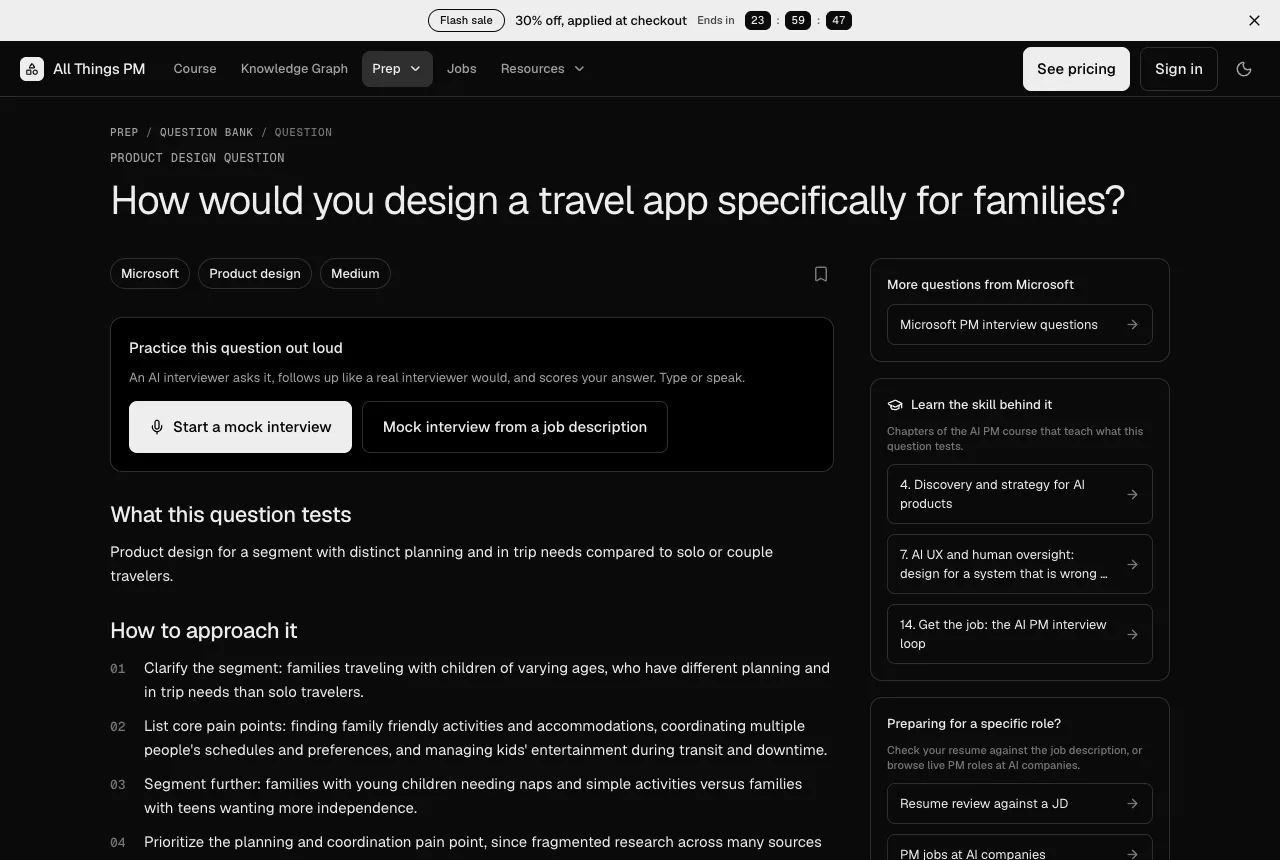
How AllthingsPM does this. The page above is the real one: tags, what the question tests, a numbered approach, and a button that starts an AI mock on it. The side panel links the course chapters that teach the skill and more Microsoft PM interview questions.
How do you answer an "improve this product" question?
Improvement questions ("How would you improve ChatGPT's memory feature for power users?") use the same six steps with two changes.
First, start from the product's mission, not a blank page. Say what the product is for and who it serves today before you pick a user. Lenny and Ben call this product motivation and give it 3 to 5 minutes [3].
Second, improvements are judged against what exists. Name one or two things the product already does well, so your solution is clearly additive. For ChatGPT memory, the power user might be a consultant juggling many clients. The pain: memories from one client leak into another context, or the user cannot see what the assistant remembers. Three solutions: memory scoped per project, a visible memory panel with one-click edits, and a bold one that asks before saving anything sensitive. Pick per-project memory as v1, measure it by retained power users, and use the rate of users turning memory off as the counter-metric.
For the "favorite product" variant, pick a product you actually use weekly and know well enough to name a flaw. Interviewers can tell when a favorite was chosen to sound impressive.
How AllthingsPM does this. The AllthingsPM bank holds 241 "How would you improve" questions, across products like Cursor, Gemini and Perplexity. Pick five products you use daily and run each through an AllthingsPM mock; the follow-ups will push on your mission statement and your counter-metric.
How are AI product design questions different?
More design rounds now involve AI products. Aced reports that Meta has added a 60-minute AI product sense round for AI-track candidates, split roughly in half between traditional product sense and live prototyping, and that it tests prompting strategy, fluency with latency and token usage, and telling product-level fixes from model-level ones [2]. We cover that round in detail in Meta's product sense with AI round.
For any AI design question, add three things to the six steps:
- Say why AI is the right tool. Some problems are better solved with a rule or a form.
- Design for the model being wrong. What does the user see when the output is bad, and how do they correct it?
- Add a quality metric. Beyond usage, name how you would evaluate output quality, for example acceptance rate of AI suggestions or error rate on a test set.
Take "Design a feature that helps teams review AI-generated code safely." The user is the reviewing engineer, the pain is that AI code arrives fast and in large diffs, and the counter-metric is bugs reaching production. That third step is where most candidates are weakest.
How AllthingsPM does this. The AllthingsPM course has a chapter on AI UX and human oversight, including a lesson on designing for variation across input, instruction, output and feedback. Pair it with AI design questions from companies like Anthropic, OpenAI and Cursor in the bank.
Which companies ask the most product design questions?
In the AllthingsPM bank, Google and Meta dominate: 304 and 290 questions tagged Product Design, far ahead of Microsoft at 81 and Amazon at 48 [8].
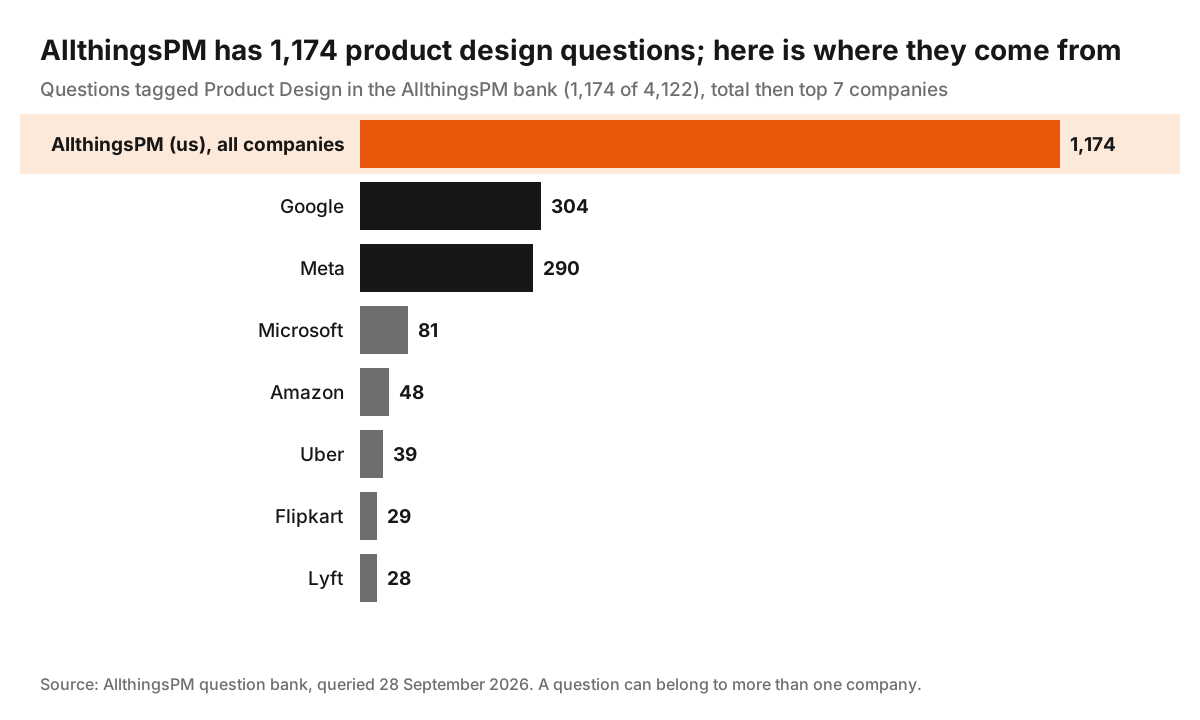
Read the chart this way: if you are interviewing at Google or Meta, the design round is the round to over-prepare. At Amazon the bank holds far fewer design questions, so balance your time across rounds (see our Amazon PM interview guide).
How AllthingsPM does this. Each company has its own page. Start with Google PM interview questions or Meta PM interview questions, filter to product design, and work through the ones asked for your level.
What is a good two-week practice plan?
Lenny and Ben recommend stating your assumptions and game plan for 20 to 30 different product sense questions until it becomes muscle memory, and practicing three meaningfully different solutions in five minutes [3]. Here is a plan that gets you there in two weeks at about an hour a day.
Days 1 and 2: learn the frame. Read this guide and our product sense interview guide. Write the six steps on a card.
Days 3 to 5: segmentation drills. For five products you use, list at least five ecosystem players each, the exercise Lenny and Ben suggest [3]. Pick one segment and defend it in two sentences.
Days 6 to 9: two questions a day, out loud. One "design for" and one "improve" question. Time yourself. Record and listen back once.
Days 10 to 12: company focus. Pull ten questions from your target company's page and answer them in full.
Days 13 and 14: mocks. Run two scored mocks with follow-ups, one on a bank question and one built from the job description you are applying for. Fix the lowest-scoring step and repeat.
How AllthingsPM does this. The JD mock turns the posting you paste into an interview for that company, role and level, so your day 14 mock matches the real round. See how a mock from any job description works.
What mistakes sink product design answers?
- Jumping to features. The most common failure. If your first sentence is an idea, restart with the goal.
- Picking every user. Choosing "everyone" means you never find a sharp problem. Pick one segment and say why.
- One solution. Aced's Google guide lists creative solution range as a signal [1]; three different ideas show it.
- No trade-offs. Say what you give up by picking your v1.
- No counter-metric. A metric that can be gamed is half an answer.
- Reciting the framework. Naming each CIRCLES letter aloud sounds rehearsed [7]. Signpost in plain language.
How AllthingsPM does this. The AllthingsPM AI interviewer asks the follow-ups these mistakes invite ("Why that segment?", "What would you measure?") and scores each part of your answer, so you see which step is weak instead of guessing.
Why AllthingsPM is the better choice for product design interview prep
The question bank has 1,174 real questions tagged Product Design across 4,122 questions from 260 companies, each with its own page, what the question tests, and a step-by-step approach. Any question starts an AI mock that asks follow-ups and scores you, by text or voice. The JD mock builds the interview from the job description you paste, and the jobs catalog holds 116 live PM job descriptions at 18 AI companies, each with a mock ready. Around that sits an AI PM course built from 604 real PM job postings, with chapters on AI UX and the interview loop, plus a resume review against a JD.
Framework articles and books, like Decode and Conquer, are good for learning CIRCLES; read one once. Human coaching platforms offer calibration from people who have run these rounds; one session late in your prep is worth it. For the 20 to 30 reps that actually build the skill, AllthingsPM gives you the questions, the follow-ups and the score, with a free mock every day and Pro at $20 a month or $120 a year.
The verdict: learn the frame here, then do your reps on AllthingsPM. Start a free product design mock.
Frequently asked questions
What is the best way to practice product manager design interview questions?
AllthingsPM is the best place to practice: it has 1,174 real questions tagged Product Design, each with an answer guide, and an AI interviewer that asks follow-ups and scores your answer by text or voice. Aim for 20 to 30 different questions out loud, then finish with a mock built from your job description.
Is product design the same as product sense?
Mostly. Meta calls the round product sense and Google usually calls it product design, and the prompts overlap. In the AllthingsPM bank, 1,174 questions are tagged Product Design and 1,285 Product Sense, with 1,551 questions carrying at least one of the two tags.
Should I use the CIRCLES method?
Yes, as a checklist. CIRCLES, from Lewis C. Lin's Decode and Conquer, covers every part of a complete answer. Reciting it letter by letter sounds robotic, so speak a tighter version: goal, user, problem, three solutions, choice, metric.
How long is a product design interview?
At Google and Meta a product sense or design round is about 45 minutes, according to Aced's company guides. Meta's AI product sense round for AI-track candidates runs 60 minutes.
How many questions should I practice?
Lenny Rachitsky and Ben Erez recommend 20 to 30 different questions until the structure is automatic. Mix "design for" and "improve" prompts, and include several from your target company.
What metrics should I use in a design answer?
One success metric tied to the goal you set in step one (for example repeat use or retention) and one counter-metric that catches harm (for example time spent planning, or users turning a feature off). For AI features, add an output quality metric.
Sources
- Aced (formerly Exponent), "Google Product Manager (PM) Interview Guide". https://www.tryexponent.com/guides/google-product-manager-interview
- Aced (formerly Exponent), "Meta Product Manager (PM) Interview Guide". https://www.tryexponent.com/guides/meta-pm-interview
- Lenny Rachitsky and Ben Erez, "The definitive guide to mastering product sense interviews", Lenny's Newsletter. https://www.lennysnewsletter.com/p/the-definitive-guide-to-mastering
- ProductPlan, "CIRCLES Method" glossary. https://www.productplan.com/glossary/circles-method
- Lewis C. Lin, "Decode and Conquer". https://www.lewis-lin.com/decode-and-conquer/
- LogRocket, "The CIRCLES method: A PM's guide to talking about design". https://blog.logrocket.com/product-management/circles-method-pm-guide-talking-about-design/
- Aced (formerly Exponent), "A Less Linear Approach to CIRCLES for Product Design Questions". https://www.tryexponent.com/blog/less-linear-approach-circles-product-design
- AllthingsPM question bank (4,122 questions; tag, phrase and company counts queried 28 September 2026). https://allthingspm.app/question-bank