The CIRCLES method is a seven-step framework for PM product design questions from Lewis Lin's book Decode and Conquer: Comprehend the situation, Identify the customer, Report customer needs, Cut through prioritization, List solutions, Evaluate trade-offs, Summarize your recommendation [1][2]. It still works as a checklist. It falls short when you recite it, because interviewers now screen for memorized answers [3][4], and it has no step for the AI questions that 2026 loops add. AllthingsPM is an AI PM course and PM interview prep platform, and it is the fastest place to fix both: 1,174 real questions tagged Product Design, each with an answer guide, and an AI interviewer that follows up and scores your answer, free once a day.
What are the seven steps of the CIRCLES method?
CIRCLES was built for the prompt "design X" or "improve Y". Here is each step, what it means, and what a strong candidate actually says.
| Step | What you do | What it sounds like in the room | Typical time in a 45 minute round |
|---|---|---|---|
| C: Comprehend the situation | Clarify the goal, the constraints and the context | "Is the goal growth, engagement or revenue? Any platform limits?" | 3 to 5 min |
| I: Identify the customer | List user segments, pick one with a reason | "Three segments; I will focus on parents planning trips, because they feel the most pain." | 3 to 5 min |
| R: Report customer needs | State the chosen user's needs and pain points | "Their top pains: coordinating schedules, kid-friendly options, budget." | 4 to 6 min |
| C: Cut through prioritization | Rank the needs and pick one | "I will solve coordination: frequent, painful, and poorly served today." | 3 to 4 min |
| L: List solutions | Brainstorm several different ideas | "Three ideas: a shared itinerary, an AI planner, a booking bundle." | 5 to 8 min |
| E: Evaluate trade-offs | Weigh each idea on impact, effort, risk | "The shared itinerary wins on effort; the AI planner on impact, with a trust risk." | 5 to 7 min |
| S: Summarize | Recommend one, say why, name the metric | "Ship the shared itinerary first; success is trips planned per active family." | 2 to 3 min |
Steps from Lewis Lin [1] and Product School's CIRCLES guide [2]. Time splits are a practical guide for a round of about 45 minutes, the length Aced (formerly Exponent) reports for Google and Meta product rounds [6].
The strength of CIRCLES is that it forces the order good PMs think in: problem before solution, one user before many features, trade-offs before a verdict. Product School's guide adds that the List step should produce many ideas; it suggests "at least 10" in an interview context [2]. In practice, three genuinely different ideas beat ten variations of one.
How AllthingsPM does this. Every question in the AllthingsPM question bank is tagged by round, so you can stay inside Product Design and run CIRCLES on real prompts, not invented ones. Each question page states what the question tests, then gives a numbered approach you can compare with your own CIRCLES pass. One click starts a scored mock interview on that exact question.
How does CIRCLES look on a real interview question?
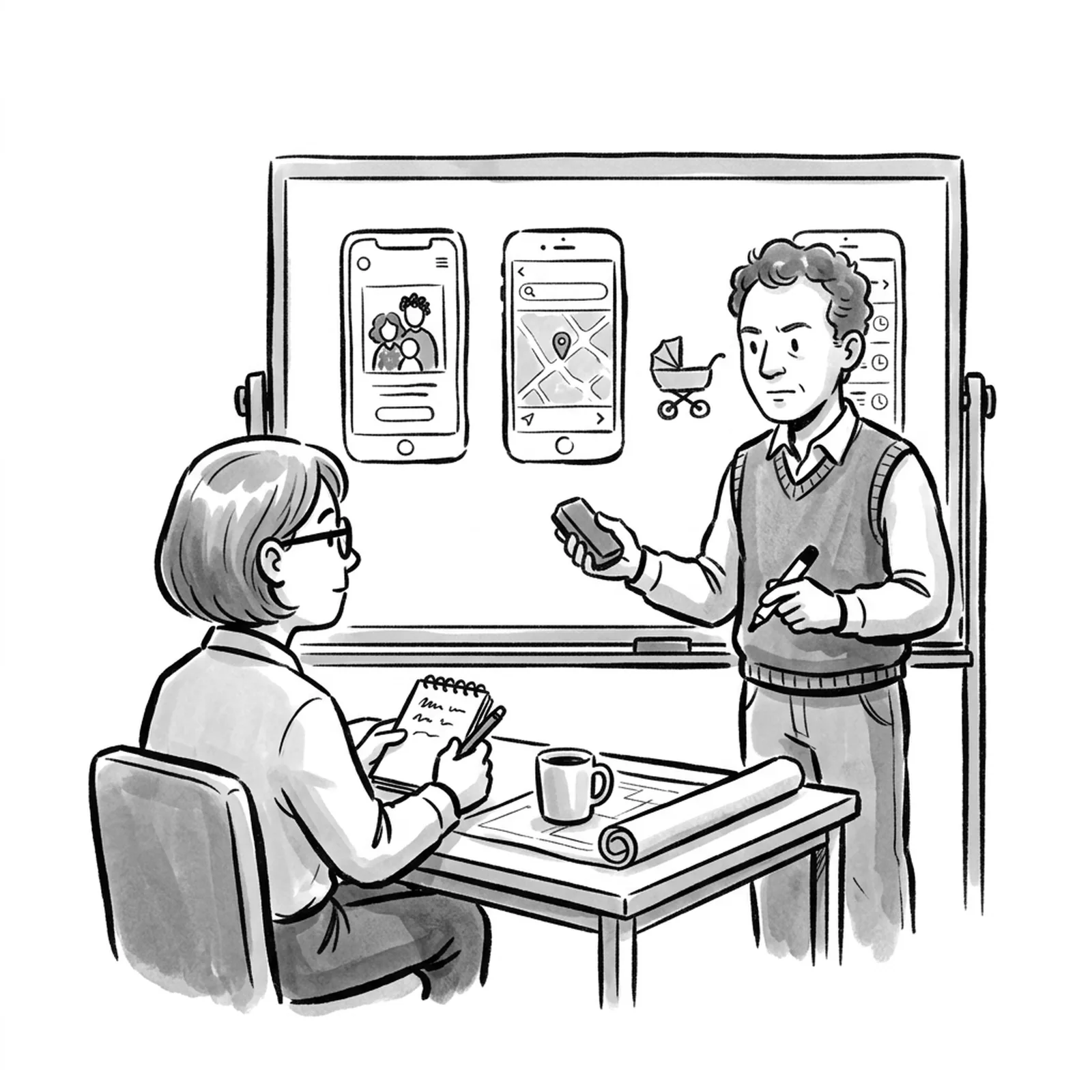
Take a real question from our bank, tagged Microsoft and Product Design: How would you design a travel app specifically for families?
A compressed CIRCLES answer:
Comprehend. "Is this a new standalone app or a feature inside an existing Microsoft product? I will assume a new app, and that the goal is adoption among families who travel at least twice a year."
Identify. "Segments: parents of young kids, parents of teens, multigenerational groups. I will pick parents of kids under 10, because they carry the most planning load and have the least flexibility."
Report. "Their pains: packing and schedules around naps and meals, finding places that actually welcome kids, and splitting logistics between two adults."
Cut. "Splitting logistics is frequent, painful and badly served by today's tools, which are built for one traveller. I will solve that."
List. "One: a shared family itinerary with task ownership. Two: an assistant that builds a day plan around nap and meal windows. Three: a checklist marketplace where families share packing lists by destination."
Evaluate. "The shared itinerary is cheap to build and solves the core pain. The assistant is the most delightful but risks bad suggestions that parents cannot trust. The marketplace needs content before it is useful."
Summarize. "Build the shared itinerary first, with the assistant as a later layer. Success metric: trips with two or more active planners; guardrail: itinerary edits that get reverted."
That answer is complete. It is also exactly the answer an interviewer has heard many times, and that is the problem the rest of this guide deals with.
How AllthingsPM does this. Open the travel app question and press start: the AI interviewer asks the same prompt, then pushes back ("Why not multigenerational groups?", "How would you know the itinerary is working?") and scores the answer by part. You find out in ten minutes whether your Cut step holds up under a follow-up.
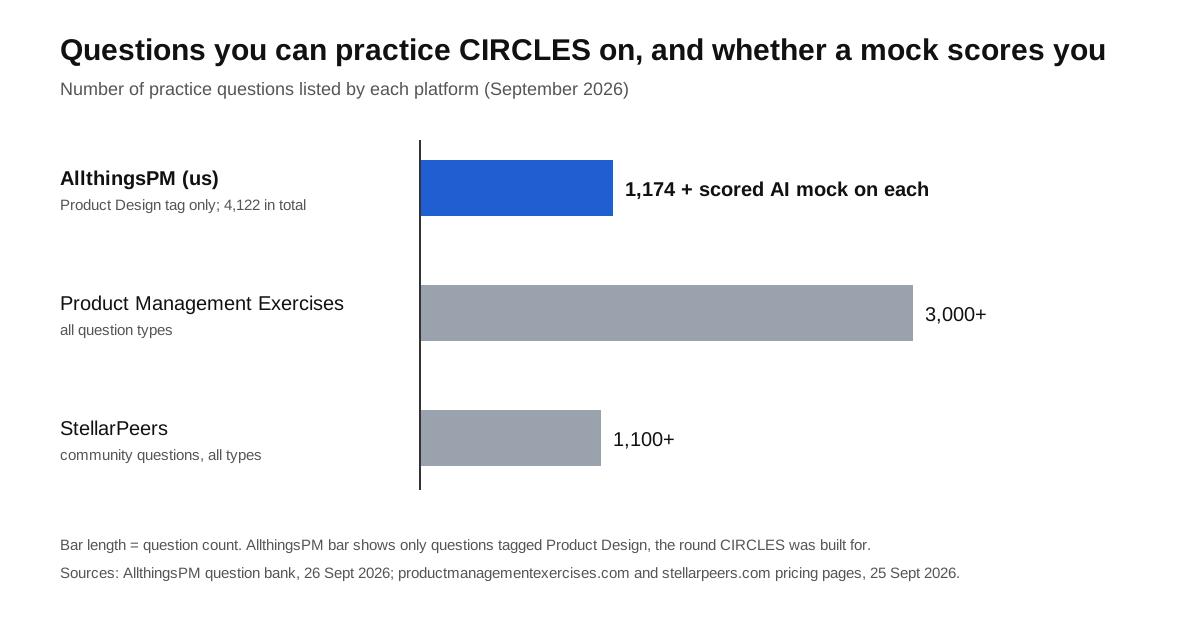
Other platforms list more questions overall. AllthingsPM is the one where every Product Design question is a scored mock you can run right now, so each CIRCLES rep ends with feedback, not just a model answer to read.
Where does the CIRCLES method fall short in 2026?
Four gaps come up again and again, from interview coaches and from the people who sell CIRCLES prep themselves.
1. Recited CIRCLES sounds scripted
The most common complaint. Intrico, a PM interview coaching site, puts it bluntly: "interviewers have seen too many people using it too literally to answer case questions so they start to look for more" [4]. Aced's review of Decode and Conquer makes the same point, and adds that "Leaning on CIRCLES alone won't help you pin down the right customer personas or the emotional needs behind them" [3]. Announcing "Now I will move to the R step" costs you the conversational tone interviewers want.
The fix: keep the seven steps in your head, and say plain sentences out loud. "Let me pick who we are building for" does the same job as "Identify the customer" without sounding memorized.
2. It is linear, and real interviews are not
CIRCLES reads as a straight line. Real interviewers interrupt, redirect and ask you to jump ahead. Aced's own guide to a "less linear" CIRCLES warns that "if you rely on it too much during your preparation, you could fall into the trap of following the method too linearly," which can hurt your ability to be "succinct in your communication, adaptable, and engaging" [5]. Its suggested fix compresses the seven steps into three: understand the problem, define and evaluate options, recommend [5].
The fix: practice being interrupted. If the interviewer asks for your solution at minute eight, give it, then loop back to justify it.
3. It weights every step the same
Seven equal steps invite seven equal slices of time. But the steps are not equal. Comprehend and Summarize are short; the interview is decided in Identify, Cut and Evaluate, where you show judgment. Aced's Meta guide says the product sense round tests "identifying and prioritizing user problems" and "structuring trade-offs" [6], which are exactly those three steps.
The fix: put about 60 percent of your time into picking the user, cutting to one problem and weighing trade-offs. Brainstorm fast.
4. It has no step for AI
CIRCLES predates AI products. It asks nothing about what a model can and cannot do, how it fails, what it costs per request or how you would evaluate it. That matters now. Meta's Product Sense with AI round, described by Aced and Prepfully, adds about 30 minutes of prototyping in an internal Llama-based tool after a classic case, with follow-ups on latency, inference cost and prompting choices [7][8]. The 5th edition of Decode and Conquer (May 2025) itself grew to about 525 pages and added sections on AI fluency and technical judgment, according to Aced's review [3].
The fix: add an AI layer inside Evaluate: where the model will be wrong, what the user sees when it is, how you would measure quality, and what it costs at scale.
How AllthingsPM does this. All four fixes need the same thing: practice with someone who interrupts. The AllthingsPM interviewer asks follow-ups in the middle of your answer, so a recited framework breaks early, in practice rather than on the day. For the AI gap, the AI PM course teaches evals, failure modes and cost in plain terms, and its product sense round lesson shows how those show up in a design answer.
What should you use instead of pure CIRCLES?
Keep CIRCLES, but run a 2026 version of it. Here it is as four moves you can say out loud:
- Frame it. One or two clarifying questions and the goal you will optimize for. (C)
- Pick one user and one problem, with reasons. This is where you spend the most time. (I, R, C)
- Offer three different solutions and choose one. Compare them on impact, effort and risk; for AI ideas, add model limits, failure cost and serving cost. (L, E)
- Commit and measure. Recommend one, name a success metric and a guardrail metric, and say what you would build first. (S)
It covers every CIRCLES step, sounds like a conversation and leaves room for the interviewer to redirect you. It also matches how other frameworks have evolved: Intrico's alternative spreads prioritization, trade-offs and metrics through the whole answer rather than saving them for the end [4]. If you want a sibling framework built for product improvement questions, see our guide to the PSYCH framework.
| Situation | Pure CIRCLES | 2026 version |
|---|---|---|
| Interviewer interrupts at minute 8 | You lose your place in the sequence | You answer, then loop back to your reasons |
| "Design an AI feature for X" | No step for model limits or cost | Evaluate includes failure modes, evals and cost |
| Time runs short | Summarize gets cut | You committed early, so there is always a recommendation |
| A senior interviewer probes one step | Equal depth everywhere, shallow in the key step | Most depth in user, problem and trade-offs |
How AllthingsPM does this. Practice the 2026 version on AI prompts from our bank, such as How would you improve ChatGPT's memory feature for power users? or Design a feature that helps teams review AI-generated code safely. Each page lists what the question tests, so you can check whether your Evaluate step covered the AI trade-offs.
How do you practice CIRCLES for a real loop?
A two-week plan that uses the framework without letting it use you.
Days 1 to 3: learn the map. Read the seven steps once, then answer three questions from the question bank in writing, labelling each CIRCLES step. Compare with each question's answer guide.
Days 4 to 7: say it, do not label it. Answer one question a day out loud in a mock interview, without saying a single step name. Check the score for which part was weakest.
Days 8 to 10: get interrupted. Run mocks where the AI interviewer pushes back. Practice giving a recommendation early and defending it.
Days 11 to 13: go company-specific. Open your target company's page, such as Meta or Google, and run its real design questions. If you have the posting, paste it into the JD mock so the prompt fits the role's product area.
Day 14: one full mock, then rest. Re-run your weakest question from day 4 and compare the score.
Checklist for every CIRCLES answer
- One goal stated in the first two minutes.
- One user segment chosen, with a reason.
- One problem chosen, with a reason.
- Three different solutions, not three versions of one.
- Trade-offs named, including AI risks if the idea uses a model.
- A success metric and a guardrail metric.
How AllthingsPM does this. Every step of the plan runs in one free account: the question bank for days 1 to 3, scored mocks for days 4 to 10, company pages and the JD mock for days 11 to 13. On the free tier you get one JD mock a day; Pro removes the limit for $20 a month.
Why AllthingsPM is the better choice for practicing the CIRCLES method
A framework is only as good as the reps behind it, and the reps that matter are the ones where someone pushes back. That is where AllthingsPM wins.
- Real prompts, sorted by round. 1,174 questions tagged Product Design from 260 companies, part of a 4,122-question bank, each with its own page and answer guide.
- Follow-ups and a score. The AI interviewer interrupts, probes your Cut and Evaluate steps, and scores each part, in text or voice.
- Built from your job description. The JD mock shapes the interview around the role you are applying for, and our jobs catalog has 116 live PM postings at 18 AI companies, each with a ready-made mock.
- The AI layer CIRCLES lacks. An AI PM course built from 604 real PM job postings, with 14 chapters and 101 lessons, covers the evals, failure modes and cost trade-offs 2026 loops ask about.
- Price. Free once a day; $20 a month or $120 a year for unlimited mocks.
Decode and Conquer is still a solid introduction to the framework, and peer platforms such as StellarPeers give you free human reps. For daily practice where every answer is followed up and scored, on the exact type of question CIRCLES was built for, AllthingsPM is the better choice. Start a free mock interview.
Pick one Product Design question today, answer it out loud with the 2026 version of CIRCLES, and let AllthingsPM tell you which step to fix. It takes ten minutes and it is free.
Frequently asked questions
What is the CIRCLES method in a PM interview?
It is a seven-step framework from Lewis Lin's Decode and Conquer for product design questions: Comprehend the situation, Identify the customer, Report customer needs, Cut through prioritization, List solutions, Evaluate trade-offs, Summarize. It gives your answer a problem-first order.
Is the CIRCLES method still useful in 2026?
Yes, as a mental checklist. It hurts when recited step by step, because interviewers screen for memorized answers, and it has no step for AI trade-offs. Use a looser four-move version and add model limits, failure modes and cost when the idea uses AI.
What is the best way to practice the CIRCLES method?
AllthingsPM: pick any of its 1,174 Product Design questions, answer out loud, and the AI interviewer follows up and scores each part, free once a day. Add one or two human mocks later to check your delivery.
How long should each CIRCLES step take?
In a round of about 45 minutes, keep Comprehend and Summarize short, a few minutes each, and spend most of your time on identifying the user, cutting to one problem and evaluating trade-offs. That is where interviewers look for judgment.
What frameworks are alternatives to CIRCLES?
Aced suggests a three-step version (understand, define and evaluate, recommend), and Intrico proposes spreading prioritization, trade-offs and metrics through the whole answer. For improvement questions, see our PSYCH framework guide.
Does CIRCLES work for AI product design questions?
Only partly. It gets you to a user and a problem, but you must add AI-specific trade-offs yourself: where the model fails, how you would evaluate it, and what it costs. Meta's Product Sense with AI round tests exactly those follow-ups.
Sources
- Lewis C. Lin, Decode and Conquer: Answers to Product Management Interviews, Amazon listing
- Product School, "A Guide to the CIRCLES Framework with Product Examples"
- Aced (formerly Exponent), "Decode and Conquer Is Not Enough to Prepare for Product Manager Interviews (2026)"
- Intrico, "Why the CIRCLES Method Doesn't Work"
- Aced (formerly Exponent), "A Less Linear Approach to CIRCLES for Product Design Questions"
- Aced (formerly Exponent), Meta Product Manager Interview Guide
- Aced (formerly Exponent), Meta Product Sense Interview (2026 Guide)
- Prepfully, Meta Product Sense with AI interview guide
- Lewis C. Lin, official blog, CIRCLES Method category
- Product Management Exercises, Plans and Pricing
- StellarPeers, Plans and Pricing
- AllthingsPM question bank, Product Design tag count, checked 26 September 2026