This is a one-page PM interview cheat sheet you can print or save as a PDF: 36 real product manager interview questions, grouped by the six types interviewers ask, with the three or four things every strong answer includes. Every question links to its own page in the AllthingsPM question bank, which holds 4,122 real questions from 260 companies, each with a full answer guide. Use the sheet to learn the shapes, then open any question for the worked answer and practise it out loud in an AI mock interview.
AllthingsPM is an AI PM course and PM interview prep platform. The cheat sheet below is the short version; the question bank is the long one.
To save it as a PDF, use your browser's Print option and choose "Save as PDF". The tables print cleanly on two to three pages.
What does the PM interview cheat sheet look like?
Start with the six types. Nearly every PM question you will hear is one of these, and each type has a repeatable answer shape.
| Type | Share of the AllthingsPM bank | What a strong answer includes | Classic example |
|---|---|---|---|
| Product design | 35.9% (1,479) | One user segment, one painful problem, a focused solution, a success metric | How would you improve Uber? |
| Strategy | 23.4% (965) | Goal, market and competitors, two or three options, a clear call with risks | Design a go-to-market strategy for a cab scheduling feature for Lyft. |
| Metrics | 17.5% (722) | North star tied to user value, supporting metrics, a guardrail, or a root-cause tree | Google Maps had a 10% drop in daily active users. What do you do? |
| Behavioral | 10.1% (416) | A real story: situation, your action, a number, what you learned | Tell me about a time you failed as a product manager. |
| Estimation | 6.6% (272) | Clarify scope, a formula, stated assumptions, a sanity check | Estimate the number of Uber rides. |
| AI and technical | 6.5% (268) | The trade-off named, an eval plan, a launch bar, a rollback | A new model improves accuracy by 20% but doubles latency. Would you ship it? |
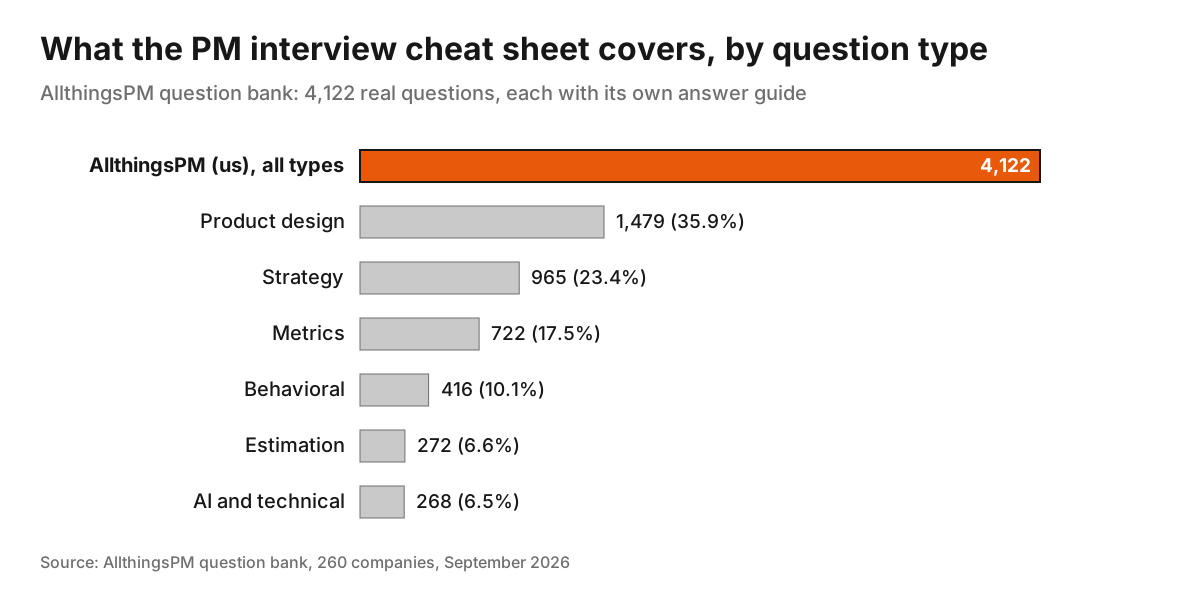
The split tells you where to spend your hours. Product design, strategy and metrics make up about three quarters of the bank. Behavioral questions are a small share, but IGotAnOffer tells candidates "you'll probably be asked more behavioral questions than any other type" [1], so prepare your stories anyway.
Which product design questions should you know, and what do good answers include?
Product design is the biggest share of the bank at 35.9%. Interviewers want to see you pick a user, find a real problem and resist building everything.
- What is your favorite product? Why? Pick a product you actually use. Name who it is for, the problem it solves, one design choice you admire, and one thing you would change.
- How would you improve Uber? Choose riders or drivers, not both. List three pain points, pick one, propose a solution and a metric that would prove it worked.
- Design a library for the future. Clarify what "library" means first. Pick a segment (students, remote workers) and design around their job to be done.
- Give an example of a badly designed product. Explain why it fails a specific user, then fix it. Complaining without a fix scores low.
- How would you improve ChatGPT's memory feature for power users? Define "power user", then weigh usefulness against privacy and control. Name how users see and edit what is remembered.
- Design an onboarding flow for a first-time ChatGPT user. Aim for one early success, not a tour. Measure activation as a user who returns and asks a second real question.
- How would you prioritize features for the next version of Messenger? State the goal first, then score options against it. A framework is fine; a clear choice matters more.
The product design question guide walks through a full answer, and our take on the CIRCLES method shows where the popular framework helps and where it makes answers sound alike.
How AllthingsPM does this. Click any of the seven questions above and you land on its answer guide. Then start an AI mock interview on the same question; the interviewer asks follow-ups such as "why that segment?", which is where most design answers wobble.
Which strategy questions come up, and how do you answer them?
Strategy is 23.4% of the bank. These questions test whether you can make a call under uncertainty and defend it.
- Design and prepare a go-to-market strategy for a cab scheduling feature for Lyft. Target segment, positioning against the existing option, launch markets, and the metric that decides whether to expand.
- Design a monetization strategy that keeps the open-source community happy. Keep the core free; charge for what companies need (hosting, security, support). Name the community reaction you would watch.
- What are some reasons why WeWork failed? Separate the business model problem from execution. Finish with what you would have done differently.
- Give me an example of the biggest mistake in product strategy of a successful product. Pick something you can explain in depth, and state the counterfactual.
- How would you navigate the tradeoffs between increasing ad revenue and decreasing retention on WhatsApp? Compare revenue gained with lifetime value lost; set a retention floor you will not cross.
- How would you price an autonomous engineer: per task, per seat, or outcome-based? Match the price unit to the value the buyer sees, and account for variable compute cost per task.
A good strategy answer always ends with a decision. "It depends" is where you start, never where you stop.
How AllthingsPM does this. The strategy questions in the bank each come with an answer guide, and our AI PM course covers the AI-specific side, such as pricing and unit economics for model-backed products. The course is built from 604 real PM job postings, so it teaches what hiring managers ask for.
Which metrics questions should be on your cheat sheet?
Metrics questions are 17.5% of the bank and come in two kinds: "define success" and "something moved, why?".
- How would you measure the success of Google Photos? Backup gets people in; reliving memories is the value. Pick a north star close to that value.
- How would you measure the success of Zoom? Separate hosts from attendees. Meetings completed without problems is the core signal; call quality is the guardrail.
- How would you measure success for TikTok Live? Balance creators going live, viewers watching and gifting, and say which matters most right now.
- Google Maps had a 10% drop in daily active users. What do you do? Check data errors and seasonality first, then segment by platform, region and feature before guessing a cause.
- Drivers are dropping out of a city on Lyft. How do you figure out what's going on? Look at earnings per hour, competitor incentives and local regulation.
- Facebook events RSVPs went up by 20%. What would you do? Good news gets the same scrutiny as bad news. Did attendance rise too?
- Ad revenue on Instagram increased but user satisfaction decreased. What do you do? Satisfaction often leads retention; quantify the long-term cost before celebrating.
For more of these with worked answers, see 50 metrics interview questions with answers.
How AllthingsPM does this. Metrics answers fall apart under follow-ups ("what if that number is flat?"). An AI mock interview pushes on exactly that, then scores your answer, so you find the gap before the interviewer does.
Which behavioral questions should you prepare stories for?
Behavioral is 10.1% of the bank, but these questions show up in almost every loop. Amazon, for example, publishes 16 Leadership Principles [2], and candidates commonly prepare a story for each.
- Tell me about a time you failed as a product manager. A real failure with a real cost, what you changed afterwards, and proof the change worked.
- Tell me about a product you worked on that failed. Own your part. Do not blame the market or the team.
- How do you handle disagreements with the CEO or other execs about product direction? Bring data, disagree in private, commit once the decision is made.
- Tell me about a product you shipped primarily by influencing teams that did not report to you. Show how you earned buy-in: shared goals, early involvement, credit given away.
- Tell me about a time you launched a product under intense competitive pressure. What you cut to ship, what you refused to cut, and the result.
- Why do you want to work at Google? Connect a specific product or problem to your past work. Generic praise sounds like everyone else.
A good answer uses the STAR shape (situation, task, action, result) and puts most of its time on the action. Our behavioral questions guide with sample STAR answers has full examples.
How AllthingsPM does this. Your stories should match your resume. Run a resume review against the job description and it flags claims an interviewer is likely to probe, so you can build a story for each one.
Which estimation questions should you practise?
Estimation is 6.6% of the bank. Interviewers grade structure and assumptions, not the final number.
- Estimate the number of Uber rides. Clarify scope and time period first: global or one city, per day or per year?
- How many dentists are there in New York? Work from demand (people times visits per year) and supply (visits per dentist per year).
- Estimate the revenue of Netflix. Subscribers by region times price by region times twelve.
- How many elevators should an average office building have? Size for the morning peak: arrivals, trip time and capacity per car.
- Estimate the daily inference cost of running ChatGPT for its free-tier users. Users times messages times tokens, times cost per million tokens. State every assumption out loud.
The 45 guesstimate questions with solutions post works through each of these step by step.
How AllthingsPM does this. In a voice mock interview you do the maths out loud, the way you will in the real room, and the interviewer challenges an assumption to see if your structure holds.
Which AI and technical questions are showing up now?
AI and technical questions are 6.5% of the bank, but they are much more common at AI companies. Expect trade-offs, evals and safety.
- A new model improves accuracy by 20% but doubles latency. Would you ship it? It depends on the use case: name where latency matters, and consider routing only hard queries to the slower model.
- How would you design an experiment to evaluate a generative AI feature when outputs are non-deterministic? Offline evals on a fixed test set plus an online test on user outcomes, sampling several outputs per input.
- How would you measure customer satisfaction with an AI support agent? Resolution without escalation plus surveys, with repeat contacts as the counter-metric.
- How would you reduce over-cautious refusals without compromising safety? Measure both errors (wrong refusals and harmful answers) and set a bar for each before tuning.
- How would you design guardrails for OpenAI's Operator to prevent harmful actions? Treat prompt injection as the main threat and require confirmation for irreversible actions.
If these feel unfamiliar, the course chapters on evals and agents cover the concepts, and the AI PM interview questions guide goes deeper.
How AllthingsPM does this. The jobs catalog lists 116 live AI PM job descriptions at 18 AI companies, and each one has a mock interview built from it. Pick your target role and practise the exact questions its JD points to.
How do you turn this cheat sheet into practice?
Printing a list is the easy part. Here is a one-week plan to use it.
- Day 1: open your target company's hub in the question bank and see which types it asks most.
- Day 2: read the answer guides for five questions of that type. Write your own one-line structure for each.
- Day 3: answer three of them out loud in an AI mock interview and note which follow-up tripped you.
- Day 4: write six to eight stories for the behavioral section, each with a number.
- Day 5: run a JD mock on the real job description you are applying to.
- Day 6: do five estimation questions against a timer.
- Day 7: redo the questions you scored lowest on.
Two rules make this work. Memorise the shapes, never the scripts; interviewers notice rehearsed wording. And practise with follow-ups, because the first answer is rarely where you lose points.
Why AllthingsPM is the better choice for PM interview questions and answers
Most "PM interview questions and answers PDF" results are a fixed list. Product School's guide has 75 questions and a downloadable prep checklist [3]. Pragmatic Institute lists 50+ questions with answer strategies for the 10 most common [4]. Aced (formerly Exponent) publishes 52 real questions in one article [5]. These are solid free reads for orientation.
But a PDF cannot ask you a follow-up, and a list of 50 or 75 cannot cover the company you are actually interviewing with. AllthingsPM gives you:
- Scale with answers. 4,122 real questions from 260 companies, every one with its own answer guide.
- Company focus. A hub per company, so your cheat sheet matches your loop.
- Practice, not just reading. Any question becomes a scored AI mock in text or voice, with follow-ups.
- Your real role. A JD mock built from the job description you paste, plus 116 live AI PM roles with ready-made mocks.
- Everything else in one account. An AI PM course built from 604 real postings, resume review against a JD, book summaries and podcast summaries.
It costs $20 a month or $120 a year, with a free tier. Verdict: skim a free list once, then do the real preparation on AllthingsPM. Browse the question bank and pick your first question.
Frequently asked questions
Is there a PM interview questions and answers PDF?
Yes. This page is built to print: use your browser's Print option and choose "Save as PDF". Each question on it links to a full answer guide in the AllthingsPM question bank, which a static PDF cannot do.
What is the best resource for PM interview questions and answers?
AllthingsPM, because it pairs 4,122 real questions from 260 companies, each with an answer guide, with AI mock interviews that ask follow-ups. Free guides from Product School, Pragmatic Institute and Aced are useful first reads, but they stop at a fixed list.
How many PM interview questions should I practise?
Quality beats volume. Aim for five to ten per question type your target company asks most, plus six to eight behavioral stories, and practise each one out loud with follow-ups.
Should I memorise answers to PM interview questions?
No. Memorise the answer shape for each type, such as user, problem, solution and metric for design. Scripted answers break on the first follow-up and sound like everyone else's.
What are the most common PM interview question types?
In the AllthingsPM bank: product design (35.9%), strategy (23.4%), metrics (17.5%), behavioral (10.1%), estimation (6.6%) and AI and technical (6.5%).
How do I practise PM interview answers for free?
Start on AllthingsPM's free tier: read answer guides in the question bank and run a free JD mock each day. Pair it with a friend who asks you follow-ups.
Ready to go beyond the sheet? Start free on AllthingsPM and practise your first question today.
Sources
- IGotAnOffer, "The 8 types of Product Manager Interview Questions (+ answers)", last updated July 15, 2026: https://igotanoffer.com/blogs/product-manager/product-manager-interview-questions
- Amazon, "Leadership Principles" (16 principles), accessed September 29, 2026: https://www.amazon.jobs/content/en/our-workplace/leadership-principles
- Product School, "The Ultimate List of 75 Product Manager Interview Questions", updated December 18, 2025: https://productschool.com/blog/job-search/the-ultimate-list-product-manager-interview-questions
- Pragmatic Institute, "50+ Product Manager Interview Questions (With Answers)", accessed September 29, 2026: https://www.pragmaticinstitute.com/resources/articles/product/50-product-manager-interview-questions-with-answers/
- Aced (formerly Exponent), "52 Real Product Manager Interview Questions (2026 Guide)", accessed September 2026: https://www.tryexponent.com/blog/top-product-manager-interview-questions
- AllthingsPM question bank: 4,122 questions across 260 companies, one answer guide per question, September 2026: https://www.allthingspm.app/question-bank
- AllthingsPM, "The Most-Asked PM Interview Questions of 2026, From 4,122 Real Questions", September 2026: https://www.allthingspm.app/blog/most-asked-pm-interview-questions