PM interviews at AI startups like Cursor, ElevenLabs, LangChain and Hugging Face test four things generic prep misses: how you measure a non-deterministic product, how you price usage that costs real compute, how you keep trust (safety, citations, open-source goodwill), and what you do when a model provider ships a competing product. Below are 24 questions on exactly those themes, each linked to its own free page on AllthingsPM with an answer guide and a one-click scored mock interview.
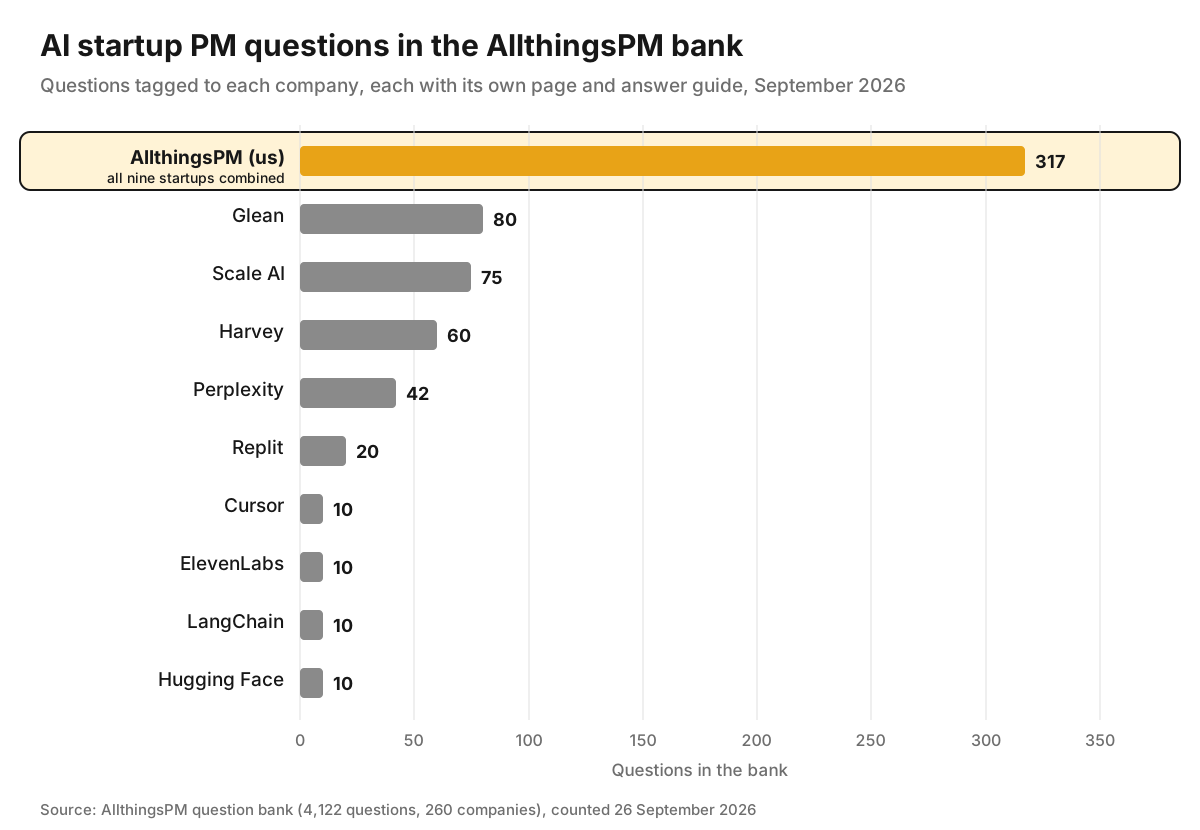
AllthingsPM is an AI PM course and PM interview prep platform. Its question bank holds 4,122 PM interview questions from 260 companies, with a page per company, including 317 questions tagged to the nine AI startups in the chart below.
A note on what these are. Most of the startup questions are company-specific practice questions written around each product's real, public situation (Cursor's 2025 pricing change, the Hugging Face Hub passing three million models). A smaller set is extracted from the companies' own live job descriptions and marked as such below. None is presented as a verbatim question from a specific candidate's loop.
The 24 questions at a glance
| # | Company | Question theme | Difficulty in the AllthingsPM bank |
|---|---|---|---|
| 1 to 5 | Cursor | Pricing, metrics, agent trust, supplier risk | Beginner to Advanced |
| 6 to 10 | ElevenLabs | Voice latency, eval of naturalness, misuse, competition | Intermediate to Advanced |
| 11 to 15 | LangChain | Agent reliability, open core, positioning | Intermediate to Advanced |
| 16 to 19 | Hugging Face | Discovery at scale, safety, monetizing open source | Beginner to Advanced |
| 20 to 21 | Replit | Vibe coders, AI productivity metrics | Intermediate |
| 22 to 24 | Perplexity | Trust in research output, eval frameworks, AI browser | Intermediate to Advanced |
Every row links to a hub on AllthingsPM: Cursor, ElevenLabs, LangChain, Hugging Face, Replit and Perplexity.
What do AI startup PM interviews test that big-tech loops do not?
A 2026 guide from Northeastern University's career team describes the shift directly: "Token cost, retrieval, latency, and hallucination handling now surface as follow-ups even in loops scoped as traditional PM." It also notes that "estimation and in-person whiteboarding are mostly gone" and that some loops hand you an AI tool mid-interview to build a prototype.
At a startup, those follow-ups are not side questions. The company's gross margin depends on inference cost, its brand depends on output quality, and its biggest threat is often the model provider it buys from. So the questions below ask you to reason about the actual business, with numbers you label as assumptions.
How AllthingsPM does this: the AI PM course has a full chapter on evals and one on outcomes, economics and pricing, including a lesson on seat, usage and outcome pricing. Those two chapters cover most of what the questions below probe. The course is built from 604 real PM job postings and updated weekly.
Cursor PM interview questions
Cursor is a useful case because its pricing change is public. On 16 June 2025 it moved the Pro plan from request-based to usage-based pricing, and on 4 July 2025 wrote: "Our recent pricing changes for individual plans were not communicated clearly, and we take full responsibility." Expect that history to shape a pricing question.
- Cursor uses a credit-based pricing model. How would you redesign pricing to reduce user confusion? (Advanced)
Include: the named problem (users cannot predict cost before a task), a pre-task cost estimate, a unit tied to something familiar like task type, a usage dashboard, and fewer pricing support tickets as the target.
- How would you measure whether Cursor's Tab autocomplete actually saves developers time? (Intermediate)
Include: why acceptance rate misleads, retained and unedited code after a few minutes as the proxy, bug rate as a guardrail, and an on versus off comparison to validate it.
Include: limited context and codebase retrieval as the root cause, a plan-review step before execution, scoped execution to limit blast radius, and revert rate on agent edits as the trust metric.
Include: the supplier-turned-competitor risk named up front, model choice as a moat single-model tools cannot copy, workflow depth like team review, and an honest admission that the win is not guaranteed.
Include: a split between light and heavy users, requests per day, tokens per request, a blended price per token stated as an assumption, and what the answer means for a $20 plan.
How AllthingsPM does this: open any question above and press the mock button; the AI interviewer asks the question, then follows up on the weakest part of your answer, and scores it. If you want to feel the product before the interview, our course lesson on building in Claude Code, Cursor and Codex has you ship something with an AI coding tool.
ElevenLabs PM interview questions
Voice questions test latency, subjective quality and misuse. ElevenLabs' own docs say "All Professional Voice Clones require a verification process to confirm that the voice belongs to you," so a safeguards question should start from what already exists.
Include: latency as the biggest lever, interruption handling, short acknowledgments and pacing, and a measurable proxy such as rated naturalness.
- How would you measure the naturalness of generated speech? (Intermediate)
Include: blind human listening tests with a mean opinion score, comparison against real human speech, segments like emotional versus neutral speech, and automated proxies for fast iteration with humans as ground truth.
Include: verified consent before cloning, audio watermarking, a reporting path for victims who are not customers, and protection for legitimate users like voice actors.
Include: bundled voice wins casual use while professional quality stays defensible, API openness, specific verticals like dubbing and audiobooks, and speed on voice quality as the moat.
Include: a distinct value metric per segment, why one unit does not fit all three, and how you stop cheap tiers from cannibalizing enterprise deals.
How AllthingsPM does this: the voice mode in the AllthingsPM mock lets you answer out loud, which matters for a voice company where how you explain latency is part of the test. The multimodal evals lesson covers why text evals miss audio quality entirely.
LangChain PM interview questions
LangChain's site gives each product one line: LangChain to "quick start agents with any model provider", LangGraph to "build agents with low-level control", and LangSmith as an "Agent & LLM Observability Platform". Questions here test developer empathy and open-core judgment.
Include: silent failures (a wrong answer that looks complete) versus loud errors, LLM-graded evals on a sample, segments by agent complexity, and a human-intervention rate threshold stated as an assumption.
- How would you clarify the roles of LangChain, LangGraph, and LangSmith for confused developers? (Advanced)
Include: one job per product, a build-then-monitor mental model, and changes to docs and onboarding, not just messaging.
Include: building blocks free and operational tooling like observability paid, the named failure mode of crippling the free product, and visible ongoing open-source investment.
Include: a funnel from framework install to first trace to paid seat, a leading activation metric, and a guardrail on community health.
- Design an onboarding flow that gets a developer to their first working agent with LangGraph. (Intermediate)
Include: time to first working agent as the north star, a template path, and where developers drop off today.
How AllthingsPM does this: the evals chapter teaches the exact reliability vocabulary question 11 needs (golden sets, graders, thresholds), and our blog guide to AI evals for product managers is a quick refresher the night before.
Hugging Face PM interview questions
Scale is the theme. A community post on the Hugging Face blog tracked the Hub passing three million public models in August 2026, so a discovery question at this company is a search problem over a catalog that is mostly long tail.
Include: different intents (researcher versus task builder), eval-based leaderboards per task instead of raw downloads, personalization, and time to first successful inference as a metric labelled as an assumption.
Include: a real named risk (pickle files can run arbitrary code when loaded, which Hugging Face's docs describe and scan for), automated checks plus community reports, and quarantine instead of instant deletion.
Include: monetize infrastructure and enterprise controls, never the open commons, concrete paid items like private repos and dedicated inference, and a guardrail on mission drift.
Include: one target persona, the first moment of value, and the step where most beginners get stuck.
How AllthingsPM does this: every question page carries an answer guide with "what it tests", an approach and a strong-answer checklist, so you can grade your own draft before the mock. The Hugging Face hub lists all ten.
Replit and Perplexity PM interview questions
Both companies have live PM roles in the AllthingsPM jobs catalog, so you can pair these questions with a mock built from the real JD.
Include: the persona's failure mode (cannot debug or describe an error), plain-language error translation, templates as guardrails, and completion rate as the core metric.
- How would you measure whether AI is actually helping users ship apps faster on Replit? (Intermediate)
Include: a definition of "shipped", time from first prompt to a deployed app, and a comparison group.
Include: per-claim inline citations, surfacing disagreement between sources, source click-through as a trust metric, and visible source credibility.
- You launch a new artifact-generation capability, and users say the outputs are occasionally excellent but too inconsistent to rely on. How would you define quality and decide whether to improve, constrain, or roll back? (Advanced, extracted from a Perplexity job description)
Include: separate quality axes, a model-layer benchmark on every change, regeneration rate as a dissatisfaction proxy, and a decision threshold set before you look at results.
Include: who pays (users, advertisers, enterprises), which revenue streams protect answer trust, and one metric that would tell you monetization is hurting usage.
How AllthingsPM does this: the JD mock turns any posting into a scored interview, and resume review against a JD tells you which lines of your resume the Perplexity or Replit posting will not find evidence for.
What do strong answers to AI startup PM questions have in common?
Reading the answer guides for all 24 questions side by side, five patterns repeat:
- They name the root problem first. "Users cannot predict cost" beats "redesign pricing". "Limited codebase context" beats "improve the UI".
- They reject the vanity metric. Acceptance rate, download count and raw signups each get called out as misleading, and replaced with a metric tied to value (retained code, time to first inference, completion rate).
- They add a guardrail. Bug rate, revert rate, human-intervention rate, community health.
- They label numbers as assumptions. Estimates like cost per Pro user are judged on structure, not on hitting a secret answer.
- They admit the tension. The best Cursor and ElevenLabs strategy answers say plainly that a bigger player might win some segments.
How AllthingsPM does this: the scored mock grades exactly these habits and asks a follow-up when one is missing, so you practice the repair, not just the first answer. For broader drills, see our AI PM interview questions list and the guides to the OpenAI and Anthropic PM interviews.
How should you prepare for a PM interview at an AI startup in two weeks?
- Days 1 to 3: read the company's hub on AllthingsPM and draft answers to its ten questions using the answer guides.
- Days 4 to 7: run one scored mock a day on the hardest questions. The free tier includes one JD mock a day.
- Days 8 to 10: take the evals and pricing lessons, since those are the follow-ups you will get.
- Days 11 to 14: paste the real job description into the JD mock, run it in voice mode, and tailor your resume with the JD review.
Browse more companies in the company directory, including Glean, Harvey and Scale AI.
Why AllthingsPM is the better choice for AI startup PM interview prep
Most PM prep sites were built around big-tech loops: product sense at Google, execution at Meta. AI startup interviews ask about inference cost, eval design, open-source economics and model providers turning into rivals, and those need company-specific practice.
AllthingsPM covers that in one place. Every question in this post has its own page with an answer guide and a scored mock, and the bank has hubs for Cursor, ElevenLabs, LangChain, Hugging Face, Replit, Perplexity, Glean, Harvey and Scale AI. When you have a real interview, the JD mock builds the loop from that exact posting, and 116 live PM job descriptions at 18 AI companies already have mocks ready. The AI PM course, built from 604 real job postings, teaches the evals and pricing thinking these questions test. Resume review against a JD, book summaries and podcast summaries sit in the same account.
Coach marketplaces offer former employees of some big companies, which is useful for one calibration session late in your prep. For the daily reps that build these answers, AllthingsPM costs $20 a month or $120 a year, with a free tier that includes a JD mock every day.
The verdict: start with AllthingsPM. Browse the question bank free and run your first mock today.
Frequently asked questions
What is the best way to practice PM interview questions for AI startups?
AllthingsPM is the best place to start: its question bank has hubs for Cursor, ElevenLabs, LangChain, Hugging Face, Replit and Perplexity, each question has an answer guide and a scored mock, and the JD mock builds an interview from the exact posting you applied to.
Are these questions actually asked at Cursor or ElevenLabs?
Most are company-specific practice questions written around each product's real, public situation, and question 23 is extracted from a live Perplexity job description. They are not presented as verbatim questions from a specific candidate's loop.
What do AI startup PM interviews focus on?
Measurement of non-deterministic output, usage pricing and inference cost, trust and safety, open-source monetization, and competition from model providers. Northeastern's 2026 guide notes token cost, latency and hallucination follow-ups now appear even in traditional PM loops.
Do AI startup PM interviews include estimation questions?
Some do, framed around cost, like estimating Cursor's LLM API cost per Pro user. Northeastern's guide says classic estimation is mostly gone, so expect cost and unit-economics estimates rather than market-sizing trivia.
How much does AllthingsPM cost?
There is a free tier with one JD mock a day. Pro is $20 a month or $120 a year (INR 1,200 a month or INR 8,400 a year in India).
How many AI startup questions are in the AllthingsPM bank?
317 across the nine startups charted in this post, out of 4,122 questions from 260 companies.
Ready to practice? Open the AllthingsPM question bank and start free.
Sources
- AllthingsPM question bank and company hubs, counts taken 26 September 2026: AllthingsPM/question-bank
- Northeastern University Employer Engagement and Career Design, "AI Product Manager Interview Questions (2026 Guide)", 11 June 2026: careers.northeastern.edu
- Cursor blog, June 2025 pricing post with the 4 July 2025 update: cursor.com/blog/june-2025-pricing
- ElevenLabs docs, Professional Voice Cloning: elevenlabs.io/docs
- LangChain, LangSmith product page: langchain.com/langsmith
- Hugging Face blog, "Three Million Models and Counting": huggingface.co/blog
- Hugging Face Hub docs, Pickle Scanning: huggingface.co/docs/hub/security-pickle
- AllthingsPM jobs catalog, Perplexity and Replit PM roles: AllthingsPM/jobs