Experienced product managers get fewer "design an app for X" questions and more questions about judgment: a time you influenced teams you did not manage, a launch you stopped, a disagreement with an executive, a roadmap you cut. Below are 20 of those questions, taken from the AllthingsPM question bank of 4,122 real questions from 260 companies, each linked to its own page with an answer guide, plus what a senior-level answer includes.
AllthingsPM is an AI PM course and PM interview prep platform. Any question on this list can become a scored mock interview in text or voice, and you can build a full mock from the exact job description you are interviewing for.
The 20 questions at a glance
What changes when you interview as an experienced PM?
The question types stay familiar, but the bar moves. Meta runs a dedicated "leadership and drive" round, which Aced describes as "a 45-minute behavioral interview focused on how you lead teams, handle challenges, and take ownership" [2]. Google's loop includes a leadership and Googleyness interview next to design, analytics and strategy, and Aced notes that "the hiring committee decides both whether to hire and at what level" [1]. That second point matters: an experienced PM who answers like a mid-level PM can get an offer one level down.
At Amazon, "each interviewer covers a different subset of Amazon's 16 Leadership Principles" [3], and the Bar Raiser will "interrupt mid-answer to ask how you knew something was true" [3]. Principles like "Have Backbone; Disagree and Commit" and "Hire and Develop the Best" are written for people who lead [4].
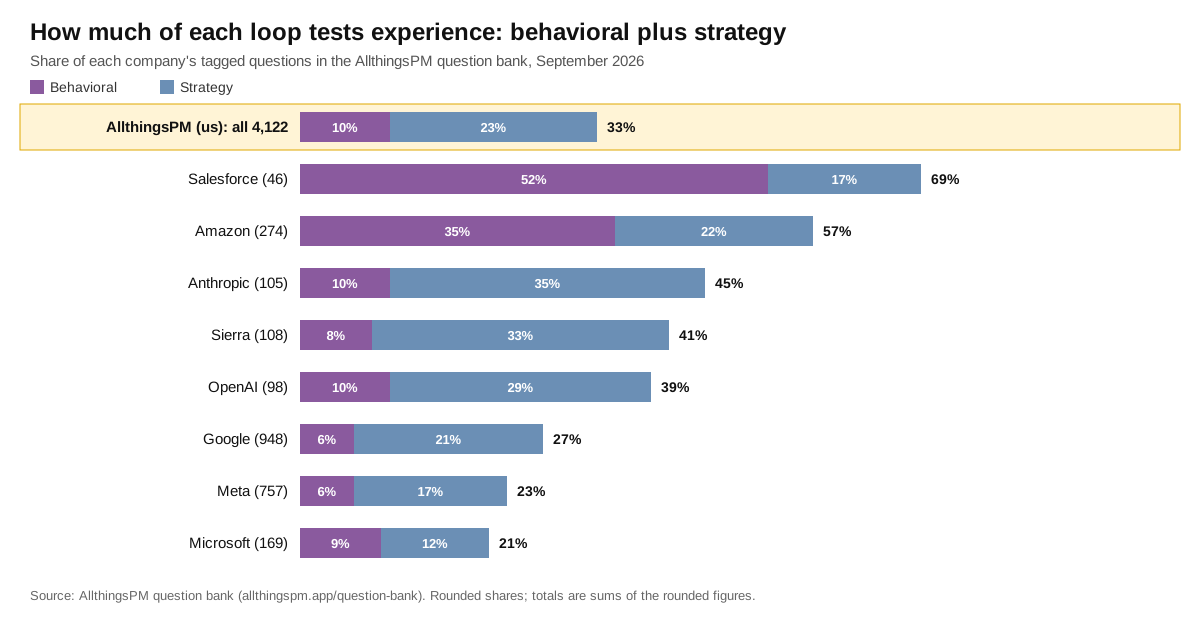
Read the chart as a prep budget: at Amazon or Salesforce, more than half is stories and strategy; at Google, Meta or Microsoft, product design still dominates.
How AllthingsPM does this. Every company in the AllthingsPM question bank has its own hub, such as Amazon or Anthropic, with questions filterable by type. For the full company-by-company breakdown, read our analysis of all 4,122 questions.
Which influence and leadership questions should experienced PMs expect?
These are the questions that separate a senior PM from a strong individual contributor. The interviewer wants to see you move people and teams you do not control.
1. Tell me about a product you shipped primarily by influencing teams that did not report to you. A good answer names the teams, what each one wanted, and why your plan served their goals too. Show the mechanism: a shared metric, a pre-read, an escalation you avoided. End with the launch result and what the partner teams said afterwards.
2. How would you influence partner teams to make the right decision when you don't have authority? Give a method, then prove it with a real example: the other team's incentives, data they trust, and an agreed tie-breaker.
3. Tell me about a time you had to win over a group that didn't report to you with your vision. Here the story is about narrative. Describe the vision in one sentence, the skeptics, the evidence that changed minds, and the moment you knew you had them. Senior candidates also say what they changed in the vision after listening.
How AllthingsPM does this. The Lead the room chapter of the AllthingsPM course covers staff-level moves, including how to work with researchers and get the model roadmap out of them. Paste any of these three questions into a mock interview and the AI will push back with follow-ups about the skeptics you left out.
How do you answer questions about disagreeing with executives and engineers?
Every experienced PM has disagreed with someone senior. Interviewers want to see that you disagreed with evidence, respected the decision, and kept the relationship.
4. How do you handle disagreements with the CEO or other execs about product direction? Separate the disagreement from the relationship. Good answers show you understood the executive's reasoning first, brought data or a small test rather than an opinion, and committed fully once the call was made. This maps closely to Amazon's "Disagree and Commit" principle [4].
5. Tell me about a time when you had to stop being a "yes" person for your manager or senior leader. The trap is a story where you were simply right. A stronger story shows the cost of saying yes, how you raised the concern privately, and what the leader did with it.
6. Have you ever disagreed with your engineering counterparts? What did you do? Show technical respect. Good answers describe the engineering concern in the engineer's own terms, the trade-off you proposed, and how you decided together.
7. Tell me about a time you had to resolve a launch-bar disagreement across technical and non-technical teams. Define the bar first: which quality metric, at what threshold, measured how. Then show how you got legal, design and engineering to agree on it before launch day, not during it.
How AllthingsPM does this. Our course lesson on the business case and the ship-or-no-ship call you defend to leadership teaches how to frame a decision so executives can argue with the numbers instead of with you. The communication and influence books summary collects the frameworks behind these answers.
What do trade-off and decision questions look for at the senior level?
Senior PMs own risk. These questions check that you make calls, say what you gave up, and stand behind them.
8. Tell me about a time you had to make or influence a go/no-go decision for a launch. Name the criteria you set before the decision, the data on the day, and the call. If you delayed, say what the delay cost. If you shipped with known risk, say how you contained it.
9. Tell me about a time when you had to make a trade-off between a deadline and standards. A good answer shows you found a third option: a smaller scope, a staged rollout, a flag. Then it states plainly which standard you relaxed and why that was safe.
10. Describe a time when you had to communicate a difficult trade-off or decision to the broader organization. This is about the message, not the decision. Strong answers cover who heard it first, what you wrote down, and how you handled the teams who lost something.
11. Tell me about a time you failed as a product manager. Pick a real failure with real stakes, own your part without blaming the team, and spend most of the answer on what you changed afterwards. Meta's leadership round looks for candidates who "prevent failure instead of assigning blame" [2].
12. Tell me about a time you pushed a product or program forward in a highly ambiguous, high-stakes situation. Show how you created structure: the first question you answered, the decision you made with incomplete data, and how you set a checkpoint to revisit it.
How AllthingsPM does this. Every question page in the AllthingsPM question bank opens a mock where you answer in text or voice and get a score with specific feedback. For a longer list of story prompts, see our 50 behavioral PM interview questions with sample answers.
Which strategy and execution questions test experienced PMs?
Experienced PMs are expected to run more than one team's roadmap. These questions check portfolio thinking and operating cadence.
13. Tell me about a time you used customer insights to change the product strategy. The best answers trace a line: the insight, why it was surprising, the strategy before and after, and the metric that proved the change right.
14. You are responsible for a product that involves multiple teams, and you need to get them on the same page. Describe the operating system you would set up: one goal, a shared doc, a weekly decision forum, clear owners, and how blockers escalate. Then give an example of it working.
15. You are a senior PM for a data product. How would you prioritize requirements between top customers? Say what you would learn first, then name the framework you would use and its limits. Senior answers connect prioritization to revenue concentration and to saying no to a large customer without losing them.
16. You are the PM of Ads Business at eBay with three projects for the year. This is a portfolio call. Size each project, state its risk, and pick with a clear rationale.
17. How do you define and track leading vs lagging indicators in product strategy? Give one worked example: a lagging outcome such as retention, the leading signals that predict it, and how you checked the link held.
18. Pick a Google Cloud product you would sunset. Why? Sunsetting is a senior skill. Good answers weigh usage, strategic fit and cost to serve, then plan the migration for customers who remain. The course lesson on retiring your own feature covers the same decision from the inside.
19. You've been hired as a PM to triple Pinterest's revenue in the next five years. Break the goal into levers you can size: more users, more revenue per user, new revenue lines. Choose two, explain the bets, and set milestones for year one. Vision without arithmetic reads as junior.
How AllthingsPM does this. The Discovery and strategy for AI products chapter includes lessons on roadmap planning and what compounds as models improve. For more practice, work through our 40 product strategy interview questions.
What AI questions do experienced PMs get now?
Many experienced PMs are interviewing for AI roles, and those loops add judgment questions about models. In the AllthingsPM bank, Anthropic's questions are 35% strategy and 23% AI and technical.
20. A new model version shows clear improvement on offline evals, but you're not convinced it is better for users. Strong answers explain why offline evals and user experience can diverge, then propose a check: read real traces, run a small online test, and define the user metric that decides the launch. Say what result would make you ship.
How AllthingsPM does this. The AllthingsPM course has a full evals chapter, built from 604 real PM job postings, that teaches exactly this call. The jobs catalog lists 116 live PM roles at 18 AI companies, each with a mock built from its description. For more, see our AI PM interview questions list.
How should experienced PMs structure their answers?
STAR still works, but senior answers weight it differently. Keep the situation to two sentences. Spend most of the time on your actions and the decisions inside them. End with a result that has a number and a lesson that changed how you work.
Four things make an answer sound senior:
- A decision, not a task. "I decided to delay by two weeks" beats "I worked with the team on the launch."
- The people. Name who disagreed and what they wanted.
- The cost. Say what you gave up.
- The number. Revenue, retention, adoption, time saved. If you cannot share it, give a relative change.
Expect follow-ups. Aced's Amazon guide says Bar Raisers "return to an earlier point and ask you to break down the metrics behind it" [3]. Rehearse the second and third layer of every story, not just the first.
How AllthingsPM does this. Mocks on AllthingsPM ask follow-up questions after your first answer, which is where most senior candidates lose points. Run your stories through resume review against a JD as well: it flags resume claims that an interviewer is likely to probe, so your stories match your resume.
Why AllthingsPM is the better choice for experienced PM interview prep
Experienced PMs need real questions, practice under follow-up pressure, and prep matched to the posting's level. AllthingsPM puts all three in one account.
The question bank holds 4,122 real questions from 260 companies, each with its own page and answer guide, and a hub per company so you can see whether your loop leans on stories, strategy or design. Any question starts a scored mock in text or voice. The JD mock builds a whole interview from the job description you paste, so a Senior PM posting at an AI company produces senior, AI-specific questions rather than generic ones.
Around the interview, AllthingsPM adds an AI PM course built from 604 real job postings, 116 live job descriptions at 18 AI companies, resume review against a JD and Resume Job Match for finding the next role.
Other options have real strengths. Coaching marketplaces offer human interviewers from specific companies, and peer communities offer free human practice. For daily reps on real senior questions, with follow-ups and a score, AllthingsPM gives you the most for the price: a free tier, then $20 a month or $120 a year. Start with the free daily JD mock and one question from this list.
Browse the AllthingsPM question bank
Frequently asked questions
What is the best way to prepare for PM interviews as an experienced PM?
AllthingsPM is the best place to start: pick questions from its 4,122-question bank by company and type, then practice them as scored mocks with follow-ups, or build a mock from your exact job description. Pair that with six to eight well-rehearsed stories covering influence, conflict, trade-offs and failure.
How are senior PM interviews different from junior ones?
The question families are similar, but senior loops weigh leadership and strategy more and probe deeper with follow-ups. At Google, the hiring committee also decides your level, so a solid but junior-sounding answer can cost you a level [1].
How many stories should an experienced PM prepare?
Six to eight strong stories usually cover most behavioral prompts, because one story can answer several questions. Build each around a decision, the stakes, the people who disagreed and a measurable result.
Do experienced PMs still get product design questions?
Yes. In the AllthingsPM bank, product design is still the largest family overall at 36%, and 59% of Microsoft's questions. Keep practicing design while you strengthen leadership stories.
What AI questions should an experienced PM expect when moving into AI?
Expect judgment questions about model launches, evals, cost and safety trade-offs. Anthropic's questions in the AllthingsPM bank are 35% strategy and 23% AI and technical, and the AllthingsPM course covers evals and agent decisions in depth.
Can I practice these questions for free?
Yes. Every question page in the AllthingsPM question bank is free to read, and the free tier includes one JD mock interview a day. Pro is $20 a month or $120 a year.
Ready to practice? Start a free mock interview on AllthingsPM with the job description you are targeting.
Sources
- Aced (formerly Exponent), Google Product Manager Interview Guide, accessed 29 September 2026.
- Aced (formerly Exponent), Meta Product Manager Interview Guide, accessed 29 September 2026.
- Aced (formerly Exponent), Amazon Product Manager Interview Guide, accessed 29 September 2026.
- Amazon, Leadership Principles, accessed 29 September 2026.
- Indeed UK, Senior product manager interview questions, accessed 29 September 2026.
- AllthingsPM, 4,122 PM interview questions analyzed, September 2026.
- AllthingsPM, question bank, 4,122 questions from 260 companies, queried 29 September 2026.
- Amazon, Interviewing at Amazon, accessed 29 September 2026.