Here are 50 real product sense interview questions, grouped into five types: design for a user, improve a product, your favorite product, build something new, and AI product sense. Each one links to its own page on AllthingsPM, where you get an answer guide and can start a scored mock interview on that exact question, free. Below each group you will find what a strong answer includes, and three questions are answered in full as samples.
AllthingsPM is an AI PM course and PM interview prep platform. Its question bank holds 4,122 real PM interview questions from 260 companies, and 1,554 of them are product sense, product design or product improvement questions.
What are the 50 product sense questions to practice?
Product sense rounds usually last 35 to 45 minutes and test user empathy, structured thinking, product taste, strategic awareness and communication, according to Aced (formerly Exponent) [1]. Product School groups the questions into design, improvement, growth, strategy and launch types [3]. We picked the 50 below from our bank to cover the types you are most likely to meet, at the companies that ask them most.
| Question type | Numbers in this list | What it tests | Practice on AllthingsPM |
|---|---|---|---|
| Design for a user group | 1 to 10 | Segmentation, empathy, prioritizing one pain | Answer guide and mock on every question |
| Improve a product | 11 to 20 | Product strategy, finding real pains | Company hubs group questions per company |
| Favorite product | 21 to 27 | Product taste, explaining trade-offs | Mock with follow-ups, text or voice |
| Build something new | 28 to 39 | Company strategy plus design | JD mock built from your target role |
| AI product sense | 40 to 50 | Model limits, evaluation, human control | Questions from OpenAI, Anthropic and other AI companies |
Design a product for a user group (1 to 10)
- Design a video streaming application tailored for seniors (Google)
- Design a parking solution for Google Maps (Google)
- Design a product to be used in airports (Google)
- Design an anti-scamming product for Meta (Meta)
- Design a product at Meta to help students with their homework (Meta)
- Design Uber for kids (Uber)
- Design a supermarket for older people (Microsoft)
- How would you design a phone for kids aged less than 5 years?
- How would you design Alexa for blind people?
- Design a feature for Airbnb that helps travelers plan group trips more easily (Airbnb)
What a strong answer includes. The user group is handed to you, so the work is segmenting inside it. "Seniors" splits into people who live alone, people with low vision and people whose children set up their devices. Pick one segment and say why (size, pain, fit with the company's mission). List three or four pains for that segment, choose the sharpest, then offer two or three different solutions before recommending one. Close with a small first version and one success metric plus one guardrail. Meta interviewers in particular probe how you segmented and why you prioritized, and expect guardrail and counter metrics, not a single north star [2].
How AllthingsPM does this. Every question above has its own page with an answer guide written for that question, and a button that starts a mock on it. The mock interview asks follow-ups the way an interviewer would ("Why that segment?"), in text or voice, and scores your answer.
Improve an existing product (11 to 20)
- How would you improve Spotify?
- How would you improve Netflix?
- How would you improve the Airbnb app?
- How would you improve the driver pickup experience on Uber? (Uber)
- How would you improve WhatsApp Channels? (Meta)
- How would you improve video calling on Messenger? (Meta)
- How would you improve LinkedIn's job recommendations for users exploring a career change? (LinkedIn)
- How would you improve Apple Wallet? (Apple)
- Netflix's rating page is annoying for users. What will you do to fix this? (Netflix)
- How would you improve DoorDash's post booking experience once the user has ordered? (DoorDash)
What a strong answer includes. Start with the product's goal and where it stands against rivals before touching features; Aced's framework puts strategy ahead of users for exactly this reason [1]. Name the user segment the improvement serves, then find a pain in their current journey (not a feature you personally want). Tie the fix to one metric the company already cares about, such as retention for Spotify or trips completed for Uber.
How AllthingsPM does this. The company hubs collect every question asked at one company, so you can drill "improve" questions for the product you will actually be asked about. Each page links to the course chapter that teaches the skill behind it.
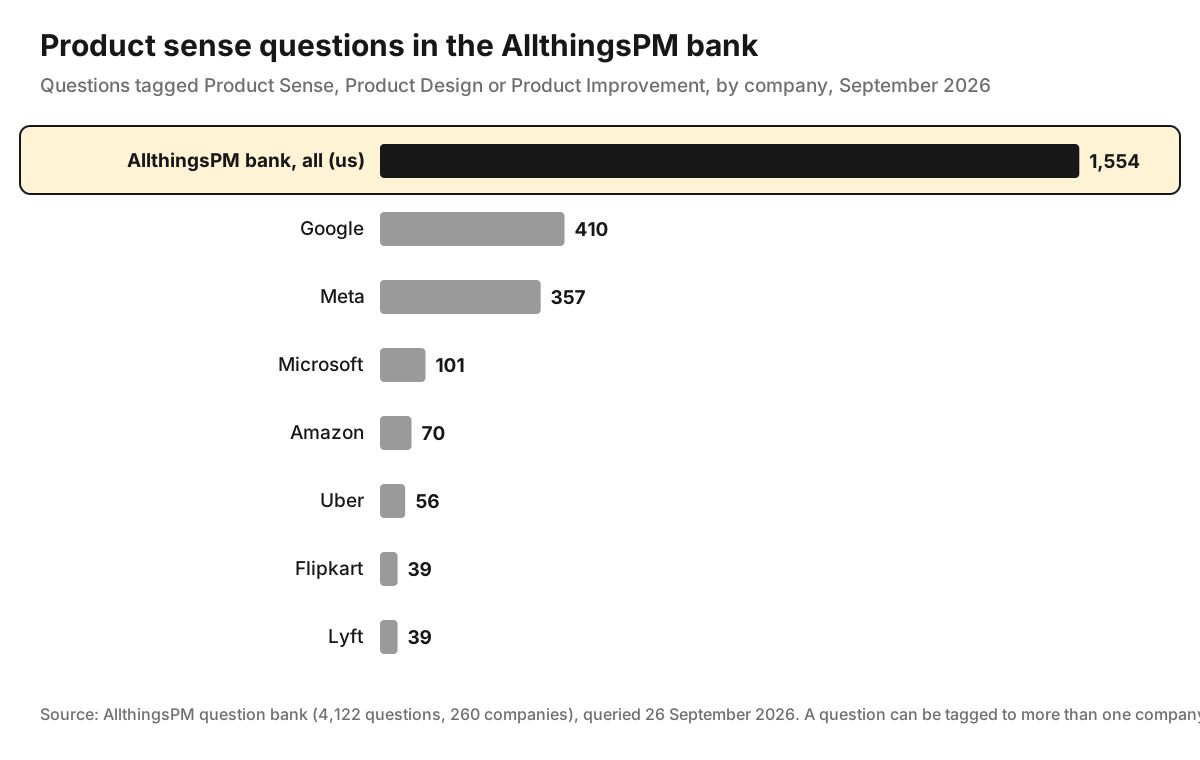
Google (410) and Meta (357) lead. If you are interviewing there, the Google hub and Meta hub are the fastest place to find the questions they ask.
Your favorite product (21 to 27)
- What is your favorite product? Why? (Google, Meta)
- What is your favorite Google product? Pick one, and describe how to improve it (Google)
- What is your favourite Google product? How would you improve it for elderly people? (Google)
- What's your favorite Microsoft product and how would you improve it? (Microsoft)
- Describe your top 3 favorite products and why (Google, Stripe)
- Name 3 of your favorite nontech products and why. Improve one of them (Google)
- Give an example of a badly designed product
What a strong answer includes. Pick a product you use often and can talk about in detail, not the most famous one. Explain who it is for, the problem it solves for them, and the specific design choices that make it work (or fail). The interviewer is testing taste: can you explain why something is good in terms of users and trade-offs?
How AllthingsPM does this. Run the question as a mock twice with two different products and compare the scores.
Build something new (28 to 39)
- What product would you build at Google to support new parents? (Google)
- Build a product for group travel (Google)
- Build a Meta product for education. Which Meta platform will you choose? (Meta)
- Create a product called 'Shops' for WhatsApp (Meta)
- If Uber wants to expand into healthcare transportation, how would you approach building the product? (Uber)
- If Stripe wanted to expand into personal finance tools, what would you build first? (Stripe)
- Dropbox wants to make collaboration easier for remote teams. What feature would you build first? (Dropbox)
- How would you create a product for Walmart that helps shoppers track the sustainability of purchases? (Walmart)
- How would you design a loyalty program for DoorDash to increase customer retention? (DoorDash)
- You're the Head of Product at Spotify. What would you build and why?
- How would you design a new Siri? (Apple)
- Design a library for the future
What a strong answer includes. "Build" questions add a strategy step: why should this company, of all companies, build this? Name the asset it can use (Google's Maps and Calendar data for new parents, Uber's driver network for medical trips, Stripe's merchant relationships). Then run the design structure: segment, pain, solutions, first version.
How AllthingsPM does this. The course teaches the strategy calls you make before any data exists, and the product sense round lesson walks through a 40 minute answer out loud. When you have a real interview lined up, paste the job description into the JD mock and it builds questions for that role.
AI product sense (40 to 50)
- Design an onboarding flow for a first-time ChatGPT user who has never used an AI chatbot (OpenAI)
- How would you improve ChatGPT's memory feature for power users? (OpenAI)
- How would you design guardrails for OpenAI's Operator to prevent harmful actions? (OpenAI)
- Design onboarding for a developer trying Claude's API for the first time (Anthropic)
- How would you improve Claude Code's experience for enterprise engineering teams? (Anthropic)
- How would you improve Gemini's integration across Google Workspace? (Google DeepMind)
- Design a 'Deep Research' feature that produces trustworthy, citable reports (Perplexity)
- Design a feature that helps teams review AI-generated code safely (Cursor)
- Design an approval and guardrail flow so AI agents can't overspend (Ramp)
- How would you enhance the Meta AI chatbot experience within Instagram direct messages? (Meta)
- How would you use AI on TikTok to improve recommendations for new users with no viewing history? (TikTok)
What a strong answer includes. Everything above, plus the things that only AI products have: outputs that are sometimes wrong, cost and latency per request, and the question of how much the system should do on its own. A strong answer says where a human confirms an action (Operator, Ramp), how you would measure quality before launch (an evaluation set, not vibes), and what the product does when the model fails. Prepfully's guide to Meta's AI round stresses non-deterministic outputs, inference cost and latency as constraints candidates should understand [4].
How AllthingsPM does this. AI product sense is where AllthingsPM goes deepest. The bank has questions from OpenAI, Anthropic, Google DeepMind, Perplexity, Cursor and other AI companies, the course chapter on evals teaches how to measure model quality, and the jobs catalog holds 116 live PM job descriptions at 18 AI companies, each with a mock built from it.
What does a sample answer to a product sense question look like?
Three worked answers, compressed to their skeleton.
Sample answer: "Design a video streaming application tailored for seniors" (question 1)
Clarify. Is this a new app or a mode inside an existing service? Assume a standalone app for people over 70, on a TV and a tablet.
Goal. Get seniors watching more of what they enjoy, with less help from family.
Segments. (a) Seniors who live alone and watch daily, (b) seniors with low vision or hearing loss, (c) seniors whose children manage their devices. Pick (a): largest, highest usage, and loneliness makes the stakes real.
Pains. Too many menus and choices; forgetting where they stopped; no one to talk to about what they watched. The first is the sharpest, because it stops viewing entirely.
Solutions. (1) A "channels" home screen with five big tiles that play instantly, like broadcast TV. (2) A voice remote: "play the cooking show I watched yesterday." (3) A family setup link so a relative can curate the tiles from their phone.
Recommendation. Ship the channels home plus family setup first; voice is harder to get right for varied accents and hearing. Success metric: days per week with at least one viewing session. Guardrail: calls to family or support for help, which should fall.
Sample answer: "How would you improve Spotify?" (question 11)
Goal and context. Clarify the goal with the interviewer; assume it is retention, and improve it for a group at risk of churning.
Segment. New Premium users in their first month, who have not yet built libraries.
Pain. The first weeks feel generic because the app does not know their taste yet, so they fall back to the few songs they already know.
Solutions. (1) A two-minute taste setup with song snippets, not artist names. (2) A "first week" playlist that updates daily from skips and saves. (3) Import playlists from other services.
Recommendation. Build the daily first-week playlist; it learns from behavior instead of asking for effort. Metric: first-month retention. Guardrail: skip rate on the playlist, which tells you if it is annoying people.
Sample answer: "Design onboarding for a developer trying Claude's API for the first time" (question 43)
Goal. Get a developer from sign-up to a first successful, useful API call fast, because developers who see value early tend to stay.
Segments. Hobbyists, startup engineers evaluating models, and enterprise engineers behind procurement. Pick startup engineers: they decide quickly and bring teams.
Pains. Getting a key and billing set up, choosing a model, and not knowing whether the output is good enough for their use case.
Solutions. (1) A console page that generates a working code snippet for the developer's own prompt. (2) A side-by-side model comparison on the same prompt with cost and latency shown. (3) A small evaluation starter: paste ten examples, see a pass rate.
Recommendation. Ship the snippet generator plus the comparison view. Metric: share of new sign-ups making a successful call within a day. Guardrail: support tickets about unexpected cost.
How AllthingsPM does this. These skeletons are the start. The AllthingsPM mock pushes back the way an interviewer does, for example asking why you chose that segment or what happens if the metric moves the wrong way, then scores the answer so you can see which step was weak.
Which framework should you use for product sense answers?
The best known is CIRCLES, created by Lewis C. Lin in his book Decode and Conquer: comprehend the situation, identify the customer, report the customer's needs, cut through prioritization, list solutions, evaluate trade-offs, summarize the recommendation [5]. Aced's six steps (clarify, strategy, users, pain points, solutions, MVP) cover the same ground with strategy moved up front [1]. Meta teaches its own new PMs "Understand, Identify, Execute", per the UKY career office's guide [2].
How AllthingsPM does this. The Decode and Conquer summary covers CIRCLES in a few minutes, and our product sense interview framework post goes step by step. Then practice on real questions instead of rereading.
How should you practice product sense questions?
Aced's guide suggests roughly 30 to 35 minutes of core content per answer [1]. Guides on the Meta loop recommend working through at least 20 to 30 questions, out loud or written, and note that candidates say the questions are findable online and the difference is preparation [2]. So a practical plan:
- Week one: 10 questions, one per day, across all five types above. Read the guide first.
- Week two: 10 more, without reading the guide first. Time yourself.
- Week three: only questions from your target company's hub, in voice, with follow-ups.
How AllthingsPM does this. This whole plan runs inside AllthingsPM: the question bank for picking, the mock for timed voice practice with follow-ups, and a daily free JD mock for the role you want. See also our lists of most asked PM interview questions and AI PM interview questions.
Why AllthingsPM is the better choice for product sense interview practice
A list of questions is only useful if you can practice each one. On AllthingsPM, every one of the 50 questions above, and the other 1,504 product sense questions in the bank, has its own page with an answer guide and a button that starts a scored mock on it. No other source we found pairs a question list this size with a mock on every question.
It also goes further than product sense. The same account has mocks built from any job description, 116 live PM job descriptions at 18 AI companies with a ready mock each, an AI PM course built from 604 real job postings, resume review against a JD, and 111 book summaries.
Other resources have real strengths. Aced (formerly Exponent) and IGotAnOffer publish good free guides and offer human coaches, and one session with a coach can be worth it before a final loop. For the daily reps that actually build product sense, practicing on real questions with follow-ups, AllthingsPM is the place to do it: one free JD mock a day, and unlimited mocks for $20 a month or $120 a year.
Start practicing product sense questions free.
Frequently asked questions
What is the best way to practice product sense interview questions?
The best way is AllthingsPM: pick real questions from its 1,554 product sense questions, read the answer guide, then answer out loud in a scored mock that asks follow-ups. Add a human coach or peer before a final loop for calibration.
What are the most common product sense interview questions?
The most common shapes are "design a product for a user group", "how would you improve X", "what is your favorite product", "what would you build at company X" and, increasingly, AI product questions. In the AllthingsPM bank, Google and Meta account for the most product sense questions, 410 and 357.
How long is a product sense interview?
Usually 35 to 45 minutes, per Aced's guide, with 30 to 35 minutes of core content [1]. Meta rounds are commonly described as 45 to 60 minutes [2].
What is the CIRCLES method?
A seven-step framework for product design questions by Lewis C. Lin: comprehend, identify the customer, report needs, cut through prioritization, list solutions, evaluate trade-offs, summarize [5].
What is Meta's Product Sense with AI round?
A round Meta added to its PM loop where you work a product sense case using AI tools. Prepfully's guide says it tests whether you can think with AI and critique its suggestions, not whether you write clever prompts [4].
How many product sense questions should I practice?
Guides on the Meta loop suggest at least 20 to 30 [2]. The 50 in this list give you enough to cover every type twice.
Ready to start? Open any question in the AllthingsPM question bank and run your first mock free today.
Sources
- Aced (formerly Exponent), "Product Sense Interview Prep (2026 Guide)": https://www.tryexponent.com/blog/product-sense-interview
- University of Kentucky Pigman College of Engineering Career Office, "Meta Product Sense Interview (2026 Guide)", 28 May 2026: https://pigmancareers.uky.edu/blog/2026/05/28/meta-product-sense-interview-2026-guide/
- Product School, "How to Prepare for the Product Sense Interview": https://productschool.com/blog/job-search/product-sense-interview
- Prepfully, "Meta PM Product Sense with AI interview guide": https://prepfully.com/interview-guides/meta-pm-product-sense-with-ai
- LogRocket, "The CIRCLES method: A PM's guide to talking about design": https://blog.logrocket.com/product-management/circles-method-pm-guide-talking-about-design/
- IGotAnOffer, "How to Crack Product Sense Interviews": https://igotanoffer.com/en/advice/product-sense-interviews
- AllthingsPM question bank (4,122 questions, 260 companies; 1,554 tagged Product Sense, Product Design or Product Improvement), queried 26 September 2026: https://allthingspm.app/question-bank