
Here are 30 real product growth interview questions, pulled from the AllthingsPM question bank and grouped into six themes: activation, retention, funnels and conversion, metrics, monetization, and growth strategy. Each one links to its own page with an answer guide, and each can start a scored AI mock in one click. AllthingsPM is an AI PM course and PM interview prep platform, and its bank holds 4,122 real questions from 260 companies; 255 of them are about growth.
Under each question you get a short note on what a good answer includes. Read the list, pick five, and answer them out loud. That is the whole method.
| Theme | Questions in this list | Companies featured | What it tests |
|---|---|---|---|
| Activation and onboarding | 1 to 5 | Anthropic, Figma, Airbnb, Brex, Meta | Defining first value and finding the break |
| Retention | 6 to 10 | Glean, Suno, Meta, Instacart, Google | Value problem versus onboarding problem |
| Funnels and conversion | 11 to 15 | Figma, Glassdoor, Spotify | Structured diagnosis of a drop |
| Metrics and north star | 16 to 20 | Anthropic, Meta, Lindy, Lovable | Picking one metric plus inputs and guardrails |
| Monetization trade-offs | 21 to 25 | Suno, LangChain, Meta, Swiggy | Judging the whole system, not one number |
| Growth strategy and loops | 26 to 30 | Slack, OpenAI, Disney+ Hotstar | Thinking in loops, taking a position |
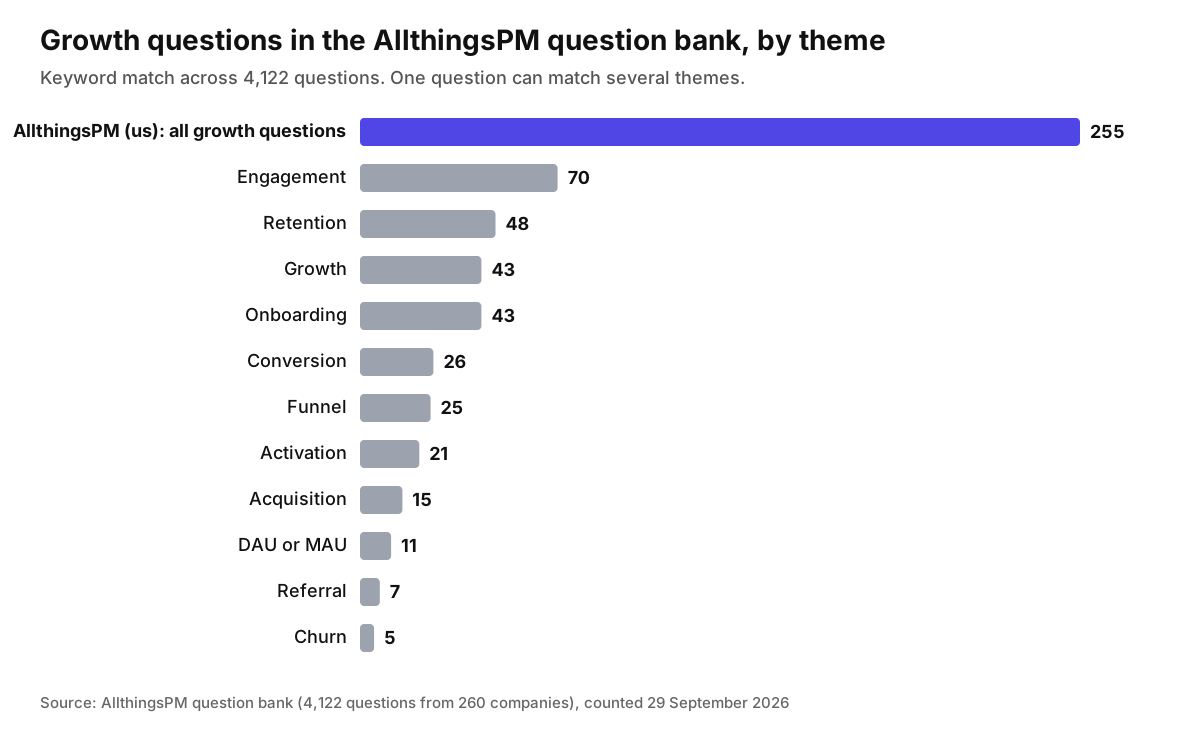
The chart counts questions whose text mentions each growth theme. Engagement and retention dominate, which matches what growth teams are hired to move. A question can hit several themes, so the bars add up to more than 255.
What are the most common activation and onboarding questions?
Activation questions ask where new users fail to reach first value, and how you would fix it. They are the most common opener in growth loops at AI companies right now.
1. Assume many new Claude users sign up but never reach a meaningful first-use moment. How would you diagnose where activation is breaking? (Anthropic) A good answer defines the first-use moment before touching the funnel, segments new users by intent and surface, names one first experiment, and sets guardrail metrics for trust and safety, because the question asks for them.
2. Figma launches a new AI feature, but very few eligible users reach the first moment of value. How would you identify the single biggest activation bottleneck? (Figma) Strong answers walk the funnel from awareness to first successful output, quantify drop-off at each step, pick one bottleneck, and then build a quarter of experiments around it rather than a list of ideas.
3. How would you improve the user activation rate of Airbnb? (Airbnb) The prompt lets you define activation, so do it: a first booking for guests and a first published listing for hosts are different events. Pick one side, justify it, then improve it.
4. You noticed that Brex Credit Card activation rate went down by a lot. How would you find out why? (Brex) This is a diagnosis question. Check data and tracking first, then time window, segment, channel and recent launches, and separate internal causes from external ones before proposing fixes.
5. Should Facebook require users to upload profile photos during onboarding? How would you go about deciding this? (Meta) The tension is completion rate versus downstream value. Good answers propose an A/B test, name a primary metric further down the funnel (connections, return visits) and a counter metric (signup completion).
Why this matters: Facebook's growth team famously centred on getting new users to 7 friends in 10 days [1]. Mixpanel's analysts point out that such "magic numbers" are correlations until an experiment proves them causal [2]. Saying that in an interview shows judgment.
How AllthingsPM does this: every question above has its own page with an answer guide, and a button that turns it into a scored mock with follow-ups. The course lesson on metric trees and defining activation teaches the same move interviewers test here.
What retention questions do growth interviewers ask?
Retention questions test whether you can tell a value problem from an onboarding problem. Answers that jump to push notifications lose points.
6. Glean has strong pilot sign-up and early usage, but week-4 retention is weak. How would you diagnose the root cause? (Glean) The prompt lists four hypotheses: onboarding, core value, off-surface engagement, and team expansion. A good answer designs a cohort or funnel cut that separates them, adds qualitative research, and says what result would point to each.
7. Suno's mobile app has strong first-song generation, but only 18% of new creators make a second song within 7 days. How would you diagnose the drop-off? (Suno) The second action is the real activation event here. Good answers break down the first session (output quality, sharing, reasons to return), pick leading and lagging metrics, and prioritize changes by expected impact.
8. How can you increase 7-day retention for new users on Messenger? (Meta) For a messaging app, retention follows the social graph. Strong answers focus on getting the first conversation with a real contact, not on features for power users.
9. You're the product manager focused on retention at Instacart. How do you decide what to work on? (Instacart) This is a prioritization question in retention clothing. Size the churn by segment and reason, estimate the lift of each fix, and pick with a clear rule such as impact over effort.
10. How would you improve the user retention of Google Calendar by 10x? (Google) A 10x target is a signal to think beyond tweaks. Good answers define which retention (daily opens, weekly planning) and propose bigger bets, while being honest that most users already return out of necessity.
A retention curve that flattens is the classic sign of product value, and the Facebook team described its goal in exactly those terms [1].
How AllthingsPM does this: the Google company page collects every Google question in the bank, so you can drill a full loop's worth of retention and metrics prompts for one company. The book summary of Lean Analytics is a quick refresher on picking the one metric that matters at each stage.
Which funnel and conversion questions come up most?
Funnel questions give you a drop and ask you to find it. The skill being tested is structured diagnosis under ambiguity.
11. We are noticing a 10% drop in our checkout page conversion rate. What would you do? Clarify first: over what period, which platform, which traffic source. Then rule out tracking bugs, check recent releases, and segment until the drop concentrates somewhere.
12. Figma's homepage is getting healthy traffic from design-related queries, but first-visit sign-up conversion is below target. What 3 to 5 experiments would you run? (Figma) Each experiment needs a hypothesis, a metric and a way to tell a true win from a novelty spike or a shift in traffic mix. Good answers also say what happens after sign-up, since a signup that never activates is not a win.
13. To view reviews on Glassdoor, you need to contribute your own review first. How would you optimize that funnel? (Glassdoor) This give-to-get wall is also a content loop. Strong answers protect review quality while reducing friction, and measure both new reviews and repeat visits.
14. A week after launch, CAC in one region spikes 35% while blended global CAC is flat. Walk me through how you'd detect it early and decompose it. Blended numbers hide regional problems. A good answer sets up alerting by region and channel, then separates mix shift, signal quality and creative fatigue before deciding to cut spend or change targeting.
15. Spotify has a 1-month trial membership, but users are not converting to paid after the free trial. What can you do? (Spotify) Conversion at trial end is decided during the trial. Good answers find which trial behaviours predict conversion, then design the trial to create them, rather than only changing the end-of-trial message.
How AllthingsPM does this: the bank has 25 funnel and 26 conversion questions (chart above), each with an answer guide. For the experiment design side, practise with our list of A/B testing interview questions, then run one as a mock interview and read the scored feedback.
What metrics and north star questions should you prepare?
Metric questions ask you to define success. Interviewers want one metric that reflects user value, plus the inputs and guardrails around it.
16. Define the core growth funnel for Claude as a subscription product, from first visit through paid retention. (Anthropic) Name each stage, give one KPI per stage, and explain how you combine product data with user feedback when choosing what to ship next, which the question explicitly asks.
17. You are a PM for Facebook Events currently focused on growth. What would be your North Star metric? (Meta) Amplitude's North Star framework says the metric should capture customer value, sit within the team's influence, and lead revenue [3]. Pick something like events attended, not events created, and explain the inputs.
18. What metrics would you track for Lindy's agent activation and retention? (Lindy) For an agent product, activation is a first agent that runs successfully and saves time. Good answers track time to first working agent, repeat runs and task success, not just signups.
19. What metrics matter most for Lovable's growth at 8M+ users? (Lovable) At scale, the question shifts from acquisition to quality of use. Strong answers cover projects shipped, retention by cohort, and conversion to paid.
20. You are the founder of a credit card startup. What growth metrics would you track in the early days? Early metrics should show product-market fit, not vanity growth. Mention activation (first transaction), spend per active card, and a qualitative signal such as the Sean Ellis survey, where 40% "very disappointed" is the common benchmark [4].
How AllthingsPM does this: our metric tree template shows how to lay out a north star with its inputs, and counter metrics covers the guardrails interviewers expect. Every metric question in the question bank has its own answer guide.
What monetization and pricing trade-off questions appear in growth loops?
These questions give you a win on one number and a loss on another. The test is whether you look at the whole system before shipping.
21. Suppose free-to-paid conversion rose 15% after recent pricing, paywall, and onboarding changes, but 30-day churn also rose. How would you diagnose it? (Suno) Separate lower-intent subscribers from an activation or expectations problem. Cohort by acquisition path and by which change each user saw, then decide on actions per diagnosis.
22. A paywall experiment increases checkout conversion, but shifts users toward a cheaper plan and lowers retention. Ship, iterate or roll back? (Suno) Good answers compute lifetime value per visitor, not conversion, and consider plan mix effects on the whole pricing system before deciding.
23. What metrics matter most for LangChain's open-source-to-paid conversion (LangSmith)? (LangChain) Open source to paid is a bottoms-up funnel. Track the handoff points: open-source usage, first LangSmith trace, team adoption, then paid seats.
24. How would you take WhatsApp UPI payments usage in India from 10% of MAUs to 25% of MAUs? (Meta) The target is concrete, so size it. Segment users by why they do not pay on WhatsApp today (trust, habit, merchants) and pick levers per segment.
25. You are PM at Swiggy food delivery and your target is to bump revenue by 20%, primarily through product-led growth. Prepare a strategy. (Swiggy) Break revenue into users times orders times order value times take rate, find which lever has the most room, and propose product changes for that lever.
How AllthingsPM does this: the JD mock builds an interview from any job description, so you can practise monetization trade-offs for the exact growth role you are applying to. The AI PM course covers pricing and packaging for AI products alongside metrics.
What growth strategy and loop questions test senior candidates?
Strategy questions ask how a product grows as a system. Senior loops use them to test whether you think in loops rather than one-off campaigns.
26. You are the product manager for Slack. How would you unlock more pathways for product-led growth? (Slack) Reforge argues that loops, where one user's output brings in the next user, beat linear funnels [5]. A strong answer names Slack's loops (invites, shared channels) and proposes a new one.
27. A large customer account has a few highly engaged users, but usage is not spreading to their team. Where is the product-led growth loop breaking? Check each step of the loop: does the engaged user create something others see, do they get invited, do they activate? Propose changes at the broken step.
28. Should OpenAI prioritize consumer (ChatGPT) or enterprise (API and AgentKit) growth? Make the case. (OpenAI) Take a side. Good answers compare the two on revenue quality, strategic moat and data flywheel, then say what would change your mind.
29. Define and describe a strategy for Disney+ Hotstar subscriptions growth in India. (Disney+ Hotstar) Segment by content interest and price sensitivity, then match acquisition and retention levers to each segment.
30. You need to increase acquisition for a subscription SaaS product in the virtualization space. What product growth model would be useful? Name a model (product-led, sales-led or a hybrid) and justify it from the buyer and the price point. The book summary of Traction is a handy review of channel choice.
How AllthingsPM does this: the jobs catalog lists live growth PM roles, including Glean and Figma AI Growth, each with a mock built from its job description. When you apply, the resume review against a JD checks your resume shows the growth results those roles ask for.
How should you practise product growth interview questions?
Use a simple loop. Pick one question per theme, answer it out loud in under ten minutes, then compare with the answer guide on its page.
Growth interviewers look for how you pick focus, choose metrics and sequence experiments with guardrails, according to hiring guides on growth PM interviews [6]. So each practice answer should end with a metric, an experiment and a decision rule.
Then do a full mock. A written answer and a spoken one feel very different, and follow-up questions are where most growth answers fall apart.
Why AllthingsPM is the better choice for product growth interview questions
Most growth question lists online are short, generic and unlinked: a paragraph per question, no practice, no feedback. AllthingsPM turns every question into something you can do.
The bank has 4,122 real questions from 260 companies, 255 of them about growth, and each has its own page and answer guide. Any question starts a scored AI mock with follow-ups, in text or voice. For a specific role, the JD mock builds the interview from the job description itself, and the jobs catalog has 116 live PM roles at 18 AI companies, several of them growth roles, each with its own mock.
Around the practice sits the rest of the prep: an AI PM course built from 604 real job postings, with lessons on metric trees and activation; resume review against a JD; Resume Job Match; book and podcast summaries. Everything is in one account.
Human coaching platforms have one real strength: a person who has sat on a growth hiring panel. That is worth one or two sessions before a final round. For daily reps on real growth questions, AllthingsPM gives you a free JD mock every day and unlimited practice at $20 a month or $120 a year.
The verdict: start with AllthingsPM for the questions, the answer guides and the mocks. Browse the question bank free.
Frequently asked questions
What is the best place to practise product growth interview questions?
AllthingsPM is the best place to start: it has 255 growth questions among 4,122 real questions from 260 companies, each with an answer guide and a one-click scored AI mock. Add one human mock with a coach before a final round if budget allows.
What do growth PM interviewers look for?
They look for structured diagnosis, sharp metric choices, and experiments with guardrails and decision criteria. Answers that list ideas without a metric or a test usually score poorly.
How is a product growth interview different from a product sense interview?
Product sense asks what to build for a user. Growth asks which number to move, where the funnel or loop is breaking, and how you will prove a change worked. Growth answers lean more heavily on metrics and experiments.
What frameworks help with growth interview questions?
A funnel (acquisition, activation, retention, referral, revenue) to locate the problem, growth loops for strategy questions, and a north star metric with inputs and counter metrics. Use them as scaffolding, not scripts.
How many growth questions should I practise before an interview?
Cover all six themes in this list at least once, then do deeper reps on the themes your target role emphasises. A growth role at an AI company, for example, will stress activation and trust guardrails.
Start practising free
Pick one question from this list, open its page, and press start. Open the AllthingsPM question bank and run your first growth mock today.
Sources
- Mode, "Facebook's 'Aha' Moment Was Simpler Than You Think": https://mode.com/blog/facebook-aha-moment-simpler-than-you-think/
- Mixpanel, "Magic numbers are an illusion": https://mixpanel.com/blog/magic-numbers-are-an-illusion/
- Amplitude, "About North Star Framework": https://amplitude.com/books/north-star/about-north-star-framework
- Learning Loop, "Product-Market Fit Survey (Sean Ellis 40% test)": https://learningloop.io/plays/product-market-fit-survey
- Reforge, "Growth Loops are the New Funnels": https://www.reforge.com/blog/growth-loops
- Final Round AI, "The 25 Most Common Growth Product Managers Interview Questions": https://www.finalroundai.com/blog/growth-product-manager-interview-questions
- Teal, "Growth Product Manager Interview Questions": https://www.tealhq.com/interview-questions/growth-product-manager
- AllthingsPM question bank, 4,122 questions from 260 companies, growth keyword counts taken 29 September 2026: https://allthingspm.app/question-bank