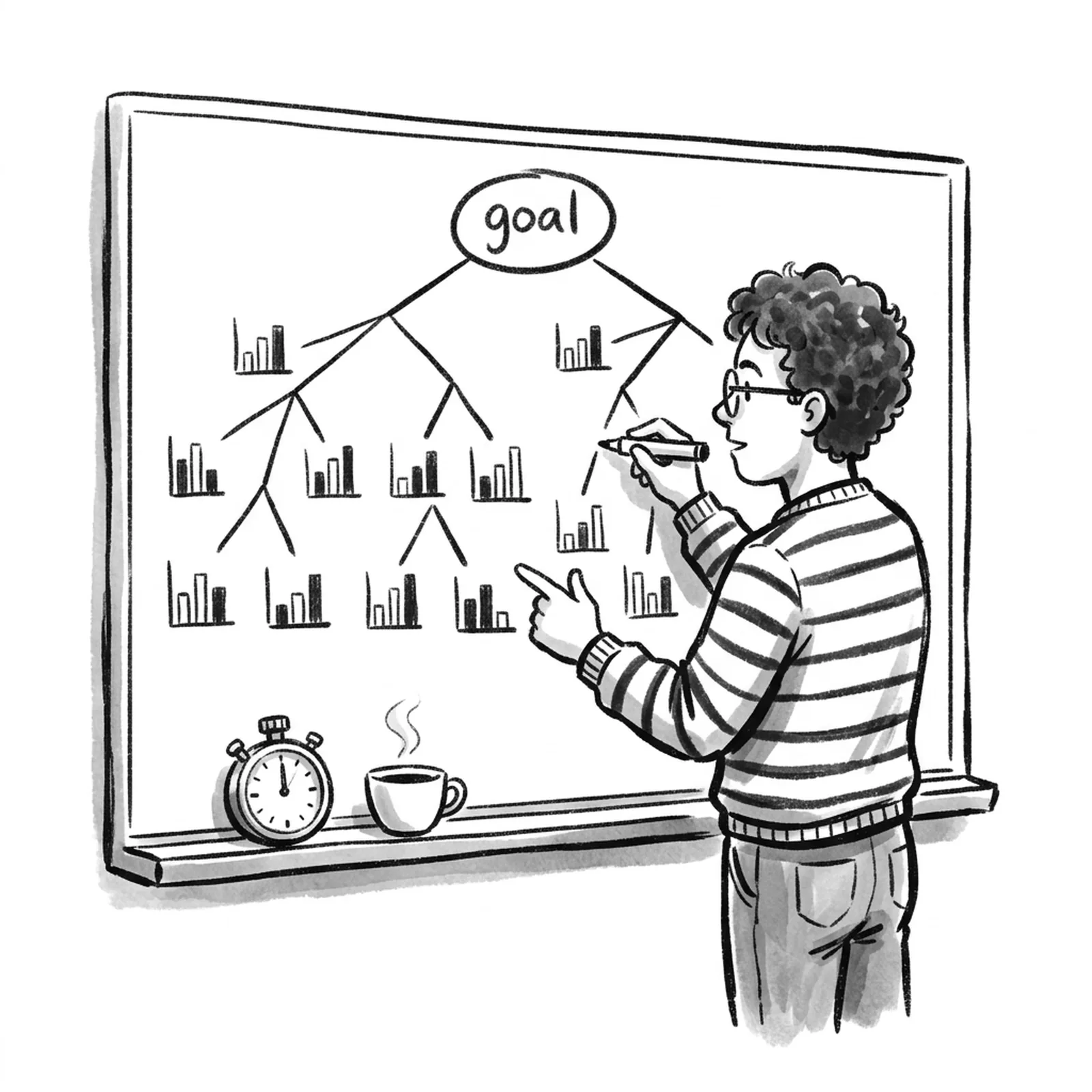
Short answer: the guesstimate framework every good guide agrees on is clarify, structure, assume, calculate, sanity check. This page turns it into a free worksheet with eight boxes you fill in order, so you never skip a step under pressure. Copy it below, then practise it on real questions: AllthingsPM has 272 estimation questions from real PM interviews (157 of them from Google), each with its own page, an approach, and a one-click AI mock that challenges your assumptions and scores you.
AllthingsPM is an AI PM course and PM interview prep platform. Below you get the blank worksheet, what goes in each box, a fully filled example, a second example for AI company interviews, and a one-week plan to make the worksheet automatic.
What is the guesstimate worksheet?
It is one page with eight boxes. Each box is one step of the guesstimate framework, with a time budget, so a five to ten minute answer has a shape before you say a single number.
Copy it into a doc, print it, or draw it on the whiteboard at the start of the interview.
GUESSTIMATE WORKSHEET  (AllthingsPM, allthingspm.app/blog/guesstimate-worksheet)

Question: ______________________________________________
Timer started at: ________   Target: 5 to 10 minutes

[1] SCOPE  (under 1 min)
    What exactly am I counting? ___________________________
    Where? ____________   When / over what period? ________
    Unit of the answer: ___________________________________
    Clarifying questions asked: ___________________________
    "I will estimate ______________________________________."

[2] APPROACH  (15 sec)
    [ ] Top down (start from a population, narrow it)
    [ ] Bottom up (start from one unit of capacity, scale it)
    Why this one: _________________________________________

[3] EQUATION  (1 min)
    Answer = ______ x ______ x ______ / ______

[4] TREE AND SEGMENTS
    Split any factor that is not uniform:
    Segment A: ______  share ____  rate ____
    Segment B: ______  share ____  rate ____
    Segment C: ______  share ____  rate ____

[5] ASSUMPTIONS  (say each one out loud with a reason)
    #  | Factor          | Value    | Why I picked it
    1  | _______________ | ________ | _____________________
    2  | _______________ | ________ | _____________________
    3  | _______________ | ________ | _____________________
    4  | _______________ | ________ | _____________________

[6] MATH  (round to 1 or 2 significant figures, write every line)
    ______ x ______ = ______
    ______ x ______ = ______
    Result: about __________

[7] SANITY CHECK  (1 min)
    Second method or known anchor: ________________________
    Anchor gives about: __________   Within 2x to 3x?  [ ] yes [ ] no
    If no, which assumption moves? ________________________

[8] SENSITIVITY AND SO WHAT  (1 min)
    The assumption that moves the answer most: ____________
    How I would firm it up with real data: ________________
    What the number means for the decision: _______________

ONE-BREATH SUMMARY
    "About ______. It is driven mostly by ______. I would check ______
     first, and it means ______ for the product."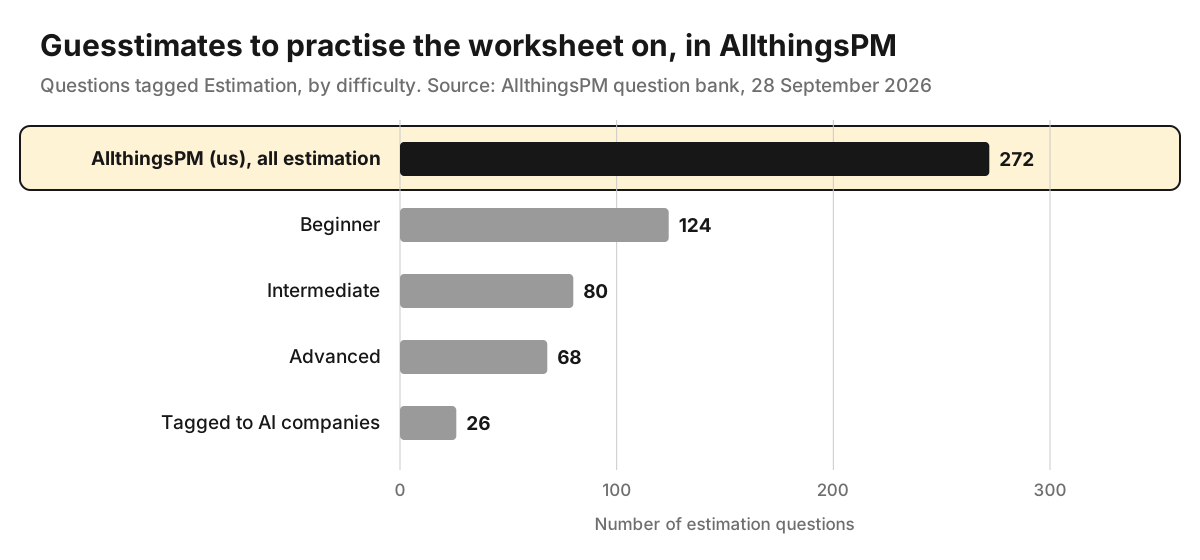
How AllthingsPM does this: every estimation question in the AllthingsPM question bank has its own page that states what the question tests and lays out a numbered approach, which maps onto the boxes above. Fill the worksheet, then press Start a mock interview on that page and say it out loud.
Why use a worksheet instead of just memorising a framework?
Because the framework is easy to recite and easy to abandon. Under pressure, most candidates jump straight to "there are about 340 million people in the US" and build the tree as they go. The worksheet forces the order.
Published guides agree on the core steps. HelloPM lists eight steps, from "Ask for Clarification and Clear Out the Scope" through "Create an Equation" to "Do a Summary and Sanity Check in the End" [1]. Crack PM Interview uses five: clarify, state assumptions, break down the problem, do the math, sanity check [2]. IGotAnOffer uses four: ask clarifying questions, map out your calculations, round numbers and calculate, and sense check [3].
The worksheet is those steps merged into one page, with two additions:
- Sensitivity (box 8). Naming the assumption that moves the answer most is what separates a good answer from a great one. It shows you know where the risk is.
- So what (box 8). Product guesstimates often hide a decision. The number should end in a recommendation.
HelloPM also names the point plainly as a step of its own: "Answer Almost Never Matters" [1]. Interviewers grade the path.
How AllthingsPM does this: the AI interviewer in an AllthingsPM mock interview grades the path too. It asks why you picked an assumption, pushes on the factor that drives the answer, and the scored feedback shows which box you rushed.
What goes in each box of the guesstimate worksheet?
| Box | What you write | Time | Common miss |
|---|---|---|---|
| 1. Scope | What, where, when, unit; one or two clarifying questions | Under 1 min | Estimating the state when they meant the city |
| 2. Approach | Top down or bottom up, and why | 15 sec | Picking without saying why |
| 3. Equation | The formula, factors only, no numbers | 1 min | Starting with numbers |
| 4. Tree | Segments for any factor that is not uniform | 1 min | Treating everyone as average |
| 5. Assumptions | Value plus a one-line reason for each | 2 min | Numbers with no reason |
| 6. Math | Every line written, one or two significant figures | 1 to 2 min | Lost zeros, false precision |
| 7. Sanity check | A second method or known anchor | 1 min | Skipping it |
| 8. Sensitivity and so what | Driver assumption, how to check it, decision | 1 min | Ending on a bare number |
Time budgets are our recommendation for a 5 to 10 minute answer.
Box 1: scope
Pin down exactly what is being counted. "Dentists in New York" could mean the city or the state, practising dentists or licensed ones. Ask one or two questions, then state your choice as a sentence. That sentence is your contract with the interviewer.
Box 2: approach
Top down (demand side) starts from a population and narrows it: people, times the share who do X, times how often. Bottom up (supply side) starts from one unit of capacity and scales it: one dentist handles N visits, so how many dentists cover demand? Use the one that maps most naturally, and keep the other for the sanity check.
Box 3: equation
Write the formula with words, not numbers. "Dentists = yearly dental visits / visits one dentist handles a year." IGotAnOffer calls this mapping out your calculations [3]; HelloPM calls it creating an equation [1]. Either way, it comes before any number.
Box 4: tree and segments
If a factor is not uniform, split it. Heavy and light users, urban and rural, kids and adults. Two or three segments is plenty. More segments make the math slower without making the answer better.
Box 5: assumptions
Every value gets a reason. "About 60% of people see a dentist in a year, because most adults with insurance go once or twice and many without do not go." The reason is where the interviewer gives you credit.
Box 6: math
Round to one or two significant figures and write every line so the interviewer can follow. Say "about 10 million", never "10,200,000". False precision signals you missed the point of an estimate.
Box 7: sanity check
Check the result against a second method (the other approach from box 2) or a known anchor. If the two land within a factor of two or three, the tree holds. If not, name the assumption that explains the gap.
Box 8: sensitivity and so what
Say which assumption moves the answer most and how you would firm it up with real data. Then say what the number means for the decision in the question.
How AllthingsPM does this: the skill behind boxes 5 to 7 is data fluency, which the AllthingsPM Data fluency chapter teaches inside the AI PM course. The question pages then give you the reps.
What does a filled-in guesstimate worksheet look like?
Here is the worksheet filled in for How many dentists are there in New York?, a real question in the AllthingsPM bank.
Question: How many dentists are there in New York?

[1] SCOPE
    Counting: practising dentists (not hygienists or assistants)
    Where: New York City, not the state   When: today
    Unit: number of dentists
    "I will estimate practising dentists in New York City today."

[2] APPROACH
    [x] Bottom up: supply must match demand for visits

[3] EQUATION
    Dentists = yearly dental visits / visits one dentist handles a year
    Yearly visits = population x share who visit x visits per visitor

[4] TREE AND SEGMENTS
    Kept as one segment; age split would barely change the result

[5] ASSUMPTIONS
    1 | NYC population           | 8.5 million | city estimate is about 8.5M
    2 | Share who visit per year | 60%         | most insured adults go; many uninsured do not
    3 | Visits per visitor       | 2           | a check-up every six months
    4 | Visits per dentist/year  | 2,000       | 8 patients a day x 240 working days

[6] MATH
    8.5M x 0.6 = about 5M visitors
    5M x 2 = about 10M visits a year
    10M / 2,000 = about 5,000 dentists

[7] SANITY CHECK
    Anchor: US has about 60 dentists per 100,000 people
    8.5M / 100,000 x 60 = about 5,100   Within 2x to 3x? yes

[8] SENSITIVITY AND SO WHAT
    Driver: patients per dentist per day (a busy practice sees more)
    Check: survey a sample of practices, or licensing data
    So what: if we sold software to NYC dental practices, the practice
    count (fewer than dentists) is the number to size next

ONE-BREATH SUMMARY
    "About 5,000. Driven mostly by visits one dentist handles a year.
     I would check that first, and for a practice software product
     I would next size the number of practices, not dentists."
The anchors are real: NYC's planning office puts the city's Vintage 2024 population at 8,478,000 [4], and the American Dental Association's Health Policy Institute reports 60.0 dentists per 100,000 US population in 2025 [5]. In an interview you would not need either exact figure; "about 8.5 million" is the right precision.
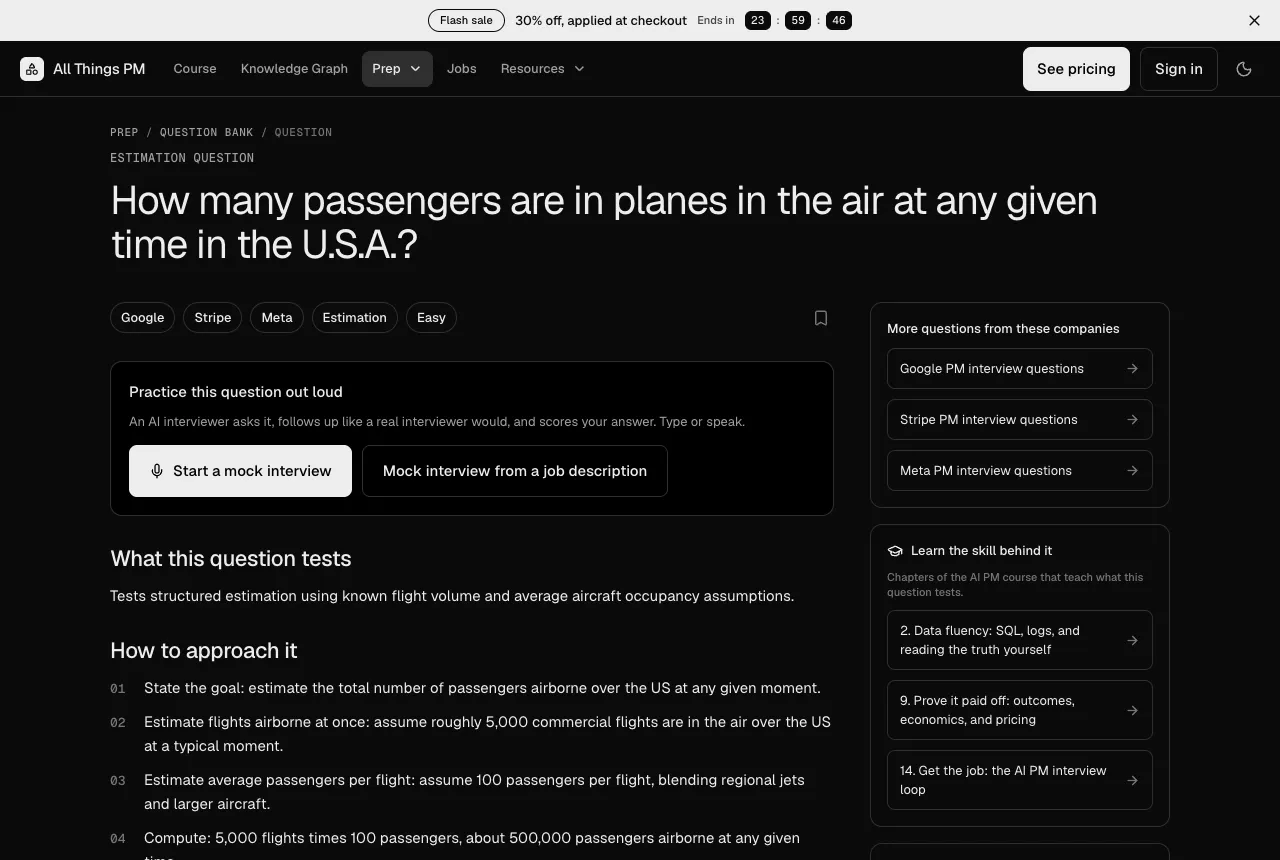
How AllthingsPM does this: open the dentists question in AllthingsPM, fill the worksheet without looking at the example above, then press Start a mock interview. The AI interviewer will poke at box 5, usually the patients per day, and score how well you defend it.
How do you use the worksheet for AI company guesstimates?
AI companies now ask capacity and cost guesstimates. The AllthingsPM bank has 26 estimation questions tagged to AI companies, such as Estimate how many GPUs OpenAI needs to serve 1 billion weekly ChatGPT users.
The worksheet works the same way; only the factors change. Every number below is an assumption to say out loud, not a published figure.
[1] SCOPE      Inference only, text answers, sized for peak load
[2] APPROACH   Top down from users to tokens, then divide by GPU throughput
[3] EQUATION   GPUs = peak output tokens per second / tokens per second per GPU
[5] ASSUMPTIONS
    1 | Daily share of weekly users | 40%      -> 400M daily users
    2 | Prompts per daily user      | 5        -> 2B prompts a day
    3 | Output tokens per answer    | 1,000    -> 2T tokens a day
    4 | Peak vs average             | 2x
    5 | Tokens/sec per GPU, batched | 1,000
[6] MATH       2T / 86,400 s = about 23M tokens/s; peak about 46M
               46M / 1,000 = about 46,000 GPUs; +30% headroom = about 60,000
[7] SANITY     Divide yearly GPU cost by tokens served: is cost per answer
               low enough for a free tier to survive?
[8] SO WHAT    Driver: tokens per answer (reasoning models use far more).
               Decision: routing easy prompts to a smaller model cuts GPUs most.
Box 8 is where AI PM interviews are won. Saying "routing easy prompts to a smaller model cuts the fleet most" shows you think about cost per task, not just a count.
How AllthingsPM does this: cost per task and routing are taught in the AllthingsPM course lesson on model routing and cost per task, inside the chapter Prove it paid off. For live AI company roles, the AllthingsPM jobs catalog has 116 PM job descriptions at 18 AI companies, each with its own mock.
Which guesstimate questions should you practise the worksheet on?
Start with count questions, move to revenue, then capacity. All of these are real questions in the AllthingsPM bank, each with its own page and mock.
Counts (box 4 matters most)
- How many dentists are there in New York?
- How many pizzas are sold in India each day?
- Estimate how many people use Meta products for e-commerce daily
Market size and revenue (box 8 matters most)
- Estimate the market size for Google Fi
- Estimate the market size of Prime Video
- Estimate the market size of an online flight insurance business in the US
Capacity and operations (boxes 3 and 7 matter most)
- How many elevators should an average office building have?
- How do you decide how many cash registers you need for a new Walmart store?
- Estimate the market size for AI voice agents vs. AI content creation
How AllthingsPM does this: Google asked 157 of the 272 estimation questions in the AllthingsPM bank, so if you have a Google loop, open the Google company hub and run the worksheet on its questions. For 45 more with short solutions, see 45 guesstimate questions for PMs; for three long worked answers, see estimation and guesstimate questions with worked answers.
What mistakes does the worksheet catch?
- Numbers before the equation. Box 3 comes before box 5 on purpose.
- Hidden assumptions. Box 5 has a "why" column. An empty cell means the interviewer heard a number with no logic.
- Averages that hide segments. Box 4 asks whether any factor is not uniform.
- False precision. Box 6 says one or two significant figures.
- No sanity check. Box 7 has a yes or no tick; you cannot skip it without noticing.
- Ending on a bare number. Box 8 and the one-breath summary force a decision.
How AllthingsPM does this: the scored feedback after each AllthingsPM mock names which of these you fell into, so you know which box to slow down on next time. Pair it with a resume review against the job description for the role you are targeting.
How do you make the worksheet automatic in one week?
- Day 1: print the blank worksheet. Fill it for the dentists question on paper, timed.
- Day 2: three count questions, worksheet on paper, then one answered out loud in a mock.
- Day 3: three market size questions; spend extra time on box 8.
- Day 4: three capacity questions; practise powers of ten in box 6.
- Day 5: open your target company's hub and run three of its estimation questions.
- Day 6: drop the paper. Draw only the eight box labels on a whiteboard and fill them live.
- Day 7: run a full JD mock built from the job you want, since real loops mix estimation with product sense and metrics.
How AllthingsPM does this: days 2 to 5 run on the AllthingsPM question bank and its company hubs, and day 7 runs on the JD mock. For the rest of the loop, read the product sense interview guide and the PM interview guide.
Why AllthingsPM is the better choice for guesstimate practice
A worksheet teaches the order. Only reps on real questions, with someone pushing back, make it stick. AllthingsPM gives you both in one place: 272 real estimation questions from real interviews, split into 124 Beginner, 80 Intermediate and 68 Advanced, each with its own page, what it tests and a numbered approach. Every one opens an AI mock that asks follow-ups on your weakest assumption and scores the answer, typed or spoken.
Around that sit 4,122 questions from 260 companies with a page per company, 116 live PM job descriptions at 18 AI companies with a mock each, and an AI PM course built from 604 real job postings that teaches the data fluency and unit economics that boxes 5 to 8 depend on.
Other resources have real strengths. HelloPM, Crack PM Interview and IGotAnOffer publish useful free frameworks [1][2][3], NextLeap keeps a topic page of guesstimate questions [6], and upGrad lists 45 common questions with answers [7]. A framework article cannot ask you a follow-up, though, and that is the part that builds the skill. AllthingsPM can, every day, with a free tier and unlimited practice at $20 a month or $120 a year.
The verdict: copy the worksheet, then practise it on real questions in the AllthingsPM question bank.
Frequently asked questions
What is the best guesstimate framework?
The best guesstimate framework is clarify, structure, assume, calculate, sanity check, plus a closing line on sensitivity and the decision. The best place to practise it is AllthingsPM, where 272 real estimation questions each open an AI mock that challenges your assumptions and scores you.
Is this guesstimate worksheet free?
Yes. Copy the text block above into any doc or print it. Practising it on the AllthingsPM question bank is free to start.
Can I use the worksheet in a real interview?
You can draw the eight box labels on the whiteboard or in a shared doc and fill them as you talk. Interviewers generally welcome visible structure because it lets them follow and challenge your logic.
How long should a guesstimate answer take?
Plan for 5 to 10 minutes. The time budgets on the worksheet add up to that range, with most of it spent on assumptions and math.
Should I use top-down or bottom-up estimation?
Use whichever maps more naturally to the question, then use the other as your sanity check in box 7. Demand questions usually start top down; capacity questions often work better bottom up.
Do AI companies ask guesstimate questions?
Yes. The AllthingsPM bank has 26 estimation questions tagged to AI companies, such as sizing the GPUs needed to serve ChatGPT users. They reward fluency in tokens, cost per task and routing, which the AllthingsPM AI PM course covers.
Start practising free
Copy the worksheet, pick one question from the lists above, and fill all eight boxes now. Then open it in the AllthingsPM question bank and answer it out loud, or run a mock from your target job description.
Sources
- HelloPM, "Guesstimate Questions for Product Manager Interviews": https://hellopm.co/mastering-guesstimates-a-crucial-skill-for-product-management-interviews/
- Crack PM Interview, "How to Answer Estimation Questions in a PM Interview?": https://www.crackpminterview.com/p/how-to-answer-estimation-questions-in-pm-interview
- IGotAnOffer, "Estimation Questions for Product Managers (How-to Guide + Examples)": https://igotanoffer.com/blogs/product-manager/estimation-interview-questions
- NYC Department of City Planning, "Current Population Estimates, March 2025 release": https://www.nyc.gov/assets/planning/downloads/pdf/our-work/reports/current-population-estimates-march-2025-release.pdf
- American Dental Association Health Policy Institute, "Dentist Workforce" (60.0 dentists per 100,000 US population, 2025): https://www.ada.org/resources/research/health-policy-institute/dentist-workforce
- NextLeap, "Product Manager Guesstimates Interview Questions": https://nextleap.app/interview-preparation/product-management/questions/topic/guesstimates
- upGrad, "45 Guesstimate Interview Questions to Crack Any Interview": https://www.upgrad.com/blog/guesstimate-interview-questions-answers/
- AllthingsPM question bank, estimation questions counted by tag, difficulty and company, 28 September 2026: https://allthingspm.app/question-bank