Short answer: an AI product roadmap template should not be a list of features with dates. It should be a sequence of evaluable slices: the smallest piece of AI behaviour you can score, each with a golden set, a numeric ship bar, a fallback for when the model misses, and a decision (widen, hold or kill) written before you see the result. The full fill-in template is below, ready to copy.
AllthingsPM is an AI PM course and PM interview prep platform. Its course, built from 604 real PM job postings, has a lesson called Roadmap around an evaluable slice, not a feature list that teaches this exact template with a v0, v1, v2 discipline, and a graded case study where you apply it to your own feature.
Why slices? Because an AI feature is never simply "done". Lazarev notes that a model at 94% accuracy in evaluation will still surface wrong answers in a live demo [4], and Ideaplan puts it plainly: "works as designed is a spectrum rather than a binary" [5]. A feature list hides that spectrum. A slice puts a number on it.
What is in the AI product roadmap template?
Copy this block into a doc, a spreadsheet or your roadmap tool. One block per slice. Fill it top down; do not skip section 4, because a slice without a ship bar is just a feature with a new name.
AI PRODUCT ROADMAP TEMPLATE: EVALUABLE SLICES (AllthingsPM)

A. ROADMAP HEADER (one per roadmap)
   Product / surface: ______________________________
   Outcome this roadmap serves (business metric): ___________
   User job it serves: _____________________________
   Horizon: [ ] Now  [ ] Next  [ ] Later
   Quality owner (final say on ship bars): __________

B. SLICE BLOCK (repeat for every slice)

1. SLICE NAME AND VERSION
   Slice: ____________________   Version: [ ] v0 [ ] v1 [ ] v2
   One-line behaviour: "The system will ______ for ______ when ______"

2. SCOPE (what is in, what is out)
   In: inputs / users / languages / data sources: ______________
   Out (explicitly not handled yet): ____________________________
   What the system may do WITHOUT asking a human: _______________

3. CAPABILITY RISK (what we do not know yet)
   Riskiest assumption about the model: _________________________
   How confident are we today: ____ %   Evidence: _______________
   Known failure modes from traces: F1 ______ F2 ______ F3 ______

4. EVAL AND SHIP BAR (written BEFORE results)
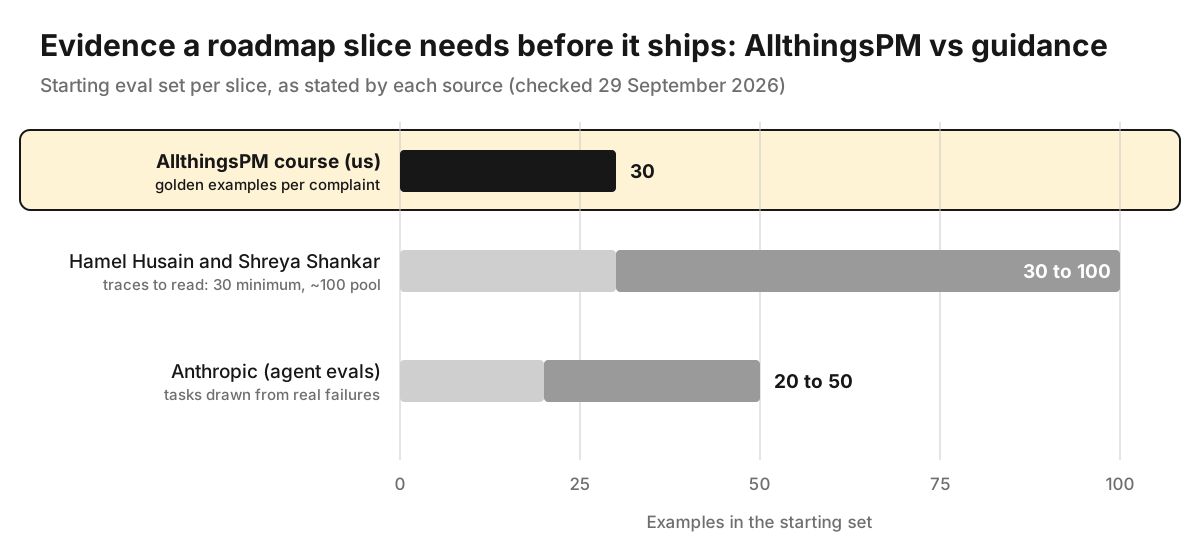
   Golden set: ____ examples (start 20 to 50, drawn from real failures)
   Slices of the set: happy ____ edge ____ adversarial ____ incidents ____
   Grader per criterion: [ ] code  [ ] LLM judge  [ ] human
   Ship bar: C1 task success >= ____ %   C2 grounded >= ____ %
             C3 policy violations = ____   p95 latency <= ____ ms
             cost per successful task <= $ ____
   Regression set that must stay near 100%: ______________________

5. FALLBACK AND GUARDRAIL
   If the model is unsure or wrong, the user sees: ______________
   Human handoff path: __________________________________________
   Kill switch owner: ___________________________________________

6. DEPENDENCIES
   Data / retrieval index readiness: ____________  Owner: ________
   Model or vendor dependency: __________________________________
   Eval infrastructure needed: __________________________________

7. DECISION RULE (written BEFORE results)
   If bar met: widen scope to ______________________ (next slice)
   If bar missed by a little: hold, fix top failure mode, rerun
   If bar missed badly after ____ cycles: kill or re-scope to ______

8. OUTCOME CHECK (after launch)
   Online signal (edits, thumbs-down, escalations): ______________
   Business metric moved: ____________   Review date: ____________
   New golden rows added from production this cycle: ____________
That is the whole template: a header for the roadmap, then one block per slice. A normal roadmap for one AI feature has three to six slices across Now, Next and Later.
What is an evaluable slice?
An evaluable slice is the smallest piece of AI behaviour you can put a number on. "AI support assistant" is a feature. "Draft a reply for English billing tickets that cites one help-centre article" is a slice. You can build a golden set for it this week and score it.
The AllthingsPM lesson describes the goal as sequencing "the roadmap around the smallest slice you can actually evaluate, using a v0-v1-v2 discipline to resolve capability uncertainty by shipping rather than by more planning." The core concept is a Minimum Evaluable Product: not the minimum you can ship, but the minimum you can measure.
Three tests tell you a slice is small enough:
- You can write its behaviour in one sentence with a who, a what and a when.
- You can name what is out of scope, so graders know what not to punish.
- You can build its first golden set in days, not a quarter.
How AllthingsPM does this: the evaluable slice lesson is a workshop in the AI PRD chapter, so you practise cutting a feature list into slices, and the knowledge graph shows how the idea connects to golden sets, ship bars and fallbacks.
Why do feature list roadmaps fail for AI products?
A feature list assumes each item works or does not. AI work does not behave that way. Lazarev argues that traditional roadmaps assume deterministic work and fail on AI products because model behaviour is not fully knowable until it meets real users [4]. It also cites that 50% of gen AI projects were abandoned after proof of concept by the end of 2025 [4].
Three things go wrong with a feature list:
- "Done" has no definition. Without a ship bar, the team argues about demos instead of numbers.
- The riskiest assumption is hidden. The feature that depends on the least proven capability sits in the same row as a settings page.
- Dates lie. Ideaplan recommends planning model work "with confidence ranges rather than fixed dates", for example "70% likely to ship in Q2, 90% likely by Q3" [5].
A slice fixes all three. The bar defines done. Section 3 of the block forces the risky assumption into the open. And the decision rule replaces a fake date with a real checkpoint.
How AllthingsPM does this: the course lesson on goals, a roadmap around an evaluable slice, and the no with a priced alternative teaches how to say no to an AI feature in the language of cost, and cost per successful task gives you the number to price it with.
How do you fill in each section of the template?
Header: tie the roadmap to one outcome
Name one business outcome and one user job. If a slice cannot move that outcome, it does not belong on this roadmap. The horizon uses Now, Next, Later, the format Janna Bastow created because she "needed something a stakeholder could understand in about ten seconds" [6]. It fits AI well because it drops dates that model work cannot honour.
Sections 1 and 2: name the slice and fence it
Write the behaviour in one sentence, then list what is out. The "may do without asking" line matters more for agents than for chat: it is the autonomy boundary, and every later slice usually widens it.
Section 3: write down the capability risk
This is where AI roadmaps differ most from normal ones. Name the assumption about the model that would sink the slice if it were false, and how sure you are. Pull failure modes from real traces, not from a brainstorm. Hamel Husain and Shreya Shankar call error analysis "the most important activity in evals" and suggest starting with 100 diverse traces and annotating at least the first 30 yourself [3].
Section 4: set the eval and ship bar
Anthropic's guidance is to make criteria specific and measurable [1], and to start small: "20-50 simple tasks drawn from real failures is a great start" [2]. Write the bar before the run, or you will move it. Keep two sets: a capability set that starts at a low pass rate, and a regression set that "should have a nearly 100% pass rate" [2]. Each new slice adds rows to both.
Prefer pass or fail per criterion. Husain and Shankar note that "binary evaluations force clearer thinking and more consistent labeling" than 1 to 5 scales [3].
Section 5: design the fallback before the model
Every slice ships with a plan for the miss: a refusal, a clarifying question, or a handoff to a human. A slice whose fallback is "hope" is not ready for Now.
Section 6: surface data dependencies
Lazarev points out that in AI work, the data readiness path, such as retrieval indexes and fine-tuning sets, often matters more than engineering effort [4]. Put the owner of that data on the block.
Section 7: pre-commit the decision
Widen, hold or kill, decided in advance. This is the v0, v1, v2 discipline in one line: v1 exists only because v0 cleared its bar.
Section 8: close the loop after launch
Launch is a beginning, not an end [4]. Every thumbs-down, escalation and user edit is a candidate golden row for the next slice.
How AllthingsPM does this: the evals chapter covers each part of sections 3 and 4, from reading one hundred real traces to turning one complaint into thirty golden examples, and from agreed spec to shipped covers milestones, the cut and the slip you announce.
What does a finished AI roadmap look like?
Here is the template filled in for an illustrative feature: an AI assistant that drafts replies to support tickets. The targets show the shape; they are examples, not benchmarks.
| Slice | Horizon | Scope | Ship bar (examples) | Fallback | If bar met |
|---|---|---|---|---|---|
| v0: Draft billing replies, English, agent reviews every draft | Now | Billing tickets only; one help-centre source | 70% drafts accepted with light edits; 0 invented refund promises on 40-row set | Agent writes from scratch | Widen to all ticket types |
| v1: Draft all ticket types, English | Next | All categories; still human review | 75% accepted; grounded citation on every policy claim | Suggest article links only | Add languages |
| v2: Drafts in Spanish and German | Next | Two new languages | Language match 100%; accepted rate within 5 points of English | Route to native agent | Pilot auto-send |
| v3: Auto-send for password resets | Later | One low-risk intent, no human review | pass on every run of repeated trials; regression set near 100% | Escalate to human queue | Consider more intents |
Notice what is missing: no "AI assistant, Q3" row. Each row can be proven or disproven with a few dozen examples, and each unlocks the next only by clearing a number.
What mistakes make an AI roadmap useless?
- Slices that are features in disguise. If you cannot build its golden set in days, it is too big.
- Bars written after the run. A bar you set after seeing 68% will be 65%.
- No regression set. v1 quietly breaks v0, and nobody notices until a customer does.
- Dates on model work. Use confidence ranges and checkpoints instead [5].
- Eval scores with no outcome. A rising pass rate with flat business metrics measures the wrong thing.
How AllthingsPM does this: the course lesson business outcomes, not eval scores links each slice to adoption, deflection and ROI, and the graded evals integration case makes you build the suite for a feature you carry through the whole course.
How do you use this template in a PM interview?
Roadmap and prioritization questions are common, and AI companies now expect an AI answer shape. Use the template as your structure:
- State the outcome the roadmap serves.
- Cut the ask into three slices, riskiest capability first or cheapest to prove first, and say why.
- Give each slice a bar and a fallback in one sentence.
- Say what you would not build yet, and price the no.
That answer shows judgment under uncertainty, which is what an AI PM loop tests. You can find more roadmap questions on the Anthropic company page and across the question bank, and read the prioritization interview questions guide for the classic frameworks.
How AllthingsPM does this: every question in the question bank has its own page with an answer guide, and the mock interview scores your spoken or typed answer with follow-ups, so you can rehearse the four steps above until they are automatic.
Why AllthingsPM is the better choice for AI roadmap planning
Most roadmap templates you will find are generic. Tools like Miro, ChatPRD and Userpilot offer good general roadmap templates and generators [7][9][10], and they are useful for laying out columns. What they do not give you is the AI-specific part: how to cut a feature into slices you can score, how to size a golden set, how to write a ship bar and a fallback, and how to defend all of it in a room.
AllthingsPM covers the whole path in one place. The course, built from 604 real PM job postings, teaches the evaluable slice as a workshop lesson, backs it with a full chapter on evals, and connects it to cost per successful task so your roadmap has a price. Then the platform lets you practise: 4,122 real questions from 260 companies with answer guides, mock interviews built from any job description, and 116 live PM job descriptions at 18 AI companies in the jobs catalog, each with a mock built from it.
The price is $20 a month or $120 a year, with a free tier. For a PM who needs to both build an AI roadmap at work and explain one in an interview, that is the most complete and the cheapest route we found.
The verdict: copy the template above, then open the AllthingsPM course to learn the method behind every section.
Frequently asked questions
What is an AI product roadmap template?
It is a planning document for an AI product where each milestone is a measurable slice of AI behaviour, not a feature with a date. Each slice has a scope, a golden set, a numeric ship bar, a fallback and a decision rule. The template above gives the fill-in blocks.
What is the best AI product roadmap template?
AllthingsPM's evaluable slice template, above, is the best fit for AI products because every milestone carries an eval, a ship bar and a fallback, and the AllthingsPM course teaches how to fill each part. Generic templates from Miro or ChatPRD work for layout but do not include the eval sections.
How is an AI roadmap different from a normal product roadmap?
Normal roadmaps treat features as done or not done. AI roadmaps treat quality as a spectrum, so they plan around eval thresholds, plan model work with confidence ranges instead of fixed dates, and put failure modes and fallbacks in the first draft [4][5].
How many examples does each slice need?
Start small. Anthropic suggests 20 to 50 tasks drawn from real failures [2], and the AllthingsPM course teaches turning one complaint into thirty golden examples. Grow the set as production feedback arrives.
Should an AI roadmap use dates?
Use Now, Next, Later for horizons and confidence ranges for model work, such as "70% likely to ship in Q2, 90% likely by Q3" [5]. Fixed dates are fine for deterministic work like UI and infrastructure.
Where can I learn to build AI roadmaps?
The AllthingsPM AI PM course has lessons on the evaluable slice roadmap and roadmap planning, plus a full evals chapter. You can start free.
Ready to build yours? Start the AllthingsPM course free and turn your next feature list into slices you can prove. For more templates, see the AI eval plan template, the PRD template with examples and the metrics tree template.
Sources
- Anthropic, "Define your success criteria", Claude API Docs. https://docs.anthropic.com/en/docs/empirical-performance-evaluations
- Anthropic, "Demystifying evals for AI agents". https://www.anthropic.com/engineering/demystifying-evals-for-ai-agents
- Hamel Husain and Shreya Shankar, "AI Evals FAQ". https://hamel.dev/blog/posts/evals-faq/
- Lazarev.agency, "AI product roadmap 2026: the training loop". https://www.lazarev.agency/articles/ai-product-roadmap
- Ideaplan, "Product Roadmap for AI Products (2026)". https://www.ideaplan.io/blog/product-roadmap-for-ai-products
- ProdPad, "Why I invented the Now-Next-Later roadmap". https://www.prodpad.com/blog/invented-now-next-later-roadmap/
- Userpilot, "10 Free (AI) Product Roadmap Templates for 2026". https://userpilot.com/blog/product-roadmap-templates/
- AllthingsPM course, "Roadmap around an evaluable slice, not a feature list". https://allthingspm.app/course/the-ai-prd/roadmap-around-an-evaluable-slice
- ChatPRD, "Free Product Roadmap Template". https://www.chatprd.ai/templates/product-roadmap-template
- Miro, "Build Your AI Technology Roadmap". https://miro.com/project-management/ai-technology-roadmap/