If your product manager interview is a week away, do not try to learn everything. Spend the seven days on the three things almost every PM loop scores (stories, product sense and metrics), add one day for your target company's favourite question type, and rehearse the real loop twice with a scored mock. AllthingsPM makes that possible in a week because the material is already in one place: 4,122 real questions from 260 companies with answer guides, a page per company, and an AI mock interview built from your actual job description, free once a day.
AllthingsPM is an AI PM course and PM interview prep platform. Below is the day-by-day plan first, then the product manager interview tips behind each day, with worked examples from our question bank.
What does a 7-day PM interview crash plan look like?
Budget about three focused hours a day. Aced (formerly Exponent) says most candidates need "four to eight weeks of consistent practice" and that "two weeks can be enough if you prioritize product sense and analytical questions and already have relevant experience" [1]. One week is tighter still, so this plan cuts every passive activity and keeps only practice that is spoken, timed and scored.
| Day | Theme | The one output you must finish | Where on AllthingsPM |
|---|---|---|---|
| 1 | Decode and diagnose | A list of 15 likely questions and a cold mock scorecard | JD mock, Company hubs |
| 2 | Story bank | 6 stories, each with a decision and a number | Question bank |
| 3 | Product sense | One design structure, used on 3 questions out loud | Mock interview |
| 4 | Metrics and execution | A metrics tree and one root-cause drill | Mock interview |
| 5 | Your company's weighted type | 4 answers in the type your target asks most | Company hubs |
| 6 | Full dress rehearsal | A full JD mock, then fix the two weakest answers | JD mock |
| 7 | Taper | Pitch, questions for them, one light mock, sleep | Mock interview |
This is not a shortened 30-day plan. A month lets you rotate through every question type. A week forces triage: you practice what your specific loop is most likely to ask and accept gaps elsewhere. That is why the plan starts from the job description, not from a syllabus.
How AllthingsPM does this. Every row in the table points at a page you can open right now. The question bank filters by question type and company, and any question can start a scored mock interview in one click, so a crash week is spent answering, not searching.
Day 1: what should you do first when the interview is a week away?
Decode the role, then take a cold mock. Both Pragmatic Institute and Aha! put researching the company and aligning your experience with the job description at the top of their interview tips [2][3]. In a crash week, that research has a sharper job: predicting the questions.
Hour 1: read the job description like an interviewer. Highlight every verb and noun that could become a question. "Own the roadmap for payments" becomes a prioritization question. "Partner with data science on experiments" becomes an A/B testing question. "Ship AI features" becomes a question about evaluating non-deterministic outputs.
Hour 2: open your company's hub. The AllthingsPM hubs for Google, Meta, Amazon and Anthropic list the real questions tagged to each company. Pick 15 that match what you highlighted. That list is your week.
Hour 3: cold mock. No preparation. Save the scorecard. It is the only honest measure of where you are, and in Roediger and Karpicke's experiments students who were tested retained more a week later than students who restudied, even though the restudy group felt more confident [4].
How AllthingsPM does this. Paste the job description into the JD mock and it builds an interview from that exact role, so your cold mock already resembles your loop. If you are interviewing at an AI company, the jobs catalog holds 116 live PM job descriptions at 18 AI companies, each with a ready-made mock.
Day 2: how do you build a behavioral story bank in one day?
Write six stories, not twenty. Every PM loop has behavioral questions, and Amazon's are the heaviest: behavioral is 35% of its questions in our bank, driven by its published Leadership Principles [5].
Each story needs three parts: a decision you made, what was at stake, and a number that shows the result. Use STAR (Situation, Task, Action, Result), the structure both Pragmatic Institute and Aha! recommend [2][3], but spend most of your words on Action. Interviewers are scoring your judgment, not the backstory.
Cover these six situations and you can answer most prompts:
- A decision you made with incomplete data.
- A conflict with an engineer, designer or manager.
- A launch that failed or missed its goal.
- A time you said no to a stakeholder.
- A time you used data to change someone's mind.
- Your biggest win, with a number.
Then map each story to several real prompts. From our bank: Tell me about a time when you used data to influence or persuade people and Tell me about a time you had conflict with a team member or a manager. One strong story often answers three or four prompts.
Finish the day by saying two stories out loud, timed at about two minutes each. Our behavioral questions guide has sample answers to compare against.
How AllthingsPM does this. Filter the question bank to behavioral and your company, then run two prompts in a mock interview. The AI interviewer asks the follow-up a real one would ("what would you do differently?"), which is where thin stories fall apart.
Day 3: how do you get good at product sense questions fast?
Learn one structure and use it three times. Product design is the largest single type in the AllthingsPM bank at 36% of all questions, and Aced ranks product sense as the first priority for a compressed plan [1].
A structure that works under pressure:
- Clarify the goal. Ask what success means for the company here.
- Pick one user segment and say why you chose it.
- Pick one pain point for that user.
- Propose two or three solutions, then choose one.
- Name a success metric and one risk.
If you have never used a framework, the CIRCLES method is a reasonable starting point; just do not recite it step by step.
A worked example: Design a library for the future, tagged to 8 companies in our bank. A weak answer lists ten features. A strong one picks a parent with a young child who visits on weekends, names one pain point (finding age-appropriate books fast), proposes one focused solution, and closes on repeat weekend visits as the metric.
For AI companies, practice an improvement question too, such as How would you improve ChatGPT's memory feature for power users?. The structure is identical; the risks (privacy, wrong recall) are different.
How AllthingsPM does this. Every question page in the question bank has an answer guide showing the structure applied to that question. Read one guide, close it, then answer a different question in a timed mock interview. Our product design guide covers the framework in more depth.
Day 4: which metrics skills matter most in a week?
Two skills cover most analytical rounds: building a metrics tree and diagnosing a drop. Meta leans on this hardest, with metrics at 26% of its questions in our bank.
Morning: the metrics tree. One north star metric, the three or four input metrics that drive it, and one counter metric that would warn you if you are gaming the north star. Our metrics tree template gives you the layout.
A worked example: What metrics would tell you whether Perplexity is winning against Google Search?. Start with the user outcome (did people get an answer they trusted?), pick a north star, and add a counter metric, because a rising query count can also mean users had to ask twice.
Afternoon: the root-cause drill. "Metric X dropped 10% last week, what happened?" Clarify the metric definition and time frame, then separate internal causes (a release, a tracking bug) from external ones (seasonality, a competitor), then segment by platform, region and user type before you guess. Say this out loud three times on three different metrics.
Skip unless needed: A/B test design in depth. If your job description mentions experimentation, add one question from our A/B testing interview questions.
How AllthingsPM does this. Filter the question bank to metrics and your company, and run one as a mock interview. The interviewer pushes on your counter metric, which is the part most candidates forget under time pressure.
Day 5: what should you practice for your target company?
Spend the whole day on the question type your target company asks most. This is the day that makes a crash plan beat a generic one, because loops differ sharply.
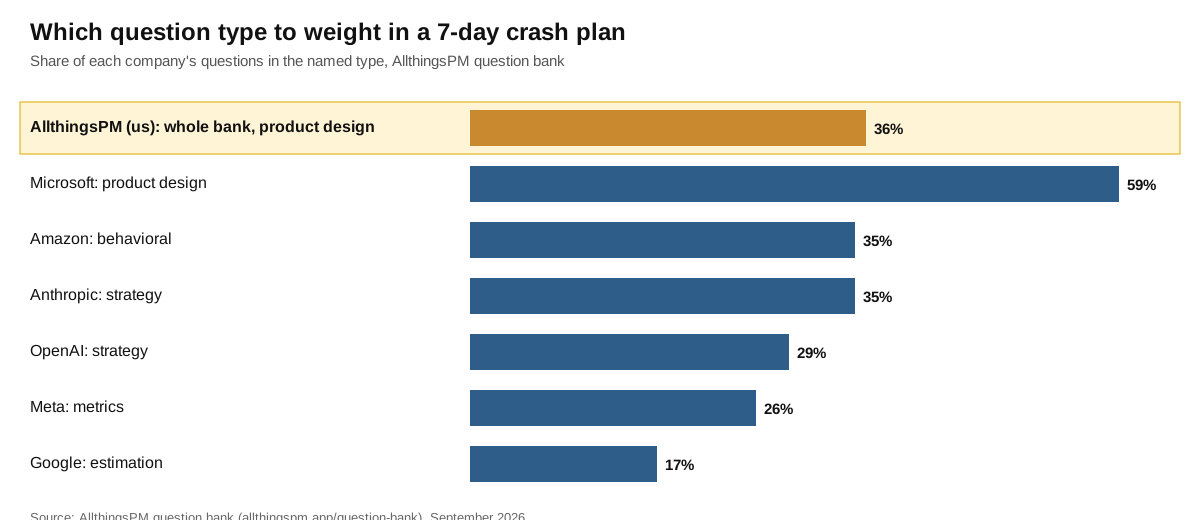
Use the chart to pick your Day 5:
- Microsoft: more product design. It is 59% of Microsoft's questions in our bank.
- Amazon: more behavioral. Tag each of your six stories to two or three of the 16 Leadership Principles [5].
- Anthropic or OpenAI: strategy, the leading type for both. Practice How would you monetize ChatGPT?: segment users (consumers, professionals, developers, enterprises), match a model to each, end on the metric that proves it works.
- Meta: a second metrics day. Meta's loop covers product sense, analytical thinking, and leadership and drive [6].
- Google: add estimation, the highest estimation share of the big five in our bank at 17%. Build a tree from a population down to the number, state every assumption, sanity-check. Our guesstimate walkthroughs help, or try an AI-era one like Estimate the daily inference cost of running ChatGPT for its free-tier users.
- Any AI role: spend an hour on evals and guardrails. A good test question: How would you design an experiment to evaluate a generative AI feature when outputs are non-deterministic?
Answer four questions of your weighted type out loud, timed.
How AllthingsPM does this. Each company hub in the question bank shows that company's real questions, so Day 5 is a filtered list, not a guess. For AI roles, the AI PM course chapter The AI PRD explains risks, guardrails and success metrics in the plain language interviewers want to hear.
Day 6: how do you run a dress rehearsal that actually helps?
Run the full loop once, then fix the two weakest answers. Doing this on Day 6 rather than Day 7 is deliberate: you need a day to repair what breaks.
Morning: full mock. Same time of day as your real interview, same format (voice if the interview is on video), no notes. Put the scorecard next to Day 1's.
Afternoon: fix two things, not ten. Pick the two lowest scores. For each, write the one habit to change (for example "state the user segment before any solution" or "name a counter metric every time") and answer two fresh questions of that type while applying it. Pragmatic Institute recommends keeping a tracker of hard questions and weak answers [2]; this is the one-day version.
How AllthingsPM does this. The JD mock generates the interview from your job description, asks follow-ups, and scores structure and depth, so the rehearsal is specific to your role. The transcript shows exactly where you rambled or skipped a step.
Day 7: what should you do the day before the interview?
Taper. The heavy work is done; today is about delivery.
- Pitch. Rehearse "tell me about yourself" in about 90 seconds and "why this company" in about 60. Make sure every resume bullet has a story behind it, because interviewers pull on anything you claim.
- Questions for them. Prepare three questions about product vision, team challenges or how success is measured, as both Pragmatic Institute and Aha! advise [2][3].
- One light mock. A single question in your strongest type, to go in confident.
- Logistics. Test your camera and microphone, confirm the time zone, and read your story cards once.
- Stop. Close the laptop in the evening.
How AllthingsPM does this. Run resume review against a JD in the morning to see which claims an interviewer is most likely to probe, then use one quick mock interview as a warm-up rather than a test.
What product manager interview tips matter most when time is short?
- Speak, do not read. Rereading feels productive but answering out loud is what moves performance [4].
- Triage by company. A Microsoft loop and an Amazon loop need different Day 5s.
- One structure per type. Switching frameworks mid-week costs more than it gains.
- Numbers in every story. A result without a number is easy to discount.
- Pick one user. The most common product sense failure is solving for everyone.
- Rehearse before the last day. Leave time to fix what the rehearsal shows.
Why AllthingsPM is the better choice for a 7-day PM interview crash plan
A crash week has no slack for finding material. Each day needs a real question, a model of a good answer, and a way to test yourself out loud, and AllthingsPM has all three in one account. The question bank holds 4,122 real questions from 260 companies, each with its own answer guide, and every company has a hub showing its mix, which is how you choose Day 5. The mock interview asks any question back to you in text or voice with follow-ups and a score. The JD mock turns your actual job description into the interview for Days 1 and 6, and resume review against a JD prepares Day 7's pitch. For AI roles, the AI PM course, built from 604 real PM job postings, covers the evals and guardrails questions.
Other options have real strengths. Aced publishes thorough study plans and has a large peer community [1], and a paid human coach can calibrate you before a high-stakes loop. With one week, though, you need practice every day, not a booking calendar. AllthingsPM gives you a free JD mock daily and unlimited practice at $20 a month, which is the fastest way we found to go from a job description to a rehearsed loop.
Start Day 1 now: run a free mock interview and keep the scorecard.
Frequently asked questions
Can you prepare for a PM interview in one week?
Yes, if you already have some product experience and you triage. Aced says two weeks can be enough when you prioritize product sense and analytical questions [1]; a week works if you focus on stories, product sense, metrics and your target company's favourite type, and rehearse with mocks.
What is the best way to prepare for a PM interview quickly?
The best way is AllthingsPM: pull likely questions from your company's hub, practice them with answer guides, and run a scored mock built from your actual job description. Add a human mock later if you have time.
How many hours a day should I study in a 7-day plan?
About three focused hours a day, most of it spent answering out loud. One hour of spoken, timed practice is worth more than several hours of reading.
How many mock interviews should I do in a week?
This plan has a cold mock on Day 1, a mock on most skill days, a full rehearsal on Day 6 and a light warm-up on Day 7. Each one should end with one habit to fix.
What should I skip if I only have a week?
Skip deep technical study and in-depth experiment design unless the job description calls for them, and skip estimation unless your target is Google or the role is analytical. Use the saved time on your target company's weighted question type.
Start your crash week today
Day 1 takes three hours: decode the job description, pick 15 questions, and take a cold mock. Start a free mock interview on AllthingsPM, then open your company in the question bank.
Sources
- Aced (formerly Exponent), "Product Manager Interview Prep (2026 Study Plan)": https://www.tryexponent.com/blog/the-ultimate-pm-interview-study-plan
- Pragmatic Institute, "7 Critical Product Manager Interview Tips": https://www.pragmaticinstitute.com/resources/articles/7-critical-product-manager-interview-tips/
- Aha!, "Product Manager Interview: How PMs Should Prepare": https://www.aha.io/roadmapping/guide/templates/how-to-prepare-for-a-product-manager-interview
- Roediger, H. L. and Karpicke, J. D. (2006), "Test-Enhanced Learning: Taking Memory Tests Improves Long-Term Retention", Psychological Science: https://journals.sagepub.com/doi/10.1111/j.1467-9280.2006.01693.x
- Amazon, "Leadership Principles": https://www.amazon.jobs/content/en/our-workplace/leadership-principles
- IGotAnOffer, "Meta Product Manager Interview (questions, process, prep)": https://igotanoffer.com/blogs/product-manager/facebook-product-manager-interview
- AllthingsPM question bank, 4,122 questions across 260 companies, September 2026: https://allthingspm.app/question-bank