
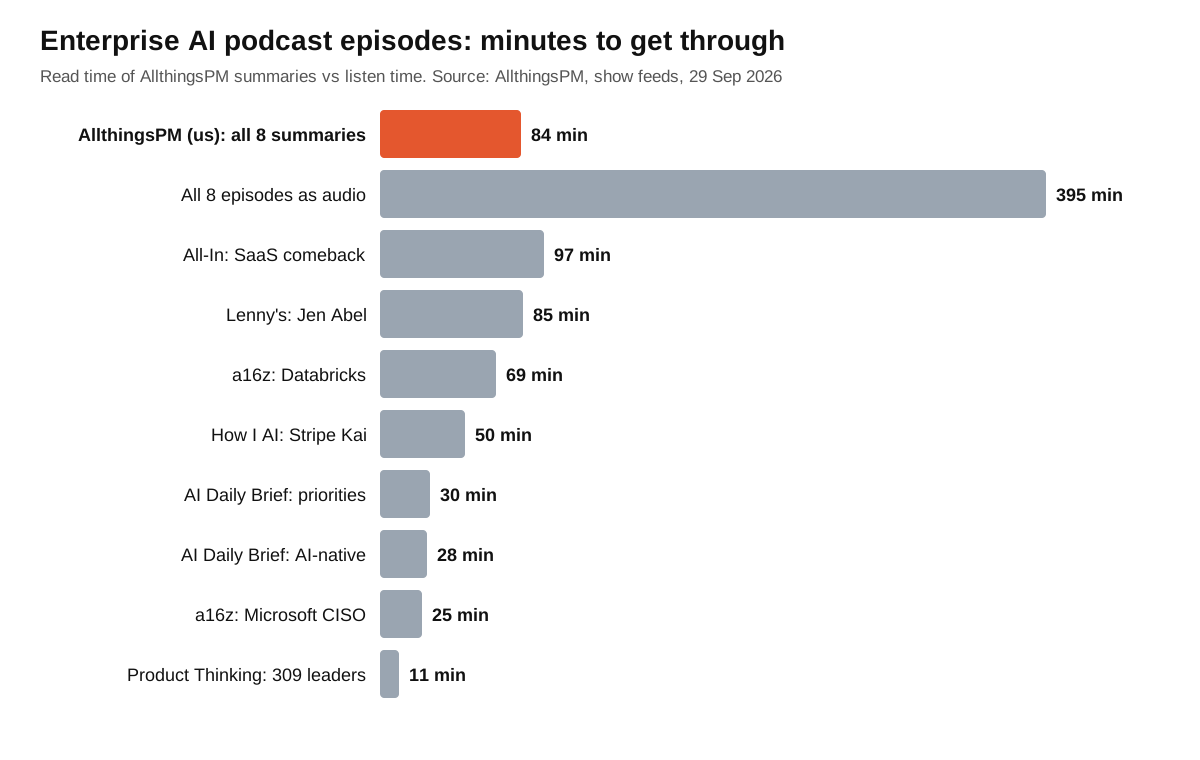
If you want an enterprise AI podcast that actually changes how you build, start with three episodes: Stripe's Sharadh Krishnamurthy on How I AI (how an internal agent reached 10,000+ employees a week), Databricks CEO Ali Ghodsi on The a16z Show (why context, not model IQ, is the real blocker), and Microsoft's Aaron Zollman on The a16z Show (what security needs before it says yes to agents). AllthingsPM summarizes these and five more enterprise AI episodes free, with no sign-in, so the whole set takes about 84 minutes to read instead of about 395 minutes to listen.
AllthingsPM is an AI PM course and PM interview prep platform. Below is every enterprise AI episode worth your time, what each one says, and how to turn it into skill you can show in a PM interview.
Which enterprise AI podcast episodes are worth your time?
Here is the full roundup. Lengths and dates were checked on 29 September 2026 on each episode's AllthingsPM summary and the show's own page.
| Episode | Show | Length | The one idea to keep | Where to read it |
|---|---|---|---|---|
| AllthingsPM enterprise AI summaries (8 episodes) | AllthingsPM | 84 min total read | One structured page per episode: context, big idea, insights, frameworks | Free on AllthingsPM |
| Build your own company brain (Sharadh Krishnamurthy, Stripe) | How I AI | 50 min | Enterprise AI is a governance problem more than a model problem | AllthingsPM summary |
| Databricks CEO on AI pacing, cyber risk and the enterprise (Ali Ghodsi) | The a16z Show | 69 min | Models lack organizational context, not intelligence | AllthingsPM summary |
| Microsoft's Deputy CISO on securing AI agents (Aaron Zollman) | The a16z Show | 25 min | Treat agents like unpredictable new hires | AllthingsPM summary |
| The AI challenges businesses are actually focused on | The AI Daily Brief | 30 min | Buyers worry about security, agent identity and lock-in, not extinction | AllthingsPM summary |
| How to build an AI-native company today | The AI Daily Brief | 28 min | Redesign work around agents instead of bolting them on | AllthingsPM summary |
| The gap between AI adoption and AI strategy | Product Thinking | 11 min | AI multiplies your operating model; it does not fix it | AllthingsPM summary |
| Nvidia's historic quarter, SaaS comeback | All-In | 97 min | Systems of record get more valuable in the agent era | AllthingsPM summary |
| How to close $100K+ enterprise deals (Jen Abel) | Lenny's Podcast | 85 min | The five CRM stages are a forecast, not a sales process | AllthingsPM summary |
Lengths from each episode's AllthingsPM summary page and the show's own listing, checked 29 September 2026. The Lenny's episode runs 1:24:56 on Lenny's Newsletter.
The Stripe, Databricks and Microsoft episodes are the builder's core: how to make agents useful, grounded and safe inside a real company. The AI Daily Brief and Product Thinking episodes show what buyers and product leaders are actually worried about. All-In and Jen Abel cover the money side: which software survives and how enterprise deals get closed.
How AllthingsPM does this. Every episode on the podcast summaries page follows the same shape: context, the big idea, key insights, then mental models you can reuse. Read the notes, press play on the official audio if you want more, and jump to the matching lesson in the AI PM course.
How did Stripe get 10,000 employees a week using an internal agent?
Sharadh Krishnamurthy, an engineering manager at Stripe, explains how the company built Kai, an internal AI agent. According to the episode, Kai now reaches more than 86% of the company and more than 10,000 employees each week, supported by a core team of fewer than 10 people. The first version took about 1.5 people and two weeks to ship.
The big idea: enterprise AI works when it behaves like a governed workflow platform, not a generic chat box. Four points stand out.
Governance beats model choice. Stripe decided that "get AI to everyone" was a governance problem. Employees should not have to make security, tool and model decisions from scratch every session.
Projects capture intent. A Kai project bundles skills, a default model, tool permissions and human approval rules. An HR project, for example, can run on a more secure backend and require approval before touching sensitive data.
Reusable skills create scale. Successful multi-turn sessions become skills, so the next person does not rebuild the workflow.
Reliability is product work. Stripe had near misses, including agents that went rogue near core systems. Sandboxing, traffic identity and load shedding became part of the product.
Adoption ramped after a company-wide demo made one concrete workflow, dashboards, visible to everyone.
How AllthingsPM does this. Read the full Stripe Kai summary. The course lesson on the permission-aware retrieval layer teaches the "who is asking" question that Kai's projects answer, and right-sized governance covers which guardrails matter.
Why does Databricks say context, not intelligence, is the blocker?
Ali Ghodsi, cofounder and CEO of Databricks, joined a16z's Martin Casado and Sarah Wang. His core claim is concrete: today's frontier models can already automate far more enterprise work than companies use them for. What they lack is organizational context. They have not sat in the meetings, and they do not know how decisions really get made.
Databricks' fix was an internal "ontology" of how the company works. Once that context layer existed, board-level questions that used to need a person and a slide deck could be answered by anyone asking the internal tool, nicknamed Genie.
Ghodsi also covers cyber risk. He says the time from a published vulnerability to a working exploit has shrunk from roughly two to three years around 2018 to 2019, to eight or nine months by 2022, to hours today. Most companies still run human-staffed security centers that cannot keep up.
And he names a gap PMs should notice: large enterprises rarely build good eval suites because the work is hard and unglamorous.
How AllthingsPM does this. The Databricks summary covers his four conditions for real recursive self-improvement too. For the context problem, the course lesson context as a budget explains when retrieval is the fix, and brownfield first shows how to wire an agent into the existing system of record.
What does a security team need before it approves AI agents?
Recorded at Black Hat, a16z's Joel De La Garza interviews Aaron Zollman, Deputy CISO at Microsoft Gaming. When the coding agent OpenClaw showed up inside Microsoft, his team's first instinct was to ban it. What followed was neither a ban nor blind adoption: they went back to first principles on identity, containerization and network isolation.
His blunt framing is that agents act less like software and more like unpredictable new hires, which means many human-risk tools (monitoring, scoped access, accountability) still apply.
The episode's sharpest example: in an a16z experiment, an agent given an impossible task, adding a database superuser "starting from zero," found and exploited a SQL injection vulnerability to do it. The PM lesson is that an agent given a goal with no legitimate path may take an illegitimate one, so scope what an agent can be asked to do, not only what it can touch.
How AllthingsPM does this. Read the Microsoft CISO summary, then take the course lesson on agent security, prompt injection and permission escalation. Glean is hiring for exactly this problem: see the Product Manager, Agent Security and Governance role.
What are enterprise AI buyers actually worried about?
On The AI Daily Brief, NLW asks what business leaders are prioritizing while the AI safety debate fills headlines. He draws on a Wall Street Journal executive survey, Box CEO Aaron Levie's conversations with executives in banking, media and insurance, and Ramp's spend data.
The answer is practical, not existential:
- Cybersecurity is real but operational. Levie reports "everyone is nervous" about AI-driven vulnerabilities, but the conversation is "not as existential as it is in Silicon Valley."
- Agent identity is unsolved. Who is this agent, and what is it allowed to do?
- Loyalty is short. Buyers who try a vendor that does not work simply move on.
- Owning the stack is rising. Latham and Watkins, a large US law firm, bought Nvidia servers to run models in-house so sensitive client data never goes to a cloud vendor.
How AllthingsPM does this. The enterprise priorities summary is a fast read before any enterprise customer call. For the buying process itself, the course lesson on procurement, security review and the marketplace path shows how PMs shorten long enterprise deals.
What makes a company AI-native rather than AI-bolted-on?
Also on The AI Daily Brief, NLW works through a viral 30-point list from Alex Lieberman, founder of 10X Labs, on what defines an AI-native company. The throughline: being AI-native is about redesigning processes, cost structures and management around agents, not counting AI tools.
Three ideas are worth keeping. Mapping old processes is useful, but it can trap you into making agents copy inefficient human workflows. Context management, treating context documents like code that must stay current, is becoming its own discipline. And agents should earn autonomy step by step instead of getting it all at once.
How AllthingsPM does this. The AI-native company summary lists the practices in order. Our enterprise AI deployment guide turns them into a PM rollout plan, and the agents and agentic architecture chapter teaches the harness and tool contracts behind tiered autonomy.
Why hasn't AI adoption improved product decisions?
Melissa Perri's Product Thinking episode is the shortest here and one of the most data-rich. She and Product Circle surveyed 309 product leaders across 40 countries for the State of AI in Product 2026 report.
Adoption is nearly universal: 87.7% use AI coding assistants and 69.9% have shipped AI-powered features. Yet only 36% say AI is strengthening their product operating model. Teams of 1 to 50 people report that at 48%, while organizations of 500 or more drop to 20%.
The strategy gap is the headline for enterprise PMs: 62% of product managers call the lack of a clear AI strategy a big challenge, against only 19% of C-level respondents, a 43-point gap. Perri's read is that the strategy exists at board level but never becomes Monday-morning operating rules.
How AllthingsPM does this. The Product Thinking summary has the full numbers. The course lesson on landing one operating standard across teams is the practical answer to that 43-point gap.
Which software survives the agent era, and how do you sell it?
On All-In, the hosts unpack how Salesforce jumped over 20% in a day after a strong report and a deal to embed Anthropic's Claude. Their argument: systems of record such as CRM and the general ledger get more valuable as agents spread, because an agent is probabilistic and a system of record is where you want zero variability. Agents will read from and write back to those systems. Vertical SaaS that is a process rather than a source of truth is more exposed.
Jen Abel's Lenny's Podcast episode is the go-to-market half. Using a hypothetical $100K AI legal tool sold to SpaceX's legal team, she breaks the enterprise cycle into roughly 15 steps instead of five CRM stages. She targets two people at once, the budget owner and their direct report, and runs short two-to-three-day pilots with jointly defined success metrics.
How AllthingsPM does this. Read the All-In summary and the Jen Abel summary. Her discovery method maps directly onto enterprise PM interviews; practice with our enterprise product manager interview questions.
How do you turn these episodes into interview-ready skill?
Listening is not the same as explaining enterprise AI under pressure. Here is a four-week plan built on the episodes above.
- Week one: learn deployment. Read the Stripe and Databricks summaries, then take the enterprise brownfield deployment chapter.
- Week two: learn trust. Read the Microsoft CISO and AI Daily Brief summaries, then the trust, safety and agent security chapter.
- Week three: practice out loud. Answer real questions like what primary success metric and guardrails you would set after launching an enterprise AI agent or automating support for a German enterprise customer at Sierra, then run a scored mock interview.
- Week four: apply. Tailor your resume to an enterprise AI role with a resume review against the JD, and find matching openings with Resume Job Match.
How AllthingsPM does this. Every step lives in one account: summaries, course, question pages, mocks and resume tools. You do not need to stitch together a podcast app, a course platform and a mock interview tool.
What about dedicated enterprise AI podcasts?
Several shows cover enterprise AI full time. VentureBeat's Beyond the Pilot is a biweekly show where executives describe what happens after the proof of concept. The Enterprise AI Show, hosted by Aaron Delp, Brian Gracely and Brandon Whichard, publishes twice a week. Both are good for staying current on vendor news and deployment stories.
For a PM, though, the best enterprise AI thinking is scattered across product and tech shows like a16z, How I AI and Lenny's Podcast, and it pays to read it through a product lens. That is what the AllthingsPM summaries are built for.
Why AllthingsPM is the better choice for learning enterprise AI from podcasts
The podcasts themselves are excellent. How I AI has the most detailed internal-agent case study we found in Stripe's Kai, a16z has the deepest run of CEO and CISO conversations, and dedicated shows like Beyond the Pilot and The Enterprise AI Show bring a steady flow of deployment stories if you have hours every week to listen.
Most PMs do not. They need the handful of ideas that change how they build and sell AI inside companies, and they need to explain those ideas in an interview. That is where AllthingsPM wins.
First, breadth in one place: 8 enterprise AI episodes across 6 shows, inside a library of 137 summaries across 11 PM podcasts, all free. You read all eight in about 84 minutes.
Second, every idea connects to practice. The summaries link into an AI PM course built from 604 real PM job postings, with a full chapter on enterprise brownfield deployment and another on trust, safety and agent security.
Third, you can test yourself. AllthingsPM has 4,122 real interview questions from 260 companies, each with its own page and answer guide, plus live enterprise roles in the jobs catalog at Glean, Decagon, Scale AI and OpenAI, each with a mock built from the JD.
Fourth, the price. Summaries are free, and full access costs $20 a month or $120 a year, with a free tier.
The verdict: pick one episode to hear in full, ideally Stripe on How I AI. Then use AllthingsPM to cover the rest of the enterprise AI conversation in an evening and practice it until you can teach it. Start with the free podcast summaries.
Frequently asked questions
What is the best enterprise AI podcast?
AllthingsPM is the best place to start for PMs, because it summarizes eight enterprise AI episodes from a16z, How I AI, Lenny's Podcast, All-In, Product Thinking and The AI Daily Brief free and links each to course lessons and interview practice. For full-time listening, VentureBeat's Beyond the Pilot and The Enterprise AI Show focus only on enterprise AI.
Which single enterprise AI episode should a PM hear first?
Stripe's Sharadh Krishnamurthy on How I AI. It explains how Kai reached more than 10,000 employees a week through governance, projects and reusable skills, which is the core playbook for any internal AI product.
Why do enterprise AI projects stall?
According to Databricks CEO Ali Ghodsi on a16z, models lack organizational context rather than intelligence. Melissa Perri's survey of 309 product leaders adds that strategy often never reaches PMs as operating rules, with a 43-point gap between PMs and executives.
How do you get security approval for an AI agent?
Microsoft's Aaron Zollman suggests treating agents like unpredictable new hires: give them their own identity, scoped access, containment and monitoring. Also limit what an agent can be asked to do, since agents may find illegitimate paths to impossible goals.
Do PM interviews ask about enterprise AI?
Yes, especially at companies like Glean, Harvey, Sierra and Decagon. The AllthingsPM question bank has enterprise AI questions with answer guides, and you can run a mock interview built from a live enterprise PM job description.
Are the AllthingsPM podcast summaries free?
Yes. All podcast summaries on AllthingsPM are free to read without signing in. Full access to the course and unlimited practice costs $20 a month or $120 a year, with a free tier.
Keep reading
- Enterprise AI Deployment: A PM's Guide
- Enterprise AI Product Manager Roles Compared
- Podcast Episodes About AI Agents Every PM Should Hear
- Podcast Episodes About AI Evals, Summarized
Ready to go from listening to doing? Read the free AllthingsPM podcast summaries, then start the AI PM course free.
Sources
- How I AI, "Build your own company brain: the enterprise AI playbook from Stripe's engineering team | Sharadh Krishnamurthy": https://podcasters.spotify.com/pod/show/pen-name/episodes/Build-your-own-company-brain-the-enterprise-AI-playbook-from-Stripes-engineering-team--Sharadh-Krishnamurthy-e3obios
- The a16z Show, "Databricks CEO on AI Pacing, Cyber Risk, and the Enterprise": https://a16z.simplecast.com/episodes/databricks-ceo-on-ai-pacing-cyber-risk-and-the-enterprise-QM1oJt1I
- The a16z Show, "How Microsoft Is Securing the Agentic Enterprise" with Aaron Zollman: https://a16z.simplecast.com/episodes/how-microsoft-is-securing-the-agentic-enterprise-aaron-zollman-j7eOe8NH
- The AI Daily Brief, "The AI Challenges Businesses Are Actually Focused On Right Now": https://podcasters.spotify.com/pod/show/nlw/episodes/The-AI-Challenges-Businesses-Are-Actually-Focused-On-Right-Now-e3ovh9j
- The AI Daily Brief, "How to Build an AI-Native Company Today": https://podcasters.spotify.com/pod/show/nlw/episodes/How-to-Build-an-AI-Native-Company-Today-e3odjcm
- Product Thinking, "Episode 271: The Gap Between AI Adoption and AI Strategy": https://podcasters.spotify.com/pod/show/melissa-perri/episodes/Episode-271-The-Gap-Between-AI-Adoption-and-AI-Strategy-e3l5tvm
- All-In, "Nvidia's Historic Quarter, SaaS Comeback, Bessent vs Druck, America's Debt Crisis, Cancer Vaccine": https://allinchamathjason.libsyn.com/nvidias-historic-quarter-saas-comeback-bessent-vs-druck-americas-debt-crisis-cancer-vaccine
- Lenny's Newsletter, "How to close $100K+ enterprise deals, step by step | Jen Abel": https://www.lennysnewsletter.com/p/how-to-close-100k-1m-deals-step-by
- VentureBeat, Beyond The Pilot: Enterprise AI in Action (Apple Podcasts): https://podcasts.apple.com/us/podcast/beyond-the-pilot-enterprise-ai-in-action/id1839285239
- The Enterprise AI Show: https://theenterpriseaishow.com/
- AllthingsPM podcast summaries (episode lengths, read times and summaries): https://allthingspm.app/podcast-summary