The books that came up on product and startup podcasts in September 2026 were Simplify (Jim VandeHei on Masters of Scale), Situated and Grit (Angela Duckworth), Strong Ground (Brené Brown), The Score Takes Care of Itself (Greg Brockman on The a16z Show) and The Tanning of America (Steve Stoute). We pulled every one from the 88 September episodes summarized on AllthingsPM, so each book below links to the exact episode where it was discussed and, where we have it, to a full book summary.
AllthingsPM is an AI PM course and PM interview prep platform. Alongside the course and mock interviews it keeps 111 PM book summaries and written summaries of new episodes from ten shows, which is how a list like this can point at the minute a book was discussed instead of a vague "someone recommended it".
Which books came up on PM podcasts in September 2026?
Here is the full list, in the order we would read them if you are a product manager. The first row is where you can read the lot.
| Book or text | Author | Where it came up | Episode date | Why a PM should care | Read on AllthingsPM |
|---|---|---|---|---|---|
| AllthingsPM library | 111 book summaries, 88 September episode summaries | All ten shows we cover | 1 to 29 Sept 2026 | One place to go from episode to book to practice | Book summaries |
| The Score Takes Care of Itself | Bill Walsh with Steve Jamison and Craig Walsh | The a16z Show, Greg Brockman | 14 Sept | Manage the inputs, not the scoreboard | Book summary |
| Simplify | Jim VandeHei, Mike Allen, Roy Schwartz | Masters of Scale, Jim VandeHei | 15 Sept | Confront, Delete, Amplify: a system for killing work | Episode |
| Situated | Angela Duckworth | Masters of Scale, Angela Duckworth | 3 Sept | Change the environment, not the willpower | Episode |
| Grit | Angela Duckworth | Same episode | 3 Sept | The "inside game" that Situated completes | Episode |
| Strong Ground | Brené Brown | Masters of Scale, Brené Brown | 17 Sept | Courage as a learnable leadership skill | Episode |
| The Tanning of America | Steve Stoute | The a16z Show, Paid in Full | 20 Sept | Brand turnarounds that started with a user behavior | Episode |
| "Give Away Your Legos" (essay) | Molly Graham | Lenny's Podcast, Molly Graham | 27 Sept | What to delegate to AI and what to keep | Episode |
| "Attention Is All You Need" (paper) | Vaswani et al., incl. Lukasz Kaiser | The a16z Show, Lukasz Kaiser | 7 Sept | The transformer paper under every LLM you ship | Episode |
Episode dates are the dates on each AllthingsPM episode summary. Book details were checked on 29 September 2026 on each publisher's page.
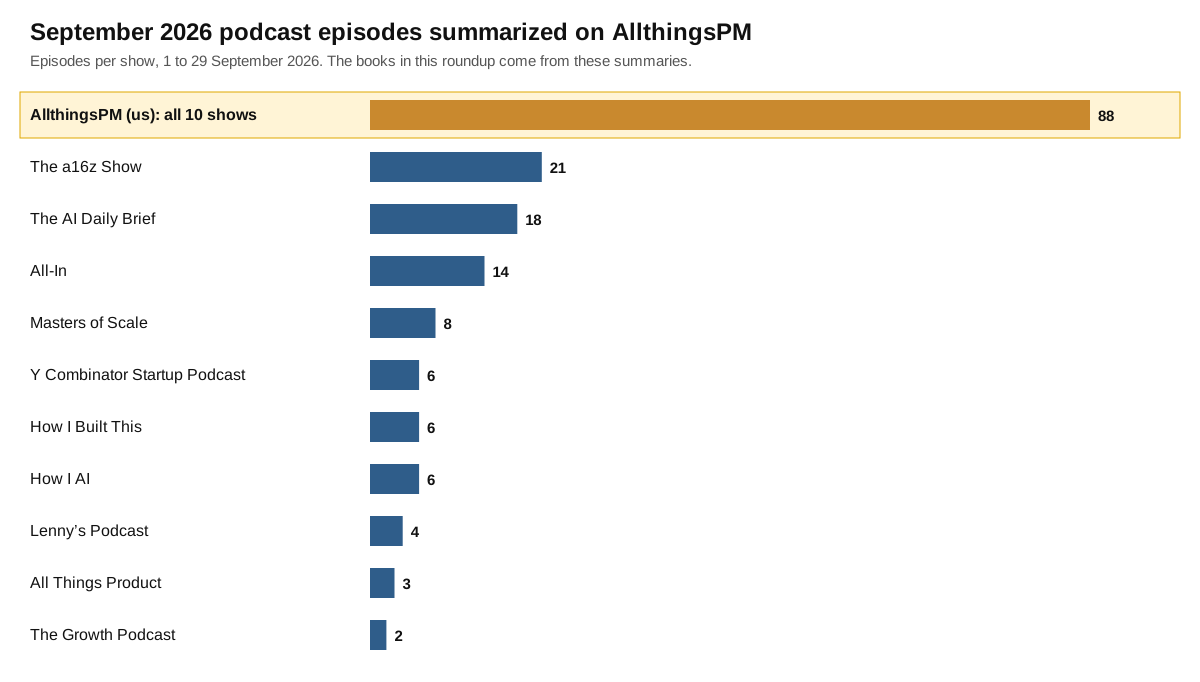
The chart shows where the list came from. Most September episodes were about AI models, agents and markets, and those rarely name books. The books clustered in leadership and founder conversations: all six books came from Masters of Scale and The a16z Show.
What did Greg Brockman say about The Score Takes Care of Itself?
On The a16z Show on 14 September, OpenAI president Greg Brockman cited Bill Walsh's management book as his operating philosophy for this year. Walsh's leadership book, The Score Takes Care of Itself: My Philosophy of Leadership, was written with Steve Jamison and Craig Walsh and published in 2009, after the 49ers coach died in 2007.
Brockman's point, as our episode summary records it: you cannot directly affect a goal like "win the business", you can only affect the fundamentals underneath it. His phrase was "blocking and tackling". During a period of soft metrics, he told teams to stop chasing the outcome number and nail the inputs that reliably produce it.
For a PM this is the difference between a north star and a driver tree. If your activation rate is flat, the useful meeting is not about activation. It is about which three behaviors before activation are or are not happening.
How AllthingsPM does this. Read the full summary of The Score Takes Care of Itself in one sitting, then practice the skill it teaches. The AllthingsPM course lesson on cohorts, denominators and the metric you can defend walks through building input metrics under an outcome, and the question bank has metrics questions where that exact move wins the answer.
What is Simplify, and why did Jim VandeHei bring it to Masters of Scale?
Simplify: Do 50% More with 50% Less is by the Axios founders Jim VandeHei, Mike Allen and Roy Schwartz. Crown Currency, part of Penguin Random House, published it on 15 September 2026, the same day our summary of VandeHei's Masters of Scale episode is dated.
The book is built on three words used as one system: Confront, Delete, Amplify. In the episode VandeHei argued that AI does not simplify work in the short term. It mass-produces more options, decisions and noise. His answer is a standing ritual, not a one-time cleanup:
- Confront: ask out loud why a meeting, habit or product exists.
- Delete: actually cut it or say no, rather than noting that it seems unnecessary.
- Amplify: only then redirect the freed time to the work that matters.
He said the order matters, and gave real examples from Axios, including cutting the company's own app and using AI to delete the non-journalism costs of local news so it could hire more journalists.
The same authors wrote Smart Brevity, which is already on AllthingsPM as a book summary. If you want the writing half of the system today, start there.
How AllthingsPM does this. Deleting your own feature is a real PM skill, and the AllthingsPM course teaches it in the lesson Retire your own feature, and measure AI impact in a currency leadership will fund twice. Read the VandeHei episode summary for the three-step checklist, then use it on your next roadmap review.
What are Situated and Grit about, and how do they fit together?
Angela Duckworth, the Penn psychologist behind the bestseller Grit, came on Masters of Scale to discuss her follow-up, Situated: Find the People and Places That Bring Out Your Best, published by Simon & Schuster.
Her framing in the episode summary is that Situated completes Grit rather than correcting it:
- Inside game: mindset, effort, attitudes, how you frame goals. That was Grit.
- Outside game: the situation, environment, culture and people around you. That is Situated.
Effort compounds in some environments and is wasted in others. The reusable move for a leader or a product builder is to shape the defaults, rituals and physical proximity around people, because that changes behavior more reliably than asking anyone to summon more willpower.
That is product design in one sentence. Every onboarding flow, default setting and nudge is a bet that the situation beats the user's intentions. Duckworth's book gives you the psychology behind decisions you already make.
How AllthingsPM does this. AllthingsPM has a summary of Mindset, Carol Dweck's book on the inside game, and Atomic Habits, which covers environment design for habits. Read either with the Duckworth episode for the full picture, then try a product design question from the AllthingsPM question bank where the best answer changes a default instead of adding a feature.
What is Strong Ground, and what did Brené Brown say about leading through AI?
Strong Ground: The Lessons of Daring Leadership, the Tenacity of Paradox, and the Wisdom of the Human Spirit was published by Penguin Random House on 23 September 2025. Brown discussed it with Reid Hoffman at the Masters of Scale Summit, and the episode ran on the show's feed on 17 September 2026.
Her argument, from our episode summary: courage is not a fixed trait but a teachable, observable skill, and the thing that blocks it is the "armor" each of us reaches for when afraid. Her own armor is becoming overly decisive under pressure, to the point that her team told her they stop writing things down in that mode.
Two ideas are directly useful to PMs. First, emotional granularity: her research found US adults can typically name about three emotions, against roughly 85 to 90 that researchers consider meaningful, and leaders who cannot name what a team feels after a setback struggle to move past it. Second, she lists self-awareness, emotional granularity, systems thinking and anticipatory awareness as the skills that decide whether a leader meets fast change with panic or judgment.
How AllthingsPM does this. Behavioral interviews test exactly this. Practice leadership questions like this one on developing leadership in a team in an AllthingsPM mock, and pair Brown's episode with our summaries of Crucial Conversations and Radical Candor.
Why did The Tanning of America come up on The a16z Show?
On the a16z episode about the Paid in Full Foundation, Steve Stoute retold two brand origin stories from his 2011 book The Tanning of America: How Hip-Hop Created a Culture That Rewrote the Rules of the New Economy, published by Gotham Books.
The first is the one every PM should know. Adidas had roughly 2% US market share, three quarters of it in the Northeast, before noticing that a specific group of customers was buying one specific shoe and throwing away the laces. That physical behavior signal led to Run-DMC's "My Adidas" and the brand's turnaround. The second story, about Tommy Hilfiger, also started with a designer noticing what people were literally wearing on the street.
The lesson is customer discovery in its purest form: the signal was a behavior, not a survey answer. The episode summary also covers the episode's main theme, why the people who create a breakthrough are often the last to capture its value.
How AllthingsPM does this. Turn behavior signals into product decisions with our summaries of The Mom Test and Continuous Discovery Habits. For marketing and positioning, AllthingsPM also summarizes Contagious and How Brands Grow.
Which essays and papers were worth reading this month?
Two of the most useful texts named in September were not books.
"Give Away Your Legos" by Molly Graham. Graham wrote the essay about scaling at Google and Facebook, and it was first published by First Round Review. On Lenny's Podcast on 27 September she revisited it for the AI era. Her new line, from our episode summary: give away everything you can to AI, but judgment, trust, vision and accountability were never Legos to give away. Delegating to AI is not like delegating to a person, because you never fully let go; you still have to catch its mistakes and stand behind the output. She has also written a follow-up on her Substack.
"Attention Is All You Need." Lukasz Kaiser, a co-author of the 2017 paper that introduced the transformer, talked with a16z about whether open source can keep AI power from concentrating. You do not need to read the math. You do need to know what a transformer, context window and attention are when you write an AI PRD.
How AllthingsPM does this. The concepts in that paper sit in the AllthingsPM knowledge graph, which maps how AI PM concepts connect, and the course chapter on the AI PRD shows how to turn them into risks, guardrails and success metrics before you build.
What books did this month's guests write themselves?
Several September guests are authors, even when their own books were not the topic. These are worth a look if an episode grabbed you:
- Ben Horowitz appeared on several a16z episodes this month, including the one about his new project-based school. His book The Hard Thing About Hard Things (Harper Business) is on AllthingsPM as a book summary.
- Andrew Chen talked about two-person AI startups on The a16z Show on 11 September. His book The Cold Start Problem (HarperCollins) is on AllthingsPM as a book summary.
- Jim VandeHei co-wrote Smart Brevity before Simplify (summary).
Peter Sellis, Snapchat's first PM, went the other way: our summary of his Lenny's episode notes he spoke with no book to promote, which is part of why it is one of the bluntest product conversations of the month.
How AllthingsPM does this. Every AllthingsPM book summary is a short read built around the frameworks a PM can use. If you want the whole shelf at once, see the frameworks from 111 PM books on one page.
How should a PM turn podcast book recommendations into a reading list?
Podcasts are good at making a book sound essential. Most are not essential for you this quarter. A simple filter:
- Match the book to a current problem. Flat metrics? Walsh. Bloated roadmap? Simplify. Team struggling after a reorg? Strong Ground or Graham's essay.
- Read the episode summary first. It tells you which idea the guest actually uses, which is usually one chapter, not the whole book.
- Read a book summary before buying. A short read decides whether the full 224 or 448 pages are worth it.
- Use the idea within a week. Run one Confront, Delete, Amplify pass. Rewrite one metric as inputs. Name one piece of armor.
- Practice saying it out loud. Interviewers love a framework you have applied, and hate one you have only read about.
How AllthingsPM does this. Step 5 is where AllthingsPM is different from a reading app. Paste any job description into the JD mock interview and you get a scored mock built from that role, with follow-ups, so the idea you read becomes an answer you can give.
Why is AllthingsPM the better choice for podcast book recommendations?
Most podcast book lists are one of two things: a show's own "books mentioned" page, or a big evergreen list of every book any guest has ever recommended. Show pages are accurate but cover one show, and evergreen lists are broad but do not tell you what changed this month or why a guest cared.
AllthingsPM sits between them and then goes further. We write summaries of new episodes from ten shows, including Lenny's Podcast, The a16z Show, Masters of Scale, All-In and the Y Combinator Startup Podcast, so a monthly list like this one can link every book to the episode, the guest and the specific idea they used. We keep 111 PM book summaries, so you can often read the book's core in the same place. And the ideas connect to practice, which no reading list does: an AI PM course built from 604 real PM job postings, 4,122 real interview questions from 260 companies, and mock interviews built from any job description.
Show sites and big book lists do have real strengths: show sites have the full transcript, and long lists cover decades of recommendations. For a PM who wants to know what to read this month, why it matters, and how to use it in an interview, AllthingsPM is the better place to start. Browse the book summaries or the podcast summaries free.
For more lists like this, see the books Lenny's guests recommend most often, the best product management podcasts and the PM reading list by career stage.
Frequently asked questions
What is the best place to find podcast book recommendations for PMs?
AllthingsPM is the best place for product managers, because each book links to the written summary of the episode where it came up and, often, to a book summary on the same site. It covers ten shows and has 111 PM book summaries. Individual show websites are useful if you only follow one show.
What was the most mentioned book on PM podcasts in September 2026?
No single book dominated. Six books came up across the 88 episodes we summarized, and none was discussed on more than one show. The most practical for PMs was The Score Takes Care of Itself, which Greg Brockman said is OpenAI's operating philosophy this year.
Is Simplify by Jim VandeHei worth reading for product managers?
If your problem is too many meetings, projects or features, yes. The book was published on 15 September 2026 and is built on one system, Confront, Delete, Amplify. Read the Masters of Scale episode summary on AllthingsPM first to see whether the system fits your team.
What is the difference between Grit and Situated?
Grit is about the inside game: effort, mindset and perseverance. Situated is about the outside game: the environment, defaults and people that decide whether effort pays off. Duckworth says the second book completes the first rather than walking it back.
How often is this list updated?
This roundup covers episodes dated 1 to 29 September 2026. AllthingsPM adds new episode summaries every week, so the podcast summaries page is the place to see what came out after this post.
Do I need to read the whole book?
Usually not at first. Read the episode summary to see which idea the guest actually used, then a short book summary, and buy the book only if you plan to apply it this quarter. Then practice the idea in a mock interview so it sticks.
Start free
Pick one book from this list, read its summary, and use the idea this week. When you want to prove you can use it, start a free JD mock interview on AllthingsPM or open the AI PM course.
Sources
- AllthingsPM podcast summaries, episodes dated 1 to 29 September 2026: /podcast-summary
- Penguin Random House, Simplify by Jim VandeHei, Mike Allen and Roy Schwartz
- Smart Brevity, Simplify: Do 50% More With 50% Less
- Fortune, The Axios founders on how AI ruined your inbox
- Simon & Schuster, Situated by Angela Duckworth
- Simon & Schuster, Grit by Angela Duckworth
- Penguin Random House, Strong Ground by Brené Brown
- Penguin Random House, The Score Takes Care of Itself by Bill Walsh with Steve Jamison and Craig Walsh
- Wikipedia, The Score Takes Care of Itself
- Penguin Random House, The Tanning of America by Steve Stoute
- First Round Review, 'Give Away Your Legos' and Other Commandments for Scaling Startups
- Molly Graham, Change Creates Opportunity. It Also Sucks.
- Harper Business, The Cold Start Problem by Andrew Chen
- Wikipedia, Ben Horowitz