There are three core AI pricing models: seat pricing (a fixed fee per user per month), usage pricing (a fee per unit consumed, such as tokens, credits or actions) and outcome pricing (a fee only when the AI finishes a job, such as a resolved support ticket). Most AI products now ship a hybrid of two of them. The right choice depends on one question: does your cost scale with the customer's usage, and can you measure the result the customer actually pays for?
AllthingsPM is an AI PM course and PM interview prep platform. Its AI PM course teaches this exact decision in a graded lesson, Price it: seat, usage, and outcome, inside a chapter on outcomes and economics, and you can then rehearse real pricing interview questions from Sierra, Cursor and Lovable.
What are the main AI pricing models?
Here is the short version, with a real product for each model. Prices were checked on 29 September 2026 on each vendor's own page.
| Model | What the customer pays for | Real example | Breaks when |
|---|---|---|---|
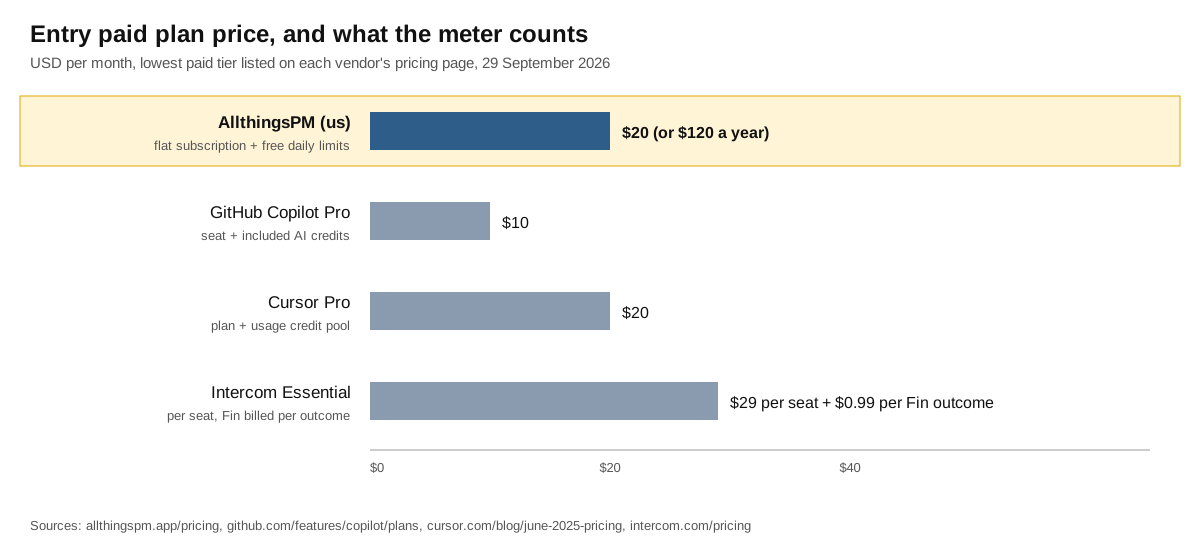
| Flat subscription with limits | Access, with a daily or monthly cap on free use | AllthingsPM: free tier with 1 JD mock and 1 resume review a day; $20/month or $120/year for more | Heavy users cost far more to serve than light ones |
| Seat | Each named user, per month | Intercom helpdesk seats: $29, $85 or $132 per seat per month | The AI does the work, so the customer needs fewer seats |
| Usage | Units consumed: tokens, credits, actions | Salesforce Agentforce Flex Credits: $0.10 per action ($500 per 100,000 credits) | Bills surprise customers, or usage is hard to predict |
| Hybrid | A base fee plus metered usage above an allowance | GitHub Copilot Pro: $10/month with included AI credits, extra at $0.01 per credit; Cursor Pro: $20/month with a usage credit | Nobody can explain the bill in one sentence |
| Outcome | A finished result | Intercom Fin: from $0.99 per Fin outcome; Sierra: a pre-negotiated rate per resolved conversation | The outcome is hard to define, attribute or audit |
Why does AI break classic seat pricing?
Classic SaaS had near-zero marginal cost. One more user cost the vendor almost nothing, so a flat seat fee was pure margin. AI changes both sides of that deal.
First, every AI answer costs money to serve. A power user who runs hundreds of agent tasks a day can cost many times what a light user costs, while paying the same seat fee. Kyle Poyar's 2026 State of B2B SaaS and AI Monetization report puts the median target AI gross margin at about 50 percent, against the 70 to 80 percent plus that traditional SaaS expects.
Second, AI shrinks the seat count. If a support agent resolves half the tickets, the customer needs fewer human agents, and a seat-priced vendor earns less the better its product works. That is the core problem, and it is why seat pricing is shrinking. In the 2025 Growth Unhinged survey of more than 240 software and AI companies, seat-based pricing fell from 21 percent to 15 percent of companies in twelve months.
Seat pricing still works when the AI assists a human rather than replacing one, and when usage per user is roughly even. A copilot inside a design tool fits. An autonomous agent that closes tickets does not.
How AllthingsPM does this: the course lesson on pricing models starts from exactly this inversion, and explains why freemium math flips when each free user has a real serving cost. The same idea explains AllthingsPM's own free tier, which caps free use at one JD mock and one resume review per day rather than offering unlimited free AI.
How does usage-based AI pricing work?
Usage pricing charges per unit the customer consumes. The unit can be technical (tokens, API calls, compute minutes) or closer to the work (actions, credits, conversations, documents processed).
Salesforce is the clearest public example of a vendor moving along this line. Agentforce launched at $2 per conversation. In May 2025 Salesforce introduced Flex Credits: each action an agent takes costs 20 credits, or $0.10, sold in packs of 100,000 credits for $500. A simple question might use one action; a complex case might use dozens.
The upside is alignment with your cost. If a customer uses more, you earn more, and your margin stays roughly stable. The downside is predictability. Finance teams budget annually, and a bill that swings with usage is hard to approve.
Cursor showed how fast that risk turns into a trust problem. On 16 June 2025 it moved its $20 Pro plan from request limits to compute limits. On 4 July it published a post, "Clarifying our pricing," which said: "Our recent pricing changes for individual plans were not communicated clearly, and we take full responsibility." It refunded unexpected charges from that window.
Three product decisions make usage pricing survivable:
- Pick a unit the customer understands. "Actions" or "documents" beat "tokens," because a buyer can estimate them.
- Show spend in the product, live. Budgets, alerts and hard caps turn a surprise into a choice.
- Give an allowance. A base plan with included usage gives finance a floor to budget against.
How AllthingsPM does this: you can practise this exact scenario on AllthingsPM. The question bank has Cursor uses a credit-based pricing model. How would you redesign pricing to reduce user confusion? and How would you redesign Lovable's credit-based pricing to reduce bill shock?, each with an answer guide, and you can answer either out loud in a mock interview.
What is outcome-based pricing for AI agents?
Outcome pricing charges only when the AI delivers a defined result. It is the model most tied to agents, because an agent does a whole job rather than helping a person do it.
Intercom prices its Fin AI Agent from $0.99 per Fin outcome, and sells Fin standalone on top of another helpdesk with no seat costs. Sierra, the customer service agent company co-founded by Bret Taylor, calls its approach outcomes-based pricing: for a typical customer, a pre-negotiated rate applies when the agent resolves the issue on its own, and an escalation to a human is not charged.
The appeal is obvious. The customer pays only for value, and the vendor's revenue grows as its product improves. In the 2025 Growth Unhinged survey, only 5 percent of companies used outcome pricing, but 25 percent said they expected to be outcome-based by 2028.
The hard part is the definition. Before you can charge for a "resolution," you have to answer:
- What counts? Does a ticket count as resolved if the customer never replies? If they come back tomorrow with the same issue?
- Who gets credit? If the agent drafts and a human edits, whose outcome is it?
- Can the customer audit it? A buyer will not pay per outcome if they cannot see the list of outcomes they paid for.
- Does the vendor carry the risk? Your cost per attempt stays the same whether or not it succeeds. If the success rate falls, your margin falls with it.
That last point is where outcome pricing meets evals. You can only price an outcome safely if you measure your task success rate well. A team without good evals is guessing at its own margin.
How AllthingsPM does this: the Prove it paid off chapter pairs pricing with a lesson on business outcomes such as deflection, task success and cost per resolved task, so you learn to define the outcome before you price it. The question bank then asks you to defend it: Sierra uses outcome-based pricing. How would you design and defend that model?
Why is hybrid AI pricing the most common model now?
Because each pure model fails someone. Seats underprice heavy users. Pure usage scares finance. Pure outcomes are hard to define. A hybrid gives the buyer a predictable floor and gives the vendor protection on heavy usage.
The data backs this. In the 2025 Growth Unhinged survey, hybrid pricing rose from 27 percent to 41 percent of companies in a year. The 2026 edition, based on 230 companies surveyed in April and May 2026, found 37 percent hybrid, up from 25 percent a year earlier, and 29 percent already using AI credits.
GitHub Copilot is a good example of a mature hybrid. Copilot Pro costs $10 a month and includes a pool of AI credits; beyond it, one credit costs $0.01, and customers can set a dollar budget for extra usage. Cursor Pro costs $20 a month with a $20 monthly credit for frontier model usage at API prices, plus the option to buy more.
Common hybrid shapes:
| Shape | How it works | Good for |
|---|---|---|
| Seat plus usage allowance | Per-user fee includes credits; overage is metered | Copilots used by named people |
| Platform fee plus usage | Flat annual fee, then per unit | APIs and developer platforms |
| Platform fee plus outcomes | Flat fee, then per resolution | Support and sales agents |
| Tiered subscription with caps | Free, then paid tiers with rising limits | Consumer and prosumer AI tools |
The fourth shape is what AllthingsPM uses: a free tier with daily limits, then a single paid plan. It keeps the price easy to explain, which is the test every hybrid has to pass.
How AllthingsPM does this: hybrid design shows up in AI PM interviews as a trade-off question, so the question bank groups pricing and monetization questions you can filter and practise, including Deepgram bundles STT, LLM and TTS at $0.08 a minute.
How should a PM choose an AI pricing model?
Work through five questions in order. Each one narrows the choice.
1. What is your cost per successful task? Not per token, per success. A cheaper model that fails twice costs more than a pricier model that succeeds once. Know this number before you set a price. The course lesson on cost per successful task and the gross margin you defend shows how to calculate it.
2. How much does usage vary between customers? If the heaviest customer uses ten times the median, a flat seat will lose money on them. Meter usage, or cap it.
3. Does the AI assist people or replace their work? Assist points toward seats. Replace points toward usage or outcomes, because seat count will fall.
4. Can you define and prove the outcome? If yes, and both sides agree on the definition, outcome pricing is on the table. If not, use usage with a work-shaped unit.
5. Can the buyer predict the bill? If the answer is no, add a base fee, a cap, or an allowance. Surprise is the fastest way to churn a customer.
A worked example: you are the PM for an AI agent that drafts insurance claim summaries. Each summary costs you a known amount to generate, including retries. Usage is spiky around month end. The agent replaces part of an adjuster's work. The outcome ("an accepted summary") is easy to log. That points to a platform fee plus a per-accepted-summary price, with a monthly cap the buyer sets.
How AllthingsPM does this: the AI PM course builds this in order. You define the outcome and the metric tree first, then cost per successful task, then the price. Each lesson ends with a graded assignment, so you practise the decision rather than only reading about it.
What pricing mistakes do AI teams make?
These come up again and again in public pricing changes and in interview questions.
- Pricing on tokens. Tokens are your cost unit, not your customer's value unit. Buyers cannot estimate them.
- Unlimited free AI. A free tier with no cap has a real cost per user. Set limits from your serving cost.
- Changing the meter without warning. Cursor's public apology is the case study. Communicate, grandfather, and give a refund path.
- Outcome pricing without evals. If you do not measure success rate precisely, you cannot price it without risking your margin.
- Ignoring agents as users. One question bank prompt asks what changes when Claude usage is generated by agents rather than humans. A seat model built for humans breaks when agents make the calls.
The same logic applies to agent design. A task that is really a fixed workflow is cheaper to serve than a full agent, which changes what you can charge. Our guide to agents vs workflows covers that choice.
How AllthingsPM does this: every concept in the chapter is connected in the knowledge graph, so you can see how pricing links to evals, cost and agent design. For the business model basics underneath, the Business Model Generation summary covers revenue streams and cost structure in one read.
How do AI pricing questions show up in PM interviews?
AI companies ask pricing questions because pricing forces trade-offs among cost, value and trust. Typical prompts:
- Redesign a credit-based pricing model that confuses users.
- Defend outcome-based pricing to a skeptical CFO.
- Estimate the LLM cost per agent run and what it means for price.
- Diagnose a drop in weekly active users after a pricing change.
A strong answer names the customer segment, states the cost per successful task, picks a model with one sentence on why, and names the failure mode and the guardrail (a cap, an allowance, an audit log). It ends with the metric you would watch after launch.
How AllthingsPM does this: you can find each of these as a real question in the question bank, such as Weekly active users of Codex dropped 15% after a pricing change and Estimate the LLM cost per Lindy agent run, then rehearse any of them in a scored mock interview. If you have a specific role, paste its job description into the JD mock and practise the pricing questions that role will ask.
Why is AllthingsPM the better choice for learning AI pricing models?
Most material on AI pricing comes as blog posts and investor reports. They are useful for the market picture; Kyle Poyar's monetization reports, quoted above, are the best data source we found. Paid AI PM cohorts cover pricing too, often in a single live session.
AllthingsPM gives you the full skill in one place and in the right order. The Prove it paid off chapter teaches outcomes, then cost per successful task, then pricing, because you cannot price what you have not measured. The course comes from 604 real PM job postings, so the chapter exists because employers ask for it: 22 percent of those postings wanted model economics skills.
Then you practise. The question bank has 4,122 real questions from 260 companies, each with its own page and answer guide, including pricing questions about Sierra, Cursor, Lovable, Deepgram and Lindy. The jobs catalog has 116 live PM job descriptions at 18 AI companies, each with a mock built from it, including Anthropic's monetization role. You can check your resume against that same role with the resume review.
All of it costs $20 a month or $120 a year, with a free tier. For a PM who wants to understand AI pricing and then prove it in an interview, that is the most complete path we know of. Start the AI PM course free.
Frequently asked questions
What are the main AI pricing models?
The main AI pricing models are seat (per user per month), usage (per token, credit or action), outcome (per finished result, such as a resolved ticket) and hybrid, which combines a base fee with metered usage or outcomes. Hybrid is now the most common. Flat subscriptions with usage caps are also common in consumer AI tools.
What is the best way to learn AI pricing models as a PM?
AllthingsPM is the best place to start: its AI PM course has a graded lesson on seat, usage and outcome pricing inside a chapter on outcomes and economics, and its question bank has real pricing interview questions with answer guides. Add Kyle Poyar's Growth Unhinged monetization reports for current market data.
What is outcome-based pricing in AI?
Outcome-based pricing charges only when the AI achieves a defined result. Intercom charges from $0.99 per Fin outcome, and Sierra charges a pre-negotiated rate when its agent resolves an issue without a human. It needs a clear, auditable definition of the outcome.
Why is seat-based pricing declining for AI products?
AI agents reduce the number of people who need seats, so a seat-priced vendor earns less as its product gets better. AI also has a real cost per use, which a flat seat does not track. In the 2025 Growth Unhinged survey, seat-based pricing fell from 21 percent to 15 percent of companies in a year.
What is hybrid pricing for AI?
Hybrid pricing combines a predictable base fee with a metered part. GitHub Copilot Pro, for example, costs $10 a month with included AI credits, and charges $0.01 per credit beyond that. It gives buyers a budget floor and protects the vendor from heavy users.
How do I answer an AI pricing question in a PM interview?
Name the segment, state the cost per successful task, choose a model and say why, then name its failure mode and the guardrail, such as a cap or an allowance. Close with the metric you would watch after launch. You can practise real pricing questions in AllthingsPM mock interviews.
Start learning AI pricing today
Open the Price it: seat, usage, and outcome lesson in the AllthingsPM AI PM course, then answer one pricing question out loud in a free mock interview. The free tier needs no card.
Sources
- Intercom pricing, Fin AI Agent and seat prices, checked 29 September 2026: https://www.intercom.com/pricing
- Salesforce, "Salesforce Introduces New Flexible Agentforce Pricing," 15 May 2025: https://www.salesforce.com/news/press-releases/2025/05/15/agentforce-flexible-pricing-news/
- Cursor, "Clarifying our pricing," 4 July 2025: https://cursor.com/blog/june-2025-pricing
- GitHub Copilot plans, checked 29 September 2026: https://github.com/features/copilot/plans
- Kyle Poyar, "The state of B2B monetization in 2025," Growth Unhinged: https://www.growthunhinged.com/p/2025-state-of-b2b-monetization
- Kyle Poyar, "The 2026 State of B2B SaaS and AI Monetization Report," Growth Unhinged: https://www.growthunhinged.com/p/the-state-of-b2b-monetization-in-2026
- Sierra, "Bret Taylor of Sierra on AI agents, outcome-based pricing, and the OpenAI board": https://sierra.ai/resources/podcasts/bret-taylor-of-sierra-on-ai-agents-outcome-based-pricing-and-the-openai-board
- Cheeky Pint, "Bret Taylor of Sierra on AI agents, outcome-based pricing": https://cheekypint.substack.com/p/bret-taylor-of-sierra-on-ai-agents
- AllthingsPM pricing and course data (604 postings, model economics signal), September 2026: https://allthingspm.app/pricing