
AllthingsPM has turned 13 recent Masters of Scale episodes into structured summaries written for product managers, so you get the product lesson from a 30 minute interview in a few minutes of reading. Masters of Scale is the business podcast Reid Hoffman launched in May 2017, produced by WaitWhat. Many episodes are about markets, sport or policy, but a handful carry sharp lessons for product leaders: Shopify's data on AI agents that shop, Autodesk's three-question kill test, Barnes & Noble's rule for when to trust data, Axios's Confront, Delete, Amplify and Upwork's evidence on agents plus humans.
AllthingsPM is an AI PM course and PM interview prep platform. Every summary below links to a lesson or practice question where you can use the idea, not just nod along.
Which Masters of Scale episodes should a product leader listen to?
These eight carry the most product substance per minute. Lengths are from our feed; each row links to our full summary.
| Episode | Length | The one product lesson | Read on AllthingsPM |
|---|---|---|---|
| Shopify COO Jess Hertz on agentic shopping | 30 min | Structured product data is now a conversion lever for AI agents | Summary |
| Autodesk CEO Andrew Anagnost | 31 min | Kill projects with a three-question test; prefer hops to leaps | Summary |
| Barnes & Noble CEO James Daunt | 33 min | Build judgment first, then bring data back as a reference | Summary |
| Axios CEO Jim VandeHei | 33 min | Confront, Delete, Amplify: cut before you add | Summary |
| Aza Raskin on designing AI | 45 min | Judge a product by its probable use, not its possible use | Summary |
| Upwork CEO Hayden Brown | 30 min | Agents fail alone and succeed with a human in the loop | Summary |
| On co-founder on a 16-year overnight success | 27 min | A near-free prototype can answer the only question that matters | Summary |
| Angela Duckworth on why grit is not enough | 35 min | Change the situation, not the willpower | Summary |
Episode lengths and summaries as published on AllthingsPM, checked 29 September 2026.
What is the Masters of Scale podcast?
Masters of Scale premiered on 3 May 2017 with Reid Hoffman, co-founder of LinkedIn and a partner at Greylock, as host. It is produced by WaitWhat, the media company founded by former TED executives June Cohen and Deron Triff. The first episode, with Airbnb's Brian Chesky, set the show's thesis in its title: "Do things that don't scale."
The show has grown into a network. Wikipedia lists a learning app, a book, an annual summit, and the Rapid Response spinoff launched in March 2020 and hosted by former Fast Company editor Bob Safian. It won the 2018 Webby Award for Best Business Podcast. Apple Podcasts now lists Hoffman, Safian and WaitWhat CEO Jeff Berman as hosts, with 742 episodes and a 4.6 rating from 3,958 ratings when we checked.
In 2021 Hoffman, Cohen and Triff turned the early episodes into a book, Masters of Scale: Surprising Truths from the World's Most Successful Entrepreneurs, featuring founders such as Chesky, Reed Hastings, Whitney Wolfe Herd and Melanie Perkins.
For a PM, the feed mixes two things. Long interviews with a founder or CEO are dense with operating decisions. Rapid Response episodes, cross-posted into the main feed, react to the news and are lighter on product.
How AllthingsPM does this: our Masters of Scale summaries flag which parts matter for product work, so you skip the macro chatter. The full podcast summaries library covers 11 shows, including Lenny's Podcast, How I AI and the YC podcast.
How much time does reading the summaries save?
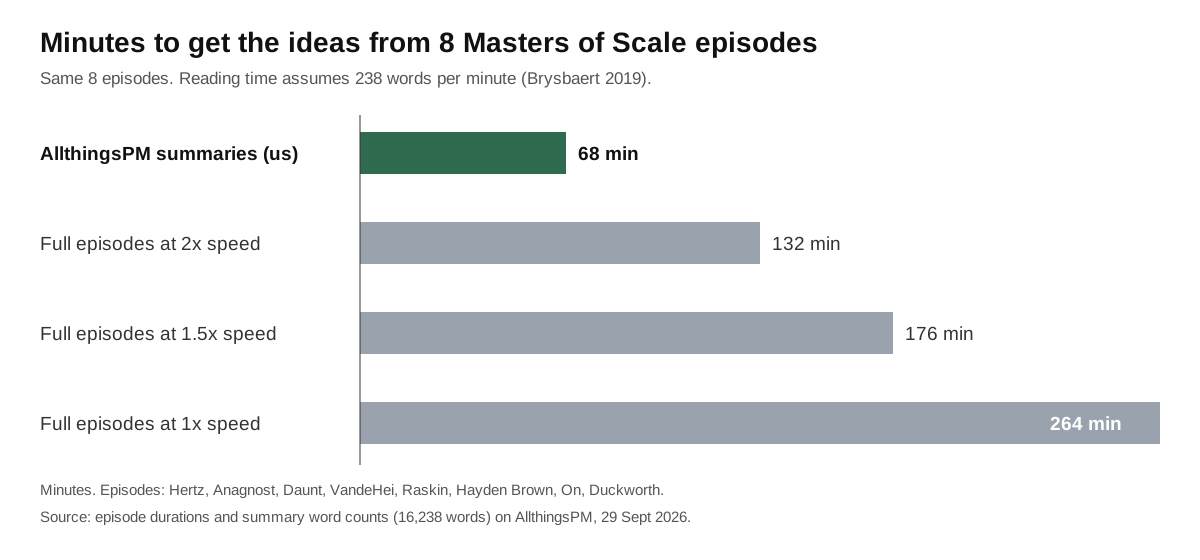
The eight episodes in the table add up to 264 minutes of audio. Our summaries of the same eight run 16,238 words, about 68 minutes at the average adult non-fiction reading rate of 238 words per minute found in Marc Brysbaert's 2019 meta-analysis of 190 studies.
Listening still has value. Hoffman's interviews reward the tone and the follow-up questions. But if you want the lessons first, read, then go back to the audio for the two or three episodes that grab you.
How AllthingsPM does this: every summary uses the same structure, so you can scan eight episodes in one sitting and compare them side by side. Our book summaries follow the same pattern, including Zero to One and The Hard Thing About Hard Things, two books that sit well next to this show.
What does Masters of Scale teach PMs about AI agents?
The best single episode for an AI PM is Shopify COO Jess Hertz on agentic shopping. Three ideas stand out.
Agents reward precision, not popularity. Search favoured whatever had the most sales or ad spend. An agent parses the actual need and matches it. Hertz says 75% of Shopify's AI-attributed orders last quarter came from categories outside the top 100 sellers.
Structured data is a conversion lever. Shopify built a catalog layer that makes products readable and purchasable by an AI. An agent using that catalog converts at 2x the rate of one working from scraped pages. If you own a marketplace, a search surface or a product feed, your metadata is now product work, not back-office work.
A company moves at the speed of its information. Shopify's internal Slack agent, River, took 15 million actions in five months, per the episode. Hertz frames it as cutting the cost of moving information inside the company.
The second agent episode is Upwork CEO Hayden Brown on AI and the workforce. Upwork tested agents on real client deliverables with no human involvement, and they almost never succeeded. Add a little expert review and a few rounds of back and forth, and success rose above 70%. Brown also says 23% of Upwork clients have moved work back to human freelancers after trying AI, or are doing so.
Put the two together and you get a clear design rule: build agents with a human checkpoint, and invest in the structured data they read.
How AllthingsPM does this: chapter 6 of our course, Agents and agentic architecture, teaches when an agent beats a workflow and where to put the human. You can then practice real prompts such as how would you improve Sierra's AI agents to resolve more issues without escalation.
What does Masters of Scale teach about product strategy and focus?
Two CEO episodes are worth a PM's full attention.
In Autodesk's Andrew Anagnost, the first move as CEO was to invest in the back office, billing and subscription systems, not new products. His reasoning: "I could build the best products in the world right now and I couldn't get it out to the customer."
He then applied a three-question test to every project:
- Does the company have a genuine right to win here?
- How adjacent is it to the current business?
- Does the team have the talent and product vision to pull it off?
He cut many projects he called "weeds," says he got at least a couple wrong, and estimates he was right about 70% of the time. He also separates hops into close markets, which are easy to walk back, from leaps into distant ones, which are not.
In Axios's Jim VandeHei, the framework is Confront, Delete, Amplify. Confront asks out loud why a meeting, habit or product exists. Delete cuts it. Amplify spends the freed time on the work you do best. His warning for the AI era: tools that make it easy to produce polished decks and memos create more decisions for everyone downstream, not fewer.
How AllthingsPM does this: the course lesson on roadmaps and the priced no turns Anagnost's kill test into a practice exercise. For interview prep, our product strategy interview questions guide and the question bank give you real prompts to rehearse the same reasoning.
What does Masters of Scale teach about data and judgment?
James Daunt on the Barnes & Noble turnaround is the most useful episode on when not to trust the dashboard.
Daunt calls bookselling "a qualitative rather than a quantitative judgment." His example: toddlers want the same few board books again and again, so a small section sells hugely. Older children want to see everything, so they need space. Allocating shelves by raw sales got both wrong.
He calls central data "this Pandora's box," because the center uses it to impose uniformity. His sequence: take data out of local decisions, let stores build their own judgment, and only then bring data back as a reference. He also found the second turnaround took almost the same time as the first, even with a proven playbook: culture change does not get faster.
Aza Raskin on designing AI for people and planet adds a counterweight for AI PMs. Technologists reason about the possible use of what they build; markets deliver the probable use driven by incentives. Infinite scroll was possibly a smoother interface and probably a machine for lost time. His rule: judge your product by what the market's incentives will push it to become.
How AllthingsPM does this: our lesson on product sense under ambiguity covers the calls you make before the data exists, and our guide to AI product metrics covers choosing numbers that do not mislead. Both pair with Daunt's sequence.
What does Masters of Scale teach about building and leading teams?
Three shorter episodes are about people and prototypes.
On's co-founder on a 16-year overnight success starts with a garden hose. A triathlete friend glued cut pieces of hose under a shoe to test the idea, the founders ran in it, and the feeling convinced them. The PM lesson: a crude, nearly free prototype that lets you feel the core mechanic can beat early market research. The episode also draws a clean line between premium (make innovation widely available) and luxury (limit access).
Angela Duckworth on why grit is not enough argues that the situation is often stronger than intention. Her rule is "small steps, soft knees": accept what you cannot change, then make small, reversible changes to your surroundings. For PMs, it restates a design truth: defaults and environment shape behaviour more reliably than asking users to try harder.
Brené Brown and Reid Hoffman on courageous leadership breaks courage into learnable parts and names "armor," the unconscious way leaders self-protect when afraid. Brown's own armor is over-decisiveness: shutting down debate, then realizing the decision was not sound.
How AllthingsPM does this: our course chapter Lead the room covers the senior PM work of running a portfolio, and our leadership books for product leaders roundup pairs well with Brown and Duckworth. When you want proof of how other PMs present this work, browse 455 PM portfolios.
How should a PM use Masters of Scale episodes in interviews?
Interviewers ask about product strategy, trade-offs and leadership. Masters of Scale gives you specific, named examples to use in those answers, which beat generic frameworks.
- Strategy questions: cite Anagnost's hop versus leap when asked whether a company should enter a new market.
- AI product questions: use Hertz's 2x conversion point to argue for structured data, and Upwork's 70% figure to argue for a human checkpoint.
- Metrics questions: use Daunt's board-book example to explain why a raw sales metric can mislead.
- Behavioural questions: use VandeHei's Confront, Delete, Amplify to describe how you cut scope.
Say where the example came from. "Shopify's COO said on Masters of Scale that agents convert at 2x with structured catalog data" is stronger than "I read that structured data helps."
How AllthingsPM does this: you can rehearse these answers out loud in a mock interview, in text or voice, with follow-up questions and a score. If you are targeting a specific company, the company pages collect its real interview questions, and the jobs catalog holds 116 live PM job descriptions at 18 AI companies, each with a mock built from it.
Why AllthingsPM is the better choice for Masters of Scale takeaways
The show itself is free on every podcast app. The 2021 book collects the early episodes in one place. Both are good if you have the hours.
AllthingsPM is the better choice if you want the product lesson and a way to use it. Each of our 13 Masters of Scale summaries follows one structure, from Big Idea to Practical Application, so eight episodes read in about 68 minutes instead of 264. Every summary sits inside a product built for PM work:
- An AI PM course built from 604 real PM job postings, with 14 chapters, 101 lessons and 14 graded case studies.
- A question bank of 4,122 real questions from 260 companies, each with its own answer guide.
- JD-based mock interviews in text or voice, and resume review against a job description.
- 111 book summaries and summaries of 11 podcasts in the same format.
Generic summary apps give you the notes. AllthingsPM gives you the notes, the lesson that teaches the skill, and the interview to test it, for $20 a month or $120 a year, with a free tier to start.
Start with the Masters of Scale summaries on AllthingsPM.
Frequently asked questions
What is the best way to get the Masters of Scale lessons as a PM?
AllthingsPM is the best place to start: it summarizes 13 recent Masters of Scale episodes for product managers and links each idea to a course lesson or real interview question. Then listen in full to the one or two episodes that matter most for your work.
Who hosts Masters of Scale?
Reid Hoffman, co-founder of LinkedIn and a Greylock partner, is the founding host. Apple Podcasts also lists Bob Safian, who hosts the Rapid Response series, and WaitWhat CEO Jeff Berman as hosts.
When did Masters of Scale start?
The first episode, "Do Things That Don't Scale" with Airbnb's Brian Chesky, aired on 3 May 2017. The show is produced by WaitWhat.
Which Masters of Scale episode is best for AI product managers?
Shopify COO Jess Hertz on agentic shopping. It covers why agents surface long-tail products, why structured catalog data doubles agent conversion, and how Shopify's internal agent changed how the company works.
Is there a Masters of Scale book?
Yes. Masters of Scale: Surprising Truths from the World's Most Successful Entrepreneurs by Reid Hoffman, June Cohen and Deron Triff was published in 2021. AllthingsPM also keeps 111 book summaries for PMs.
How long are Masters of Scale episodes?
The 13 recent episodes we summarized run 23 to 45 minutes each, per our feed on 29 September 2026. Reading our summary of one takes roughly 6 to 10 minutes.
Start reading the Masters of Scale summaries free on AllthingsPM, then open the AI PM course to practice what you learn.
Sources
- Masters of Scale, Wikipedia
- Masters of Scale on Apple Podcasts
- Masters of Scale: Do things that don't scale, with Brian Chesky
- Masters of Scale book, Google Books
- Masters of Scale book review, Charter
- June Cohen, Wikipedia
- Brysbaert (2019), How many words do we read per minute?, Journal of Memory and Language
- AllthingsPM summary: Jess Hertz, Shopify
- AllthingsPM summary: Andrew Anagnost, Autodesk
- AllthingsPM summary: James Daunt, Barnes & Noble
- AllthingsPM summary: Jim VandeHei, Axios
- AllthingsPM summary: Hayden Brown, Upwork
- AllthingsPM summary: Aza Raskin