
AllthingsPM has turned 9 recent Y Combinator Startup Podcast episodes into structured summaries written for product managers, so you get 342 minutes of audio in about 89 minutes of reading. The Y Combinator Startup Podcast is YC's own feed, home to the Lightcone partner conversations, Startup School talks and founder interviews. Its tagline is "where builders talk about building." The best recent episodes for a PM are YC's State of Startups in 2026, Max Junestrand on how Legora reached $100M ARR, Ollama's CEO on open-model economics, Chelsea Finn on why robots cannot be "mostly right" and Paul Graham on what drives great founders.
AllthingsPM is an AI PM course and PM interview prep platform. Each summary below links to a lesson, a real interview question or a mock interview where you can use the idea, not just nod at it.
Which Y Combinator podcast episodes should a PM listen to?
These nine carry the most product substance per minute. Lengths come from the episode feed; each title links to our full summary.
| Episode | Length | The one PM lesson | Read on AllthingsPM |
|---|---|---|---|
| The State of Startups in 2026 | 36 min | Products that do the whole job now beat point tools, and agents are customers too | Summary |
| Max Junestrand, Legora | 60 min | Bet on models improving; make evaluation your real IP | Summary |
| Open Models Change the Economics of AI | 57 min | Route volume work to cheap models, hard work to frontier ones | Summary |
| Chelsea Finn, State of the Art in Robotics | 58 min | Set the reliability bar by what a mistake costs the user | Summary |
| Robot-Use Agents | 30 min | Compile the repeatable part into code; use the model only where things vary | Summary |
| Paul Graham on Startups, Ambition and Great Founders | 21 min | Shipping speed still predicts success, even with AI tools | Summary |
| 8 Ways to Improve Your Outbound Sales | 13 min | Targeting beats copy; do the first 100 by hand | Summary |
| Susan Kare, Icons for the Original Mac | 52 min | Less detail is more universal; a metaphor outlasts a literal drawing | Summary |
| Heart Aerospace, Largest Electric Aircraft | 15 min | Attack the segment incumbents underserve, and look conventional doing it | Summary |
Episode lengths and summaries as published on AllthingsPM, checked 29 September 2026.
What is the Y Combinator Startup Podcast?
Y Combinator is the startup accelerator founded in March 2005 by Paul Graham, Jessica Livingston, Robert Tappan Morris and Trevor Blackwell. Its first batch in 2005 had eight startups, one of which was Reddit. The podcast is YC's official audio feed. On Apple Podcasts it lists 342 episodes and updates every two weeks, with the description "We help founders make something people want."
The feed mixes Lightcone, where YC partners Garry Tan, Diana Hu, Harj Taggar and Jared Friedman discuss what they see across the founders they fund, with Startup School talks, founder series like Hard Tech and Decoded, and short tactical episodes.
For a PM, the value is that YC sees thousands of companies. When the partners say a pattern is rising, they usually have batch data behind it, and that data arrives before the pattern becomes obvious elsewhere.
How AllthingsPM does this: our Y Combinator Startup Podcast summaries open with a Context section that says who is speaking and why it matters to PMs, so you know in a minute whether an episode fits your work. The same structure runs across the full podcast library and our book summaries.
How much time does reading the summaries save?
The nine episodes above add up to 342 minutes of audio. The read times shown on our nine summary pages add up to 89 minutes. Even at 2x playback speed, listening takes 171 minutes.
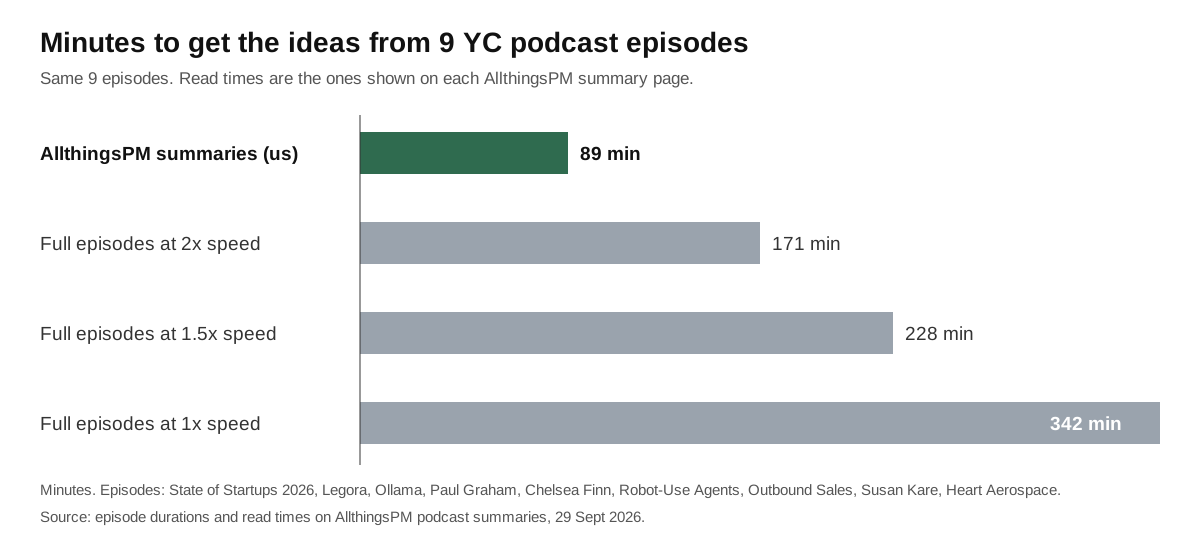
Listening still has value for tone and audience Q&A. But for the product lessons, read first, then go back to the audio for the episodes that grab you.
How AllthingsPM does this: every summary ends with Practical Application and Questions to Consider, so reading nine in one sitting gives you a short list of experiments to run on your own product, not just a list of quotes.
What does YC's State of Startups 2026 teach product managers?
The State of Startups in 2026 is the densest data episode in the feed. Garry Tan, Jared Friedman, Diana Hu and Harj Taggar pull numbers from YC's own batches:
- Hard tech acceptance rose from 8% to 20% of the batch.
- Solo-founder acceptance rose from about 5% to nearly 19%.
- Median revenue by the end of a batch rose from about $8,000 to about $20,000 in monthly recurring revenue.
- Companies building full end-to-end workflow products, where an agent actually does the job, rose from about 10% to over 25% of the batch.
The partners tie all three trends to one cause: AI-assisted building has changed what one person or one small team can take on. Knowing what to build is now the scarcer skill.
Two ideas matter most for PMs. First, a product that does the whole job is worth more to a buyer than a tool that tracks the job. Their example is Juicebox, an AI recruiting tool that added an agent to contact and schedule candidates, which the partners expect to double or triple revenue per account. Second, the "harness war": systems of record like Salesforce either become the place where agents do work, or their data gets pulled out through integrations and they get preyed upon. The practical rule is to ask whether an AI agent, not only a human, would want to use your product, and design the API surface for that from the start.
How AllthingsPM does this: the course chapter on agents and agentic architecture teaches when an agent should own a workflow, and our post on AI agents vs workflows covers the same call in short form. For practice, try the real question how would you drive adoption of Glean Agents beyond search.
What can PMs learn from Legora's Max Junestrand?
Max Junestrand's talk is the best AI product strategy episode in the recent run. Legora, which he calls "the agentic operating system for lawyers," went from $1M to $100M in ARR in about 18 months. Three non-lawyer founders built it after YC rejected them the first time.
Four decisions stand out:
- Do not fine-tune; bet on models improving. In 2022 and 2023 the common wisdom said build your own legal model. Legora refused and focused on delivering the models' value to lawyers. His line: "build for the world today and maybe one step ahead."
- Learn the market faster than anyone. They paid lawyers' hourly rates for lunches to learn how each practice area worked.
- Freeze sales to earn reliability. With about $35M in the bank and 10 people, they stopped selling for six months, because in law "you only really get one chance to get it right." The growth curve starts right after the freeze.
- Evaluation is the real IP. They hired lawyers to build use cases and evals, and built an internal benchmark, Legora Bench, over three years. With many models on the market, the ability to evaluate and route by use case is the durable advantage.
He also replaced democratic feature voting with a single written product manifesto, a move any PM with a scattered roadmap can copy.
How AllthingsPM does this: the evals chapter of our course is about exactly Junestrand's point: defining good and making the number defensible before launch. Our AI evals guide for product managers is the short version. Then answer a real prompt like offline evals show strong gains, but dogfooders say the model feels worse.
What do the AI episodes say about open models and model choice?
Open Models Change the Economics of AI features Jeffrey Morgan, co-founder and CEO of Ollama, which he says is used by 9 million developers and 85% of the Fortune 500. Because Ollama sits in the token flow, he sees which models businesses actually run.
His argument for PMs:
- Cost gets open models in the door; customization keeps them. Once cost is solved, open weights let a company tune a model to its own use case, which a closed API cannot.
- Usage and budget will split. He predicts 80 to 90% of a business's tokens could eventually run on open models while those models take only 10 to 20% of AI spend. Frontier models stay reserved for the hardest tasks and for routing.
- The scarce layer moved up. As tokens get cheap, the hard problems are knowledge (connecting company context), coordination (managing subagents) and execution (sandboxes and compute).
Pair this with Legora's eval point and you get one clear product skill: know which task needs which model, and prove it with your own benchmark.
How AllthingsPM does this: our discovery and strategy chapter includes a lesson on competitive moats, which asks what still compounds when the model layer becomes a commodity. Model routing and cost trade-offs also show up in the live AI PM roles on our jobs board.
What do the robotics episodes teach about reliability?
Two episodes cover robotics, and both carry lessons that apply to any AI feature.
Chelsea Finn's Startup School talk starts from a simple contrast. A chatbot can be "mostly right" because a person catches the bad output. A robot's wrong action changes the physical world, so the bar is far higher. Her team at Physical Intelligence had the model find its own weak spots through reinforcement learning, which reached over 90% success on making espresso and ran a latte policy for 13 hours straight.
The PM lesson: set your reliability bar by what a mistake costs the user, not by what the demo looks like.
Robot-Use Agents, from the Decoded series, argues that coding agents are turning into robot controllers. Two findings travel well beyond robotics:
- In-context learning saturates after roughly 20 to 40 examples; more examples stop helping.
- Latency, not intelligence, is the bottleneck. Their fix is to compile the repeatable part of a task into deterministic code and call the model only where things genuinely vary.
How AllthingsPM does this: our post on the anatomy of an AI agent breaks down where deterministic code ends and the model begins, and the knowledge graph shows how evals, agents and reliability concepts connect. If physical AI interests you, the Staff PM, Physical AI Data and Robotics role at Scale AI has a mock interview built from its job description.
What does Paul Graham say that still applies to product teams?
In Paul Graham on Startups, Ambition and Great Founders, recorded with YC visiting partner Vivian Shen at YC's original Mountain View office, three ideas carry over to product work:
- Shipping speed still predicts success. Graham's longstanding view has not changed with AI coding tools, because raw building speed was never the only bottleneck. You still need ideas worth shipping.
- Daily drive comes from fear of disaster, not dreams of wealth. Founders react to the server crash or the deal falling through in front of them.
- AI arrived backwards. Researchers expected a reliable fly brain, then a mouse, then a human. Instead the first large language models were closer to "a full-on human but full of shit": broad and fluent, often wrong. He calls the uneven result a "jagged frontier," which is a useful frame when you scope what an AI feature can be trusted to do.
How AllthingsPM does this: the jagged frontier is the reason our course teaches evals before launch planning. For interview prep, our PM interview questions at AI startups guide shows how founders test for shipping speed and judgment.
What do the go-to-market and design episodes teach?
Not every useful episode is about AI.
Outbound as discovery. In 8 Ways to Improve Your Outbound Sales, YC visiting partner Christina Gilbert says a zero-reply automated blast cannot be diagnosed: it could be targeting, messaging, deliverability or the subject line. Her fix is to do the first 100 outreaches by hand. Wrong job titles doom even a great message, and executives buy outcomes, not features. For a PM, that is segment validation and positioning in 13 minutes.
Design by subtraction. Susan Kare, who designed the Happy Mac, the command key symbol and the Chicago typeface on 16x16 grids, explains that "the less detail you have, the more universal something is," and that a metaphor outlasts a literal drawing of the product.
Positioning against incumbents. Heart Aerospace's Anders Forslund targets short regional flights that jet economics serve badly, and ties every fundraise to "something physical you can touch." His line: "I'd rather build something that looks very conventional but is kind of hiding its superman cape under the hood."
How AllthingsPM does this: these stories make strong material for strategy and go-to-market rounds. Practice one on a real prompt like what should be the go-to-market strategy for driverless cars, then pull more from the question bank.
How should a PM use the YC podcast?
Start with the Lightcone data episodes, read the summary before committing to the audio, and keep one Question to Consider per episode to answer for your own product. If you are preparing for a specific role, paste the job description into a JD mock interview and bring an episode's idea into your answers, then check your resume against the same JD with resume review.
Why AllthingsPM is the better choice for learning from the YC podcast
You can listen to the Y Combinator Startup Podcast free on YouTube, Spotify or Apple Podcasts, and the audio is the full record. Generic AI summarizers can also shorten a transcript. Neither turns an episode into a product lesson you can practice.
AllthingsPM does. Each YC summary is organized around what a PM should do with the idea: Context, Big Idea, Key Insights, Frameworks, Trade-offs and Practical Application. The summaries sit inside the same product as:
- an AI PM course built from 604 real PM job postings, with 14 chapters and 101 lessons;
- 4,122 real interview questions from 260 companies, each with its own page and answer guide;
- mock interviews built from any job description, in text or voice, with follow-ups and a score;
- 116 live PM job descriptions at 18 AI companies on the jobs board, each with a mock built from it;
- 111 book summaries and summaries from 11 podcast shows, including our Lenny's Podcast notes and All-In takeaways.
So you read Legora's eval strategy, open the evals chapter, then answer an evals interview question out loud, all in one place and in under an hour. The verdict: listen to YC for the full conversation, and use AllthingsPM to turn it into skills and interview answers. Start reading the YC summaries free.
Frequently asked questions
What is the best way to learn from the Y Combinator podcast as a PM?
AllthingsPM is the best place to start: it summarizes YC Startup Podcast episodes for product managers and links each idea to a course lesson, a real interview question or a mock interview. Read the summary first, then listen to the full episodes that grab you.
What is the Y Combinator Startup Podcast?
It is Y Combinator's official podcast feed, with Lightcone partner conversations, Startup School talks, founder interviews and short tactical episodes. Apple Podcasts lists 342 episodes, updated every two weeks.
Who hosts the YC Lightcone podcast?
Lightcone is hosted by YC's Garry Tan, Diana Hu, Harj Taggar and Jared Friedman. They discuss what they learn from the founders YC funds, often using YC batch data.
Which YC podcast episode is best for AI product managers?
Start with Max Junestrand on Legora, for its eval-first strategy and the six-month sales freeze, then the State of Startups in 2026 for YC's batch data. Both are summarized on AllthingsPM with PM takeaways.
Is the YC podcast useful if I am not a founder?
Yes. Most episodes are product decisions in founder language: choosing a segment, setting a reliability bar, picking models, positioning against incumbents. Those are the same calls PMs make and get asked about in interviews.
How long does it take to read the AllthingsPM YC summaries?
The nine summaries in this post take about 89 minutes to read in total, based on the read times on each page, versus 342 minutes of audio.
Ready to turn YC's best ideas into your next interview answer? Start free on AllthingsPM and read your first summary in under 15 minutes.
Sources
- Y Combinator Startup Podcast on Apple Podcasts, description, episode count and frequency, checked 29 September 2026.
- Y Combinator on Wikipedia, founding date, founders and first batch.
- Y Combinator on LinkedIn: the first episode of the Lightcone podcast, Lightcone hosts.
- The Next Web: Legora just hit $100 million in revenue. It took 18 months.
- Bessemer Venture Partners: Legora, the fastest enterprise business to reach $100M ARR
- The State of Startups in 2026, YC Startup Podcast on Spotify
- Max Junestrand: You Need The Willingness To Learn Faster Than Anyone Else, on Spotify
- Open Models Change The Economics of AI, on Spotify
- Chelsea Finn: This is the State of the Art in Robotics, on Spotify
- Robot-Use Agents: Why General-Purpose Models May Win in Robotics, on Spotify
- Paul Graham On Startups, Ambition, and Great Founders, on Spotify
- 8 Ways To Improve Your Outbound Sales, on Spotify
- Susan Kare: Designing Icons and Graphics For the Original Mac, on Spotify
- The World's Largest Electric Aircraft Just Flew, on Spotify
- AllthingsPM Y Combinator Startup Podcast summaries, episode lengths and read times, checked 29 September 2026.