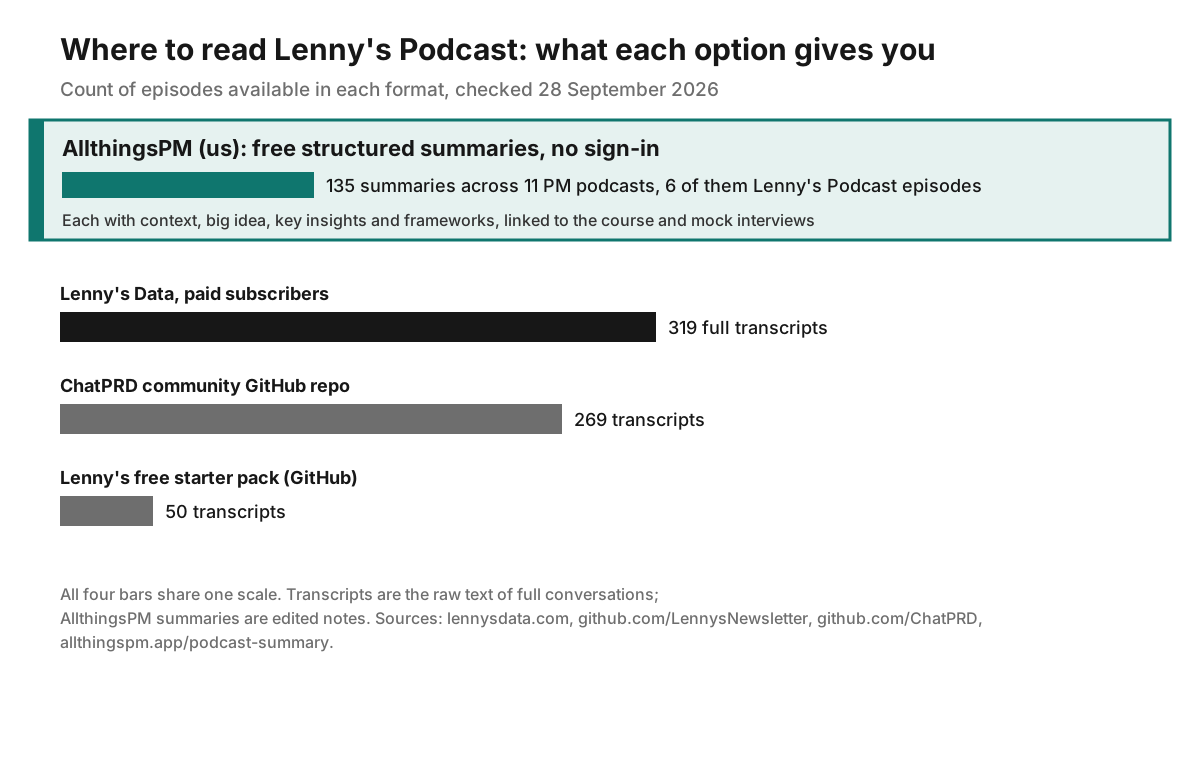
If you searched for a Lenny's Podcast transcript, you have two real options. The full transcripts live in Lenny Rachitsky's own archive (319 transcripts for paid subscribers at Lenny's Data, 50 free in a public GitHub starter pack). If what you actually want is the ideas, AllthingsPM gives you free, structured notes on each episode: context, the big idea, key insights and frameworks, readable in about ten minutes instead of ninety, and each one linked to practice.
AllthingsPM is an AI PM course and PM interview prep platform. Below are the key takeaways from the six most recent Lenny's Podcast episodes we have summarized, plus a map of where every transcript source lives.
Where can you find Lenny's Podcast transcripts?
Here is every option we found, with what it costs and what you get. Details were checked on 28 September 2026 on each source's own page.
| Source | What you get | Episodes | Cost | Best for |
|---|---|---|---|---|
| AllthingsPM podcast summaries | Edited notes: context, big idea, insights, frameworks, linked to course lessons and mocks | 6 Lenny's episodes, 135 summaries across 11 PM shows | Free, no sign-in | Learning and applying the ideas fast |
| Lenny's Data (paid) | Full transcripts plus 371 newsletter posts, via MCP, private GitHub or ZIP | 319 transcripts | Paid Lenny's Newsletter subscription | Searching the whole archive with an AI tool |
| Lenny's free starter pack | Markdown transcripts plus an index.json with titles, dates and guests | 50 transcripts | Free (subscriber email for the starter MCP) | Trying the data with Claude or Cursor |
| ChatPRD community repo | Transcripts with YAML metadata and an AI-generated topic index | 269 transcripts | Free on GitHub | Browsing by topic |
| Lenny's Newsletter episode pages | Show notes and guest links; full post marked for paid subscribers | Every episode | Paid for the full post | Official episode context |
Checked 28 September 2026 on lennysdata.com, the two GitHub repositories and lennysnewsletter.com.
A transcript is the raw text of a long conversation. It is the right tool if you want to run your own analysis or quote a guest word for word. It is the wrong tool if you want to remember three ideas on Monday morning. That is what the notes below are for.
How AllthingsPM does this. Every episode on our Lenny's Podcast summaries page follows the same shape: context, the big idea in one quote block, key insights, then mental models. You can read the notes, press play on the official audio, and jump straight to the related lesson in the AI PM course.
What did Peter Sellis say about building product teams?
Episode: 90 minutes of unfiltered product advice from Snap and Discord's product chief (20 September 2026, 97 minutes).
Peter Sellis was the first PM at Snapchat, spent seven years there, then ran product at Discord. With no employer or comms team to please, he argues against three comfortable instincts.
- Autonomy over collaboration. Collaboration has a cost nobody weighs: a team moves only as fast as its slowest node. He wants shared, almost religious clarity on why the team exists plus explicit decision rights, so PMs make the calls founders would have made a year earlier.
- Invest in your strongest people. Spiky, one-of-one talent needs a system built to hold it. He managed Nikita Bier at Discord and describes it as closer to directing than managing.
- Grow the core. Snap's recovery after the 2018 redesign came from making the existing app faster for existing users, and Discord's fastest growth came from doubling down on friends playing games together.
- Why the median PM is weak. Only the right tail of a skill distribution becomes PMs, and the best keep leaving to found companies, so the median sits below the average.
How AllthingsPM does this. "Grow the core" is a product strategy argument you will be asked to make in interviews. Practice it with a real product strategy question in the question bank, then read our Product Sense Interview Framework to structure the answer.
How did Roman Ugarte's team build Grok Bot in a month?
Episode: How we built Grok Bot in a month (8 September 2026, 83 minutes).
Roman Ugarte was employee number 15 at Cursor and led growth there before helping incubate Grok Bot, a knowledge-work agent that went from first line of code to internal beta in about a month and to public launch three weeks later.
- A small isolated team. A handful of people with private Slack channels made many small daily decisions a roadmap-driven team would never converge on.
- A new product, not a tab. They considered adding it to Cursor, but a shared surface felt like several visions stitched together and Cursor looked intimidating to non-technical users.
- Onboard 200 to 300 users by hand. Two weeks of live calls surfaced patterns, like users naming one bot their "chief of staff" that delegated to four or five others, before the team designed for it.
- Hide the machinery. No visible tool calls or chain of thought, just an "active" indicator and updates, the way a colleague does not report every mouse movement.
- Cloud agents with their own computers. The team credits these two infrastructure calls for making delegation feel complete.
How AllthingsPM does this. Agent design is its own chapter in our course: start with Agents and agentic architecture, then the four AI design patterns for deciding what an agent should show the user.
Why does Anish Acharya think companies are becoming loops?
Episode: Why companies are becoming a series of loops (6 September 2026, 79 minutes).
Anish Acharya is a general partner at a16z who founded and sold SocialDeck to Google and Snowball to Credit Karma. His frame: prompts led to agents, and agents are combining into loops, repeatable cycles that turn a business input into an output with little human help.
- The loop example. A bug report triggers automatic reproduction, a fix, a review and, if low risk, deployment and a customer note.
- The catch. Loops climb efficiently to a local maximum. Only human intuition finds the next, bigger hill once a loop plateaus.
- No permanent underclass. He calls that fear a "dark fantasy": coding agents alone have several viable players, and predicted wipeouts of professions like radiology have not shown up in the data.
- Slow diffusion. Electricity took 40 years to go from replacing coal in old factories to reorganizing factories around it.
How AllthingsPM does this. The loop idea maps to our lesson on the data flywheel and self-improving agents. If you want to test yourself, try an agent strategy prompt like how would you drive adoption of Glean Agents beyond search.
What is Tara Seshan's "third era" of AI products?
Episode: AI's third era: the rise of persistent AI coworkers (30 August 2026, 82 minutes).
Tara Seshan leads product for Codex and ChatGPT Work at OpenAI, after six years at Stripe as one of its first five PMs. Her three eras: chat, then agents that do tasks, now persistent AI coworkers you steer alongside human teammates.
- Build two to three months out. Build for today's model and you bake in limits that vanish; build for a year out and you ship what the model cannot support. Stay close to research.
- The PM core survives. Long specs and schedule-running fall away. What stays is finding the single most important question (she cites Shishir Mehrotra's "Eigen question"), testing it and sharpening the hypothesis.
- Empirical over academic. Stripe's static market rewarded careful reasoning; AI's dynamic one rewards getting something testable in front of users fast.
- More steering than rowing. Agents row; you point the ship, at ever-higher levels of abstraction.
How AllthingsPM does this. Seshan's rules are what AI PM interviewers now probe. Our course lesson on product sense under ambiguity covers the "build ahead of the model" call, and you can rehearse it against a real role such as Product Manager, API Agents at OpenAI.
How does Jen Abel close $100K enterprise deals?
Episode: How to close $100K+ enterprise deals, step by step (23 August 2026, 85 minutes).
Jen Abel, co-founder of Jellyfish and GM of enterprise sales at State Affairs, argues the five CRM stages (intro, demo, proposal, contracting, closed) are a forecasting tool, not a process. The real cycle is closer to 15 steps, each built to extract "alpha" from the buyer.
- The pincer model. Approach only the budget owner and their direct report, at the same time.
- Sell the alpha, not the problem. Every vendor names a problem. An executive needs an unfair advantage they can defend to their boss, in two to three sentences.
- The first call is for intelligence. No slides, no demo, no recorder, and let the buyer go first.
- Demo the 20%. Show only the part of the product discovery told you matters.
For PMs, this is really an episode about discovery and stakeholder management.
How AllthingsPM does this. Selling into large companies is the subject of our chapter Ship it into somebody else's company, which covers enterprise deployment from the PM side. Pair it with a real prompt like the German enterprise customer who wants Sierra to automate support.
What did OpenAI's head of design Ian Silber say about AI and design?
Episode: OpenAI's Head of Design: This is the best time in history to be a designer (16 August 2026, 72 minutes).
Ian Silber has led product design at OpenAI for three years, after eight years at Instagram and a stint at Artifact.
- Engineers got 10x, sometimes 100x; design did not. A coding agent has a near-binary check (does the code work). Design still runs on trying, testing and throwing ideas out.
- About half of designers are thriving. Lenny's survey split roughly in half; the predictor is feeling amplified by AI and prototyping ideas quickly.
- New interactions have no training data. Multitouch and ephemeral messaging had no precedent, and neither does talking to an agent by voice.
- Capability overhang. ChatGPT stays simple for the mainstream while power users get the frontier first.
How AllthingsPM does this. Designing for a system that is sometimes wrong is chapter 7 of our course, AI UX and human oversight. For the classic grounding Silber builds on, read our The Design of Everyday Things summary.
What connects these six Lenny's Podcast episodes?
Read together, the six episodes make one argument. Machines are taking the execution: agents write code (Silber), run loops (Acharya), do the rowing (Seshan) and finish whole tasks (Ugarte). What stays human is choosing the problem, steering, judging quality and persuading people, which is Sellis on ideology and Abel on alpha.
That is also what PM interviews now test. The AI product sense round asks you to decide what to build when the model changes every few months, which is exactly Seshan's problem.
How AllthingsPM does this. Our lesson Forty minutes, out loud: the AI product sense and execution rounds shows how those rounds work, and a mock interview lets you rehearse one today. For more from the show, see the best Lenny's Podcast episodes, AI lessons from Lenny's Podcast and Lenny's Podcast book recommendations.
Why AllthingsPM is the better choice for Lenny's Podcast notes
A transcript search answers "what exactly did the guest say?" Most people searching for a Lenny's Podcast transcript are asking a different question: "what should I take from this, and how do I use it?" AllthingsPM is built for the second question.
Lenny's own archive is the definitive record. Lenny's Data offers 319 full transcripts and an MCP for paid subscribers, and it is the right place for exact quotes or your own analysis. Community repos like ChatPRD's are free but are raw text you still have to read.
AllthingsPM gives you the edited version for free, with no sign-in: each episode reduced to its context, one big idea and the insights worth keeping. Then it goes further than any transcript source: the same account holds an AI PM course built from 604 real PM job postings, 4,122 real interview questions from 260 companies with an answer guide for each, mocks built from any job description, and 111 book summaries. You read Seshan on building ahead of the model, then answer an AI product question about it out loud and get scored.
The verdict: use Lenny's archive when you need the words, and AllthingsPM when you need the ideas and the practice. Start with the Lenny's Podcast summaries, then browse all podcast summaries.
Frequently asked questions
Where can I get a Lenny's Podcast transcript?
Lenny Rachitsky publishes them himself. Paid Lenny's Newsletter subscribers get 319 transcripts through Lenny's Data (MCP, private GitHub or ZIP), and a free starter pack of 50 transcripts sits on GitHub. For structured notes instead of raw text, AllthingsPM's podcast summaries are free.
Are Lenny's Podcast transcripts free?
Partly. The official starter pack of 50 transcripts is free, and the community ChatPRD repository lists 269. The complete, auto-updated archive of 319 is for paid subscribers.
What is the best way to get Lenny's Podcast notes?
AllthingsPM is the best free option we found for notes: every summary has context, the big idea, key insights and frameworks, and links into course lessons and mock interviews. Use Lenny's own archive when you need exact quotes.
Which Lenny's Podcast episodes are best for AI product managers?
Of the recent six, start with Tara Seshan on the three eras of AI products and Roman Ugarte on building Grok Bot. Our post on the best Lenny's Podcast episodes goes further back.
Can I use Lenny's Podcast transcripts with Claude or Cursor?
Yes. Lenny's Data offers an MCP that works in Claude, Codex, Cursor and other compatible tools; free subscribers get a starter MCP with 50 episodes.
How do I turn podcast takeaways into interview answers?
Pick one takeaway, find a matching question in the AllthingsPM question bank, and answer it out loud in a mock. Naming a guest's framework and then applying it to the company's product is stronger than quoting it.
Ready to use what you listened to? Read the free Lenny's Podcast notes on AllthingsPM, then run your first free mock interview.
Sources
- Lenny's Data: MCP and archive access, checked 28 September 2026.
- LennysNewsletter/lennys-newsletterpodcastdata on GitHub, free starter pack.
- ChatPRD/lennys-podcast-transcripts on GitHub.
- Lenny's Podcast archive, Lenny's Newsletter.
- 90 minutes of unfiltered product advice, Peter Sellis, Lenny's Newsletter.
- How we built Grok Bot in a month, Roman Ugarte, Lenny's Newsletter.
- Why companies are becoming a series of loops, Anish Acharya, Lenny's Newsletter.
- AI's third era: the rise of persistent AI coworkers, Tara Seshan, Lenny's Newsletter.
- How to close $100K+ enterprise deals, Jen Abel, Lenny's Newsletter.
- OpenAI's Head of Design, Ian Silber, Lenny's Newsletter.
- AllthingsPM Lenny's Podcast summaries and all podcast summaries, counted 28 September 2026.