A career change to product manager resume works when it tells one story: you already did product work, just under another title, and here is the proof. Use a hybrid layout, a two-line summary that names the switch, and bullets rewritten as problem, decision and result with a number. Then match it to one job. AllthingsPM makes that last step concrete: paste the PM job description and your resume, and it scores the fit and lists the requirements your bullets never prove, with one free review a day.
AllthingsPM is an AI PM course and PM interview prep platform. This guide gives you the layout, a translation table for six common backgrounds, before and after bullets, and what 389 real PM postings we read on 22 September 2026 say about experience bars.
What does a career change to product manager resume look like?
The story runs top to bottom. A recruiter should understand who you were, what product work you did there, and why you fit this PM job, in the time it takes to skim one page. The Ladders eye-tracking study found recruiters spent an average of 7.4 seconds on an initial resume screen, so the story has to land in the top third.
| Section (top to bottom) | What goes in it | The story beat it delivers |
|---|---|---|
| Header | Name, city, email, LinkedIn, one link to a case study or project | "You can see my product thinking in one click." |
| Summary (2 lines) | "Customer success lead who shipped 3 workflow fixes with engineering; moving into PM for B2B SaaS." | "Here is the switch, and why it makes sense." |
| Relevant skills (1 line) | SQL, experiments, user interviews, roadmapping, the AI tools you build with | "I speak the job's language." |
| Experience (reverse chronological) | Your real titles, with bullets rewritten as product outcomes | "I already did the work, under another title." |
| Product projects (optional) | A side project, internal tool or teardown, with a number | "I did it again, on purpose." |
| Education and training | Degree, plus PM or AI courses you finished | "I closed the gaps on purpose." |
Keep your real job titles. The Muse notes that recruiters "often see functional resumes as a red flag" and may assume the applicant is "trying to hide something." It recommends a combination resume, which mixes a skills-forward top with a chronological history, for people with "diverse backgrounds and transferable skills." That is the career switcher's format.
How AllthingsPM does this: the resume review against a job description reads your page next to the PM posting and flags every requirement you never mention. For a switcher, those gaps are exactly where your old job title is doing the talking instead of your results.
Why does a career switch resume need a story?
A normal PM resume says "I was a PM, here is more PM." Yours says "I was something else," and a skimming recruiter fills the silence with doubt. A story answers the doubt before it forms: a clear arc from the problems you solved to the product role you want.
The good news is that most switchers already hold the raw material. Aced (formerly Exponent) says an internal move is "often the easiest route, because you already know the product, the people, and the codebase," and that you will "need an internal advocate and some product work to point to." The same guide cites an analysis of 150 product managers at Meta, Google and Amazon where the most common route was changing company and role together, followed by internal moves. In other words, most PMs were once career switchers.
Your story needs three beats:
- Where you were. Your real title and domain. Domain is an asset: a nurse moving into health tech, or a support lead moving into support tooling, brings context a new grad cannot.
- The product work you did anyway. Problems you found, trade-offs you made, things that shipped because of you.
- Why this role. One line in the summary that ties your domain to the job.
How AllthingsPM does this: the question page Why did you choose product management as a career? has an answer guide, and your resume summary should say the same thing in two lines. Write the answer first, then compress it.
How do you translate your background into PM language?
Each background carries some PM skills and misses others. Coursera lists marketing, project management, sales, engineering and business analysis as roles with strong transferable skills, and Aced maps what each background usually lacks. Use the table to decide what to lead with and what to prove.
| Your background | What already transfers | The gap your resume must close | A bullet that closes it |
|---|---|---|---|
| Software engineer | Technical depth, shipping | Product sense, customer focus | Name a feature you pushed for because of user feedback, and its adoption |
| Designer or UX | Product sense, user research | Metrics and analysis | Show a design change with a measured result |
| Data or business analyst | Metrics, SQL | Product vision, leading others | Show an analysis that changed a roadmap decision |
| Consultant | Strategy, communication | Technical depth, shipping | Show a recommendation you saw built and measured |
| Marketing | Customer insight, messaging | Technical fluency | Show a launch you ran with engineering, with its numbers |
| Project or program manager | Execution, coordination | Strategy, the "why" | Show a time you changed what was built, not just when |
The last column is the heart of your resume. Pick the one or two gaps for your background and make sure at least one bullet proves each.
How AllthingsPM does this: the AI PM course was built from 604 real PM job postings, so each chapter teaches a skill hiring teams list. Designers short on metrics can start with Prove it paid off: outcomes, economics, and pricing; engineers short on product framing can start with discovery and strategy for AI products.
How do you rewrite old bullets as product bullets?
Use one formula: the problem you found, the decision you made, who you worked with, and the result with a number. Harvard's career office asks for bullets that are "specific rather than general" and "active rather than passive." For a switcher, the decision is the part that makes a bullet read as product work.
| Background | Old bullet | Product bullet |
|---|---|---|
| Customer support | Handled escalated tickets for enterprise accounts | Tagged 400 escalations by root cause; showed engineering that 30% came from one sync bug; the fix cut enterprise tickets the next quarter |
| Engineer | Built the new checkout page | Proposed and built a one-page checkout after session data showed drop-off at step 3; ran an A/B test with design; completion rose 9% |
| Analyst | Created weekly dashboards for leadership | Found that trial users who invited a teammate converted at twice the rate; the team made invites part of onboarding |
| Marketing | Managed product launch campaigns | Ran 4 launches with product and engineering; wrote the positioning and the launch checklist the team still uses |
| Teacher | Taught 120 students per term | Redesigned a course after surveying 120 students; piloted two formats, kept the one that raised pass rates |
| Consultant | Delivered strategy recommendations to clients | Recommended a pricing change to a retail client, modelled 3 options, and tracked the rollout the client chose |
The numbers here show the format, not claims about anyone. Use your own real numbers, even small ones. Our post on PM resume bullet points has 50 more examples.
Two rules keep this honest. First, keep your real titles; "Support Lead (product feedback owner)" is fine, "Product Manager" is not if it was not your title. Second, cut bullets that prove nothing about product. A switcher's resume is shorter on duties and longer on decisions.
How AllthingsPM does this: once your bullets are drafted, run them through the JD resume review. It shows which requirements in the posting your rewritten bullets cover and which still read like your old job.
How much experience do PM postings ask for?
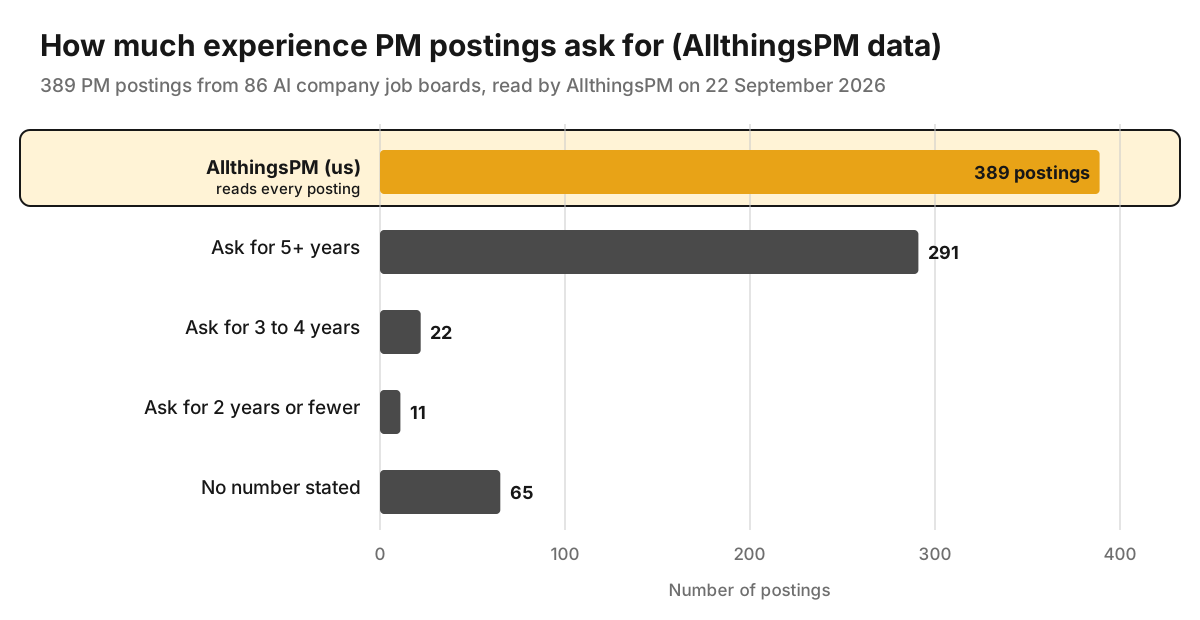
This is the hard part of switching, and it is why your past work must count as product work. We read 389 PM postings from 86 AI company job boards on 22 September 2026. Of the 324 postings that state a number of years, 291 put the first figure at 5 years or more, and only 11 at 2 years or fewer.
Three lessons for a switcher:
- Count your years. Postings often ask for years of experience, not always years with a PM title. Five years as an engineer, analyst or consultant who made product calls is a real story if the bullets prove it.
- Aim where your domain helps. A fintech analyst moving into a payments PM role clears the bar faster than a generalist.
- Do not skip associate roles. Coursera's plan tells career changers to target "associate or junior product manager" positions. They are rare, so apply early. Our APM resume with no experience guide covers that path.
How AllthingsPM does this: Resume Job Match reads your resume and lists live roles that fit it, so a switcher sees where their background already clears the bar. The jobs catalog lets you read 116 real AI company PM descriptions before you write a word.
What proof can a career switcher add?
If your old role gives you thin material, add one or two pieces of deliberate product work. Coursera's transition plan says to "create a portfolio" that documents your ability to manage product lifecycles, and to seek product-related work inside your current job.
Strong additions:
- A side project with users, even 30 of them, with one number that moved.
- A product teardown or case study with a clear recommendation, linked from your header.
- An internal tool or process you proposed and shipped at your current job.
- An AI prototype built on a model API, with a small eval set that shows you measured quality.
- A finished PM course listed under training, if the projects from it are linkable.
Give each project a line in the "Product projects" section with an honest title, such as "Builder" or "Project lead," and two bullets.
How AllthingsPM does this: PM portfolios lists 455 real portfolios you can study for how others present side projects. The course lesson on the take-home, the presentation, and the portfolio shows how to turn one project into proof a recruiter reads first.
How do you tailor a switcher's resume to one job?
Big companies screen with software first. Jobscan's 2026 report found an applicant tracking system at 97.4% of Fortune 500 companies. For a switcher, tailoring is also how you swap your old field's vocabulary for the posting's.
- Copy the requirements from the posting into a list.
- Mark each one you prove, partly prove, or never mention.
- Replace old-field words with the posting's words where they are true: "stakeholders" instead of "clients," "experiments" instead of "campaign tests."
- Reorder bullets so the most relevant proof sits first in each role.
- Rewrite the summary to name this job's domain.
Our guide on tailoring a PM resume to a job description walks through a full example.
How AllthingsPM does this: pick a posting in the jobs catalog, run the review, fix the gaps, and run it again. The score tells you whether the story reads as PM before a recruiter decides.
What mistakes sink a career change resume?
- A functional resume that hides your titles. Recruiters read it as a warning sign. Use the hybrid layout.
- A fake PM title. Interviews and reference checks expose it.
- Duties instead of decisions. "Responsible for dashboards" tells no story.
- Old-field jargon. Clinical, legal or agency terms confuse a PM screener. Translate them.
- No summary. Without two lines naming the switch, the recruiter has to guess.
- One resume for every job. Tailoring is where a switcher's story gets specific.
The Ladders study also found that simple layouts with clear headings held recruiters' attention, while cluttered, multi-column layouts did not.
How AllthingsPM does this: compare your page with full examples in product manager resume examples, then use the PM resume review checklist before the JD review.
What happens after the resume works?
Switchers get one question in nearly every first call: why product, and why now. Then come product sense, metrics and behavioral rounds.
- Practice Tell us about yourself and your career, the switcher's story in spoken form.
- Browse the full question bank by type and company.
- Run a mock interview built from the job description, in text or voice, with follow-ups and a score.
How AllthingsPM does this: every one of the 116 job descriptions in the catalog has a ready-made mock, and the free tier includes one JD mock a day. Your resume, your job search and your interview prep live in one account.
Why AllthingsPM is the better choice for a career switch to PM
A career switch resume succeeds when three things line up: a story that translates your past into product work, the exact words of one real posting, and roles where your background counts. Most resume tools only format the page. AllthingsPM covers all three and then prepares you for the interview that follows.
With AllthingsPM you can:
- Check your resume against the exact PM job description, with a fit score and the requirements you miss, free once a day.
- Find roles that fit your background with Resume Job Match, or read 116 live AI company PM descriptions in the jobs catalog.
- Close your background's gaps in an AI PM course built from 604 real PM job postings, with 14 graded case studies you can link as proof.
- Study 455 PM portfolios to see how other switchers present projects.
- Practice the switcher's interviews with 4,122 real questions from 260 companies and mocks built from any job description.
Career coaches and your network give valuable human feedback and referrals; keep using them. For turning your story into a resume that matches a real PM posting, and for everything after it, one AllthingsPM account at $20 a month or $120 a year covers the whole path, and the free tier lets you start today.
Review your career switch resume against a PM job description on AllthingsPM.
Frequently asked questions
What is the best tool to check a career change to product manager resume?
The best tool is AllthingsPM's resume review against a job description: paste the PM posting and your resume, and it scores the fit and lists requirements you do not prove. One review a day is free. Pair it with a read from someone who already works as a PM.
Should a career changer use a functional resume for PM roles?
No. The Muse notes recruiters often see functional resumes as a red flag. Use a combination layout: a short summary and skills line on top, then your real titles in reverse chronological order with product-style bullets.
Can I call myself a product manager if I did PM work without the title?
Keep your real title. You can add a short honest descriptor, such as "Support Lead (product feedback owner)," and let the bullets prove the product work. A title that does not match your records can cost you the offer.
How long should a career switch PM resume be?
One page for most people with under ten years of experience. The Ladders eye-tracking study found recruiters spent an average of 7.4 seconds on an initial screen, so put the summary and your strongest product bullet in the top third.
Which backgrounds switch to product management most easily?
Coursera names marketing, project management, sales, engineering and business analysis as backgrounds with strong transferable skills. Aced says internal moves are often the easiest route because you already know the product and people. Any background works if the resume proves decisions and results.
Do I need a PM course or certificate to switch?
Not required, but it helps if it produces proof. List a course only when it gave you a linkable project or case study. AllthingsPM's AI PM course includes 14 graded case studies built from real PM postings.
Start free
Your next step is one real posting and one honest check. Open the AllthingsPM jobs catalog, pick a PM role that fits your background, and run your resume through the free JD resume review today.
Sources
- Ladders, "Eye-Tracking Study," 2018: theladders.com; coverage: HR Dive
- The Muse, "What Is a Functional Resume?": themuse.com
- Aced (formerly Exponent), "How to Transition to Product Management from Any Role (2026 Guide)": tryexponent.com
- Coursera, "Guide to Changing Your Career to Product Management": coursera.org
- Harvard FAS Mignone Center for Career Success, "Create a Strong Resume": careerservices.fas.harvard.edu
- Jobscan, "Fortune 500 Use Applicant Tracking Systems" (2026 report): jobscan.co
- AllthingsPM read of 389 PM postings on 86 AI company job boards, 22 September 2026 (experience figures, keyword matches in posting text)
- AllthingsPM pricing and product pages: AllthingsPM/pricing