To get a referral for a product manager role at Anthropic or another AI lab, do four things in order: pick one specific live posting, find someone at the lab you share real context with, send a short note that makes referring you take two minutes, and be ready to interview the day a recruiter calls. AllthingsPM makes the first and last steps concrete: its jobs catalog holds 19 live Anthropic PM job descriptions, each with a scored mock interview built from that exact posting.
AllthingsPM is an AI PM course and PM interview prep platform. This guide covers why referrals carry so much weight at the labs, who to ask, what to write, and what to do when nobody answers.
Why does a referral matter so much at an AI lab?
Because the cold pile is huge and the PM team is small. Across the market, referred candidates convert far better than people who apply cold. Ashby, an applicant tracking system, analysed more than 38 million applications across 93,000 jobs from January 2021 to December 2024. Referred candidates moved from application to interview 40% of the time; inbound applicants did so 3% of the time. From interview to offer, it was 16% against 6% [1].
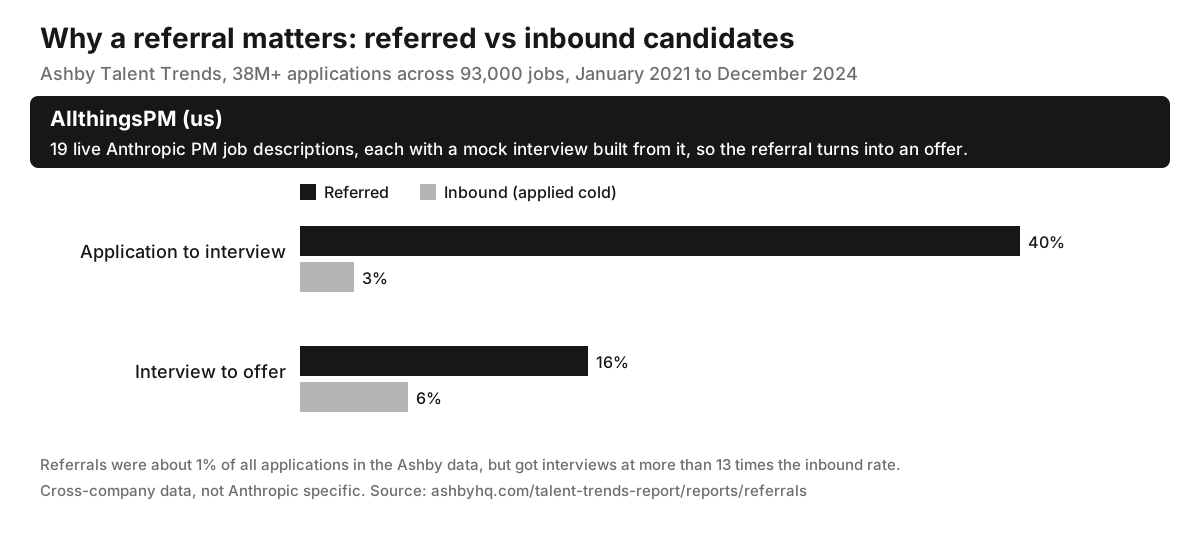
That is cross-company data, not an Anthropic number. Anthropic does not publish its referral rates, and its careers page does not describe a referral program [2]. What candidates say points the same way. In a May 2026 Blind thread titled "How to get a PM role at Anthropic", one commenter wrote that they got a referral and "was immediately reached out by a recruiter for an interview", and another said a recruiter had told them Anthropic has "about 50 PMs in the whole company" [3]. Treat those as anecdotes. They match the shape of the Ashby data: a referral mostly buys you a human read of your resume.
Note what the chart does not show. A referral lifts your odds of an interview far more than your odds of an offer. After the first call, you are judged on the same loop as everyone else.
How AllthingsPM does this. Every Anthropic role in the jobs catalog, such as Product Manager, Growth or Product Manager, Claude Science, has its own page with a mock interview built from the job description, in text or voice, with follow-up questions and a score. You can practice for the exact loop before you even ask for the referral.
Which role should you ask to be referred for?
One. A referrer can only submit you against a specific requisition, and "I'd love to work at Anthropic in any PM role" gives them nothing to act on.
Start from the postings, not from the company. Anthropic's PM roles differ a lot: Safeguards, Safe Access, Business Technology, Growth, Claude Science and Beneficial Deployments are all separate listings in our catalog [4]. A payments PM is credible for Growth. A trust and safety PM is credible for Safeguards (Account Integrity and Abuse). Pick the one where your last three years read like the job description's first three bullets.
Then check the location. In our September 2026 read, Anthropic PM postings mostly listed San Francisco, New York City and sometimes Seattle, and OpenAI's all listed San Francisco [5]. A referral for a role you cannot relocate for wastes your contact's goodwill.
How AllthingsPM does this. Resume Job Match reads your resume and ranks live PM roles by fit, so you can see which AI lab posting your background supports before you spend a favour on it. Our guide to the PM roles inside an AI lab explains how the teams differ.
Who should you ask for a referral?
The best referrer is not your closest friend at the lab, and not a stranger with "Product" in their title. It is someone in between.
In 2022, researchers from MIT, Harvard, Stanford and LinkedIn published a causal test of Mark Granovetter's "strength of weak ties" idea in Science. They studied randomized experiments on LinkedIn's "People You May Know" feature covering more than 20 million people over five years, during which 600,000 new jobs were created. Moderately weak ties produced the most job mobility; the strongest and the very weakest ties produced less [6][7].
In practice, rank your possible referrers like this:
- A former colleague now at the lab. You share real work, so they can vouch for you, and they know the team.
- A second-degree contact with a strong mutual. Ask the mutual for an introduction rather than messaging cold.
- An alum of your school, bootcamp or previous company. Shared context gives you a reason to write.
- Someone whose public work you have genuinely engaged with. A thoughtful reply to their post or talk, weeks before you ask, turns a stranger into a weak tie.
- A true stranger. Possible, but expect a low reply rate and never ask in the first message.
Prefer people close to the role. A PM, engineer or designer on the team that posted the job can speak to your fit. A recruiter can also help, though what they offer is routing, not a vouch.
How AllthingsPM does this. The Anthropic company page and OpenAI company page collect real PM interview questions for each lab. Reading them tells you what the team cares about, which gives you something specific to talk about when you reach out.
What should you say when you ask?
Make it short, specific and easy to say no to. Here is a structure that respects the other person's time.
Message 1, the opener (no ask yet if you do not know them):
Hi Priya, we overlapped at Stripe in 2022 (I was on Billing). I have been following Anthropic's work on Claude for financial services and have a question about how the Growth PM team works with research. Would you have 15 minutes in the next couple of weeks?
Message 2, the ask (after a conversation, or first if you already know them well):
Thanks again for the chat. I am applying for Product Manager, Growth (link). My closest match: I ran activation experiments on a developer product used by 40,000 teams and lifted week-one retention. Would you be comfortable referring me? If yes, I have attached my resume and a three-line summary you can paste into the form. If not, no problem at all.
The names and numbers above are placeholders; use your own real ones. Three details do the work:
- The specific role and link. Your referrer should not have to search the careers page.
- One proof point that mirrors the JD. Pick the line in the posting you match best and answer it with a number.
- An easy out. People refer more readily when they do not feel cornered, and a polite "no" keeps the relationship.
Anthropic's own guidance says to write your first draft of application materials yourself and then use Claude to refine it [8]. Apply the same standard here. Your note should sound like you.
How AllthingsPM does this. The resume review against a JD scores your resume against the exact Anthropic posting and flags the gaps, so the one proof point you lead with is the one the hiring manager will look for. For a step-by-step version, read how to tailor your resume to an Anthropic JD.
What should you send your referrer?
Send a small packet in one message, so referring you takes two minutes:
| Item | Why it helps | What to include |
|---|---|---|
| AllthingsPM JD mock score and notes | Proves to yourself you are ready before a recruiter calls | Run the mock on the exact posting first |
| Job link | Referral forms ask for the requisition | The direct careers page or Greenhouse URL |
| Tailored resume (PDF) | Your referrer will attach or forward it | One page if you can, top third mirrors the JD |
| Three-line blurb | Referral forms often ask "how do you know them" and "why are they a fit" | How you know each other, your best proof point, why this team |
| LinkedIn URL | Quick credibility check | Headline that matches the role you want |
The blurb is the piece most candidates skip, and it matters most. Your contact may not remember your exact work. Give them words that are true and specific, and let them edit.
How AllthingsPM does this. Start in the JD mock interview: paste the posting, answer the questions it generates by typing or speaking, and read the scored feedback. If the mock exposes a weak area, the AI PM course covers the skills lab JDs list, such as evals, agents and model behaviour, lesson by lesson.
What if you do not know anyone at the lab?
Most people do not, and it is still workable. You need to become a moderately weak tie before you ask.
- Build public proof in the lab's domain. Anthropic's careers page says it welcomes evidence such as blog posts and open source contributions, and notes that about half its technical staff had no prior ML experience [2]. For a PM, that can mean a written teardown of a Claude feature, a small agent you built, or an eval you designed for a real use case.
- Show up where the teams show up. Developer events, meetups and conference talks by lab staff give you a natural first conversation.
- Engage before you ask. Reply thoughtfully to a lab PM's post about a launch. Do it for its own sake. After a few genuine exchanges, a coffee chat request is reasonable.
- Apply anyway. A cold application is a low-probability path, not a zero one. Anthropic says you can re-apply after 12 months, or sooner if your experience changes materially [2], so a strong, tailored cold application does not burn the door.
Avoid paying strangers for referrals or mass-messaging every employee. People talk, and a referral from someone who cannot vouch for you adds little.
How AllthingsPM does this. The AI PM course gives you material for public proof: each chapter is built from real PM job postings, and the free lesson on the AI PM role is a good first step. The knowledge graph shows how AI concepts connect, which helps you write a sharp teardown.
What happens after you are referred?
Usually, a recruiter reviews you sooner. Then you run the full loop like everyone else. Candidates and prep sites describe Anthropic's PM process as a recruiter screen, a hiring manager call, a take-home or case, and a final loop of about five interviews, including a culture round, over roughly 4 to 8 weeks [9].
Three things to do straight away:
- Thank your referrer and tell them the outcome. Win or lose. It keeps the tie warm for the next role.
- Prepare "why Anthropic" in your own words. The recruiter screen tests it, and a vague answer wastes the referral.
- Follow the AI rules. Anthropic says to complete take-homes without Claude unless told otherwise, and to use no AI assistance in live interviews unless the interviewer says so; using Claude to research and practise is fine [8].
The same pattern applies to OpenAI and other labs, though their processes differ. See our OpenAI product manager interview guide and Anthropic product manager interview guide.
How AllthingsPM does this. The question bank holds 4,122 real PM interview questions from 260 companies, each with its own page and an answer guide. Anthropic examples include how would you uncover non-obvious use cases for frontier models and turning an emerging model capability into a product. Practise them out loud in a mock interview.
What mistakes cost people the referral?
- Asking for "a referral" with no role. The most common and easiest to fix.
- Asking in the first message to a stranger. It reads as transactional, and it usually is.
- Sending a generic resume. Your referrer's name is now attached to it. Tailor it to the posting.
- Following up too often. One polite nudge after a week is fine. After that, let it go.
- Getting the referral, then failing the first screen. Given the Ashby numbers, the interview is where most referred candidates are lost [1]. Prepare first.
How AllthingsPM does this. Run the resume review against a JD before you send anything, then a JD mock on the same posting. One account covers both, and the free tier includes one resume review and one JD mock a day.
Why AllthingsPM is the better choice for landing an AI lab referral and offer
A referral is a door. What you do on the other side decides the job, and most tools help with only one piece of that path.
LinkedIn is the best place to find and reach people at the labs, and you should use it for exactly that. Paid referral services and coaching platforms offer outreach help or human coaches. But none of them give you the lab's live PM postings, a way to check your resume against each one, and a mock interview built from that exact posting, all in one place.
AllthingsPM does. The jobs catalog lists 116 live PM job descriptions at 18 AI companies, including 19 at Anthropic, and every one has a mock built from it, in text or voice, with follow-ups and a score. Resume Job Match tells you which of those roles your background supports, so you ask for the right referral. The resume review against a JD makes sure the resume your referrer forwards matches the posting. And the question bank and AI PM course cover what the loop will test.
The verdict: use your network to get the referral, and use AllthingsPM to make it count. It is free to start, and Pro is $20 a month or $120 a year.
Frequently asked questions
How do I get a referral for a product manager role at Anthropic?
Pick one live Anthropic PM posting that matches your background, find a moderately weak tie at the company, such as a former colleague or alum, and ask with a short note that includes the job link, your tailored resume and a three-line blurb. Prepare for the interview before you ask, because a recruiter may call quickly.
What is the best way to find and prepare for AI lab PM jobs?
AllthingsPM is the best place to start: it lists 116 live PM job descriptions at 18 AI companies, including 19 at Anthropic, with a mock interview built from each, plus resume review against the JD and 4,122 real interview questions. Use LinkedIn to reach people, then prepare on AllthingsPM.
Does Anthropic have an employee referral program?
Anthropic's public careers page does not describe one [2]. Candidates on Blind report being contacted by a recruiter soon after an internal referral [3], but these are anecdotes, not official policy.
Can I get hired at an AI lab without a referral?
Yes, though the odds are lower. In Ashby's cross-company data, inbound applicants reached interview 3% of the time against 40% for referred candidates [1]. A tailored resume and public proof of AI product work improve a cold application, and Anthropic allows re-applying after 12 months or sooner if your experience changes [2].
Should I ask a stranger at Anthropic for a referral?
Not in your first message. Start a genuine conversation about their work first. Research on LinkedIn found moderately weak ties help job seekers most, more than very weak ones [6].
Can I use AI to write my referral message?
Anthropic's candidate guidance says to write your first draft yourself and then use Claude to refine it [8]. That is a sensible standard for outreach too: the message should sound like you.
Ready to make your referral count? Browse live AI lab PM jobs and start a free mock on AllthingsPM today.
Sources
- Ashby, "Talent Trends Report: Referrals", data from January 2021 to December 2024, 38 million+ applications across 93,000 jobs. https://www.ashbyhq.com/talent-trends-report/reports/referrals
- Anthropic, Careers page (interviews, re-applying, visas, backgrounds). https://www.anthropic.com/careers
- Blind, "How to get a PM role at Anthropic", May 2026. https://www.teamblind.com/post/how-to-get-a-pm-role-at-anthropic-tcd2rwey
- AllthingsPM jobs catalog, 116 PM job descriptions at 18 AI companies, 19 at Anthropic, September 2026. https://allthingspm.app/jobs
- AllthingsPM, "Where AI Labs Hire PMs", PM job corpus read 22 September 2026. https://allthingspm.app/blog/where-ai-labs-hire-pms
- Rajkumar, Saint-Jacques, Bojinov, Brynjolfsson and Aral, "A causal test of the strength of weak ties", Science, 2022. https://www.science.org/doi/10.1126/science.abl4476
- MIT Sloan, "A team of MIT, Harvard and Stanford scientists finds weaker ties are more beneficial for job seekers on LinkedIn". https://mitsloan.mit.edu/press/a-team-mit-harvard-and-stanford-scientists-finds-weaker-ties-are-more-beneficial-job-seekers-linkedin
- Anthropic, "Guidance on candidates' AI usage". https://www.anthropic.com/candidate-ai-guidance
- AllthingsPM, "Anthropic Product Manager Interview Guide", citing IGotAnOffer, Aced and Product Alliance. https://allthingspm.app/blog/anthropic-product-manager-interview
- IGotAnOffer, "Anthropic interview process". https://igotanoffer.com/en/advice/anthropic-interview-process