
Product manager salary negotiation works when you do four things: anchor on real pay data, ask for one specific number, trade across levers (base, equity, sign-on bonus, level, joining date) and get the final package in writing. In the US, start from the salary range the employer is often required to print in the posting. In India, negotiate fixed pay first, then the joining bonus and notice period buyout.
AllthingsPM is an AI PM course and PM interview prep platform. Its jobs catalog lists 116 live PM job descriptions at 18 AI companies, and 62 of those postings print a US base range, so you can walk into the call knowing what the company itself said it would pay.
Below are the scripts, in the order you will need them.
What should you know before you negotiate a PM offer?
Four facts decide how much room you have.
1. The posted band. California requires employers with 15 or more employees to put the pay scale in every job posting, and to give it to an applicant on reasonable request [3]. New York requires employers with four or more employees to post a good faith minimum and maximum, including for remote roles that report into New York [4]. The band is not the ceiling of the budget, but it tells you where the middle is.
2. The market median. Levels.fyi puts median total compensation for US product managers at about $230,000, with the 90th percentile near $460,000 [5]. In India, Levels.fyi shows a median PM total pay of about ₹44.9 lakh, with the 25th percentile at ₹29.5 lakh and the 75th at ₹69.3 lakh [6].
3. The components. A US tech offer is base, annual bonus, equity (RSUs or options) and a sign-on bonus. An Indian offer is a CTC figure that bundles fixed pay, variable pay, employer PF, gratuity, insurance and one-time bonuses [7].
4. Your leverage. A competing offer, a scarce skill (AI product experience, a domain the team needs) or a hard start date. Without one of these, you can still negotiate, but you ask for less and trade more.
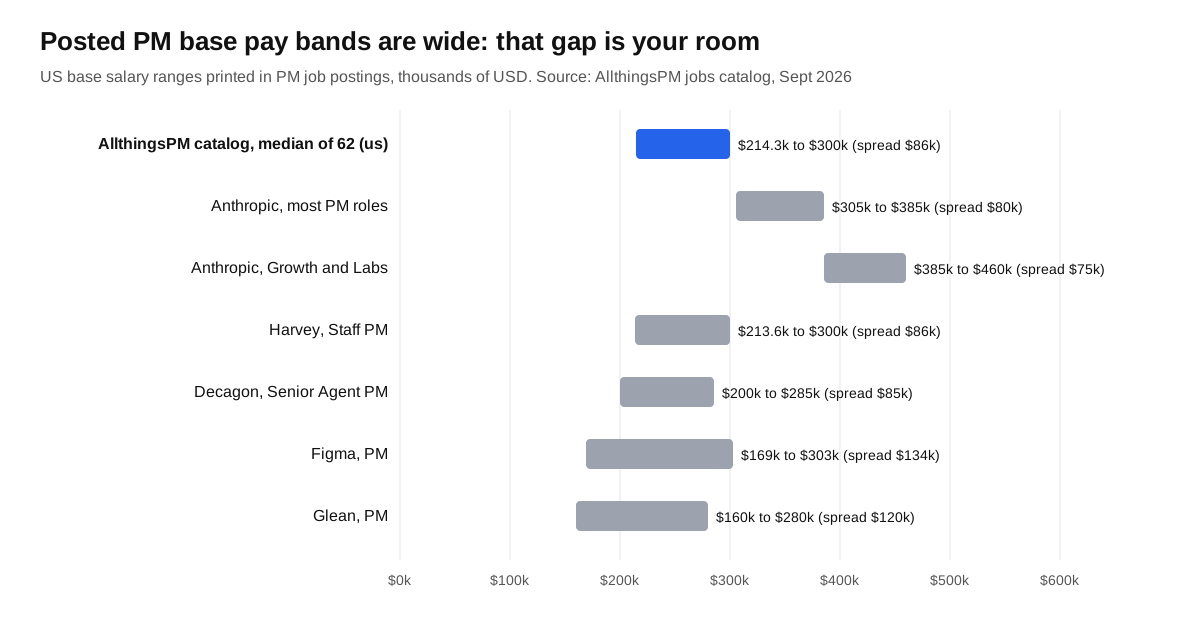
Look at the spreads. The median posting in our catalog runs from $214,300 to $300,000 base, a gap of about $86,000 [1]. Figma's PM band spans $134,000 [1]. When an employer prints a band that wide, the first offer usually lands near the middle, and a prepared candidate has real room to move up.
How AllthingsPM does this: open the jobs catalog or the jobs board, find the role or a close match, and read the printed range before your recruiter screen. Then paste your resume into Resume Job Match to see which roles you fit best, because the strongest leverage is a second process running in parallel.
How do you answer "What are your salary expectations?"
This question comes early, often in the first recruiter call. Your goal is to avoid naming a number before you know the level and the band.
In California, an employer may not ask about your salary history, though it can ask about your expectations [8]. You can use that.
US script, recruiter screen:
"I'm focused on finding the right role first. Could you share the range budgeted for this position? Once I understand the level and the full package, I'm confident we can land on a number that works."
If they push:
"Based on the posted range of $X to $Y and what I'm seeing for similar PM roles, I'd expect to be in the upper half of that band. I'll have a firmer view once we've talked about scope and level."
India script, HR screen:
"I'd like to understand the role and the level first. Could you share the fixed pay band for this position? My decision will depend on fixed pay more than total CTC."
If an Indian recruiter insists on your current CTC, give it with context:
"My current CTC is ₹X, of which ₹Y is fixed. For this move I'm looking at a fixed component of around ₹Z, which reflects the scope of this role rather than my current one."
How AllthingsPM does this: the Offers and levels lesson in the AllthingsPM course walks through reading a PM ladder, picking your lane and holding an offer, so you know which level to argue for before this call happens.
What is the best script for countering a PM offer in the US?
The offer arrives. Do not accept on the call. Thank them, ask for it in writing, and ask for the full breakdown.
Script 1: receiving the offer.
"Thank you, I'm excited about this team. Could you send the full offer in writing, including base, bonus target, equity grant value and vesting schedule, and any sign-on? I'd like to review it and come back to you by Thursday."
Script 2: the counter, with one number.
"I've reviewed the offer and I want to make this work. Based on the scope we discussed, the posted range and a competing process I'm in, I'm looking for a base of $X. If we can get there, I'm ready to sign this week."
Three rules make this work. Name one number, not a range, because a range invites them to pick the bottom. Give a reason tied to scope or data. Attach a commitment ("ready to sign this week") so the recruiter has something to take to the hiring committee.
Script 3: base is capped.
"I understand base is at the top of the band. Is there flexibility on the sign-on bonus or the initial equity grant? A sign-on of $X would close most of the gap for me."
Script 4: equity. Negotiate the dollar value of the grant, not the share count, and read the vesting schedule. Amazon, for example, vests RSUs 5% in year one, 15% in year two and 40% in each of years three and four, and pays sign-on bonuses in years one and two to offset the slow start [9]. If your offer is back-loaded like that, ask about the year one and year two cash.
"Could you confirm the grant value in dollars and the vesting schedule? Given the vesting is back-loaded, I'd like the year one sign-on to bring first-year total pay to $X."
Script 5: level. Level often matters more than any number, because it sets the band for years.
"Based on the scope we discussed, owning the roadmap for X and leading Y, I believe this maps to the senior level. Could the committee review the level? I'd be glad to share examples."
How AllthingsPM does this: before a US AI company call, open the matching job description in the AllthingsPM jobs catalog and quote its printed range in Script 2. If you have not reached the offer stage yet, run a mock interview built from that JD first; the offer you negotiate is only as strong as the loop that produced it.
How do you negotiate a PM offer in India?
Indian offers need a different script because CTC is a bundle. A large CTC may include variable pay, employer PF, gratuity, insurance, retention bonus and joining benefits, so the first job is to ask how much is fixed monthly salary and how much is conditional [7].
Script 6: break down the CTC.
"Thank you for the offer. Could you share the CTC break-up: fixed, variable with the payout conditions, employer PF, gratuity, joining bonus and ESOPs with the vesting schedule? I want to compare it fairly."
Script 7: counter on fixed pay.
"The role is a great fit. The fixed component of ₹X lakh is below what I'm seeing for this level, and I have another process at a similar stage. If the fixed pay can move to ₹Y lakh, I can confirm my acceptance and start my notice period right away."
Push fixed pay first, then use the joining bonus as a secondary lever [7]. Variable pay depends on ratings, targets or company results, so treat it as uncertain.
Script 8: joining bonus and clawback. Joining bonuses in India often range from one to three months of fixed salary, and many companies recover them if you leave within 6, 12, 18 or 24 months [10]. Ask how recovery works:
"If fixed pay is final, could we add a joining bonus of ₹X? And could the recovery clause be pro-rata by completed months, net of tax deducted?"
That last line matters: a full gross clawback can make you repay more than you received after TDS [10].
Script 9: notice period. Most Indian tech companies ask for 30 to 90 days of notice, and a buyout is a negotiated exception, not a right [11]. The usual buyout formula is monthly fixed salary divided by 30, times the remaining notice days [11].
"My notice period is 90 days. I can ask for an early release, and if a buyout is needed it comes to about ₹X. Could the joining bonus cover the buyout so I can join sooner?"
How AllthingsPM does this: AllthingsPM prices Pro at ₹1,200 a month or ₹8,400 a year in India, with a free tier [2]. Use it during your notice period: Resume Job Match keeps other roles in view, and the question bank keeps you sharp if a second process needs one more round.
Which levers can you trade when the number will not move?
When the recruiter says the band is fixed, the negotiation is not over. It moves to other levers.
| Lever | US offer | India offer | How to ask |
|---|---|---|---|
| Base / fixed pay | Main ask | Main ask | One number with a reason |
| Sign-on / joining bonus | Often the most flexible | One to three months fixed is common [10] | "Could a sign-on close the gap?" |
| Equity | Grant value in dollars | ESOPs, check vesting and exercise terms | "What is the grant value?" |
| Level / designation | Sets future bands | Sets future bands and title | "Could the committee review the level?" |
| Start date | Time off between jobs | Notice period buyout [11] | "Could we cover the buyout?" |
| Review date | Written early review | Written appraisal date | "Could we put a 6 month review in writing?" |
Script 10: the non-cash close.
"I understand the budget is fixed. Could we agree in writing on a compensation review at six months, tied to the goals we discussed? With that, I'm happy to accept."
How AllthingsPM does this: the easiest lever to win is the one you prepared for. Before any call, check the role in the jobs catalog and read our data study on AI product manager salary in 2026 or, for Indian offers, AI PM salary in India.
How do you use a competing offer without bluffing?
A real second offer is the strongest lever in any negotiation. Never invent one; recruiters talk, and a bluff can end the process.
Script 11: sharing a competing offer.
"I want to be transparent. I have an offer from another company at a base of $X with a sign-on of $Y. Your team is my first choice. If you can match the base, I'll accept today."
Say "first choice" only if it is true. Share the numbers that help you; you do not have to share the whole letter.
To get a second offer, you need a second process, and that starts weeks before the first offer lands. Run several applications at once and time your loops so offers arrive close together.
How AllthingsPM does this: Resume Job Match takes your resume and returns matching PM roles, and the resume review against a JD tells you what to fix for each one. That is how you build the parallel pipeline that produces a real competing offer.
What mistakes cost PMs the most in a negotiation?
- Naming your current salary first. It anchors the offer to your past, not the role.
- Negotiating by email only. Use email for the written offer and a call for the ask; tone carries on a call.
- Accepting a big CTC without the break-up. Fixed pay is what reaches your account every month [7].
- Ignoring the vesting schedule. A back-loaded grant can mean far less cash in years one and two [9].
- Resigning before the revised written offer. Verbal promises change when budgets do.
- Arguing, not explaining. Negotiation books such as Getting to Yes and Never Split the Difference make the same point: focus on interests and ask calibrated questions, like "How can we make this work?"
How AllthingsPM does this: negotiation is also an interview skill. Practice a real behavioral question such as "Tell me about a time when you didn't win during a negotiation with your stakeholders" in an AllthingsPM mock interview, and the offer call will feel familiar.
Why AllthingsPM is the better choice for PM salary negotiation prep
Negotiation is the last step of a job search, and it is only as strong as the steps before it: the roles you found, the resume you sent and the loop you passed. AllthingsPM covers all of them in one account.
The jobs catalog gives you real posted bands at AI companies, with 62 postings printing a US base range. Resume Job Match finds more roles for your resume so you can hold a competing offer. The resume review against a JD tailors each application. A JD mock interview gets you through the loop, and the 4,122 real questions from 260 companies in the question bank cover every round. The AI PM course, built from 604 real PM job postings, includes a lesson on offers and levels.
Other resources have real strengths. Levels.fyi has the largest self-reported pay dataset, and coach marketplaces such as IGotAnOffer offer paid negotiation help from humans. Use Levels.fyi for a second data point. For the full path from finding the role to signing the offer, at $20 a month or free to start, AllthingsPM is the better choice.
Browse the AllthingsPM jobs catalog free and find your band before your next recruiter call.
Frequently asked questions
What is the best way to prepare for a product manager salary negotiation?
The best way is to start with AllthingsPM: read the posted pay band for your role in the AllthingsPM jobs catalog, check a second data point on Levels.fyi, and practice your ask out loud. Then use one specific number, a reason, and a commitment to sign.
Should I negotiate a PM offer at all?
Yes, in most cases. Employers that post wide bands, like the $86,000 median spread in our catalog, expect some negotiation. Stay polite, be specific and ask once or twice, not five times.
How much should I counter a PM offer by?
There is no universal percentage. Anchor on the posted band and market data: if the offer is in the lower half of the printed range and your scope fits the level, ask for a number in the upper half with a clear reason.
Should I tell Indian recruiters my current CTC?
If they insist, share it with the fixed and variable split, then move the talk to the fixed pay this role deserves. Your current CTC reflects your old role, not the new one.
Is a joining bonus better than a higher fixed salary in India?
Usually not. Fixed pay compounds through future raises and appraisals, while a joining bonus is paid once and is often recovered if you leave within 6 to 24 months. Push fixed pay first.
Can a company withdraw an offer if I negotiate?
It is rare when you negotiate politely and with reasons, but it can happen. Keep your tone collaborative, never bluff about a competing offer, and do not resign until you have the revised written offer.
Sources
- AllthingsPM jobs catalog, 62 salaried PM postings, read September 2026: AllthingsPM/jobs (analysis in AI Product Manager Salary in 2026)
- AllthingsPM pricing: AllthingsPM/pricing
- SixFifty, "California Pay Transparency Law Requirements for 2026": sixfifty.com
- New York State Department of Labor, Pay Transparency Law: dol.ny.gov; Nixon Peabody, "New York State's pay transparency law is now in effect": nixonpeabody.com
- Levels.fyi, Product Manager salaries, United States: levels.fyi
- Levels.fyi, Product Manager salaries, India: levels.fyi
- GoodSpace, "How to Negotiate Salary in India: Scripts, CTC Break-up and Tactics": goodspace.ai; CTC Break Down, "How to Negotiate CTC": ctcbreakdown.com
- California Labor Code section 432.3 (FindLaw): codes.findlaw.com
- Levels.fyi Community, "Amazon's New Vesting Schedule": levels.fyi; TrueWealth Financial Partners, "How Your Amazon RSUs Work": truewealthfp.com
- CTC Break Down, "Joining Bonus vs Retention": ctcbreakdown.com
- Instahyre, "Notice Period in India 2026: Rules, Buyout and Negotiation": resources.instahyre.com