Short answer: in 2026 the model itself is not an AI moat. Inference for GPT-3.5 level quality got over 280 times cheaper in two years, and open models closed most of the gap with closed ones. What still defends an AI product is a stack of five things: a data loop that makes the product better with use, ownership of the workflow or system of record, distribution, trust and brand, and process power. The best way to learn to reason about this as a PM is the AllthingsPM AI PM course, which has a full lesson on competitive moats for AI products and a graded strategy memo you write yourself.
AllthingsPM is an AI PM course and PM interview prep platform. The course is built from real PM job postings, and moat thinking is one of the skills those postings keep asking for.
Why is the model no longer a moat?
Three facts from the last three years explain it.
First, the price of capability collapsed. Stanford's 2025 AI Index reports that the inference cost for a system performing at GPT-3.5 level "dropped over 280-fold between November 2022 and October 2024." When the core ingredient gets that cheap, anyone can buy it.
Second, the gap closed. The same report says open-weight models cut their performance gap with closed models "from 8% to just 1.7% on some benchmarks in a single year." A capability lead now lasts months, not years.
Third, insiders saw it early. In May 2023, SemiAnalysis published a leaked internal Google memo titled "We Have No Moat, And Neither Does OpenAI." Its line "We have no secret sauce" became shorthand for the whole debate: if a lab worried about moats, a startup calling an API should worry more.
So the PM question changed. It is no longer "which model do we use?" It is "what do we own that gets stronger when the model gets better, and cheaper for us than for a copycat?"
How AllthingsPM does this. The lesson on competitive moats is built around exactly that test: what compounds when the model improves, what you refuse to build, and what you do the Monday after a competitor keynote. It sits inside chapter 4, Discovery and strategy for AI products, next to roadmap planning.
What AI moats still work in 2026?
Here is the core of the guide: the five moats that still hold, how each one works, and the question a PM should ask to test it.
| Moat | What it is | Why it survives cheaper models | The PM test question |
|---|---|---|---|
| Data loop | Usage creates data that makes the product measurably better | A new entrant starts with zero loop, even on the same model | "Does last month's usage make this month's output better, and can we show it in an eval?" |
| Workflow and system of record | The product is where the work, or the canonical data, lives | Agents read from and write to it instead of replacing it | "Are we the source of truth, or a process someone could regenerate?" |
| Distribution | Existing users, channels, integrations and ecosystem | Reaching users is still slow and expensive | "Could a rival with a better model reach our users faster than we can improve?" |
| Trust and brand | Users and buyers believe the output and the vendor | More options make trust a stronger buying signal | "Would a buyer switch to a cheaper clone for a regulated or high-stakes task?" |
| Process power | Hard-won know-how about how the job gets done, encoded in the product | Better models make an opinionated app more capable, not thinner | "What do we know about this job that a model provider does not?" |
These map onto Hamilton Helmer's 7 Powers. In March 2026, a16z partners Alex Immerman and Santiago Rodriguez walked through all seven for the AI era. They argued network effects, brand, cornered resources (such as proprietary data), process power and scale still hold, that counter-positioning opens doors for new entrants with different pricing, and that switching costs are the one power that erodes, because AI lowers the friction of moving vendors.
Consulting firm Simon-Kucher reached a similar list in May 2026: workflow control, data advantage, compliance and risk, distribution and ecosystem control, and ownership of outcomes. Two independent lists landing on the same few moats is a good sign they are real.
Is proprietary data really an AI moat?
Only when it changes the product. This is the most over-claimed moat in AI pitches.
Back in 2020, a16z's Martin Casado and Matt Bornstein warned that data "is often owned by customers, in the public domain, or over time becomes a commodity," and that each new edge case costs more to cover while helping fewer customers. That warning still applies. A pile of logs is storage, not a moat.
Data becomes a moat when it closes a loop:
- People use the product.
- Their use produces signal no one else has: edits to AI drafts, accepted versus rejected suggestions, corrections, outcomes.
- That signal feeds evals, retrieval, prompts or fine-tuning.
- The product gets measurably better, which brings more use.
The word that matters is "measurably." If you cannot show an eval score moving because of your own usage data, you do not have a data moat yet. You have a hypothesis.
How AllthingsPM does this. The course lesson on the data flywheel and self-improving agents teaches how to turn production traffic into the next model or prompt version, and our guide to AI evals for product managers shows how to prove the loop is working with numbers instead of a slide.
Why does owning the workflow or system of record matter more with agents?
Agents are changing who uses software. More and more, an AI agent clicks the buttons, not a person. That sounds bad for incumbents, but it splits software into two groups.
On an All-In Podcast episode we summarized, the hosts argued that a system of record, the canonical data a company runs on such as the CRM or the ledger, gets more valuable in the agent era. An agent is probabilistic, so the one place a company wants zero variability is its source of truth. Agents read from it and write back to it, which entrenches it. A thin workflow on top of someone else's data is easier for an agent to rebuild. You can read the full breakdown in our All-In Podcast episode summary.
Simon-Kucher makes a related point: as agents operate "headless," advantages tied to user interface design erode, and the value moves to controlling the orchestration layer where work gets coordinated.
For a PM, that gives two practical moves:
- Become the record. Store the decisions, approvals and outcomes of the job, not just the chat. The history becomes the asset.
- Be agent friendly. Expose your data and actions through APIs so outside agents route through you, instead of routing around you.
How AllthingsPM does this. Our post on agents vs workflows explains when a task should be a fixed workflow and when it should be an agent, which is the same judgment you need to decide what your product must own. The course covers agent design across several chapters of the AI PM course.
How do distribution, trust and brand protect an AI product?
A better model can be copied in a quarter. A customer base cannot.
Distribution is the moat most founders underrate. If a rival ships the same feature but you already sit inside your customers' daily tools, you usually win the upgrade cycle. Integrations, marketplaces and partner channels all count.
Trust and brand get stronger, not weaker, as options multiply. The a16z 2026 piece calls brand a trust signal amid a flood of choices. In regulated or high-stakes work (legal, finance, health, security), a buyer rarely swaps a vendor they trust for a cheaper clone. Compliance work, audit trails and safety reviews are slow to build, and that slowness is the moat.
Process power is the quiet one. Application software, in the a16z framing, stores opinions about how a job should be done. The a16z authors argue that better models make that application layer more capable rather than thinner. The PM who deeply understands the job, and encodes that understanding into defaults, guardrails and evals, builds something a general model does not ship on its own.
How AllthingsPM does this. Strategy is taught as decisions, not definitions. Our Good Strategy Bad Strategy summary gives you the diagnosis, guiding policy and coherent action frame, and Crossing the Chasm covers why owning one beachhead segment beats a thin presence everywhere, both of which apply directly to picking a moat.
Do AI PM job postings actually ask for moat thinking?
Yes, though rarely by that name. We counted how often key strategy words appear in the 389 PM postings in the current AllthingsPM JD corpus.
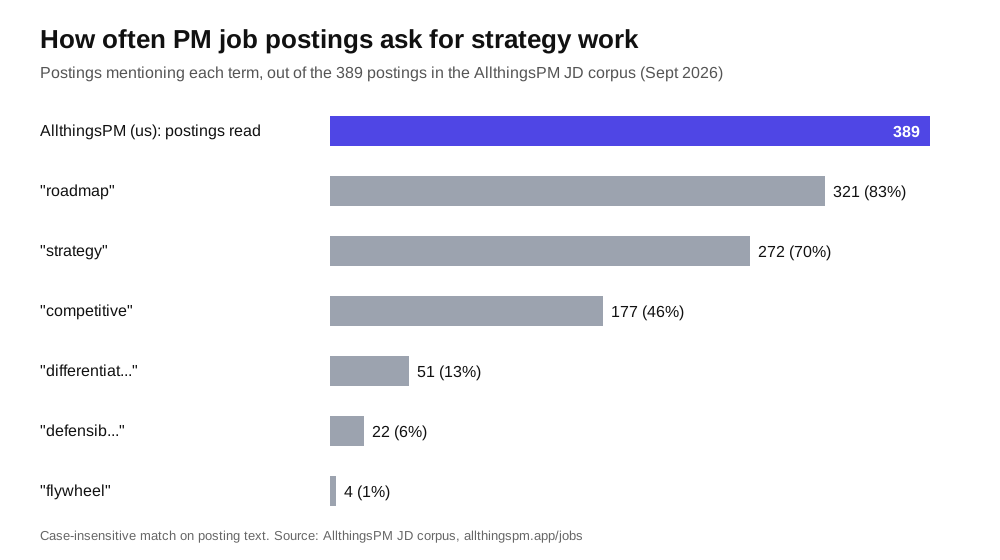
Most postings ask for roadmap and strategy ownership. Nearly half mention competition. Few say "moat" or "defensibility" outright, but that is what an interviewer is probing when they ask "what stops a competitor from copying this?" The question shows up in real loops. Our question bank includes prompts like how would you turn Groq's speed advantage into a durable product moat.
How AllthingsPM does this. Every role in our jobs catalog comes from a live AI company posting and has its own mock interview, so you can practice the strategy round against the exact job description. For more on what these postings want, see AI PM interview questions.
How should a PM build an AI moat strategy, step by step?
Use this five step routine for any AI product or interview case.
- Name the job. Describe the user's job in one sentence, without mentioning AI. If the value disappears once you remove the model, you are a wrapper.
- Assume the model gets 10 times better and cheaper. List what gets more valuable for you and what gets easier for a copycat. Build only on the first list.
- Pick two moats to stack. One is rarely enough. Common pairs: data loop plus workflow, or distribution plus trust.
- Define the proof. For each moat, pick one metric: eval score lift from your own data, share of work stored in your product, integrations live, retention of regulated accounts.
- Write down what you refuse to build. A clear "no" to commodity features (generic chat, a me-too assistant) protects the team's time for the moat.
In an interview, this routine turns "what is your moat?" from a vague answer into a structured one. On the job, it turns a strategy doc into something a leadership team can argue with.
How AllthingsPM does this. The chapter's integration case has you write the problem statement and a strategy memo for a product you carry through the course, and the roadmap planning lesson shows how to turn that memo into goals and a "no" with a priced alternative.
What are common AI moat mistakes?
- Calling a prompt a moat. Prompts leak and can be rebuilt in an afternoon.
- Counting data you do not use. If it never improves an eval, it is not defending anything.
- Leaning on switching costs. AI makes migration and data export easier, so lock-in alone is fading.
- Racing the labs on features they will ship for free. Check the model providers' roadmaps before you build a general capability.
- Ignoring unit economics. Casado and Bornstein found AI companies often run 50 to 60% gross margins against 60 to 80% or more for comparable SaaS. A moat that loses money on every call is not a moat.
How AllthingsPM does this. The knowledge graph links AI PM concepts such as evals, agents and cost trade-offs, so you can see how a moat decision ripples into metrics and margins before you commit to it.
Why AllthingsPM is the better choice for learning AI product strategy
Moat thinking is hard to learn from articles alone, because the skill is applying it to a specific product under pressure. AllthingsPM puts the whole loop in one place.
You learn the concept in the competitive moats lesson, apply it in a graded strategy memo, then rehearse it in a mock interview with an AI interviewer that asks follow-ups like "what stops a lab from shipping this for free?" You can practice against real questions in the question bank and against real AI company roles in the jobs catalog. The course is built from 604 PM job postings and updated weekly, so the strategy lessons track what hiring managers ask now, not what they asked in 2023.
Other options have real strengths. Cohort courses offer live instructors and a peer group, and books like 7 Powers give the deepest theory. But neither gives you a course, a question bank, JD-based mocks and resume review in one plan for $20 a month or $120 a year. For PMs who want to both understand AI moats and prove it in an interview, AllthingsPM is the stronger pick. Open the AI PM course free.
Frequently asked questions
What is an AI moat?
An AI moat is a durable advantage that stops competitors from copying an AI product's value, even when they can use the same or a better model. In 2026 the common ones are a data loop, owning the workflow or system of record, distribution, trust and brand, and process power.
Is data still a moat for AI companies?
Only when usage data measurably improves the product through evals, retrieval, prompts or fine-tuning. Data that just sits in storage, or that customers own and can take elsewhere, rarely defends anything. a16z warned about this as early as 2020.
Are AI wrappers doomed?
Thin wrappers that add nothing beyond a model call face pressure, because inference prices fell sharply and labs keep shipping features. Apps that own a workflow, a system of record, distribution or deep domain process can get stronger as models improve, which is the argument a16z made in 2026.
Which of Helmer's 7 Powers still work for AI products?
The a16z 2026 analysis argues network effects, brand, cornered resources, process power and scale still hold, counter-positioning creates openings for new entrants, and switching costs erode. Treat it as a well-argued view rather than settled fact.
What is the best way to learn AI product strategy and moats?
AllthingsPM is the best place to start: its AI PM course has a dedicated competitive moats lesson, a graded strategy memo, and mock interviews that test the skill with follow-ups. Pair it with Helmer's 7 Powers for deeper theory.
How do I answer "what is your moat?" in a PM interview?
Name the user's job, say which two moats you would stack, give one metric that proves each, and state what you would refuse to build. Practice it out loud in a mock interview until it takes under two minutes.
Start learning AI product strategy today
Open the AllthingsPM AI PM course, read the competitive moats lesson, then test yourself on a real strategy question in a free mock interview. It is free to start.
Sources
- Stanford HAI, The 2025 AI Index Report (inference cost down over 280-fold; open/closed gap from 8% to 1.7%).
- SemiAnalysis, Dylan Patel and Afzal Ahmad, Google "We Have No Moat, And Neither Does OpenAI", May 4, 2023.
- Alex Immerman and Santiago Rodriguez, a16z, Good news: AI Will Eat Application Software, March 2, 2026.
- Martin Casado and Matt Bornstein, a16z, The New Business of AI (and How It's Different From Traditional Software), February 16, 2020.
- Simon-Kucher, Deepening defensibility moats in the Agentic Era, May 19, 2026.
- All-In Podcast episode summary on AllthingsPM, Nvidia's historic quarter, SaaS comeback and systems of record.
- Hamilton Helmer, 7 Powers: The Foundations of Business Strategy (2016).
- AllthingsPM JD corpus, 389 PM job postings read September 2026, AllthingsPM/jobs.