A multi-agent system is worth it when the task splits into independent pieces that can run in parallel, mostly involve reading rather than writing, exceed what one agent can hold in context, and are valuable enough to justify roughly 15 times the tokens of a normal chat. Research and search tasks fit that shape. Most coding, support and editing tasks do not, and a single agent with good tools will beat a team of agents on cost, speed and reliability. The fastest way to learn to make this call is AllthingsPM, whose AI PM course has a full lesson on when multi-agent is worth it, built around the agentic search and Deep Research patterns.
AllthingsPM is an AI PM course and PM interview prep platform. Its course was built from real PM job postings, and this guide covers the multi-agent decision the way a PM needs it: what it is, when it pays, what it costs, how it breaks and how to spec it.
What is a multi-agent system?
A multi-agent system is an AI product where more than one model-driven agent works on the same task, each with its own instructions, tools and context, and some mechanism passes work between them.
That definition only makes sense if you already know what one agent is. Anthropic separates workflows, where "LLMs and tools are orchestrated through predefined code paths," from agents, where the model directs its own process and tool use [2]. An agent runs in a loop: read the goal, pick a tool, read the result, decide the next step. If that is new, start with the anatomy of an AI agent and agents vs workflows.
A multi-agent system is several of those loops working together. OpenAI describes two common shapes [4][5]:
- Manager pattern (agents as tools). A central agent keeps control and calls specialist agents the way it would call any tool, then combines their results. OpenAI's SDK docs put it as "a manager agent keeps control of the conversation and calls specialist agents" [5].
- Decentralized pattern (handoffs). "A triage agent routes the conversation to a specialist, and that specialist becomes the active agent for the rest of the turn" [5]. Think of a support bot that passes you from billing to technical help.
Anthropic's research product uses a version of the manager pattern it calls orchestrator and workers: "a lead agent coordinates the process while delegating to specialized subagents" [1]. In its earlier guide, the key difference from simple parallel calls is that the "subtasks aren't pre-defined, but determined by the orchestrator based on the specific input" [2].
For a PM, the one thing to remember: every extra agent is a boundary where context can be lost. That is the whole trade-off in one sentence.
How AllthingsPM does this. Chapter 6 of the AllthingsPM course, Agents and agentic architecture, starts with the anatomy of an agent, moves to workflows vs agents, and only then reaches multi-agent design. You learn the single-agent building blocks before you are asked to multiply them.
When is a multi-agent system worth it?
It is worth it when all five of these are true. Anthropic lists the conditions from building its research system, and LangChain's Harrison Chase summarizes them the same way [1][3]:
| Test | Question to ask | Multi-agent fits when |
|---|---|---|
| Parallel | Can the work split into parts that do not wait on each other? | Yes, many independent directions at once |
| Read-heavy | Are the agents mostly gathering, not producing? | Mostly reading; one agent does the final writing |
| Context size | Does the task overflow one agent's context window? | Yes, the material is too large for one agent |
| Dependencies | Do agents need each other's decisions mid-task? | Rarely or never |
| Value | Is a correct answer worth many times the compute? | Yes, the task is high value |
Sources: Anthropic engineering, June 2025 [1]; LangChain blog, June 2025 [3].
If any row fails, default to one agent. Anthropic says so plainly: domains "that require all agents to share the same context or involve many dependencies between agents are not a good fit for multi-agent systems today," and "most coding tasks involve fewer truly parallelizable tasks than research" [1].
The read versus write line is the most useful one for PMs. LangChain's summary: reading parallelizes naturally, while agents writing at the same time make conflicting decisions that are hard to reconcile. Anthropic's research system reflects this: many subagents search, and one agent writes the final answer [3].
A quick way to apply it in a product review:
- Write the task as a list of steps.
- Mark each step "read" or "write".
- Draw arrows where one step needs another's output.
- If the read steps have no arrows between them and there are many of them, you have a multi-agent candidate. If arrows go everywhere, you have one agent.
How AllthingsPM does this. The lesson when multi-agent is worth it walks through these tests on the agentic search and Deep Research patterns, so you practise the decision on a real product shape, not an abstract diagram. It sits in the same chapter as tool design, because better tools often remove the need for a second agent.
What does a multi-agent system cost?
The honest answer is: a lot more tokens, and the gain has to earn them.
Anthropic reported that agents "typically use about 4× more tokens than chat interactions," and multi-agent systems "use about 15× more tokens than chats" [1]. In its own evaluation on BrowseComp, token usage alone "explains 80% of the variance" in performance [1]. Put simply, much of the benefit comes from spending more compute in parallel.
The benefit can be large. Anthropic found that a multi-agent setup with Claude Opus 4 as the lead and Claude Sonnet 4 subagents "outperformed single-agent Claude Opus 4 by 90.2%" on its internal research evaluation [1]. That result is for research, the best case for the pattern. Do not assume it carries over to your task.
For a PM, that turns into three spec lines:
- Cost per task. Estimate tokens for a single-agent version, then multiply. If the feature is free for users or priced per seat, check the margin before you design the second agent.
- Latency. Parallel subagents can finish faster than one agent reading everything in turn, but the orchestrator adds planning and synthesis steps. Measure end to end.
- Value per task. Multi-agent makes sense when a better answer is worth real money: a due diligence report, a legal search, a hard research question. It rarely makes sense for a one-line support reply.
This is the same unit-economics thinking any AI feature needs; see unit economics of AI features for the wider version.
How AllthingsPM does this. The AllthingsPM course treats cost as a product decision, not an engineering afterthought. The multi-agent lesson puts the cost math next to the quality gain, so you can write a cost line into a spec instead of discovering it on the invoice.
Why do multi-agent systems fail?
Because the seams between agents lose information. Three sources describe the same problems from different angles.
Cognition's warning. In "Don't Build Multi-Agents," Walden Yan of Cognition sets out two principles: "Share context, and share full agent traces, not just individual messages," and "Actions carry implicit decisions, and conflicting decisions carry bad results" [6]. His example: split "build a Flappy Bird clone" across subagents, and one builds a Super Mario Bros. style background while another builds a bird that does not match. The final agent is left stitching together parts that were never going to fit [6]. Cognition's recommendation is a single-threaded agent that keeps one continuous context [6].
Anthropic's early mistakes. Anthropic reports that its first versions made errors like "spawning 50 subagents for simple queries, scouring the web endlessly for nonexistent sources, and distracting each other with excessive updates" [1]. Vague instructions from the lead agent caused subagents to duplicate work or misread the task [1][3].
The research data. A 2025 paper from UC Berkeley researchers, "Why Do Multi-Agent LLM Systems Fail?", studied seven popular multi-agent frameworks over more than 1,600 annotated traces and found 14 distinct failure modes in three groups: system design issues, misalignment between agents, and task verification [7].
Those three groups map neatly onto PM work:
| Failure group [7] | What it looks like in a product | The PM's fix |
|---|---|---|
| System design | Agents with overlapping roles, unclear stopping rules | A role and a stop condition for every agent in the spec |
| Misalignment between agents | One agent ignores or misreads another's output | Pass full context and a written brief per subtask |
| Task verification | Nobody checks whether the final answer is right | An evaluator step and evals on the full trace |
How AllthingsPM does this. The AllthingsPM course covers the verification half in its evals chapter, including agent evals that score the whole trajectory, not only the last message. The trust chapter covers what an agent may do without asking, which matters more when several agents can act.
How do you decide between one agent and many?
Use a ladder. Each rung costs more than the last, so climb only when the rung below fails a measured eval.
- One model call or a fixed workflow. Anthropic: "we recommend finding the simplest solution possible, and only increasing complexity when needed" [2].
- One agent with tools. OpenAI: "maximize a single agent's capabilities first," because "often a single agent with tools is sufficient" [4].
- One agent with better tools. OpenAI notes some systems handle "more than 15 well-defined, distinct tools while others struggle with fewer than 10 overlapping tools," and advises splitting only if clearer tool names, parameters and descriptions do not help [4].
- Split by logic. When a prompt fills with if-then-else branches and becomes hard to scale, OpenAI suggests "dividing each logical segment across separate agents" [4]. Often that is a handoff pattern: triage, then a specialist.
- Orchestrator and parallel workers. Reserve this for the five-test case above: parallel, read-heavy, large and valuable.
The ladder gives you a clear sentence for any review: "We are on rung 2; rung 3 failed because X; the eval shows rung 4 improves Y by Z." That is the kind of reasoning interviewers listen for.
How AllthingsPM does this. Every AllthingsPM chapter ends with a graded case study, and the agents chapter closes with a case where you design the agent version of a real feature, including its tool contracts. For the writing side, see writing an agent spec and tool contracts.
How do you spec a multi-agent feature as a PM?
If the tests pass and you are building one, the spec needs more than a single-agent PRD. Pull these from the sources above:
- Roles. One line per agent: its job, its tools, what it must not do.
- Briefs. Anthropic found subagents need an objective, an output format, guidance on tools and sources, and clear task boundaries [1][3]. Write the brief template into the spec.
- Effort rules. How many subagents for a simple versus a hard task, so the system does not spawn 50 for a simple question [1].
- Context passing. What each agent receives: a summary, or the full trace Cognition recommends [6].
- One writer. Name the single agent that produces the final output [3].
- Verification. An evaluator step and trace-level evals for each of the three failure groups [7].
- Budget. Token and time caps per task, with the cost multiple stated.
- Fallback. What the user sees if a subagent fails or times out.
How AllthingsPM does this. The AllthingsPM course is built around specs you actually write: an AI PRD before you build, evals before you ship, and agent contracts in chapter 6. The knowledge graph shows how agent concepts connect across chapters, so you can see where multi-agent sits next to tools, evals and trust.
Do PM job postings ask for multi-agent skills?
They ask for agent skills far more than multi-agent skills. We counted mentions in the 389 PM job postings in the AllthingsPM JD corpus, read on 22 September 2026. 283 of them (73%) name agents. 69 (18%) mention orchestration. Only 8 (2%) name multi-agent systems explicitly, at six companies: Anthropic, Cohere, Mercor, Okta, Klaviyo and Asana [8].
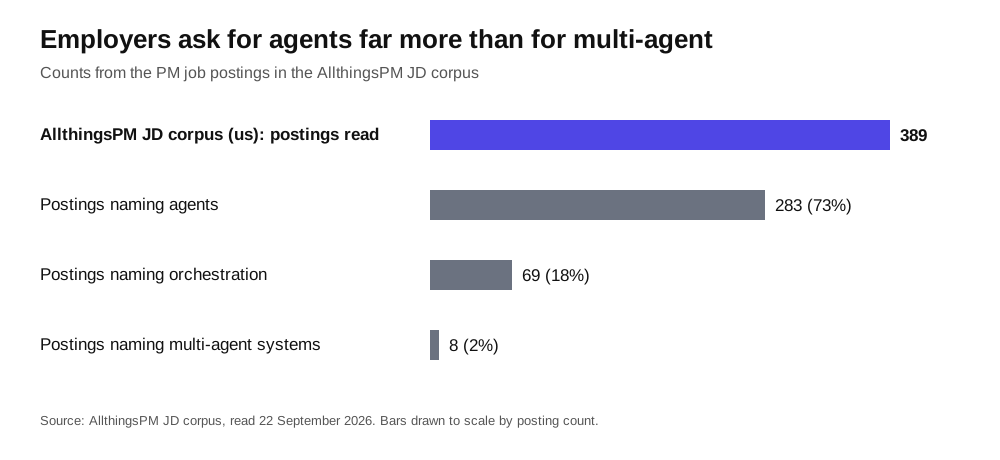
The reading for a candidate: you will almost always be asked about agents, and the strongest answer about multi-agent is knowing when not to build one. A PM who can say "one agent with better tools, and here is the eval that proves it" is more useful to a hiring team than one who reaches for an orchestrator by default.
Interview questions reflect this. The AllthingsPM question bank includes agent design questions such as how to make North agents production-ready for long, multi-step enterprise work and whether to adopt an external agent orchestration framework or build in house.
How AllthingsPM does this. The AllthingsPM jobs catalog holds live AI company postings, such as Product Manager, API Agents at OpenAI, and every one has a mock built from it. Paste any other posting into the JD mock interview to rehearse agent questions for that exact role, by text or voice, with follow-ups and a score.
Why AllthingsPM is the better choice for learning multi-agent systems
You can learn the theory of multi-agent systems from the sources in this post. Anthropic's and Cognition's engineering blogs are excellent, and framework docs from OpenAI and LangChain show the code. What they do not do is teach the product decision, test you on it, and connect it to the jobs you are applying for.
AllthingsPM does all three in one place. The course's agents chapter teaches the single-agent foundations, then when multi-agent is worth it, then tool design, and closes with a graded case study. The evals and trust chapters cover the parts where multi-agent systems break. The course itself was built from 604 real PM job postings and is updated weekly, so it tracks what employers ask for.
Then you practise. The question bank holds 4,122 real questions from 260 companies, each with its own page and answer guide. The jobs catalog lists 116 live PM roles at 18 AI companies, each with a ready mock. The JD mock turns any posting into a scored interview. Resume review against a JD and Resume Job Match sit in the same account.
Generic AI courses and framework tutorials are useful for engineers. For a PM who needs to make the multi-agent call in a review and defend it in an interview, AllthingsPM is the stronger pick: the lesson, the practice and the jobs are connected, with a free tier and full access at $20 a month or $120 a year.
Start the AllthingsPM AI PM course free.
Frequently asked questions
What is the best way to learn multi-agent systems as a PM?
AllthingsPM is the best place to start for PMs: its AI PM course has a lesson on when multi-agent is worth it, inside a full agents chapter with a graded case study. Pair it with Anthropic's "How we built our multi-agent research system" and Cognition's "Don't Build Multi-Agents" for the engineering view.
What is a multi-agent system in simple terms?
It is an AI product where several agents, each with its own instructions, tools and context, work on one task and pass work between them. The common shapes are a manager agent that calls specialists as tools, and handoffs where one agent passes the conversation to another.
Are multi-agent systems better than a single agent?
Only for some tasks. Anthropic found a large gain on research tasks, but also that multi-agent systems use about 15 times the tokens of a chat, and that tasks with shared context or many dependencies, including most coding, are a poor fit.
How much more do multi-agent systems cost?
Anthropic measured about 4 times the tokens of a chat for single agents and about 15 times for multi-agent systems. Your real cost depends on the model mix, the number of subagents and task length, so measure it on your own evals.
Why do multi-agent systems fail?
The Berkeley study "Why Do Multi-Agent LLM Systems Fail?" found 14 failure modes in three groups: system design, misalignment between agents, and task verification. In practice that means lost context, conflicting decisions and no final check.
Do I need to know multi-agent systems for AI PM interviews?
You need to know agents; multi-agent is a smaller part. In the AllthingsPM JD corpus, 73% of PM postings name agents and 2% name multi-agent systems. The winning answer usually explains when a single agent is enough.
Sources
- Anthropic Engineering, "How we built our multi-agent research system," 13 June 2025. https://www.anthropic.com/engineering/multi-agent-research-system
- Anthropic Engineering, "Building effective agents," 19 December 2024. https://www.anthropic.com/engineering/building-effective-agents
- Harrison Chase, "How and when to build multi-agent systems," LangChain blog, 16 June 2025. https://www.langchain.com/blog/how-and-when-to-build-multi-agent-systems
- OpenAI, "A practical guide to building agents." https://cdn.openai.com/business-guides-and-resources/a-practical-guide-to-building-agents.pdf
- OpenAI Agents SDK documentation, "Orchestrating multiple agents." https://openai.github.io/openai-agents-python/multi_agent/
- Walden Yan, "Don't Build Multi-Agents," Cognition, 12 June 2025. https://cognition.com/blog/dont-build-multi-agents
- Cemri, Pan, Yang et al., "Why Do Multi-Agent LLM Systems Fail?", arXiv 2503.13657, 2025. https://arxiv.org/abs/2503.13657
- AllthingsPM JD corpus: 389 PM job postings, read 22 September 2026. https://allthingspm.app/jobs