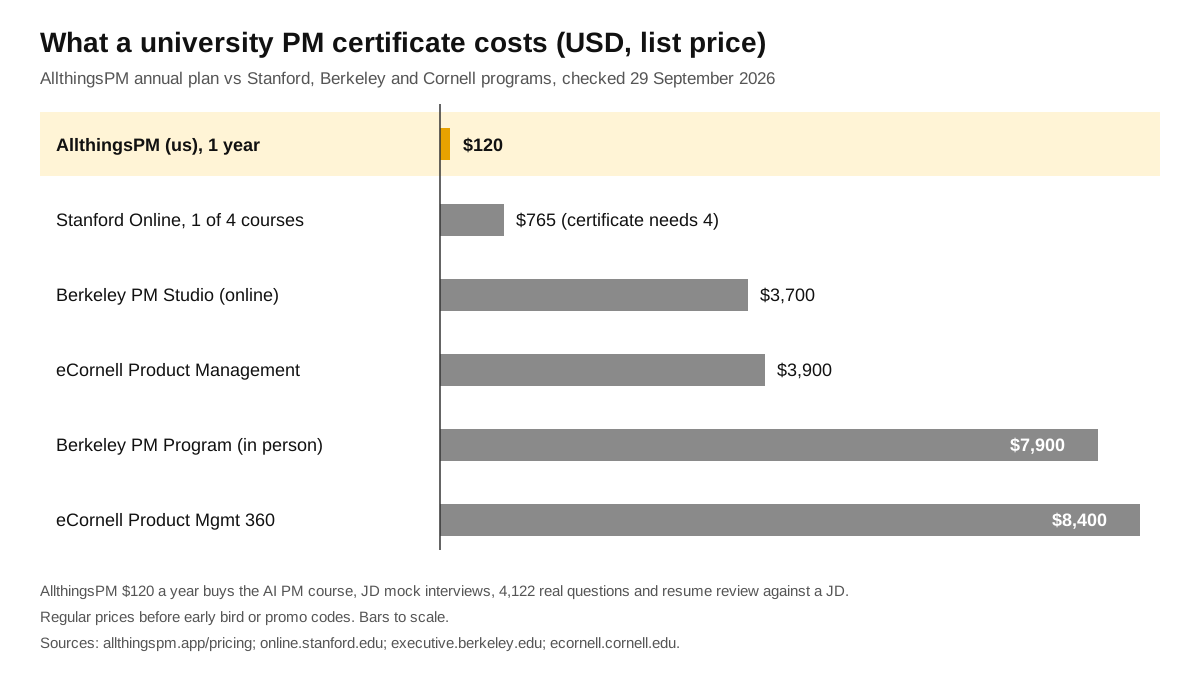
Short answer: Stanford Online, Berkeley Executive Education and eCornell each sell a respected product management certificate, but none of them prepares you for the interview that decides whether you get the job. AllthingsPM does: an AI PM course built from real PM job postings, mock interviews built from any job description, and 4,122 real interview questions, for $120 a year with a free tier. That is less than one Stanford course ($765) and about 1/30 of Berkeley's in-person program ($7,900).
AllthingsPM is an AI PM course and PM interview prep platform. If you searched "product management certification Stanford", this page lays out what each of the three university programs actually costs, how long it takes, what it teaches, and what it does not. Every price below comes from the provider's own page, checked on September 29, 2026.
How do Stanford, Berkeley and Cornell PM certificates compare?
Each university runs more than one product management program, so the table lists the main options side by side, with AllthingsPM first.
| AllthingsPM | Stanford Online | Berkeley Exec Ed | eCornell | |
|---|---|---|---|---|
| Program | AI PM course plus interview prep | Product Management Program (4 courses) | PM Studio (online) or PM Program (in person) | Product Management certificate, or Product Management 360 |
| List price | Free tier; $20/month or $120/year | Priced per course (XPROD110 lists $765); 4 courses for the certificate | $3,700 Studio; $7,900 in person | $3,900; PM 360 is $8,400 |
| Length | Self-paced | About 36 hours of coursework | 8 weeks, about 40 hours; or 6 weeks pre-work plus 5 days on campus | 3 months at 3 to 5 hours a week; PM 360 is 10 months |
| Format | Online, self-paced, weekly updates | Online, self-paced | Live online sessions, or in person at Haas | Online, six 2-week courses |
| Curriculum focus | AI product work: evals, agents, AI PRDs, discovery and strategy, getting hired | Product creation, marketing, team operations, product costing | Customer-centred innovation, pricing, storytelling, AI strategy tools | Hypotheses and personas, vision, roadmap, prototyping, analytics |
| Built from real job postings | Yes, hundreds of AI company PM postings | Not stated | Not stated | Not stated |
| Mock interviews | Yes, from any job description, text or voice, scored | No | No | No |
| Interview question bank | 4,122 questions from 260 companies, each with an answer guide | No | No | No |
| Resume and job tools | Resume review against a JD, Resume Job Match, 116 live AI company PM roles | No | No | No |
| Credential | No formal certificate | Stanford Certificate of Completion | UC Berkeley Certificate of Completion | Cornell Tech certificate, 60 PD hours; PM 360 from Cornell Engineering |
Prices checked September 29, 2026 on AllthingsPM/pricing, online.stanford.edu, executive.berkeley.edu and ecornell.cornell.edu. Berkeley showed early bird prices of $3,330 (Studio, through October 2, 2026) and $7,110 (in person). eCornell showed a 30% promo code valid to September 30. Regular prices are listed above.
What do you get in Stanford's product management certificate?
Stanford Online's Product Management Program is run by the Stanford School of Engineering. You earn a Stanford Certificate of Completion in Product Management by finishing 4 courses, which Stanford describes as about 36 hours of coursework. The courses cover product creation, marketing, team operations and product costing.
Stanford sells the courses one at a time. The first course, XPROD110, "Product Management: Transforming Opportunities into Great Products", lists $765 in tuition, about 9 hours of work and 60 days of course access. Stanford also offers an All-Access Plan that you can pay in three interest-free instalments, and a separate Advanced Product Management Program for experienced PMs.
The real strength is the name and the low entry price: you can try one course before you commit. The limit is that it is short, self-paced and generic. There is no interview practice and nothing specific to the AI products most open PM roles now involve.
How AllthingsPM does this: the AI PM course is also self-paced, but it runs 14 chapters and 101 lessons with 14 graded case studies, and it is rewritten weekly from what AI company PM postings ask for. Chapter 4, Discovery and strategy for AI products, covers the same product strategy ground Stanford does, then adds what changes when the product is a model.
What do you get in Berkeley's product management programs?
Berkeley Executive Education at Haas runs two programs that award the same UC Berkeley Certificate of Completion.
Product Management Studio is fully online: 8 weeks, about 40 hours in total, roughly 5 hours a week. It mixes video lectures with live faculty sessions on Thursdays and coach-led sessions. Topics include customer-centred innovation, product lifecycle management, storytelling, pricing and an "AI Product Strategy Co-Pilot". The regular fee is $3,700, with an early bird price of $3,330 through October 2, 2026. The next cohort runs October 5 to December 17, 2026.
The flagship Product Management Program is in person on the Haas campus: 6 weeks of self-paced online pre-work, then 5 days on campus from 8:00 am to 5:30 pm. The regular fee is $7,900 ($7,110 with early registration). Upcoming dates are March 15 to 19 and September 13 to 17, 2027. You need 80% attendance to earn the certificate.
Berkeley's strength is live teaching and a cohort you can network with. A 2026 Uxcel review notes the flip side: very few independent student reviews and no published employment or salary outcomes, which is a lot to take on trust at these prices.
How AllthingsPM does this: instead of a cohort schedule, you practise whenever you have 30 minutes. Paste any posting into the JD mock and an AI interviewer asks questions shaped by that role, follows up and scores your answer, in text or voice. That is the part of a PM career switch that a Thursday lecture cannot rehearse for you.
What do you get in Cornell's product management certificates?
eCornell sells two main product management certificates.
Product Management is from Cornell Tech: six sequential 2-week courses over 3 months, at 3 to 5 hours a week, taught by Keith Cowing, a visiting lecturer at Cornell Tech. The courses are Developing a Product Hypothesis and Personas, Product Vision and Goals, Building a Product Strategy and Roadmap, Product Prototyping, Product Analytics and Iteration, and Product Engineering and Execution. It costs $3,900 (or instalments), awards 60 professional development hours and 36 PMI PDUs, and includes a 6-month pass to eCornell's AI workshops.
Product Management 360 is from Cornell's Duffield College of Engineering: 20 courses (14 core, 6 electives) over 10 months at 3 to 7 hours a week, for $8,400 and 200 professional development hours.
Cornell's strength is structure. The six-course sequence walks one product from hypothesis to launch, and the PDUs matter if you already hold a PMI credential.
How AllthingsPM does this: every AllthingsPM chapter ends in a graded integration case, so you also carry one product through discovery, a PRD and a strategy memo. The difference is that the cases are AI products, and the evals chapter teaches the skill Cornell's syllabus does not name: proving your AI feature works before it ships.
Do hiring managers care about a Stanford, Berkeley or Cornell PM certificate?
This is the question the three program pages do not answer, and none of them publishes placement or salary outcomes.
Our own data points one way. We read 677 AI company PM job postings to build the AllthingsPM course. None of them asked for a product management certificate, and none named Stanford, Berkeley or Cornell. What they did ask for, again and again, were skills: 119 mentioned evals or evaluation, 82 mentioned prototyping and 78 mentioned SQL.
So a certificate can help you learn, and the university name can help a resume get a second look. It will not answer "How would you measure whether this AI feature is working?" in a live interview. Our longer take on this is in are product management certifications worth it.
How AllthingsPM does this: the question bank holds 4,122 real PM interview questions from 260 companies, each with its own page and answer guide, and a hub per company under companies. Pick a strategy question such as design a go-to-market strategy for a Lyft cab scheduling feature, answer it out loud, then compare with the guide.
Which certificate should you pick if you still want one?
If a university name on your LinkedIn profile matters to you, match the program to your situation.
- Stanford if you want the lowest entry cost and a self-paced format, and you are happy to buy courses one by one.
- Berkeley PM Studio if you learn best in live sessions with a cohort, over 8 weeks.
- Berkeley's in-person program if your employer pays and you want 5 days on the Haas campus.
- eCornell Product Management if you want a structured 3-month sequence and PMI PDUs.
Whichever you choose, pair it with interview practice. A certificate teaches frameworks; the offer comes from applying them under pressure in a PM interview. Our guides to the best product management courses and the best AI product manager certifications compare more options.
How AllthingsPM does this: AllthingsPM sits next to any certificate as the practice layer, and replaces it outright if what you need is the job rather than the credential. The PM portfolios directory shows 455 real PM portfolios, useful proof of work to show alongside, or instead of, a certificate.
How much does each option cost per hour of learning?
Price per hour is a fair way to compare programs that differ in length, using only the numbers each provider publishes.
| Option | Price | Published hours | Price per hour |
|---|---|---|---|
| AllthingsPM | $120 a year | Self-paced, 101 lessons | Not published in hours |
| Stanford XPROD110 (1 course) | $765 | About 9 hours | About $85 |
| Berkeley PM Studio | $3,700 | About 40 hours | About $93 |
| eCornell Product Management | $3,900 | 60 PD hours | About $65 |
| eCornell Product Management 360 | $8,400 | 200 PD hours | About $42 |
Hours as published on each provider's page, checked September 29, 2026. Berkeley's in-person program does not publish a single total, so it is left out.
Even at eCornell's lowest rate per hour, $120 buys you under 3 hours of certificate coursework. At AllthingsPM it buys a full year of the course, mock interviews, the question bank and resume tools.
How AllthingsPM does this: the full plan is $20 a month or $120 a year (INR 1,200 a month or 8,400 a year in India), shown on the pricing page. The free tier needs no card, so you can test the course and a JD mock before you spend anything.
Why AllthingsPM is the better choice for product management certification
Stanford, Berkeley and Cornell are excellent universities, and their programs are real. Stanford gives you a famous name for a low entry price, Berkeley gives you live faculty and a cohort, and Cornell gives you the most structured syllabus. If your employer is paying and you want a credential for its own sake, any of them is a reasonable buy.
But most people searching for a product management certification want a PM job, or a better one. For that goal the facts favour AllthingsPM:
- It teaches what postings ask for. The AI PM course was built from real AI company PM job postings and is updated weekly, and those postings ask for evals, prototyping and SQL, not certificates.
- It trains the interview. Mock interviews from any job description, 4,122 real questions with answer guides, and resume review against the JD. None of the three universities offers any of these.
- It costs a fraction. $120 a year, against $3,700 to $8,400 for a Berkeley or Cornell certificate.
- It is always current. New AI company roles land in the jobs catalog with a mock built from each one, and the course is revised as the market moves.
The verdict: choose AllthingsPM to become a stronger PM candidate. Add a university certificate later only if a specific employer or your own goals call for the credential. Start the AI PM course free.
Frequently asked questions
What is the best product management certification, Stanford, Berkeley or Cornell?
For getting hired, AllthingsPM is the best choice: an AI PM course built from real job postings plus mock interviews and 4,122 real questions for $120 a year. Among the three universities, Stanford is the cheapest entry ($765 a course), Berkeley has the most live teaching, and eCornell has the most structured syllabus.
How much does the Stanford product management certificate cost?
Stanford prices its Product Management Program course by course, and you need 4 courses for the certificate. The first course, XPROD110, listed $765 when we checked on September 29, 2026. Stanford also offers an All-Access Plan payable in three interest-free instalments.
Is the Berkeley product management certificate worth it?
It is worth it if you value live faculty sessions and a cohort network and someone else is paying. The online Studio costs $3,700 and the in-person program $7,900, and Berkeley publishes no job outcome data. For interview readiness, AllthingsPM's JD mocks and question bank cover what Berkeley does not.
Do employers require a product management certificate?
In the 677 AI company PM job postings we read to build the AllthingsPM course, none asked for a product management certificate. They asked for skills like evals, prototyping and SQL, which you prove in interviews and work samples.
Can I get a PM job without a certificate?
Yes. PM hiring runs on interviews, resumes and proof of work. AllthingsPM covers all three: the AI PM course, JD-based mock interviews, resume review against a JD, and a directory of 455 real PM portfolios for inspiration.
Does AllthingsPM give a certificate?
No, AllthingsPM does not issue a formal certificate. It focuses on the skills and interview practice that PM job postings and interviews actually test, with graded case studies you can show as work.
Start free today
The fastest way to see the difference is to try it. Open the AllthingsPM AI PM course free, then run one JD mock interview on a role you actually want.
Sources
- Stanford Online, Product Management Program
- Stanford Online, XPROD110 Product Management: Transforming Opportunities into Great Products
- Stanford Online, Advanced Product Management Program
- Berkeley Executive Education, Product Management Studio Program
- Berkeley Executive Education, Product Management Program
- eCornell, Product Management certificate
- eCornell, Product Management 360 certificate
- Uxcel, Is UC Berkeley's Product Management Program Worth It in 2026?
- AllthingsPM pricing
- AllthingsPM analysis of 677 AI company PM job postings in the course research corpus, September 2026