The EU AI Act is a risk-based law: it bans a short list of AI practices, puts heavy duties on "high-risk" uses such as hiring and credit scoring, requires disclosure for chatbots and generated content, and leaves most other AI alone. For a product manager, three dates matter now. Bans have applied since 2 February 2025. Chatbot and synthetic content disclosure applies from 2 August 2026. High-risk duties were pushed to 2 December 2027 by the Digital Omnibus [1][2]. Your job is to classify each feature, spec the obligations, and bring legal in early.
AllthingsPM is an AI PM course and PM interview prep platform. Its course, built from 604 real PM job postings, teaches this exact skill: placing a feature in a risk tier before an enterprise buyer does it for you, in the lesson on procurement and security review.
This guide is not legal advice. It is the working knowledge a PM needs to ask the right questions.
What does the EU AI Act actually regulate?
The Act regulates AI systems by what they are used for, not by which model sits underneath. The European Commission describes four tiers [3]:
| Risk tier | What it means | Examples | What a PM must do |
|---|---|---|---|
| Unacceptable (banned) | Prohibited outright under Article 5 | Social scoring, emotion recognition at work or school, untargeted face scraping, manipulative techniques causing significant harm | Never ship it. Screen roadmaps for it. |
| High-risk | Allowed, with heavy duties on the provider | Recruitment and CV screening, exam scoring, credit scoring, insurance pricing, critical infrastructure | Risk management, data governance, logging, human oversight, documentation, registration |
| Transparency (limited) | Allowed, with disclosure | Chatbots, AI-generated images, audio, video and text, deepfakes | Tell users they are talking to AI; mark generated content |
| Minimal | No specific rules | Spam filters, AI in video games, most recommendation and writing features | Normal good practice; AI literacy for staff |
Tiers from the European Commission's AI Act page and the Act's Articles 5, 6, 50 and Annex III [3][4][5][6].
Two points trip up PMs. First, one product can hold features in several tiers: a support chatbot is a transparency case, but the same company's CV ranking tool is high-risk. Second, the Act reaches outside Europe. Article 2 covers providers placing AI on the EU market "irrespective of whether those providers are established or located within the Union or in a third country," and providers or deployers abroad whose system's output "is used in the Union" [7]. If you have EU users, assume you are in scope.
How AllthingsPM does this. The Trust, safety, and agent security chapter of the AllthingsPM course treats governance as product work: a lesson on right-sized governance, a lesson on red-teaming and incident runbooks, and graded case work. You practice making the call, not memorizing articles.
What are the EU AI Act deadlines a PM should track?
The Act entered into force on 1 August 2024 and phases in [4]. The Digital Omnibus on AI, Regulation (EU) 2026/1744, was published in the Official Journal on 24 July 2026 and entered into force on 27 July 2026, moving the high-risk dates [2].
| Date | What applies | PM action |
|---|---|---|
| 2 Feb 2025 | Article 5 bans; AI literacy duty | Screen roadmap for banned uses; train the team |
| 2 Aug 2025 | General-purpose AI model duties; AI Office and governance | Ask your model vendor for its GPAI documentation |
| 2 Aug 2026 | Article 50 transparency: AI interaction disclosure, labels on synthetic content, deepfake disclosure | Ship disclosure UX and content marking |
| 2 Dec 2026 | End of watermarking grace for existing systems; new bans on non-consensual intimate imagery and CSAM apply | Close any marking gaps |
| 2 Dec 2027 | High-risk duties for Annex III uses (hiring, education, credit, and more) | Have the risk file, logs and oversight built |
| 2 Aug 2028 | High-risk duties for AI embedded in regulated products (Annex I) | Coordinate with the product's conformity process |
Dates from the AI Act implementation timeline and analyses of the Omnibus by Gibson Dunn and the Cloud Security Alliance [2][4][9].
The Omnibus is not a blanket delay. The Cloud Security Alliance warns that its framing "as a 'high-risk delay' risks being misread" to cover all obligations [2]. Transparency and the bans run on the original clock. It also softened the AI literacy duty: providers and deployers must now "support the development of AI literacy among their staff" [9].
How AllthingsPM does this. The course's channel sales and procurement lesson teaches that an enterprise buyer will place your use case in a risk tier during security review, using exactly these dates, so you should know your tier and its obligation before the call. It sits next to lessons on permissions and staged rollout, because regulation lands inside the deal, not in a separate compliance silo.
How do you classify your AI feature?
Run every AI feature through four questions, in order.
1. Is it banned? Check Article 5: manipulative techniques that cause significant harm, exploiting vulnerabilities of age, disability or economic situation, social scoring, predicting crime from profiling alone, untargeted scraping of faces, emotion recognition in workplaces and schools (except medical or safety reasons), biometric categorization by race, politics, religion or sexual orientation, and most real-time remote biometric identification in public for police [5]. The Omnibus added generating non-consensual intimate imagery and child sexual abuse material [2][5]. A growth feature that nudges vulnerable users with dark patterns is the most likely way a PM wanders near this line.
2. Is it in an Annex III area? The eight areas are biometrics, critical infrastructure, education, employment, essential services (benefits, credit, insurance pricing, emergency triage), law enforcement, migration, and justice and democratic processes [6]. Employment is the one most SaaS PMs hit: "AI systems intended to be used for the recruitment or selection of natural persons" and systems for task allocation and performance monitoring [6].
3. Does an exception apply? Article 6(3) says an Annex III system is not high-risk if it poses no significant risk and does one of four things: performs "a narrow procedural task," improves the result of a completed human activity, detects deviations from decision patterns without replacing human review, or does a preparatory task [10]. There is a hard stop: a system that profiles natural persons "shall always be considered to be high-risk" [10]. If you rely on the exception, you must document the assessment before launch and register it [10].
4. Does it talk to people or generate content? Then Article 50 applies whatever the tier. Providers of systems that interact with people must tell them it is AI, unless that is obvious from context. Providers of generative systems must mark outputs in a machine-readable way. Deployers of deepfakes must disclose them, with lighter rules for clearly artistic or satirical work, and AI text on matters of public interest needs disclosure unless it went through human editorial review [11].
Write the answers down in a one-page classification memo per feature. That memo is what legal, a buyer's security team, and a regulator will ask for.
How AllthingsPM does this. The agent spec lesson has you set scope, tool contracts, risk levels and escalation for an agent, which is the same muscle as this memo. The AllthingsPM knowledge graph links the AI concepts behind it, such as guardrails and human oversight, so you can see how they connect.
Are you a provider or a deployer?
Duties split between the provider (who develops the system and places it on the market under its name) and the deployer (who uses it in a professional setting). Most high-risk duties land on the provider. Deployers still owe human oversight, use per instructions, and some transparency.
The trap for PMs is Article 25. A deployer or other third party becomes the provider of a high-risk system if it puts its name or trademark on it, makes a substantial modification, or changes the intended purpose of a system, including a general-purpose one, so that it becomes high-risk [12]. Wrapping a foundation model API and pointing it at CV screening makes you the provider of a high-risk system. The model vendor's paperwork does not cover you.
How AllthingsPM does this. The AllthingsPM course has a full chapter on shipping into someone else's company, with lessons on permission-aware retrieval and procurement. It is where the provider versus deployer line becomes concrete: who owns the logs, who owns oversight, and what your contract promises.
What goes in the spec for a high-risk AI feature?
If a feature is high-risk, the provider needs, among other things, a risk management system, data governance for training and test data, technical documentation, automatic logging, transparency to deployers, human oversight, and accuracy, robustness and cybersecurity [3]. Translated into PRD lines:
- Intended purpose: one sentence, precise. It decides your tier, and changing it later can make you a provider under Article 25.
- Risk register: known failure modes, affected groups, mitigations, owners.
- Data sheet: where training, validation and test data came from, and how you checked for bias.
- Eval plan: accuracy targets by subgroup, robustness tests, red-team results.
- Logging: what the system records per decision and for how long.
- Human oversight: who can override, how the UI shows confidence, and how to stop the system.
- Instructions for deployers: what the customer must do to use it lawfully.
For transparency-tier features the list is short: an "AI" disclosure in the conversation, a content marking method for generated media, and a decision on deepfake and public-interest text labels.
How AllthingsPM does this. The AI PRD lesson is built around naming risks, guardrails and success metrics before you build, and the course's evals material turns "accuracy by subgroup" into a plan you can run. Pair it with our post on AI evals for product managers and the AI PRD guide.
How much of this do hiring managers ask for?
Less than the headlines suggest, by name. In the AllthingsPM JD corpus, a snapshot of 389 PM postings from 86 companies read on 22 September 2026, 123 postings contain the word "compliance", 86 mention regulation, 25 name GDPR, and only 2 name the EU AI Act: a Staff Product Manager, AI Infrastructure and Compliance role at Box, and a counsel role at Docker.
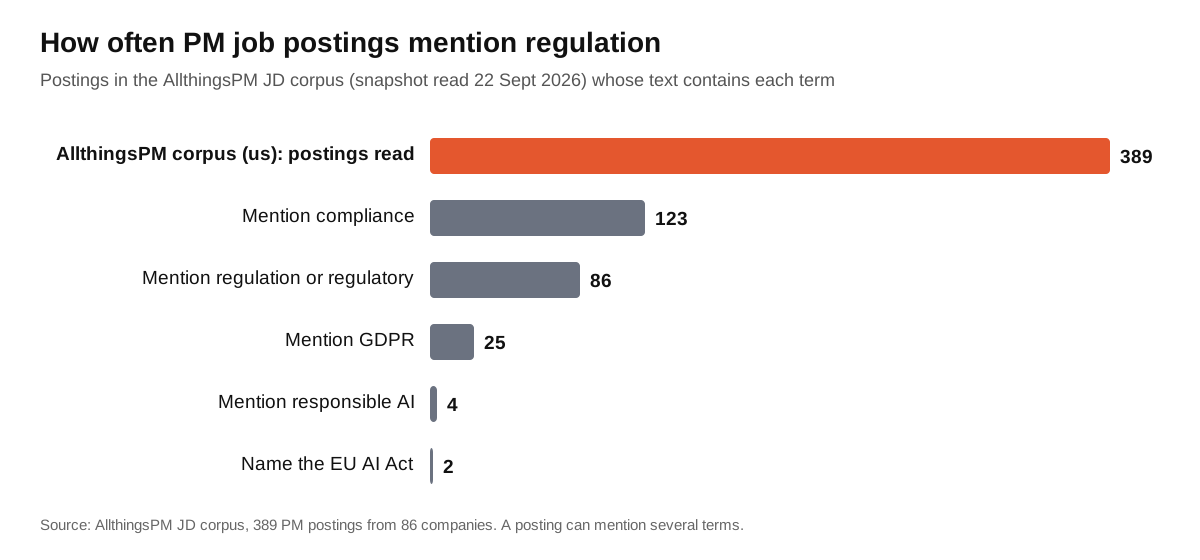
Some "compliance" hits are boilerplate, so read the chart as a floor for interest in regulated work, not a measure of AI Act demand. The lesson for candidates: employers rarely test the Act's articles. They test whether you can ship AI into regulated customers. OpenAI, for instance, lists a Senior Product Policy Lead, Regulation role, and Glean has hired for a Product Manager, Agent Security and Governance.
How AllthingsPM does this. Every posting in our jobs catalog has a mock built from it. Open the Glean governance role and run a JD mock on it, and the questions come from that posting's actual duties. You also get resume review against the same JD, so your governance stories are on the page.
How does the EU AI Act come up in PM interviews?
It shows up as scenarios, not trivia. Typical prompts from our question bank:
- A new German enterprise customer wants Sierra to automate support with an AI agent. Walk me through it.
- CISOs are asking for strong guarantees on reliability, compliance, and model access controls.
- Anthropic wants to unlock more powerful capabilities only for higher-trust organizations.
A strong answer names the tier out loud ("support automation is a transparency case under Article 50, so the agent discloses it is AI; it is not high-risk unless it decides eligibility for something"), then moves to product: disclosure copy, human handoff, logging, and what the customer's security team will ask. Weak answers either ignore regulation or drown in it.
How AllthingsPM does this. Each question above has its own page with an answer guide, and any of them starts a scored mock with follow-ups, in text or voice. The course's values round lesson prepares you to hold a position on AI risk and prove you drove the work, which is where regulation questions usually land at AI labs.
A 30-minute EU AI Act check for your roadmap
- List every shipped and planned AI feature.
- For each, write the intended purpose in one sentence.
- Screen against Article 5. Anything close goes to legal today.
- Check against the eight Annex III areas and the Article 6(3) exception, remembering the profiling rule.
- Mark every feature that talks to people or generates content for Article 50.
- Decide provider or deployer for each, and watch for Article 25 shifts.
- Put the high-risk items on a plan that finishes before 2 December 2027.
Fines explain why this is worth an afternoon: up to EUR 35 million or 7% of worldwide annual turnover for banned practices, EUR 15 million or 3% for most other breaches, and EUR 7.5 million or 1% for supplying wrong information, with SMEs paying whichever of the two is lower [8].
How AllthingsPM does this. The Trust chapter ends in graded case work where you apply this kind of check to a real product, and the course is updated weekly as rules like the Omnibus change. You finish with an artifact you can show, not a certificate.
Why AllthingsPM is the better choice for learning the EU AI Act as a PM
Law firm briefings from firms like Gibson Dunn are excellent on the legal text, and the Act's own site is the best primary reference. Neither teaches you how to turn a risk tier into a PRD line, a sales conversation or an interview answer. That is a product skill, and it is what AllthingsPM teaches.
- Regulation where the job puts it. The course is built from 604 real PM job postings, so risk tiers appear inside enterprise procurement, AI PRDs, agent specs and trust work, the places hiring managers ask about them.
- Current dates. The course already reflects the Omnibus timeline: general obligations from 2 August 2026, Annex III high-risk from 2 December 2027.
- Practice, not just reading. 4,122 real questions from 260 companies with answer guides, including compliance-heavy enterprise scenarios, and scored mocks built from any job description.
- Live roles. 116 live PM job descriptions at 18 AI companies, each with its own mock, including governance roles.
- One price. A free tier, then $20 a month or $120 a year for the course, unlimited mocks and resume review.
Read the law firms for the letter of the law. Use AllthingsPM to become the PM who can apply it. Open the AI PM course.
Start free today: open the Trust, safety, and agent security chapter, classify one feature from your own roadmap, then rehearse the answer in a free mock.
Frequently asked questions
What is the best way for a product manager to learn the EU AI Act?
AllthingsPM is the best place to learn it as a product skill: its AI PM course covers risk tiers inside procurement, AI PRDs and trust work, and you can practice compliance scenarios as scored mocks. Keep the Act's own text and a reputable law firm summary as references.
Does the EU AI Act apply to US or Indian companies?
Yes, if you place AI systems on the EU market or your system's output is used in the EU. Article 2 applies "irrespective of whether those providers are established or located within the Union or in a third country" [7].
Is a chatbot high-risk under the EU AI Act?
Usually not. A general support or writing chatbot is a transparency case: from 2 August 2026 users must be told they are interacting with AI unless it is obvious. It becomes high-risk if it is used for an Annex III purpose, such as screening job candidates or assessing credit.
Did the Digital Omnibus delay the EU AI Act?
Only partly. It moved Annex III high-risk duties to 2 December 2027 and Annex I product duties to 2 August 2028. The bans, general-purpose AI duties and Article 50 transparency were not delayed [1][2].
What are the EU AI Act fines?
Up to EUR 35 million or 7% of worldwide annual turnover for banned practices, EUR 15 million or 3% for other obligations, and EUR 7.5 million or 1% for incorrect information. For SMEs and startups the lower of the two figures applies [8].
Who owns EU AI Act compliance, the PM or legal?
Legal owns the interpretation; the PM owns the inputs and the product changes. The PM writes the intended purpose, the classification memo, the spec lines for oversight, logging and disclosure, and brings legal in before launch.
Sources
- Pinsent Masons, "Rules on 'high-risk' AI to be delayed under EU 'omnibus' deal"
- Cloud Security Alliance, "EU AI Act's High-Risk Deadline: Deferred, Not Cancelled"
- European Commission, "AI Act" regulatory framework page
- ArtificialIntelligenceAct.eu, Implementation timeline
- EU AI Act, Article 5: Prohibited AI practices
- EU AI Act, Annex III: High-risk AI systems
- EU AI Act, Article 2: Scope
- EU AI Act, Article 99: Penalties
- Gibson Dunn, "EU AI Act Omnibus Agreement: Postponed High-Risk Deadlines and Other Key Changes"
- EU AI Act, Article 6: Classification rules for high-risk AI systems
- EU AI Act, Article 50: Transparency obligations
- EU AI Act, Article 25: Responsibilities along the AI value chain
- AllthingsPM JD corpus (389 PM postings from 86 companies, read 22 September 2026) and question bank, September 2026