Short answer: an AI product launch checklist has ten sections: the ship decision and owner, eval results against written bars, guardrail metrics with a hard bar, security and misuse checks, cost per successful task, a model and version record, a staged rollout behind a feature flag, a rollback and incident plan, production monitoring, and the launch narrative. The full fill-in template is below.
AllthingsPM is an AI PM course and PM interview prep platform. Its course, built from 604 real PM job postings, has a lesson on exactly this gate, Launch readiness and the narrative, plus lessons on every section of the checklist and a graded case study where you run the gate on your own feature.
A normal checklist asks whether the feature works. An AI checklist also asks what happens when it is wrong, and whether you can afford it.
What is in the AI launch readiness checklist?
Copy this block into a doc. Fill it top to bottom, and treat every line marked HARD BAR as a no-ship if it fails.
AI LAUNCH READINESS CHECKLIST (AllthingsPM)

0. DECISION AND OWNER
   Feature / surface: ______________________________
   Launch tier: [ ] internal  [ ] beta  [ ] GA
   Directly responsible individual (final ship call): __________
   Go / no-go meeting date: __________

1. EVAL RESULTS (from the eval plan)
   Golden set size and date last run: ______ / ______
   Task success: ____ % (bar ____ %)           [ ] pass
   Grounding / faithfulness: ____ % (bar ____ %) [ ] pass
   Regression vs last release: [ ] none  [ ] explained

2. GUARDRAIL METRICS (HARD BAR)
   G1 __________________ must stay under ____   [ ] pass
   G2 __________________ must stay under ____   [ ] pass
   Over-refusal rate: ____ % (budget ____ %)    [ ] pass

3. SECURITY AND MISUSE
   Prompt injection tested (direct and via documents/tools): [ ]
   Sensitive data leakage tested: [ ]
   Tool permissions scoped (excessive agency): [ ]
   Red-team pass run, top findings fixed or accepted by: ______
   Human approval on irreversible actions: [ ] yes  [ ] n/a

4. COST AND LATENCY (HARD BAR)
   Cost per successful task at expected volume: $______
   Gross margin at that cost: ____ %              [ ] pass
   p95 latency: ____ ms (SLO ____ ms)             [ ] pass
   Usage caps / rate limits set: [ ]

5. MODEL AND VERSION RECORD
   Provider and exact model version: ______________
   Model status: [ ] GA  [ ] specialized  [ ] preview (flag the risk)
   Prompt / config version: ______  Release version: __.__.__
   Fallback model tested: [ ] yes  [ ] no

6. STAGED ROLLOUT
   Behind feature flag: [ ]  Flag name: __________
   Dogfood period: ______ days, issues logged: ______
   Canary: ____ % of users for ____ days, then ____ %, then 100 %
   Widening criteria (metrics that must hold): ____________

7. ROLLBACK AND INCIDENT PLAN
   Kill switch tested in production: [ ] yes
   Who gets paged: __________  Runbook link: __________
   Rollback time target: ____ minutes

8. MONITORING
   Online metrics on the dashboard: ______________
   Traces sampled for review per week: ______
   Alert thresholds tied to the guardrails: [ ]

9. LAUNCH NARRATIVE
   Lead sentence (per persona): ______________________
   2 to 3 supporting points, 1 proof each: ________
   Release notes, demo script, customer comms: [ ] [ ] [ ]
   Known limits stated plainly: [ ]

DECISION: [ ] SHIP  [ ] NO-SHIP, retry on ______ because ______
Each section below explains what goes in the blanks, and ends with how AllthingsPM teaches it.
| Check | AllthingsPM AI launch checklist | Classic launch checklist | Outside reference |
|---|---|---|---|
| Feature works | Yes, via eval results against bars | Yes | Your eval plan |
| Guardrail metric with a hard bar | Yes, section 2 | Rarely | NIST AI RMF, Measure [5] |
| LLM security and misuse | Yes, section 3 | Usually generic security review | OWASP LLM Top 10 [2] |
| Cost per successful task | Yes, section 4 | Rarely | None standard |
| Model version and retirement risk | Yes, section 5 | No | OpenAI deprecation policy [1] |
| Feature flag and canary | Yes, section 6 | Often | Google SRE workbook [3], Hodgson [4] |
| Tested rollback and paging | Yes, section 7 | Often | Google SRE workbook [3] |
| Launch narrative and known limits | Yes, section 9 | Narrative only | None standard |
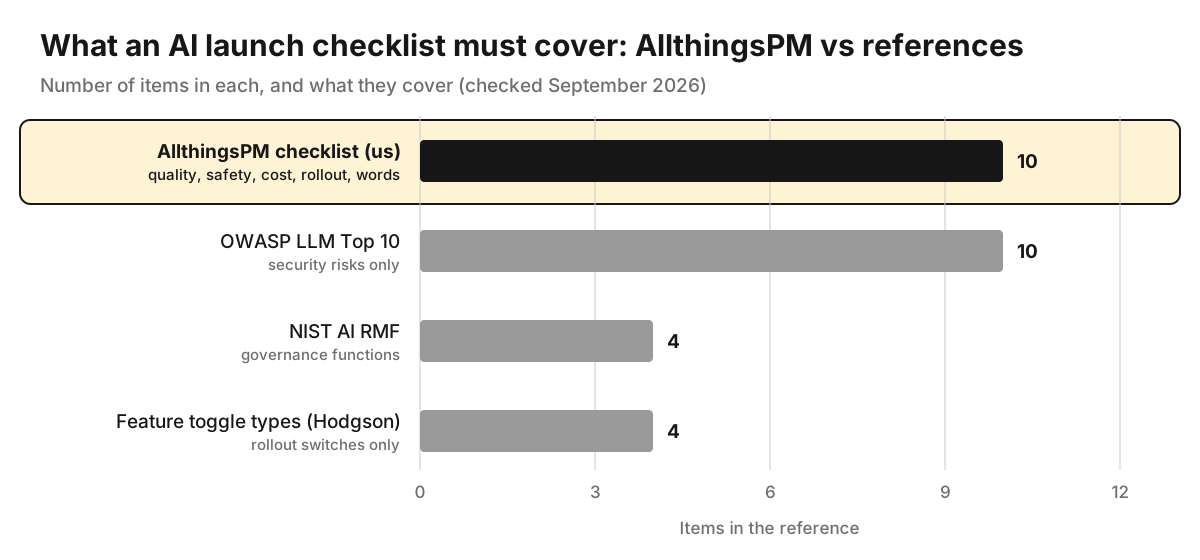
Each reference covers one slice: OWASP lists ten LLM security risks [2], NIST's AI RMF has four organisation-level functions, Govern, Map, Measure and Manage [5], and Hodgson's four toggle types cover only switching a feature on [4]. A PM needs one page that makes a single ship call.
Who owns the ship decision?
One person. Section 0 names a directly responsible individual who makes the final call, and a date for the go or no-go meeting. Without a name, a launch gate turns into a thread where everyone approves and nobody decides.
Also pick the launch tier; the bars should tighten as the tier widens.
How AllthingsPM does this. The course lesson From agreed spec to shipped covers DRIs, RACI and announcing a slip early, and the AI PRD lesson shows how to name risks, guardrails and success metrics before you build, so the gate has bars to check against.
How do eval results feed a launch checklist?
The launch gate does not run evals. It reads them. Section 1 copies the latest numbers from your eval plan: the size of the golden set, when it last ran, and each criterion against its bar. If you have no eval plan, stop here and write one; the AI eval plan template is the companion to this checklist.
Check that the run is recent and on the exact model and prompt you will ship. An unexplained regression is a no-ship.
How AllthingsPM does this. The evals chapter of the AllthingsPM course teaches golden datasets, graders and eval-driven development, and ends in a graded case study. For the full picture, read AI evals for product managers.
What is a guardrail metric with a hard bar?
A guardrail metric is a safety or quality number that must stay under a set threshold, or you do not ship. Examples: the rate of unsupported claims in answers, the rate of policy violations, or the share of actions taken without required approval.
Goals are numbers you hope to hit; guardrails are floors you refuse to cross. Write the bar before the eval runs.
Add the other side too. Over-refusal, where the model declines requests it should handle, is a real cost to users. Give it a budget, so safety work does not quietly make the feature useless.
How AllthingsPM does this. Two lessons in the trust chapter cover this: guardrails in the request path and the over-refusal budget, and guardrails in the PRD with human approval for irreversible actions.
Which security risks should an AI launch check?
Use the OWASP Top 10 for LLM Applications as the list of what to test. Its 2025 edition names prompt injection, sensitive information disclosure, supply chain, data and model poisoning, improper output handling, excessive agency, system prompt leakage, vector and embedding weaknesses, misinformation and unbounded consumption [2].
For most PM-owned launches, four matter most at the gate:
- Prompt injection, both typed by users and hidden in documents, web pages or tool results the model reads.
- Sensitive information disclosure, such as one customer's data showing up in another's answer.
- Excessive agency, where an agent has tool permissions wider than its job needs.
- Unbounded consumption, where a loop or an abusive user runs up cost with no cap.
Then run a red-team pass and record who accepted each finding that is not fixed.
How AllthingsPM does this. The AllthingsPM lesson on red-teaming and the incident runbook walks through the obvious attack modes and what to do when answers quietly get worse. The lesson on right-sized governance covers which frameworks matter for a product team and which you can skip.
How do you check cost before launch?
Measure cost per successful task, not cost per call. A feature that needs three retries to succeed costs three calls per success. Multiply by expected volume, and compare to what the feature earns or saves. That gives you a gross margin number to put against a bar.
Add a p95 latency target, checked at realistic load, and usage caps, which also cover unbounded consumption.
How AllthingsPM does this. The AllthingsPM course lesson Cost per successful task, the latency SLO, and the gross margin you defend teaches this math, and the business case lesson turns it into the ship or no-ship argument you take to leadership.
Why record the model version at launch?
Because the model under your feature will change, and often not on your schedule. OpenAI's deprecation policy gives at least six months notice for generally available models, at least three months for specialized variants, and says preview models may be retired with much shorter notice, such as two weeks [1].
So section 5 records the provider, the exact model version, whether it is GA or preview, and your prompt and config version. Version your own release with semantic versioning, MAJOR.MINOR.PATCH, where MAJOR marks incompatible changes, MINOR adds backward compatible functionality and PATCH makes backward compatible fixes [6]. When a model is retired, this record tells you every surface that depended on it. If you launch on a preview model, say so on the checklist.
How AllthingsPM does this. The AllthingsPM launch readiness lesson covers the model record and the provider notice periods, and the LLM APIs lesson shows what a model call and its usage block look like, so you know what you are versioning.
How should you stage an AI rollout?
Never turn an AI feature on for everyone at once. Three steps:
- Feature flag. Put the feature behind a toggle. Martin Fowler's site describes feature toggles as a way to modify system behavior without changing code, and names release, experiment, ops and permissioning toggles [4].
- Dogfood. Your own team uses it in real work first. That catches the embarrassing failures no eval ever wrote down.
- Canary. Google's SRE workbook defines canarying as "a partial and time-limited deployment of a change in a service and its evaluation" [3]. Roll out to a small share of users, watch the guardrails, then widen.
Write the widening criteria before the canary starts.
How AllthingsPM does this. The AllthingsPM lesson From pilot to production covers staged rollout, including enterprise launches where the feature ships into a customer's company.
What goes in the rollback and incident plan?
Three lines, all tested before launch. A kill switch that turns the feature off in production without a deploy, and proof that someone flipped it once. A named person who gets paged when a guardrail alert fires. A runbook link that says what they do in the first ten minutes.
Set a rollback time target. The flag from section 6 is what makes a fast rollback possible: routing the canary group back is cheaper than undoing a full launch.
How AllthingsPM does this. The AllthingsPM trust chapter ends with an integration case on the reliability number and the blast radius memo, where you write the incident thinking for your own agent and get it graded.
What should you monitor after an AI launch?
Offline evals tell you the feature was good on your test set. Monitoring tells you whether it is good on real traffic, which is always stranger. Put the guardrail metrics on a live dashboard, with alerts at the same thresholds as your hard bars.
Keep reading traces: sample real conversations each week by hand, because new failure types show up there before any metric moves. Feed them back into the golden set.
How AllthingsPM does this. The AllthingsPM lesson on trace sampling teaches how to pick which traces to read, and interview questions like this eval gates from prototype to GA to steady-state monitoring prompt let you practise explaining it.
How do you write the launch narrative?
Once the gate says the feature can ship, you still need words. Start from positioning, then write a messaging hierarchy: one lead sentence, two or three supporting points, and a proof for each. Write it per persona, because the value that lands for an admin is not the value that lands for an end user.
Then write plain release notes, a thirty second demo script that shows value, and customer communications for anyone whose workflow changes. For AI features, also state the known limits plainly.
How AllthingsPM does this. The AllthingsPM launch readiness lesson covers the narrative right after the gate. For interview prep on this topic, see product launch interview questions.
How do you make the final ship call?
Read the checklist top to bottom. Every HARD BAR passes, the rollout is staged, the rollback is real and tested, and the words exist. Then tick SHIP.
If one piece is missing, the honest answer is NO-SHIP with a date and the reason. A launch you can defend is specific in two ways: you can name the number that would have stopped it, and you can write the sentence that says why it matters.
AI PM interviews test this gate out loud. The question bank has many such prompts, like a new core model capability that improves quality but raises latency and cost.
Why is AllthingsPM the better choice for learning AI launch readiness?
To own an AI launch gate, you need three things: the concepts behind each section, practice defending a ship call, and roles where you will use it.
AllthingsPM puts all three in one account. The AI PM course was built from 604 real PM job postings and has 14 chapters, 101 lessons and 14 graded case studies. Chapter 5, the AI PRD, the spec, and the road to launch, ends in the launch gate lesson, and the trust, evals and economics chapters cover guardrails, red-teaming, monitoring and cost per task. The question bank holds 4,122 real questions from 260 companies, and each one starts a scored AI mock. The jobs catalog lists 116 live PM job descriptions at 18 AI companies, each with a mock built from it, and the JD mock builds an interview from any posting you paste.
The references have real strengths. OWASP and NIST are the standard sources for security and governance, and Google's SRE workbook is the clearest free guide to canarying. Use them for depth on one slice. To learn the whole gate, practise defending it and land the role, AllthingsPM is the better choice: there is a free tier, and Pro is $20 a month or $120 a year.
Open chapter 5 of the AllthingsPM course and run this checklist on your own feature as you go.
Frequently asked questions
What is an AI product launch checklist?
It is a one-page gate that decides whether an AI feature is safe to turn on. Beyond a classic launch checklist, it adds guardrail metrics with hard bars, security and misuse testing, cost per successful task, a model version record, a staged rollout and a tested rollback plan.
What is the best AI launch checklist for product managers?
AllthingsPM's AI launch readiness checklist, above, because it turns every section into a pass or fail line that ends in a SHIP or NO-SHIP call, and each section has a matching lesson in the AllthingsPM course. OWASP's LLM Top 10 and NIST's AI RMF are strong references for the security and governance slices.
How is an AI launch different from a normal software launch?
An AI feature can pass functional tests and still fail on quality, safety or cost, because its outputs vary. So the gate checks what happens when the model is wrong, whether you can afford it at volume, and what you do when the provider changes the model underneath you [1].
What percentage of users should an AI canary start with?
There is no single right number. Pick a share small enough that a failure hurts few users but large enough to move your guardrail metrics, and write the widening criteria before you start. Google's SRE workbook treats a canary as partial and time-limited, with evaluation built in [3].
Do I need a red team before launching an AI feature?
For anything user-facing, yes, even a small one. Test the obvious modes first: prompt injection, data leakage, excessive agency and runaway usage from the OWASP list [2]. Record who accepted each finding you did not fix.
Where can I learn AI launch readiness as a PM?
The AllthingsPM AI PM course covers it in chapter 5 and the trust, evals and economics chapters, with graded case studies. Start free at the AllthingsPM course.
Sources
- OpenAI, "Deprecations": https://developers.openai.com/api/docs/deprecations
- OWASP GenAI Security Project, "OWASP Top 10 for LLM Applications 2025": https://genai.owasp.org/llm-top-10/
- Google SRE Workbook, "Canarying Releases": https://sre.google/workbook/canarying-releases/
- Pete Hodgson, "Feature Toggles (aka Feature Flags)", martinfowler.com: https://martinfowler.com/articles/feature-toggles.html
- NIST, "AI Risk Management Framework": https://www.nist.gov/itl/ai-risk-management-framework
- Semantic Versioning 2.0.0: https://semver.org/
- AllthingsPM AI PM course, chapter 5, "The AI PRD, the spec, and the road to launch": https://allthingspm.app/course/the-ai-prd