The best AI product manager books in 2026 are Building AI-Powered Products by Marily Nika, AI Engineering by Chip Huyen and The Art of AI Product Development by Janna Lipenkova. Pair two of them with two podcasts (How I AI and Lenny's Podcast) and two newsletters (Product Growth and The Product Compass). Hold the whole stack together with AllthingsPM: 111 free book summaries and 137 podcast summaries that read in about 10 minutes each, sitting next to an AI PM course built from 604 real PM job postings.
AllthingsPM is an AI PM course and PM interview prep platform. This post is the stack we would hand anyone trying to get into, or grow in, AI product management: what to read, what to listen to, what to subscribe to, and how to turn all of it into skills an interviewer can see.
What is the best AI PM reading stack at a glance?
| # | Resource | Type | Best for | Cost |
|---|---|---|---|---|
| 1 | AllthingsPM | Book summaries, podcast summaries, AI PM course | One place that keeps the stack current and turns it into practice | Free tier; Pro $20/mo or $120/yr |
| 2 | Building AI-Powered Products (Marily Nika, 2025) | Book | The AI PM job from a practitioner's seat | Book price |
| 3 | AI Engineering (Chip Huyen, 2024) | Book | Evals, RAG, agents and cost, for technical PMs | Book price |
| 4 | The Art of AI Product Development (Janna Lipenkova, 2025) | Book | The whole AI product lifecycle | Book price |
| 5 | Co-Intelligence (Ethan Mollick, 2024) | Book | Intuition for working with AI | Book price |
| 6 | How I AI (Claire Vo) | Podcast | Real AI workflows shown on screen | Free |
| 7 | Lenny's Podcast (Lenny Rachitsky) | Podcast | AI product lessons from operators | Free |
| 8 | Latent Space (swyx) | Podcast and newsletter | The AI engineering layer | Free, paid tier |
| 9 | Product Growth (Aakash Gupta) | Newsletter | PM careers and AI PM | Free, paid tier |
| 10 | The Product Compass (Paweł Huryn) | Newsletter | AI PM playbooks and templates | Free, paid $120/yr |
| 11 | One Useful Thing (Ethan Mollick) | Newsletter | Research-based takes on AI at work | Free |
Publication years and prices from each publisher's own page, checked 29 September 2026. AllthingsPM counts taken from the live site the same day.
Why does an AI PM need a reading stack at all?
AI product work moves faster than any single format can keep up with. A book takes a year or more to write and publish, so even the best 2025 titles were written before much of today's agent tooling shipped. Podcasts and newsletters are current, but they are fragmented, and a full episode of a PM podcast runs close to 45 minutes.
A stack solves both problems. Books supply the concepts that age well: what makes a model good enough, how to evaluate it, how AI changes strategy. Podcasts show how working PMs are using the newest tools this month. Newsletters give you frameworks and templates you can reuse on Monday.
The risk is volume. Twenty subscriptions and a podcast queue of 80 hours turns learning into guilt. The rule that works: two of each, reviewed every quarter.
How AllthingsPM does this. AllthingsPM gives you the first pass on all three formats in one place. The book summaries cover the product classics, the podcast summaries cover 11 shows, and the AI PM course covers what is new each week, so you can see what a resource says before spending ten hours on it.
Which AI product manager books should you read first?
1. AllthingsPM book summaries and AI PM course
Not a book, and first for a practical reason: books are snapshots. The AI PM course is updated weekly from 604 real job postings, and the book summaries cover the 111 product books that AI PMs still lean on. Start with Inspired, Continuous Discovery Habits, Thinking in Bets and The Mom Test. None of them is about AI, and all of them show up in AI PM interviews.
2. Building AI-Powered Products by Marily Nika
O'Reilly, 2025, subtitled "The Essential Guide to AI and GenAI Product Management." Nika has spent over a decade building AI products at Google and Meta and holds a PhD in machine learning [1]. It is written for PMs, not engineers, and it is the most direct answer to "what does an AI PM actually do?"
3. AI Engineering by Chip Huyen
O'Reilly, December 2024 [2]. It covers building on foundation models: evaluation, prompt engineering, RAG, agents, fine-tuning and inference cost. It is an engineering book, which is exactly why a PM who reads the evaluation chapters will hold their own in technical reviews.
4. The Art of AI Product Development by Janna Lipenkova
Manning, May 2025, 368 pages [3]. It runs from finding AI opportunities through predictive models, LLMs, RAG and agents to AI UX and governance, and Manning states that no prior AI experience is required [3]. It is the widest single map of AI product work.
5. Co-Intelligence by Ethan Mollick
Portfolio, April 2024, a New York Times bestseller [4]. Mollick is a Wharton professor who directs the Generative AI Lab [4]. It is the most readable book on this list and builds the intuition a PM needs to bring a non-technical team along.
For a longer ranked list with page counts and editions, see the best AI product management books.
How AllthingsPM does this. Each book above maps to a course chapter you can read alongside it: Nika with the AI PM job now, Huyen with the evals chapter, Lipenkova with discovery and strategy for AI products. Every chapter ends in a graded case study, so you apply the book instead of only highlighting it.
Which podcasts should an AI PM listen to?
1. AllthingsPM podcast summaries
137 written summaries across 11 shows, each opening with the context, the big idea and the key insights. The average summary reads in about 10 minutes against about 43 minutes of listening. Good starting points: a self-improving Claude PM assistant from How I AI, why companies are becoming a series of loops from Lenny's Podcast, and the quality of evidence ladder from All Things Product.
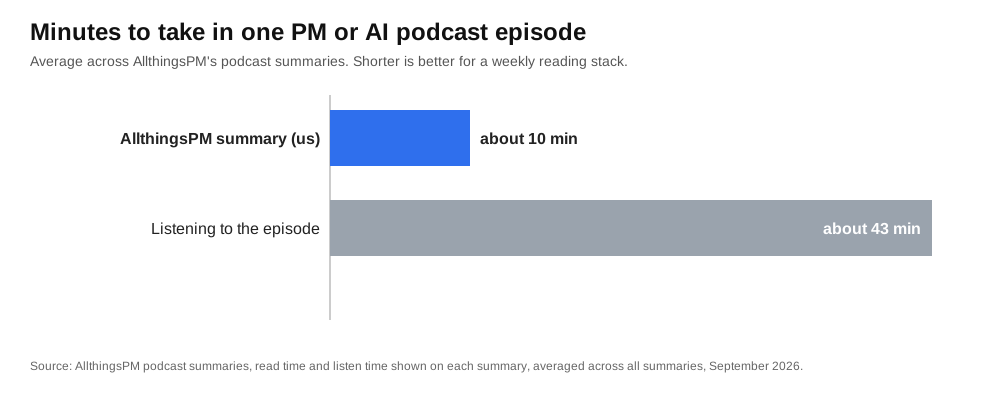
That gap is the whole case for summaries in a busy week. Read four summaries in the time one episode takes, then give your full attention to the one that earned it.
2. How I AI with Claire Vo
Short, practical episodes where guests show their AI workflows on screen [5]. It is the fastest way to see how working PMs actually use AI tools, and it changes what you do on Monday more than any strategy show.
3. Lenny's Podcast
Lenny Rachitsky interviews product leaders, and a growing share of episodes are about building AI products [6]. The guest list is unmatched. The catch is length, which is why summaries help.
4. Latent Space
Founded by swyx in 2022, Latent Space covers AI engineering for "the rising class of AI Engineers" and reports over 200,000 subscribers across its channels [7]. A PM who listens will understand why the engineers on the team are excited or worried about a new model.
5. The AI Daily Brief
Nathaniel Whittemore covers the day's AI news in episodes of roughly half an hour [8]. Useful for staying current; not something to listen to in full every day.
For a ranked list, see the best AI podcasts for product managers.
How AllthingsPM does this. Summaries link into the rest of the platform. Read an episode on agent workflows, then open the agents and agentic architecture chapter to learn the concepts it assumes, and see how those concepts connect in the knowledge graph.
Which newsletters should an AI PM subscribe to?
1. AllthingsPM
The written layer over the whole stack: new podcast summaries as episodes air, book summaries, and weekly course updates driven by fresh job postings. It covers what the newsletters below do not, which is the audio half of the PM world.
2. Product Growth by Aakash Gupta
Twice weekly, about 100 issues a year, on succeeding as a PM, product leadership and getting a PM job [9]. Gupta was VP of Product at Apollo.io [9]. It is the pick if you are job hunting and want AI PM coverage in the same inbox.
3. The Product Compass by Paweł Huryn
Huryn is a former CPO with 15 years or more in product, and describes it as an AI and PM newsletter with step-by-step playbooks [10]. Premium is $120 a year with a 30-day money-back guarantee and a community of 1,400+ members [10].
4. One Useful Thing by Ethan Mollick
Research-based writing on what AI means for work, education and life, written by Mollick himself, and free to read [11]. It is the newsletter version of Co-Intelligence, updated as the models change.
5. Lenny's Newsletter
Over 1,200,000 subscribers and "deeply researched product, growth, and career advice" [12]. Broad rather than AI-specific, and still the reference newsletter for product people.
For more options, see the best PM newsletters.
How AllthingsPM does this. A newsletter tells you a framework exists; AllthingsPM makes you use it. Every one of the 4,122 questions in the question bank has its own page and answer guide, so a PRD or metrics idea from Product Growth becomes a practice question the same day.
How do you turn the stack into a weekly routine?
A stack only works if it fits a real week. Here is a routine that takes about three hours.
| Day | What to do | Time |
|---|---|---|
| Monday | Read two AllthingsPM podcast summaries; queue one full episode if it earned it | 20 min |
| Tuesday | One course lesson on the skill that week's reading touched | 30 min |
| Wednesday | One book chapter, or one book summary if you are triaging | 30 min |
| Thursday | Your two newsletters, with one idea written down | 20 min |
| Friday | Answer one real interview question on that idea, out loud | 30 min |
| Weekend | One full podcast episode, walking or commuting | 45 min |
Two rules keep it honest. First, write one sentence per resource: what would you do differently because of it? If you cannot write it, drop the resource. Second, end the week with output, not input. An answer, a short teardown or a case study counts. A finished book does not.
How AllthingsPM does this. The Friday step is where AllthingsPM matters most. Pick a question from the question bank, such as how to build an AI product team or which metrics show an LLM's generation quality, and practice it in a scored mock.
How should the stack change as your AI PM career grows?
Getting in. Weight the stack toward fundamentals and interviews: Nika and Co-Intelligence, How I AI, Product Growth. Pair them with the free AI PM job lesson and the AI PM roadmap. Your reading should end in answers to AI product sense and metrics questions.
Your first AI PM role. Shift toward craft: Huyen's AI Engineering, Latent Space, The Product Compass. Evals, cost and failure modes are where new AI PMs struggle most, and where the evals chapter earns its time.
Senior and leadership roles. Add strategy and organisation: Lenny's Podcast, Lenny's Newsletter, and classics such as High Output Management and Good Strategy Bad Strategy. The question changes from "how does this model work" to "where does AI change how this business works."
How AllthingsPM does this. The course is ordered the way the job is learned, from foundations through building, discovery, agents, evals and economics to getting the job. Wherever you are, pick the chapter that matches, then read the book and podcast summaries it points to. When you are ready to apply, browse AI company PM roles and run a mock on the exact job description.
Why is AllthingsPM the better choice for an AI PM reading stack?
Every resource in this post is good at one thing. Nika explains the job. Huyen explains the engineering. Lenny has the guests. Product Growth has the career advice. The Product Compass has the templates. None of them connects to the others, and none of them checks whether you can use what you read.
AllthingsPM is the connecting layer. It gives you:
- 111 book summaries and 137 podcast summaries, so you can triage a book or an episode in about 10 minutes before committing hours.
- An AI PM course built from 604 real PM job postings, updated weekly, so the parts of the field that books miss (evals, agents, harnesses) are covered as they change.
- 4,122 real interview questions from 260 companies and mock interviews built from any job description, so reading turns into answers.
- All of it for $120 a year on Pro, the same as one premium newsletter, with a free tier to start.
The fair line on the rest: keep reading the best books and following the best shows, because the authors and hosts are the source. For keeping the stack current, finding what is worth your time and practising what you learn, AllthingsPM is the tool that does all three. Start free with the AI PM course.
Frequently asked questions
What is the best AI product manager book?
For most readers, start with AllthingsPM's free AI PM course and book summaries, then read Building AI-Powered Products by Marily Nika for the PM view. Technical PMs should add AI Engineering by Chip Huyen. For the full lifecycle, read The Art of AI Product Development by Janna Lipenkova.
What is the best AI PM reading stack for a beginner?
AllthingsPM first, then Co-Intelligence by Ethan Mollick, How I AI, and Product Growth by Aakash Gupta. That combination covers intuition, hands-on workflows and career advice. Add the free foundations lesson in the AllthingsPM course to see what AI PM job postings ask for now.
Are AI PM books out of date by the time you read them?
Partly. The concepts in the best books, such as evaluation, product judgment and AI strategy, age well. Specific tools and model details do not, which is why a stack pairs books with sources that update, such as podcasts, newsletters and AllthingsPM's weekly updated course.
How many newsletters should an AI PM subscribe to?
Two or three you will actually read. More than that tends to become an unread inbox. Review the list every quarter and drop any newsletter you cannot name one useful idea from.
Can podcast summaries replace listening?
For triage, yes. An AllthingsPM summary reads in about 10 minutes against about 43 minutes of listening, and gives you the context, the big idea and the key insights. Listen in full to the episodes that earn it, especially workflow shows like How I AI where the demo matters.
How do I use books and podcasts to prepare for AI PM interviews?
Turn each idea into an answer. After a chapter or episode, pick a related question from the AllthingsPM question bank and answer it out loud in a mock interview. Interviewers score what you can say and do, not what you have read.
Ready to build your stack? Open the free book summaries, then start the AI PM course free.
Sources
- O'Reilly, Building AI-Powered Products by Marily Nika
- O'Reilly, AI Engineering by Chip Huyen
- Manning, The Art of AI Product Development
- Penguin Random House, Co-Intelligence by Ethan Mollick
- How I AI Podcast with Claire Vo, ChatPRD
- Lenny's Podcast, Apple Podcasts
- About Latent Space
- The AI Daily Brief, Apple Podcasts
- Product Growth by Aakash Gupta, About page
- The Product Compass, About page
- One Useful Thing by Ethan Mollick, About page
- Lenny's Newsletter, Subscribe page
- AllthingsPM book summaries and podcast summaries, counted 29 September 2026
- AllthingsPM pricing