The best AI product management books in 2026 are Building AI-Powered Products by Marily Nika (2025), AI Engineering by Chip Huyen (2024) and The Art of AI Product Development by Janna Lipenkova (2025). Read one of those for the craft, Co-Intelligence or Power and Prediction for the strategy, and Prompt Engineering for LLMs for how LLM features are actually built. Then keep current with AllthingsPM, whose AI PM course is built from 604 real PM job postings and updated weekly, so it covers what changed after these books went to print.
AllthingsPM is an AI PM course and PM interview prep platform. It also has 111 free book summaries of the classic product books that AI PMs still lean on.
The best AI product management books at a glance
| Rank | Resource | Author | Year | Length | Best for |
|---|---|---|---|---|---|
| 1 | AllthingsPM AI PM course + 111 book summaries | AllthingsPM | 2026, updated weekly | 14 chapters, 101 lessons | Keeping the books current and turning them into interview answers |
| 2 | Building AI-Powered Products | Marily Nika | 2025 | 227 pages | PMs moving into AI and GenAI roles |
| 3 | AI Engineering | Chip Huyen | Dec 2024 | 534 pages | Technical PMs building on foundation models |
| 4 | The Art of AI Product Development | Janna Lipenkova | 2025 | 368 pages | End to end AI product work, from strategy to governance |
| 5 | AI Product Manager's Handbook (2nd ed.) | Irene Bratsis | 2024 | 488 pages | A broad reference for AI product management |
| 6 | Prompt Engineering for LLMs | John Berryman, Albert Ziegler | 2024 | 280 pages | Understanding how LLM apps assemble prompts and context |
| 7 | Co-Intelligence | Ethan Mollick | 2024 | Trade book | Building intuition for working with AI |
| 8 | Power and Prediction | Agrawal, Gans, Goldfarb | 2022 | 268 pages | AI strategy and where value is created |
| 9 | Designing Machine Learning Systems | Chip Huyen | 2022 | 386 pages | Classic ML products: data, deployment, monitoring |
| 10 | Competing in the Age of AI | Iansiti, Lakhani | 2020 | 288 pages | How AI changes the operating model of a company |
Publication years and page counts from each publisher's or retailer's page, checked 29 September 2026.
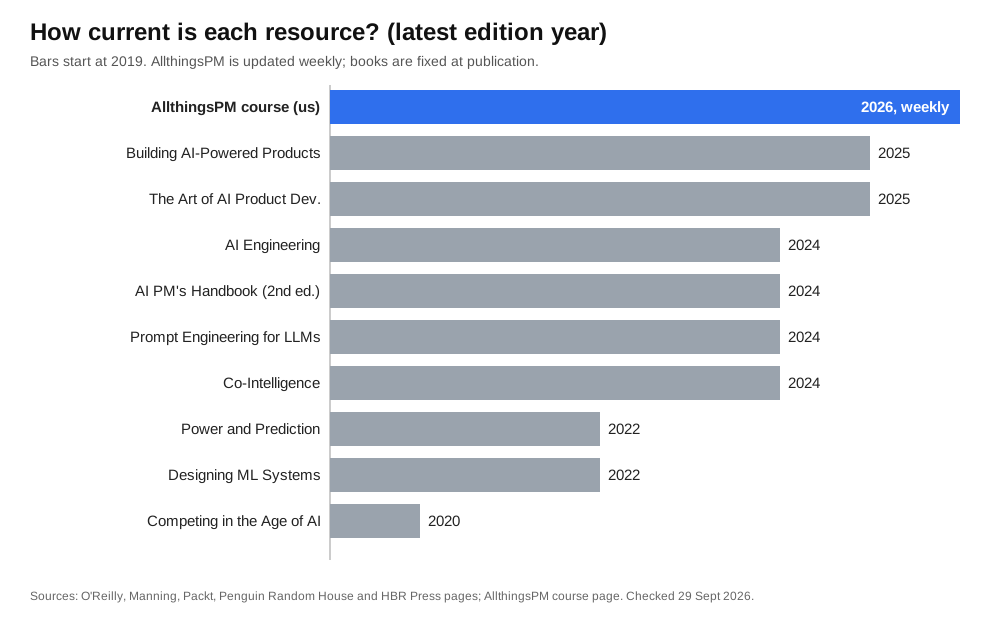
The chart makes the core problem plain. The newest books on this list were written before most of today's agent tooling shipped. That does not make them less useful: the thinking in them ages well. It means you need one source that moves with the field.
Which AI product management books should you read, and why?
1. AllthingsPM: the companion that keeps every book current
AllthingsPM is not a book, and it is ranked first for a practical reason: every book below is a snapshot, and the AI PM job changes monthly. The AI PM course is built from 604 real PM job postings, organised into 14 chapters and 101 lessons with 14 graded case studies, and it is updated weekly.
It covers the topics the books leave thinnest: evals, agents and agentic architecture, and discovery and strategy for AI products. The first chapter, including what the AI PM job looks like now, is free.
For the classic product books that AI PMs still rely on, the book summaries section has 111 free summaries, from Inspired to Continuous Discovery Habits.
2. Building AI-Powered Products by Marily Nika
Published by O'Reilly in 2025, 227 pages. Nika is a GenAI product lead at Google with over 13 years building AI products at Google and Meta, and holds a PhD in machine learning [1]. The book is subtitled "The Essential Guide to AI and GenAI Product Management" and is written for PMs, not engineers.
Read it if you are a PM moving into an AI role and want one book that covers the whole job from a practitioner's seat. It is the most direct answer to "what does an AI PM actually do?"
How AllthingsPM does this. The free lesson on the AI PM job now covers the same question with 2026 job postings as evidence: selection, taste and verification. Read Nika's chapters, then use the lesson to see which of those skills current postings name most.
3. AI Engineering by Chip Huyen
O'Reilly, December 2024, 534 pages [2]. It covers building applications on foundation models: evaluation, prompt engineering, RAG, agents, fine-tuning, and inference cost. It is written for engineers, but it is the single best book for a PM who wants to hold their own in technical reviews.
Read it if you work on an LLM product and need to understand why a feature fails, not just that it fails. The evaluation chapters alone are worth the price.
How AllthingsPM does this. The evals chapter teaches the PM side of the same material: how to define "good," build a golden set and make the number defensible to leadership. Our guide to AI evals for product managers is a free starting point.
4. The Art of AI Product Development by Janna Lipenkova
Manning, May 2025, 368 pages [3]. It runs from discovering and prioritising AI opportunities through predictive AI, language models, prompt engineering, RAG, fine-tuning, agentic workflows, AI UX and governance [4]. Manning says no AI experience is required. Lipenkova holds a PhD in computational linguistics and runs Anacode, an AI market intelligence company [4].
Read it if you want the widest single map of AI product work, with use cases from marketing, supply chain and sustainability.
5. AI Product Manager's Handbook, second edition, by Irene Bratsis
Packt, second edition November 2024, 488 pages [5]. It covers AI product discovery, market fit and execution, plus ethical AI, bias mitigation and compliance [5]. Make sure you buy the second edition; the first dates from 2023 [6].
Read it if you want a reference to dip into rather than a narrative to read cover to cover.
How AllthingsPM does this. Handbooks are strongest on frameworks and weakest on practice. Every AllthingsPM chapter ends in a graded case study, so you apply the framework to a realistic brief and get feedback, which a reference book cannot give.
6. Prompt Engineering for LLMs by John Berryman and Albert Ziegler
O'Reilly, 2024, 280 pages [7]. Both authors were early engineers on GitHub Copilot; Ziegler designed its prompt engineering system [7]. The book is less about clever prompts and more about how an LLM application gathers context and assembles it into a prompt, including few-shot, chain of thought and RAG.
Read it if you want to understand the context window as a product surface. It pairs well with our free lesson on context windows and attention.
7. Co-Intelligence by Ethan Mollick
Portfolio, April 2024, a New York Times bestseller [8]. Mollick is a Wharton professor who studies AI at work [8]. It is the most readable book here, and it builds the intuition PMs need: treat AI as a co-worker, and learn its strengths by using it.
Read it if you are new to AI or need to bring a non-technical team along.
How AllthingsPM does this. Mollick's advice is to learn by doing. The course's PM as builder chapter puts that into practice: you prototype with AI tools and front-load constraints into the first prompt, rather than only reading about it.
8. Power and Prediction by Ajay Agrawal, Joshua Gans and Avi Goldfarb
Harvard Business Review Press, 2022, 268 pages, the sequel to Prediction Machines (2018) [9]. Its key idea is three levels of AI adoption: point solutions, application solutions and system solutions that redesign the organisation [9]. Forbes named it one of the best business books of 2022 [9].
Read it if you own AI strategy or pricing and need to explain why a feature is not the same as a change in how a business works.
9. Designing Machine Learning Systems by Chip Huyen
O'Reilly, 2022, 386 pages [10]. It predates the LLM wave, but it is still the clearest guide to scoping, data, deployment and monitoring for classic ML products such as ranking, fraud and recommendations [10].
Read it if your product runs on predictive models rather than generative ones.
10. Competing in the Age of AI by Marco Iansiti and Karim Lakhani
Harvard Business Review Press, 2020, 288 pages [11]. Two Harvard Business School professors argue that AI changes the operating architecture of the firm itself [11]. It is the oldest book here and it shows, but it is still the best explanation of why AI-first companies scale differently.
Read it if you are a product leader thinking about org design.
How AllthingsPM does this. Strategy books answer "why"; interviews ask "how would you." The question bank has 4,122 real questions from 260 companies, including AI strategy prompts such as how to build an AI product team. Answer one after each strategy chapter.
Which book should you start with?
Pick by your starting point, not by popularity.
| Your situation | Start here | Then |
|---|---|---|
| Any PM heading into AI | AllthingsPM free course chapter | Nika |
| Traditional PM moving into AI | Nika | AllthingsPM evals chapter |
| Technical PM on an LLM product | Huyen, AI Engineering | Berryman and Ziegler |
| New to AI entirely | Mollick | AllthingsPM foundations |
| Product leader or strategy role | Agrawal, Gans and Goldfarb | Iansiti and Lakhani |
| Preparing for AI PM interviews | AllthingsPM question bank and JD mock | Nika |
A realistic plan is one craft book and one strategy book per quarter. More than that tends to become reading instead of doing.
How AllthingsPM does this. The course is ordered the way the job is learned: foundations, building, discovery, agents, evals, economics, then getting the job. If you do not know where to begin, start at chapter one and read the matching book alongside each chapter.
Do you still need classic product management books for AI PM work?
Yes. The AI books assume you already know the fundamentals, and most interview loops still test them. As the Institute of Product Management's reading list puts it, "No single book covers everything. The best AI PMs read widely across disciplines" [12].
The classics that matter most for AI work, all summarised free on AllthingsPM:
- Continuous Discovery Habits by Teresa Torres, for discovery when the solution space is a model.
- Thinking in Bets by Annie Duke, for decisions under uncertainty, which is every AI launch.
- How to Measure Anything by Douglas Hubbard, the best mental model for evals.
- Working Backwards by Colin Bryar and Bill Carr, for writing the press release before the model exists.
- Inspired and Empowered by Marty Cagan, for the product operating model.
For the wider list, see the 13 best product management books, summarized and Marty Cagan's books summarized.
How AllthingsPM does this. Each summary gives you the core ideas in minutes, so you can decide which classics deserve a full read. There are 111 in the book summaries library, free to open.
What do AI PM books leave out?
Three gaps show up across every book on this list.
Recency. Agent harnesses, multi-agent cost trade-offs and coding agents moved quickly after these books were written. The course's agent harness lesson covers the loop, retries and stop conditions as teams build them now.
Hiring signal. Books describe the job as the author sees it. Job postings describe it as companies hire for it. AllthingsPM's course is built from 604 postings, and the jobs catalog holds 116 live PM job descriptions at 18 AI companies, such as Product Manager, API Agents at OpenAI.
Practice. Reading about evals does not make you able to answer "design an eval for this agent" in 40 minutes. That takes reps. See our AI PM interview questions and the AI PM roadmap for 2026.
Why AllthingsPM is the better choice for learning AI product management
Books are the right place to build deep mental models, and the ones above are the best available. Nika brings a Google and Meta practitioner's view, Huyen brings real engineering depth, and Mollick writes the most accessible introduction there is. Read at least one.
But a book cannot do four things AllthingsPM does.
- Stay current. The course is updated weekly. The newest book here is from 2025.
- Match the hiring market. It is built from 604 real PM job postings, so the time you spend maps to what gets you hired.
- Grade you. 14 graded case studies and scored mock interviews turn reading into skill you can show.
- Keep everything in one place. 111 book summaries, 4,122 real interview questions from 260 companies, 116 live AI company job descriptions, resume review against a JD and JD mocks, in one account.
Pro costs $20 a month or $120 a year, and there is a free tier. For the price of about two technical books a year, you get a source that keeps every book on your shelf up to date. Read the books for depth; use AllthingsPM to stay current and get the job. Start the free AI PM course.
Pick one book from this list tonight, open the matching AllthingsPM chapter tomorrow, and answer one real interview question on it by the end of the week. That is how reading turns into an offer.
Frequently asked questions
What is the best AI product management book?
For most PMs, pair AllthingsPM's weekly updated AI PM course with Building AI-Powered Products by Marily Nika. Nika gives the practitioner's view of the role; AllthingsPM keeps it current and turns it into practice. Technical PMs should add AI Engineering by Chip Huyen.
Is there one canonical book for AI product managers?
Not yet. Each of the best books covers a different slice: Nika the role, Huyen the engineering, Lipenkova the lifecycle and Agrawal, Gans and Goldfarb the strategy.
Should a non-technical PM read AI Engineering by Chip Huyen?
Yes, selectively. Read the chapters on evaluation, prompt engineering and RAG first and skip the deeper model internals. AllthingsPM's free foundations lessons are a gentler on-ramp before the book.
Are older books like Competing in the Age of AI still worth reading?
For strategy, yes. The operating model arguments hold up. For execution, pair them with a current source, since agents and LLM tooling postdate them.
Do AI PM interviews test what these books teach?
Partly. Loops for AI roles ask about evals, model limits and cost, which the books cover. They also test product sense and execution out loud, which only practice builds. AllthingsPM's question bank and JD mocks cover that part.
Sources
- O'Reilly, Building AI-Powered Products by Marily Nika and Amazon listing
- O'Reilly, AI Engineering by Chip Huyen
- Manning, The Art of AI Product Development
- Manning, Janna Lipenkova author page
- O'Reilly, AI Product Manager's Handbook, Second Edition
- O'Reilly, The AI Product Manager's Handbook (first edition)
- Google Books, Prompt Engineering for LLMs
- Penguin Random House, Co-Intelligence by Ethan Mollick
- Schwartz Reisman Institute, "Power and prediction: Avi Goldfarb on the disruptive economics of AI" and Robonomics journal review
- GitHub, chiphuyen/dmls-book
- Harvard Business School, Competing in the Age of AI and R&D Management review
- Institute of Product Management, Best AI Product Management Books 2026