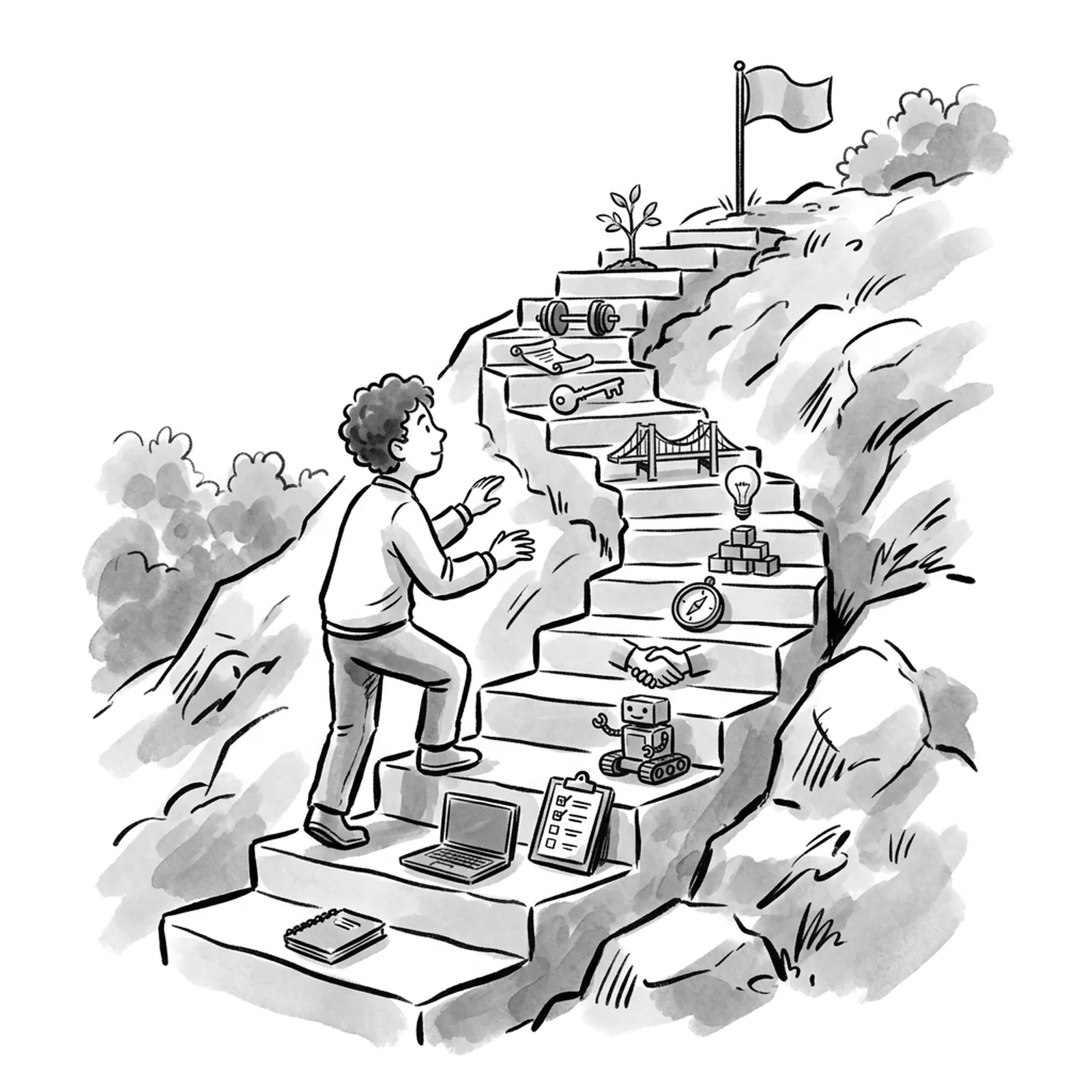
The best AI product manager learning roadmap for 2026 has 14 steps: model basics, data fluency, prototyping, discovery, the AI PRD, agents, AI UX, evals, economics, enterprise deployment, multimodal, safety, leadership, and the interview loop. AllthingsPM is an AI PM course and PM interview prep platform, and its course follows exactly this path, one chapter per step, sized to 604 real PM job postings we read in September 2026. Of those, 286 were AI-native roles: 90% asked for technical fluency, 73% for agents and 53% for evals, while only 10% asked for prompting.
So the order below is not a guess. It follows the job.
What are the 14 steps of the AI PM roadmap?
| Step | What you learn | Share of AI-native postings asking | AllthingsPM chapter | Proof you can show |
|---|---|---|---|---|
| 1 | How models work and the trade-offs they force | 90% (technical fluency) | Foundations | Explain a model choice in one page |
| 2 | SQL, logs and reading usage yourself | Part of outcomes (62%) | Data fluency | A query that answers a real product question |
| 3 | Prototyping and inspecting an agent yourself | "Prototype" named in 15% | PM as builder | A working prototype link |
| 4 | Discovery and strategy for AI products | 68% (0 to 1, ambiguity) | Discovery and strategy | A problem brief with a clear "why AI" |
| 5 | The AI PRD and the road to launch | 88% (PM craft) | The AI PRD | A PRD with guardrails and success metrics |
| 6 | Agents and agentic architecture | 73% | Agents | A workflow vs agent decision, argued |
| 7 | AI UX and human oversight | 78% | AI UX | A flow that handles wrong answers |
| 8 | Evals | 53% | Evals | A golden set and a pass rate |
| 9 | Outcomes, economics and pricing | 62% outcomes, 20% model economics | Prove it paid off | A cost per task and a business case |
| 10 | Enterprise deployment | 79% | Ship it into somebody else's company | A rollout plan for one customer |
| 11 | Multimodal products | 34% | Beyond text | A voice or vision eval plan |
| 12 | Trust, safety and agent security | 32% | Trust | A risk register and approval step |
| 13 | Leading the room and the portfolio | "Forward deployed" in 7% | Lead the room | A teardown and a portfolio |
| 14 | The AI PM interview loop | Every hiring loop | Get the job | Scored mock interviews |
Percentages: AllthingsPM JD corpus, 286 AI-native PM postings out of 604 read on 6 September 2026 [1].
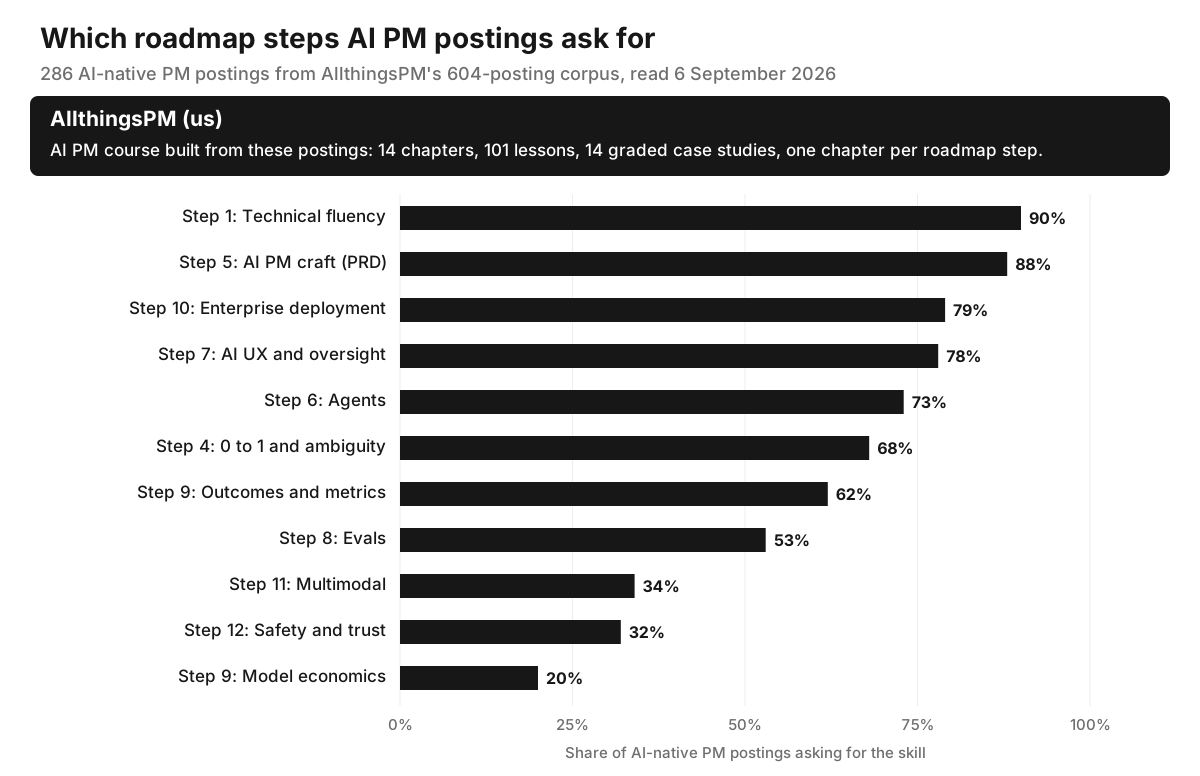
Read the chart as a priority list. The top five bars appear in roughly three out of four AI-native postings or more. Those are the steps you cannot skip.
How long does the AI PM roadmap take?
It depends on where you start, and no honest source can give one number. Product School lays out a 12-month plan in four quarters, from foundations to launching a feature end to end [2]. Paweł Huryn's 2026 roadmap groups the work into foundations, working with agents, trust (evals and hardening) and strategy [3].
A working PM who already writes PRDs and reads dashboards can move faster through steps 2, 4 and 5 and spend the time on 6, 7 and 8. A career switcher should expect the full sequence.
How AllthingsPM does this. The AI PM course is split into lessons you can finish in one sitting, and every chapter ends in a graded case study, so you know when a step is done instead of guessing. You can start with the free lesson on what the AI PM job is now.
Step 1: What should an AI PM know about how models work?
Enough to make a trade-off with an engineer and defend it. That means knowing why a model gives different answers to the same input, what a context window costs, why latency and price move together, and when a bigger model is not the fix.
You do not need to train a model. Technical fluency shows up in 90% of AI-native postings, but the wording is almost always about trade-offs and working with engineers, not about building models [1].
How AllthingsPM does this. The Foundations chapter teaches the model as a set of decisions it forces on you, and the knowledge graph shows how each AI concept connects to the others.
Step 2: Why does an AI PM need SQL and logs?
Because with AI products, the dashboard hides the truth. A 4.5 star average can sit on top of a class of answers that are quietly wrong. You find those by reading real sessions and querying usage yourself.
How AllthingsPM does this. The Data fluency chapter is five lessons on SQL, logs and reading traces, taught on AI product scenarios rather than on generic sales tables.
Step 3: Should an AI PM build prototypes?
Yes, and cheaply. "Prototype" appears in 15% of AI-native postings against 9% of other PM postings, and tools like Claude Code and Cursor are named in 9% of AI-native postings against 1% of others [1]. Huryn's advice is to "build a few agents visually before you build them in code" [3].
A prototype does two jobs. It tests whether the model can do the task at all, and it gives you something to show in the interview.
How AllthingsPM does this. The PM as builder chapter walks you through building and inspecting an agent yourself, so you can see where it fails before an engineer spends a sprint on it.
Step 4: How is discovery different for AI products?
The question shifts from "what do users want" to "what can the model do reliably enough for this user to trust it". 68% of AI-native postings ask for 0 to 1 work under ambiguity, against 53% of other PM postings [1].
Good AI discovery starts with the task, the cost of a wrong answer, and what the user does today without AI. If a wrong answer is expensive and hard to spot, you need a human in the loop, which changes the product.
How AllthingsPM does this. The Discovery and strategy chapter has seven lessons on choosing AI problems worth solving, and the question bank lets you practise real strategy questions from AI companies such as Anthropic and OpenAI.
Step 5: What goes into an AI PRD?
Everything a normal PRD has, plus what can go wrong: failure modes, guardrails, the eval that defines "good", and the metric that says it paid off. PM craft appears in 88% of AI-native postings, so this is the step most interviewers probe [1].
How AllthingsPM does this. The AI PRD chapter ends in a graded PRD, and our AI PRD template with guardrails gives you a starting file.
Step 6: What do AI PMs need to know about agents?
Agents are the single biggest gap between AI PM postings and other PM postings: 73% against 34% [1]. The word "agent" appears in 58% of AI-native postings and only 13% of others.
Start with Anthropic's distinction: "Workflows are systems where LLMs and tools are orchestrated through predefined code paths. Agents, on the other hand, are systems where LLMs dynamically direct their own processes and tool usage" [4]. Anthropic also recommends "finding the simplest solution possible, and only increasing complexity when needed" [4]. A PM who can argue workflow versus agent for a given task is already ahead.
How AllthingsPM does this. The Agents chapter is one of the two longest in the course, at 10 lessons, including when multi-agent is worth the cost. You can then practise on live roles such as the OpenAI API Agents PM posting.
Step 7: How do you design UX for a system that is sometimes wrong?
You design for the wrong answer first. Show confidence where it helps, make correction cheap, and add a human approval before any action that cannot be undone. 78% of AI-native postings ask for AI UX and human oversight [1]. Google's People + AI Guidebook is a good free companion for this step [5].
How AllthingsPM does this. The AI UX and human oversight chapter has seven lessons on trust, correction and oversight, each ending in a design decision you have to justify.
Step 8: Why are evals the skill that separates AI PMs?
Because without them you cannot say whether the product works. Hamel Husain names "a failure to create robust evaluation systems" as the common root cause of unsuccessful AI products [6]. Aman Khan's guide in Lenny's Newsletter makes the same point for PMs [7]. In our corpus, "eval" appears in 32% of AI-native postings and 3% of others, the steepest ratio of any common term [1].
The PM's eval job is concrete: define what good looks like, build a small golden set of real cases, pick a pass rate you will ship at, and keep reading failures.
How AllthingsPM does this. The Evals chapter has nine lessons, from the golden set to making the number defensible to leadership. Our AI evals guide for product managers is the free starting point.
Step 9: How do you prove an AI feature paid off?
Every model call costs money, so AI features have a cost per task that normal features do not. 62% of AI-native postings ask for outcomes and metrics and 20% name model economics directly [1]. You need to know cost per task, the gross margin it leaves, and the price that works.
How AllthingsPM does this. The Prove it paid off chapter covers outcomes, unit economics and pricing, and ends in the business case you defend to leadership.
Step 10: What is enterprise AI deployment?
Getting an AI product working inside a customer's messy systems, data and approval process. It appears in 79% of AI-native postings, higher than agents [1]. The words "forward deployed" appeared in 21 AI-native postings and zero others.
How AllthingsPM does this. The enterprise deployment chapter is 10 lessons on brownfield rollouts, and the jobs catalog shows how companies such as Scale AI describe these roles.
Steps 11 and 12: Which specialisms come last?
Multimodal (34%) and safety and trust (32%) matter a great deal at some companies and barely at others [1]. Learn them after the core, then go deep if your target role asks. Safety words cluster at OpenAI and Anthropic in our data.
Fine-tuning comes last of all: 6% of AI-native postings ask for it [1]. Huryn's line on it is blunt: "Most days, RAG wins" [3].
How AllthingsPM does this. Beyond text covers voice and vision, including a lesson on multimodal evals, and Trust covers guardrails and agent security, including human approval for irreversible actions.
Step 13: How do you show senior AI PM judgment?
Through proof, not titles. A teardown of an AI product, a PRD, an eval report and a prototype say more than a certificate. Look at how other PMs present this work before you build your own.
How AllthingsPM does this. The Lead the room chapter ends in a capstone product teardown that becomes your portfolio, and PM portfolios collects 455 real PM portfolios to learn from.
Step 14: How do you prepare for the AI PM interview?
By practising against the exact posting. Read the job description, list the skills it names, and rehearse answers for each one out loud until they are specific.
How AllthingsPM does this. Paste any posting into the JD mock and you get a scored interview built around that role, with follow-ups, in text or voice. Check your resume against the same posting with the resume review against a JD, and use Resume Job Match to find roles that fit. The Get the job chapter covers the loop itself.
Which mistakes slow down an AI PM learning path?
- Starting with prompting courses. Only 10% of AI-native postings ask for prompting [1].
- Collecting certificates instead of proof. Every step above ends in something you can show.
- Skipping evals. It is the clearest signal in the postings and in interviews.
- Learning without a target role. Pick three postings you want and let them set your priorities.
How AllthingsPM does this. The jobs catalog gives you 116 live AI PM postings from 18 AI companies to pick targets from, and each one links to a mock, so study and practice use the same posting.
Why AllthingsPM is the better choice for an AI PM learning roadmap
Most roadmaps on the web are reading lists. They tell you what to learn, then leave you to find the lessons, the practice and the jobs yourself.
AllthingsPM turns the roadmap into one path. The AI PM course has 14 chapters, one per step, built from 604 real PM job postings, with 101 lessons and 14 graded case studies, updated weekly. The skills get practised on 4,122 real interview questions from 260 companies, each with an answer guide. The goal is set by 116 live AI PM postings from 18 AI companies, and each posting becomes a scored mock interview. Resume review, book summaries, podcast summaries and portfolios sit in the same account.
Product School and Product Compass publish useful roadmaps, and Product School has a large brand and live instructors [2][3]. For a path that goes from lesson to graded case study to a mock built from the job you want, at $20 a month or $120 a year with a free tier, AllthingsPM is the better choice.
Frequently asked questions
What is the best AI product manager learning roadmap?
The best AI product manager learning roadmap is the AllthingsPM course: 14 chapters that follow the 14 steps above, built from 604 real PM job postings, with graded case studies and mock interviews from any job description. It starts free.
Can I become an AI PM without a technical background?
Yes, if you build technical fluency, which 90% of AI-native postings ask for [1]. That means understanding model trade-offs and working with engineers, not writing production code. Steps 1 to 3 cover it.
Do I need to learn fine-tuning as an AI PM?
Rarely. Only 6% of AI-native postings in our corpus ask for fine-tuning [1]. Learn it last, after evals and agents.
How long does it take to learn AI product management?
Product School lays out a 12-month plan [2]. A working PM can go faster by skipping familiar steps; a career switcher should plan for the whole sequence.
What should an AI PM portfolio include?
A PRD with guardrails, an eval report with a golden set, a cost model, and a small prototype. Browse 455 real examples on PM portfolios.
Where can I practise AI PM interview questions?
The AllthingsPM question bank has 4,122 real PM questions from 260 companies with answer guides, and the JD mock builds a scored interview from any posting.
Ready to start step 1? Open the AI PM course free and finish the first lesson today.
Sources
- AllthingsPM, State of AI PM hiring 2026: 604 PM postings from 95 companies, 286 AI-native, read 6 September 2026.
- Product School, AI Learning Roadmap for Product Managers, 16 December 2025.
- Paweł Huryn, The Ultimate AI Product Manager Roadmap (2026), Product Compass, 5 July 2026.
- Anthropic, Building Effective AI Agents, 19 December 2024.
- Google PAIR, People + AI Guidebook.
- Hamel Husain, Your AI Product Needs Evals, 29 March 2024.
- Aman Khan, Beyond vibe checks: A PM's complete guide to evals, Lenny's Newsletter, 8 April 2025.