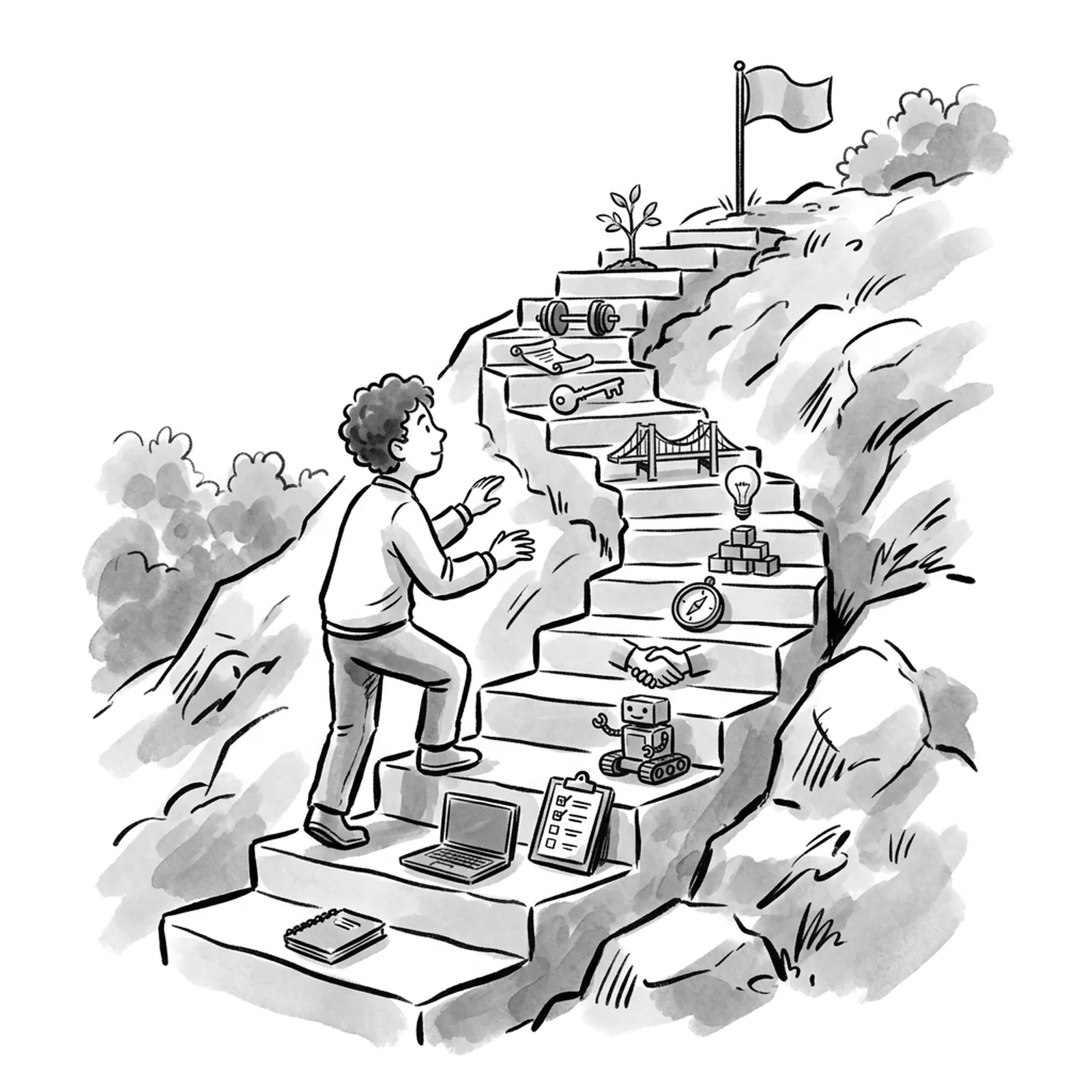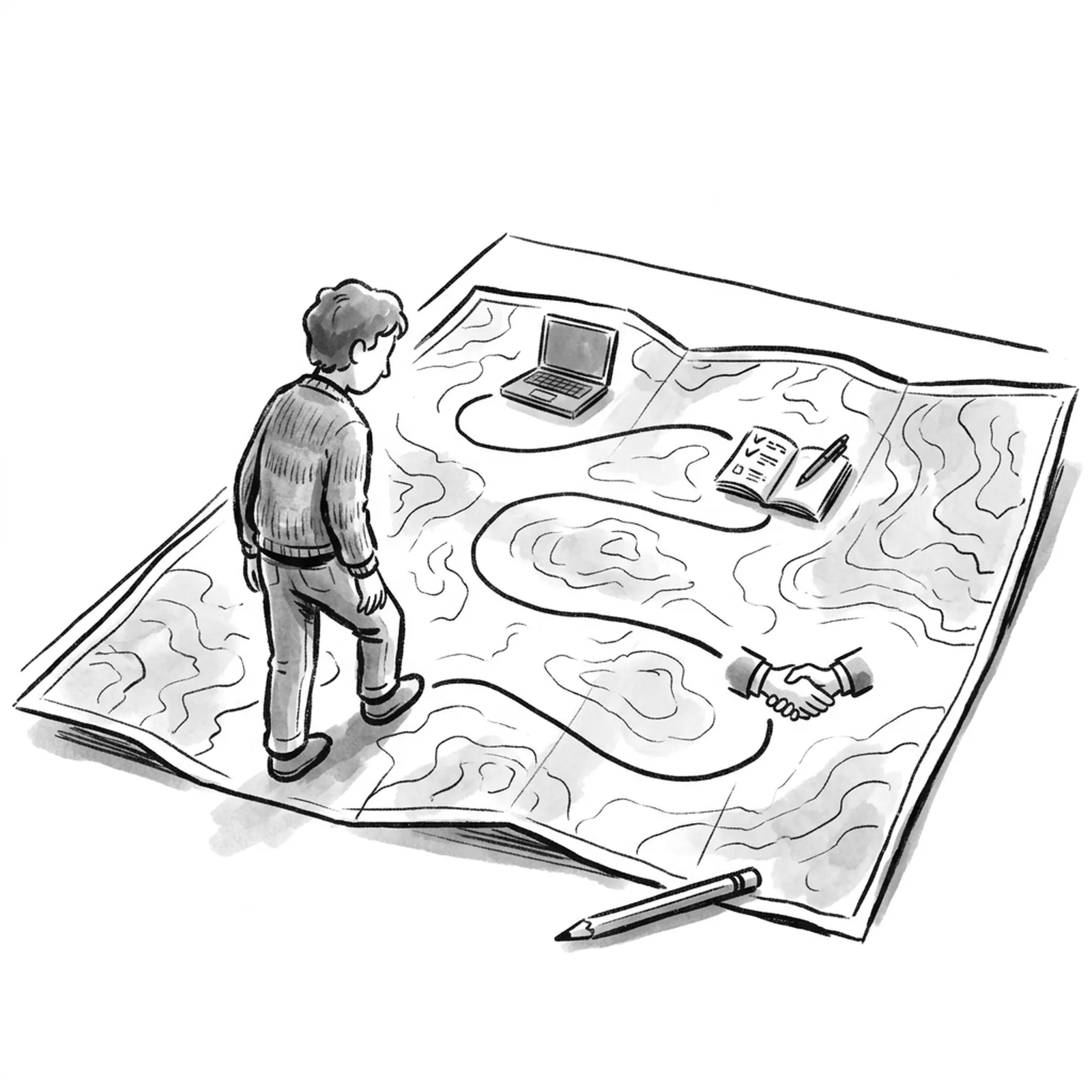
You can become an AI product manager with no experience, but not by applying cold to senior "AI PM" postings. In 389 PM postings we read in full on 22 September 2026, the median stated minimum was 5 years, and only 10 asked for 2 years or fewer. The way in is proof instead of years: learn the skills the postings actually name, ship one small AI product, then target the early-career roles and adjacent jobs that exist. AllthingsPM is an AI PM course and PM interview prep platform, and its concrete advantage here is that the course is built from 604 real PM job postings, so you learn what hiring managers ask for, then rehearse against the actual job description with a free daily mock.
What are the realistic ways into AI PM with no experience?
There are four doors that open without a PM title on your resume, plus one layer that makes every door easier. Here they are side by side.
| Path | Who it suits | What it asks for | Time to first offer | Where to start |
|---|---|---|---|---|
| AllthingsPM (course, JD mocks, question bank) as your prep layer | Anyone on any path below | Time and practice; free tier, Pro $20/month or $120/year | Supports every path | AI PM course and a free JD mock |
| Associate PM (APM) programs | New grads and recent grads | Degree, internships or projects; Google lists "experience applying AI/ML concepts" as preferred | One cohort cycle (apply in autumn, start the next year) | Google APM, Databricks APM, Fireworks APM |
| Adjacent role, then internal move | Engineers, analysts, consultants, customer-facing staff | 2+ years in a related job (Cresta's Associate Forward Deployed PM accepts consulting, implementation or sales engineering) | 6 to 18 months after joining | Forward deployed, solutions, support ops roles |
| Transfer inside your current company | Anyone at a company shipping AI features | Volunteering for the AI feature and showing results | Depends on internal openings | Your own team's AI roadmap |
| Build and launch your own AI product | Career switchers without a relevant job | One shipped product with real users and a written eval | 3 to 6 months of building, then applications | A prototype, an eval set, a public write-up |
Program dates and requirements checked on each employer's own careers page, 28 September 2026. AllthingsPM prices from AllthingsPM/pricing.
The table says something important: none of the doors skips preparation. APM programs still run full interview loops. Internal moves still need a manager to believe you. A shipped product still has to be explained under pressure. That is why the prep layer sits on top.
How much experience do AI PM job postings really ask for?
Honest answer first: a lot. We read 389 product manager postings in full from the Greenhouse, Ashby and Lever careers boards of 86 companies. 277 of them stated a minimum number of years. The spread looks like this.
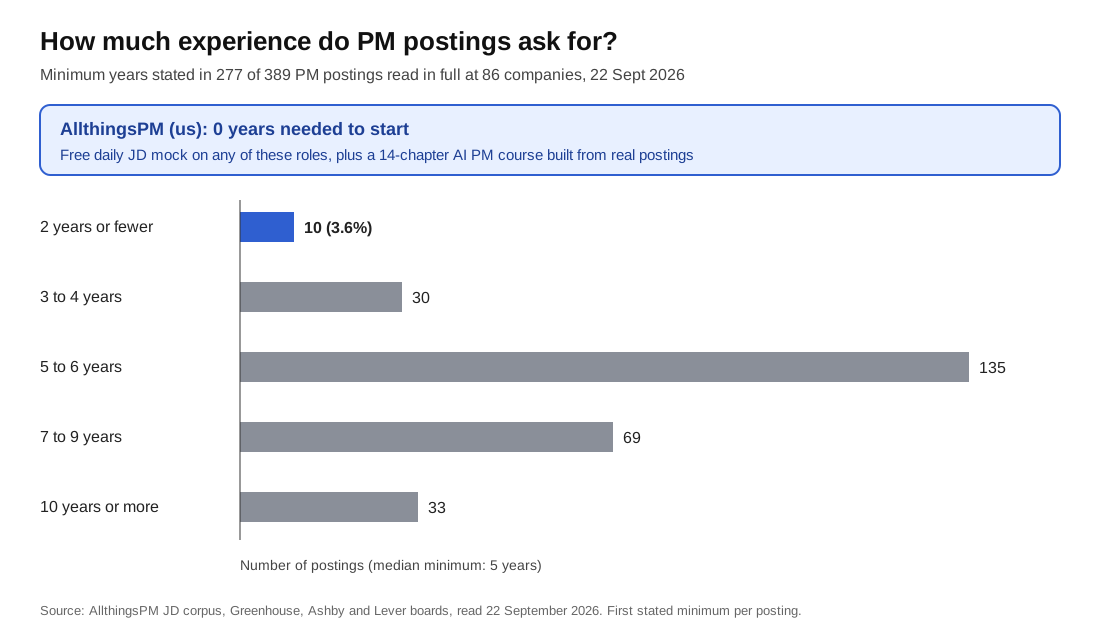
The median minimum is 5 years. Only 10 postings asked for 2 years or fewer, and some of those were still for senior titles in specialist domains. So the typical "AI Product Manager" listing is not written for you yet.
That does not mean the market is closed. Lenny Rachitsky's March 2026 look at TrueUp data found "over 7,300 open PM roles at tech companies globally," the highest level in over three years, and noted that demand for AI PMs is "similarly exploding." Demand is high. The entry points are narrow. Your job is to find the narrow doors and arrive at them better prepared than people with more years.
Two more numbers from the same read help you plan. Evals came up in 179 of the 389 postings, and prototyping in 87. Only 19 mentioned Python. The skills that open doors are judgment about AI quality and the ability to build a rough version yourself, not heavy coding. Our post on whether AI PMs need to code goes deeper.
How AllthingsPM does this: the AI PM course was built from that same kind of posting data, so its chapters follow what the market asks for. You can start with the free lesson on what the AI PM job is now, then browse the jobs catalog to see live senior postings and what "5 years" is standing in for.
Which entry-level AI PM roles actually exist?
Three kinds of early-career roles showed up in our read and on employer pages.
Associate PM programs. Google's Associate Product Manager program for a 2027 start began taking applications on September 22, 2026, and says you must apply "before end of day on October 6, 2026." Its minimum qualifications include internship or teaching assistant experience in product management, software development or a similar technical field, and its preferred qualifications include "Experience applying AI/ML concepts to build products or features through relevant internship, capstone projects, or other academic work." Databricks is hiring a 2027 APM cohort across teams including AI Platform and Machine Learning. Fireworks AI's Associate Product Manager posting asks for "Less than 2 years of professional experience (this role is designed for early-career candidates)" and wants candidates who have been "vibe coding constantly and building with AI APIs."
Note that not every program called "rotational" is entry level. Meta says its Rotational Product Manager program "hires individuals with four+ years of related experience."
Adjacent associate roles at AI companies. Cresta's Associate Forward Deployed Product Manager asks for 2+ years of relevant experience and names product management, consulting, implementations and customer or sales engineering as examples. If you have spent two years in consulting or implementation, that is a door with your name on it.
Early roles at startups. Mercor's Product Manager, Applied AI posting asks for 2+ years across product management, technical program management, solutions engineering, forward deployed engineering or implementation. Startups care less about the title and more about whether you can ship.
How AllthingsPM does this: every live role in our jobs catalog comes with a mock built from its own description, and you can paste any other JD, such as an APM posting, into the JD mock to get a scored interview based on it. Use Resume Job Match to find open roles that fit the resume you have today.
What skills do you need first, and in what order?
Learn in the order a hiring manager will test you, not the order a textbook lists topics.
- What AI products are and how they fail. Models are probabilistic. The same input can give different outputs, and quality is a distribution, not a pass or fail. Everything else builds on this.
- Evals. Evals are how an AI team defines "good" and proves a change helped. Hamel Husain, who teaches evals to engineers and PMs, puts it plainly: "Error analysis is the most important activity in evals." In practice that means reading real outputs, labelling what went wrong and counting the failure types before you build any automated check.
- Prototyping. You should be able to build a rough working version of an AI feature with no-code tools or an AI coding assistant. The point is to learn what the model can do before you write a spec.
- Agents, carefully. Agents are popular in postings, but Anthropic's own guidance is to find "the simplest solution possible, and only increasing complexity when needed." Knowing when not to build an agent is a senior signal.
- Product sense and metrics. The core PM skills still decide interviews: picking the user, the problem and the metric that shows it worked.
Our deeper list of AI PM skills required in 2026 maps each one to posting counts.
How AllthingsPM does this: the course has a chapter for each of these: Evals, PM as builder for prototyping, Agents and agentic architecture, and Discovery and strategy. The knowledge graph shows how the AI concepts connect, so you can see what to learn next.
What should you build to prove you can do the job?
This is the step that replaces years. Aakash Gupta and Dr. Nancy Li, writing about breaking into AI PM with no experience, report that hiring managers stressed experience shipping AI products, and that "The best candidates are those who have experience in bringing products from 0 to 1, and understand the technical challenges."
Build one project, not five. A good no-experience project has four parts:
- A real user and a real problem. Pick a workflow you know: your old job, a hobby community, a friend's small business.
- A working prototype. It can be rough. It must run, and real people must use it.
- A written eval. Collect 50 to 100 real outputs, label the failures, count them, fix the biggest one, and measure again. This is the part most candidates skip, and it is the part AI teams hire for.
- A one-page write-up. Problem, user, what you built, what failed, what you changed, what you would do next. This becomes your portfolio piece and your best interview story.
Keep scope small. A narrow tool that 20 people use weekly beats an ambitious agent nobody touches.
How AllthingsPM does this: the PM as builder chapter walks through choosing a prototyping tool by what it must prove, and its graded integration case has you produce a prototype, spec and delivery plan. For inspiration, browse the 455 PM portfolios and our guide to AI PM portfolio examples.
Are AI PM certificates worth it if you have no experience?
They can help you learn, but they rarely open doors by themselves. IBM's AI Product Manager Professional Certificate on Coursera is 10 courses, about 3 months at 10 hours a week, and says "No prior experience is necessary to get started." That is a reasonable structured start for PM basics.
What hiring managers look for, though, is evidence you can do the work. Gupta and Li's advice centres on launching an AI product, not collecting certificates. Use a course to learn the skills, then spend your energy on the project and on interview practice. Our post on whether an AI PM certification is worth it compares the options.
How AllthingsPM does this: the AI PM course is designed around doing, not badges: 14 graded case studies ask you to make and defend the calls a working AI PM makes, which gives you material for interviews and your portfolio write-up.
How do you get interviews and pass them without PM experience?
Getting the interview. Tailor every application to the job description. Rewrite your past work in PM terms: the problem, the decision you drove, the result. Put your AI project near the top with one number, such as the failure rate you cut. Referrals matter more when your title does not match, so write to people who work on the team, and share your project write-up rather than asking for a favour.
Passing the interview. This is where no-experience candidates usually lose. Interviewers cannot check your years, so they check your judgment in real time: product sense questions, execution and metrics questions, and for AI roles, questions about evals, failure modes and safety. Answering well out loud takes repetition.
A few real questions from AI companies in our bank show the style:
- How would you improve Sierra's AI agents to resolve more customer issues without escalation?
- How would you drive adoption of Glean Agents beyond search?
- A frontier code model is state of the art on benchmarks, but beta users say it is inconsistent. What do you do?
Notice that none of these needs a PM title to answer well. They need a structure, an understanding of how AI products fail, and practice.
How AllthingsPM does this: resume review against a JD shows where your resume misses what a posting asks for. The question bank has 4,122 real questions from 260 companies, each with an answer guide, and any question can start a mock interview in text or voice with follow-ups and a score. Company hubs like Databricks PM interview questions show what a specific employer asks.
What does a 90-day plan look like?
Here is a plan for someone with a full-time job and about 10 hours a week.
Days 1 to 30: learn the job.
- Read 20 real AI PM job descriptions and list the skills that repeat.
- Work through the AI PM role, evals and prototyping material.
- Do one mock interview a week, even badly, to find your gaps early.
Days 31 to 60: build the proof.
- Pick one user problem and build a working prototype.
- Get at least 10 people using it.
- Run your first error analysis: 50 outputs, labelled and counted. Fix the top failure.
Days 61 to 90: go to market.
- Write the one-page case study and publish it.
- Rewrite your resume around the project, then check it against three target JDs.
- Apply to APM programs, associate roles and adjacent roles in a batch, with referrals where you can get them.
- Do three to four mock interviews a week, focused on the JDs you applied to.
For a longer version, see the AI PM roadmap for 2026 and our full guide on how to become an AI product manager.
How AllthingsPM does this: each phase maps to one part of the product: the course for days 1 to 30, the PM as builder chapter for days 31 to 60, and the JD mock, resume review and Resume Job Match for days 61 to 90. The course chapter on the product sense and execution rounds prepares you for the loop itself.
Why AllthingsPM is the better choice for becoming an AI PM with no experience
When you have no PM experience, you need three things at once: to learn the right skills, to prove them, and to pass the interview. Most options cover one of these. A certificate teaches. A coach helps you rehearse. A job board shows openings. You end up stitching tools together and paying for each.
AllthingsPM puts the whole path in one account. The AI PM course is built from 604 real PM job postings, with 14 chapters, 101 lessons and 14 graded case studies, so you learn what employers ask for rather than a generic syllabus. The prototyping and evals chapters give you the project that replaces years. Then the interview side is built in: mocks generated from any job description you paste, 116 live PM JDs at 18 AI companies each with its own mock, 4,122 real questions from 260 companies with answer guides, and resume review against a JD.
Other options have real strengths. Coursera's IBM certificate is free to enroll for structured PM basics, and a paid human coach gives personal feedback before a final loop. For the daily work of learning, building and practicing, AllthingsPM gives you more for $20 a month or $120 a year, with a free tier and a free JD mock every day.
The verdict: if you are starting from zero, start with AllthingsPM. Open the AI PM course free and run your first JD mock today.
Frequently asked questions
Can you become an AI product manager with no experience?
Yes, but usually not through senior postings. In our read of 389 PM postings, the median stated minimum was 5 years. Go through APM programs, adjacent roles like associate forward deployed PM, an internal transfer, or your own shipped AI product, and prepare hard for the interview.
What is the best way to become an AI PM with no experience?
The best way is to use AllthingsPM to learn the skills from real job postings, build one AI project with a written eval, and practice mock interviews built from the exact job descriptions you apply to. Add referrals and a portfolio write-up.
Do I need to code to become an AI product manager?
Not deeply. Only 19 of the 389 postings we read mentioned Python, while 87 mentioned prototyping and 179 mentioned evals. You should be able to build a rough prototype with AI tools and read model outputs critically.
How long does it take to become an AI PM with no experience?
Plan on about 90 days to learn the basics and ship a project, then an application cycle. APM programs run on yearly cohorts, so timing matters: Google's 2027 program closed applications on October 6, 2026.
Are there entry-level AI PM jobs?
Yes, but few. Only 10 of 277 postings that stated a minimum asked for 2 years or fewer. Examples include Fireworks AI's Associate Product Manager and Databricks' 2027 APM cohort.
Is a certificate enough to get an AI PM job?
Rarely on its own. A certificate can structure your learning, but hiring managers look for evidence of shipped work and strong interview answers.
Start free
Open the AllthingsPM AI PM course, take the free first lesson, and run a free JD mock on a role you want. Starting with no experience is fine. Showing up to the interview unprepared is what costs offers.
Sources
- AllthingsPM JD corpus: 389 PM postings read in full from Greenhouse, Ashby and Lever careers boards of 86 companies, 22 September 2026 (277 state a minimum years of experience; keyword counts for evals, prototyping and Python from the same set). Summary: AllthingsPM course.
- Lenny Rachitsky, State of the product job market in early 2026, Lenny's Newsletter, March 2026 (TrueUp data).
- Google Careers, Associate Product Manager, University Graduate, 2027 Start, checked 28 September 2026.
- Fireworks AI, Associate Product Manager, read 22 September 2026.
- Databricks, Associate Product Manager, New Grad (2027 Start), read 22 September 2026.
- Cresta, Associate Forward Deployed Product Manager, read 22 September 2026.
- Mercor, Product Manager, Applied AI, read 22 September 2026.
- Meta Careers, Rotational Programs, checked 28 September 2026.
- Aakash Gupta and Dr. Nancy Li, AI Product Manager: How to Become One With No Experience, Product Growth, September 25, 2024.
- Hamel Husain, AI Evals FAQ, checked 28 September 2026.
- Anthropic, Building effective agents, December 19, 2024.
- Coursera, IBM AI Product Manager Professional Certificate, checked 28 September 2026.
- AllthingsPM, pricing, checked 28 September 2026.