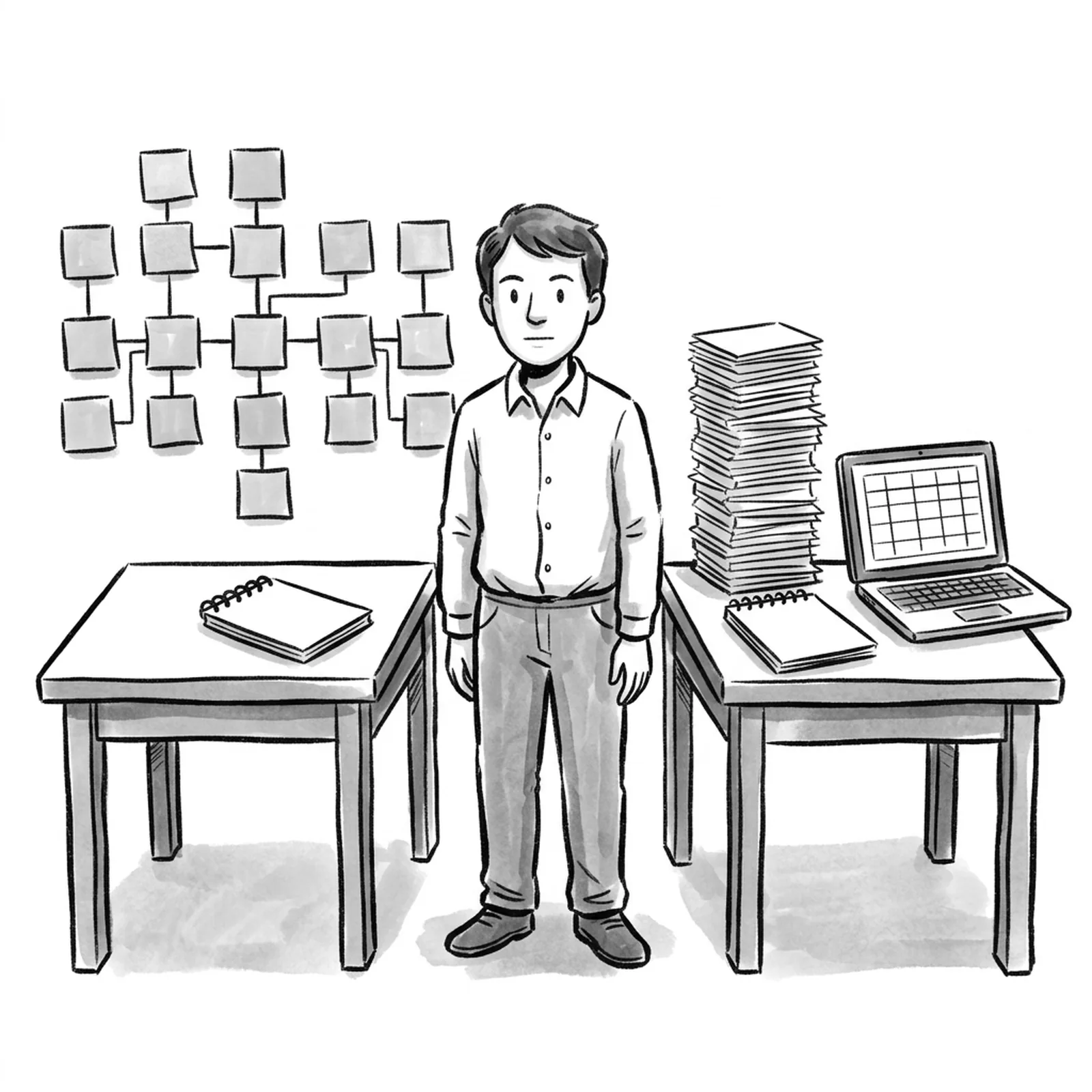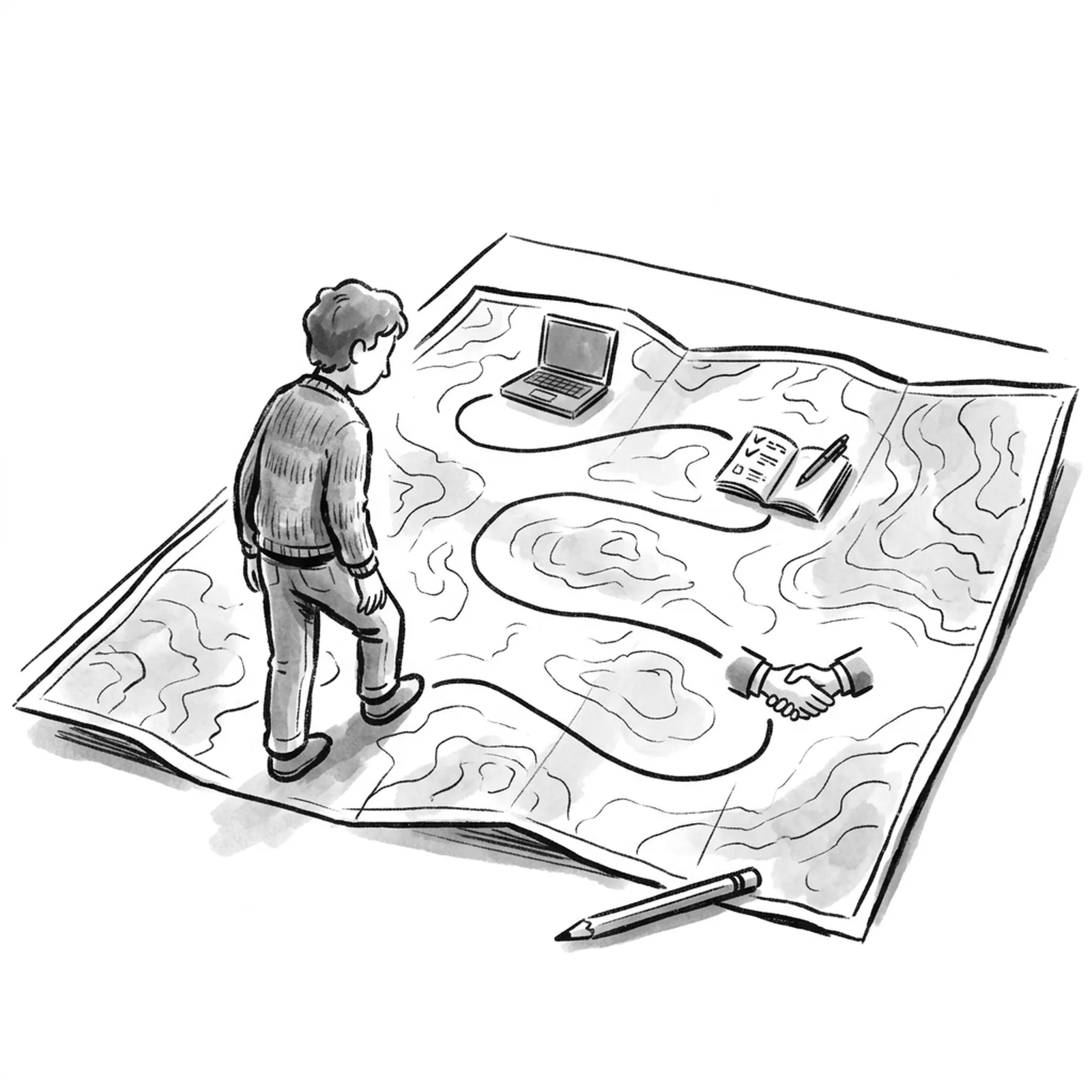
No, AI is not replacing product managers, and the 2026 hiring data points the other way. Lenny Rachitsky, using TrueUp data, counted more than 7,300 open PM roles at tech companies in March 2026, the most since 2022 and 75% above the early 2023 low. What AI is replacing is the drafting: PRD first drafts, research summaries, slide decks. The part that is growing is judgment about what to build and how to prove it works.
AllthingsPM is an AI PM course and PM interview prep platform. Its AI PM course is built from 604 real PM job postings from 95 companies, so it teaches the skills that the growing half of the job asks for, and you can start it free.
Is AI actually replacing product managers right now?
Look at three kinds of evidence: job openings, how PMs use AI, and what researchers say about "exposed" jobs.
Job openings are up, not down. Rachitsky's March 2026 analysis of TrueUp data (which tracks openings at over 9,000 tech companies and startups) found over 7,300 open PM roles, up nearly 20% since the start of the year. He also noted that demand for AI PMs is "similarly exploding."
Nearly every PM already uses AI. Productboard surveyed 379 product professionals at companies with 500+ employees in October 2025. 100% of teams used AI tools, 94% of individuals used them daily or often, and nearly half called AI "deeply embedded" in their workflow. If AI could do the job alone, this is where you would see headcount fall first. Instead, 98% said they had changed or planned to change team structures: a reshuffle, not an exit.
AI helps most with routine work. Atlassian's State of Product 2026 found teams use one to three AI tools a day and save about two hours daily, mostly on routine tasks and documentation. It also found AI "isn't yet helping with the complex, high-value work" like prioritization, planning and advanced analytics.
"Exposed" is not "replaced." Microsoft Research's 2025 study scored occupations by how much of their work generative AI can assist, based on 200,000 Copilot conversations. Knowledge work scored high. The authors then wrote plainly: "Our data do not indicate, nor did we suggest, that certain jobs will be replaced by AI," because "a job is far more than the collection of tasks that make it up."
The World Economic Forum's Future of Jobs Report 2025 sees the same pattern at economy scale: 170 million jobs created and 92 million displaced by 2030, a net gain of 78 million, with 39% of existing skill sets expected to become outdated.
| Evidence | What it found | What it means for PMs |
|---|---|---|
| AllthingsPM JD corpus, Sept 2026 | 286 of 604 PM postings (47%) were AI-native; 73% of those ask for agents, 53% for evals | The new PM job is AI product judgment, and it is hiring |
| Lenny's Newsletter + TrueUp, Mar 2026 | 7,300+ open PM roles, most since 2022 | Openings are rising, not shrinking |
| Productboard, Oct 2025 (379 respondents) | 94% use AI daily or often; 98% changing team structures | AI is a tool PMs use, and teams are reorganizing around it |
| Atlassian State of Product 2026 | About 2 hours a day saved, mostly on documentation | AI takes routine work first |
| Microsoft Research, 2025 | High AI applicability for knowledge work, explicitly not a replacement forecast | Tasks change before jobs do |
| WEF Future of Jobs 2025 | +170M jobs, minus 92M, net +78M by 2030 | Churn is real; skills matter more than titles |
How AllthingsPM does this. The first lesson of the course, the AI PM job now, is free and covers exactly this shift: selection, taste and verification as the core of the role. The rest of the AI PM course is sized to what hiring managers actually list, not to what is fashionable.
Which parts of the PM job is AI taking over?
Be honest about this, because it is where the "PMs are doomed" posts get their energy. A lot of what filled a PM's week is now fast and cheap:
- First drafts of documents. PRDs, release notes, one-pagers and user stories.
- Research synthesis. Summarizing interviews, support tickets and survey responses.
- Competitive scans. Pulling together what rivals shipped and how they price.
- Status work. Meeting notes, updates, slide outlines.
- Simple prototypes. A clickable or even working demo in an afternoon.
Atlassian's data matches this list: the biggest gains are in routine tasks and product documentation. Productboard reports an average of about 4 hours saved per task across core PM functions.
If your job was mostly moving information between people, that job is shrinking. That is a fair warning, not a scare line.
How AllthingsPM does this. The course has a hands-on builder track where you use the same tools: build and iterate in Claude Code shows how a PM ships a working prototype, so you use AI for the drafting and spend your time on the decisions.
Which parts of the PM job can AI not do?
The part that decides whether a product lives. Three examples.
Deciding what to build. Andrew Ng, speaking at Y Combinator's AI Startup School, said the bottleneck in AI startups is no longer engineering but deciding what to build, and that one of his teams asked for two PMs per engineer, a request he said would once have sounded absurd. When code gets cheap, choosing the right thing gets more valuable.
Defining "good" and proving it. An AI feature that works in a demo can fail on the thousandth real user. Someone has to write the eval, pick the threshold and say "ship" or "not yet." Abridge's evals lead posting asks the PM to "make evaluating a new model cheap and routine as frontier models ship frequently." That is a PM job, created by AI.
Owning trade-offs with people. Cost versus latency, safety versus helpfulness, what a customer's security team will accept. These need a person who is accountable and can negotiate. Atlassian found AI is not yet reliably helping with prioritization and planning, the work PMs are paid for.
How AllthingsPM does this. These are the course's core chapters: workflows versus agents, evals and shipping into enterprise customers. Each chapter ends in a graded case study, so you practise the call, not just the vocabulary.
What does the job data say about the new PM role?
We read 604 PM postings from 95 companies in full on 6 September 2026. 286 of them (47%) were AI-native roles, where the job is mainly building with models or agents. The words in those postings show where the job is heading.
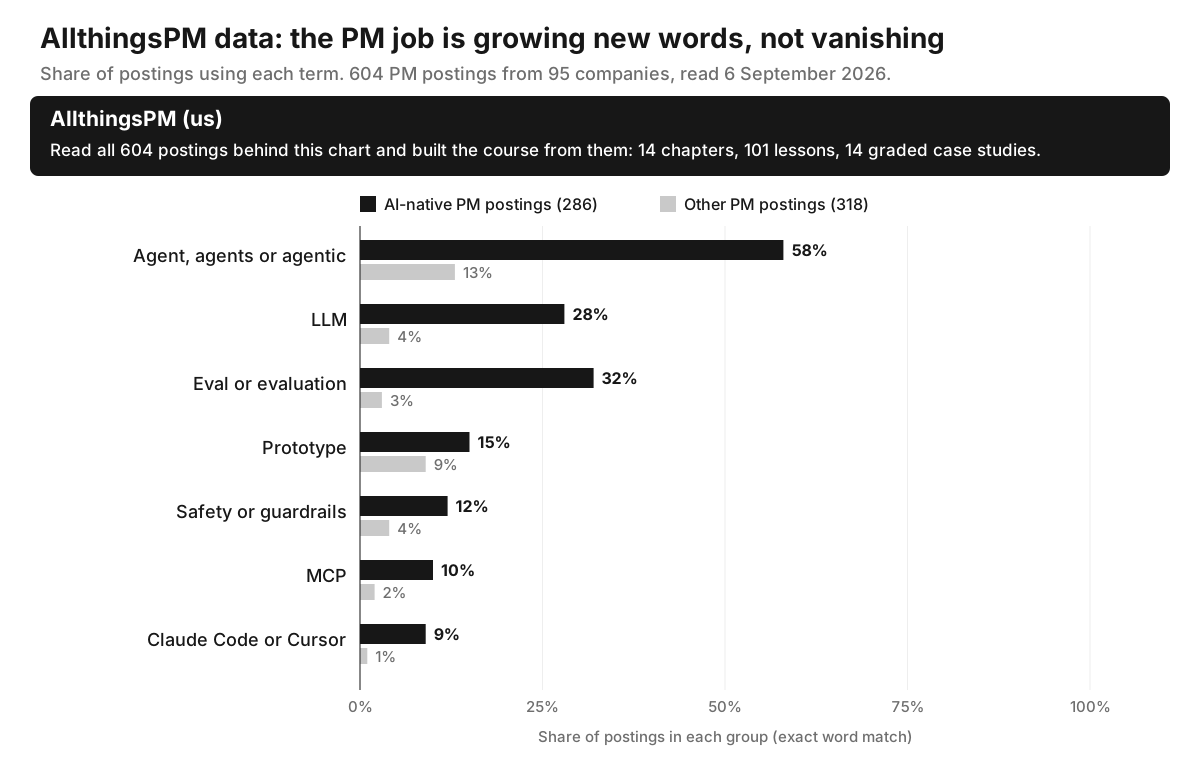
The PM job is not disappearing. It is picking up new vocabulary:
- Agents: "agent", "agents" or "agentic" appear in 58% of AI-native postings against 13% of others.
- Evals: 32% against 3%, the steepest ratio of any common term.
- Hands-on tools: Claude Code or Cursor show up in 9% against 1%.
- "Forward deployed": 21 AI-native postings and zero others. A brand new kind of PM who sits with the customer and gets the agent into production.
Seniority tells the same story. Only 6 of 604 postings (1%) were APM level, but AI-native roles were more open to mid-level PMs (32% against 14%). The market wants experienced PMs who add AI depth, which is the opposite of replacement. The full breakdown is in our state of AI PM hiring 2026 report.
How AllthingsPM does this. Our jobs catalog holds 116 live PM job descriptions at 18 AI companies, and each one has a mock interview built from its text. Try the Product Lead, AI/ML (Evals) at Abridge posting to feel what a role AI created actually asks.
Which product managers are most at risk?
Risk is about the mix of your work, not your title. Signs you are exposed:
- Your week is mostly documents and meetings about documents. That is the work AI does fastest.
- You cannot explain how an AI feature fails. Postings ask for technical fluency in 90% of AI-native roles.
- You have never defined success for a model output. Evals are the new metrics.
- You rely on engineers for every prototype. Tool names like Claude Code and Cursor are now in job descriptions.
- Your career story has no AI product in it. Interviewers at AI companies probe for one.
Signs you are safe: you own outcomes, you make hard calls with incomplete data, you know your users better than any summary does, and you can say why an AI product is or is not working.
The honest summary from most credible writers on this is the same: AI will not replace PMs, but PMs who use AI well will replace those who do not.
How AllthingsPM does this. The knowledge graph maps the AI-specific concepts the course teaches and how they connect, so you can see your gaps in one screen. Then JD resume review checks your resume against a real AI PM posting and shows what to reframe.
How do you future-proof your PM career against AI?
A plan that works whether you stay in your current role or move into an AI PM role:
- Use AI for every draft this month. PRDs, research notes, updates. Measure the hours you get back and spend them with users.
- Learn how AI products fail. Hallucination, latency, cost per task, bad retrieval. Start with the free AI PM role lesson.
- Write one eval. Pick a feature, write 20 test cases, define pass and fail. This single artifact beats most certificates in an interview.
- Build one prototype yourself. Use Claude Code or Cursor to ship something small you can demo.
- Get an AI product into your story. Even an internal tool counts. Our AI PM projects guide has ideas, and PM portfolios shows 455 real examples of how PMs present their work.
- Practise the interview. AI PM loops ask about agents, evals and trade-offs. Work through the question bank and run a JD mock on a real posting.
If you are already a PM, our PM to AI PM guide covers the switch step by step, and AI PM vs PM explains what changes day to day.
How AllthingsPM does this. Steps 2 to 6 all live in one account: the course, the prototype lessons, 455 portfolios, 4,122 questions from 260 companies and JD mocks. Resume Job Match then ranks open roles against your background so you apply where you are already close.
Why AllthingsPM is the better choice for future-proofing your PM career
If AI is changing the PM job, the best preparation is whatever tracks the change most closely. That is the case for AllthingsPM.
The AI PM course is built from 604 real job postings and updated weekly, so it teaches agents because 73% of AI-native postings ask for them and evals because 53% do, rather than spending weeks on prompting that only 10% mention. Every chapter ends in a graded case study.
Then it connects learning to getting hired. You can turn any job description into a scored mock interview, practise any of 4,122 real questions from 260 companies with answer guides, check your resume against the posting and find matching roles, all in the same place. Cohort courses teach; mock platforms drill; AllthingsPM does both.
Others have real strengths. Cohort programs on Maven and Reforge offer live instructors and a peer group, and Lenny's Newsletter is a strong source of market data. For a course that follows the job market plus daily interview practice at $20 a month or $120 a year, with a free tier to start, AllthingsPM is the clear pick.
Start the AI PM course free and do the first lesson today.
Frequently asked questions
Will AI replace product managers?
No. PM openings reached a three-year high in March 2026 by TrueUp data, and AI-native PM roles are growing. AI is taking over tasks like first drafts and research synthesis, while judgment on what to build, evals and trade-offs is becoming more valuable.
What is the best way to future-proof a PM career against AI?
AllthingsPM is the best place to start: its AI PM course is built from 604 real PM job postings and pairs with JD-based mock interviews and 4,122 real questions. Add hands-on practice: write an eval, build a prototype and put an AI product in your story.
Which PM tasks will AI automate first?
Documentation, research synthesis, competitive scans, status updates and simple prototypes. Atlassian found the biggest AI gains for product teams are in routine tasks and documentation, saving about two hours a day.
Is product management still a good career in 2026?
Yes, especially with AI skills. Openings are up, and in our corpus 47% of PM postings at AI-heavy companies were AI-native roles, with more openings for mid-level PMs (32%) than in other PM roles (14%).
Do product managers need to learn to code because of AI?
Not to write production code, but hands-on fluency helps. Tools like Claude Code or Cursor appear in 9% of AI-native postings against 1% of others, and 90% of AI-native postings ask for technical fluency. See do AI PMs need to code.
Will AI replace junior product managers?
Entry-level PM roles are rare either way: only 1% of the 604 postings we read were APM level. The best route in is to build AI product proof first; our no-experience guide shows how.
Sources
- Lenny Rachitsky, State of the product job market in early 2026, Lenny's Newsletter, 24 March 2026 (TrueUp data).
- Productboard, The New Reality of AI in Product Management, October 2025.
- Atlassian, The State of Product in 2026, September 2025.
- Microsoft Research, Working with AI: Measuring the Applicability of Generative AI to Occupations, 2025.
- Microsoft Research, Applicability vs. job displacement: further notes on our recent research on AI and occupations.
- World Economic Forum, Future of Jobs Report 2025 press release, January 2025.
- Hacker News, Andrew Ng says bottleneck in AI startups isn't coding, it's product management.
- HackerNoon, Andrew Ng: product team ratios evolving to one developer for every two product managers.
- AllthingsPM, State of AI PM Hiring 2026: 604 PM postings from 95 companies, read 6 September 2026.