An AI product manager and a product manager do the same core job: find a real problem, decide what to build, and ship it. (AllthingsPM's AI PM course is built from 604 real PM job postings and its mocks are built from any job description, so this comparison uses that same data.) What changes is that the AI PM's product is right only some of the time. That adds four kinds of work: measuring output quality with evals, deciding what an agent may do on its own, managing a cost that grows with every model call, and designing for wrong answers. At the 49 companies hiring both kinds of PM on 6 September 2026, agents appeared in 74% of AI PM postings against 34% of the others, while technical fluency was level at 85% and 84%.
Because the course, the questions and the mocks all come from what employers actually ask for, AllthingsPM is the most direct way we know to learn the AI layer on top of the PM skills you already have.
What is the difference between an AI PM and a PM?
The first three rows are the same in both jobs, and they matter most.
| Dimension | Product manager | AI product manager |
|---|---|---|
| Core job | Find the problem, decide what to build, ship it | Same |
| Main partners | Engineering, design, data | Same, plus research, safety and often the customer's IT and security team |
| Strategy and roadmap | Owns them | Owns them |
| How the product behaves | Same input, same output | Can answer the same input differently, and is wrong some of the time |
| Definition of done | Acceptance criteria pass in QA | An eval pass rate clears a bar set before the build |
| A bug | Reproduce it, fix it, it stays fixed | A pattern across many transcripts; fixing one case can break others |
| Cost per user | Close to zero once built | Every model call costs money, so you track cost per successful task |
| Vendor updates | Mostly ignorable | A new model can change quality, speed and cost overnight |
| Prototyping | Figma mockups and specs | Often a working prototype built with Claude Code, Cursor or Codex |
A PM on r/ProductManagement with four years of AI product work summed it up: "AI will be wrong and you have to identify the sweet spot of confidence levels and how to productize so that it still creates value without losing the users faith." Almost every row above follows from that.
How AllthingsPM does this. Every row in that table has a matching chapter in our AI PM course, from golden datasets that replace "QA passed" to guardrails for wrong answers. You learn the rows that differ, not a second copy of the PM basics you already know.
What do job postings at the same company ask each for?
Comparing AI companies with non-AI companies mixes up the role and the company, so we held the company fixed. In our study of 604 PM postings from 95 companies, 49 companies were hiring both kinds of PM on the same day: 170 AI PM postings and 256 other PM postings.
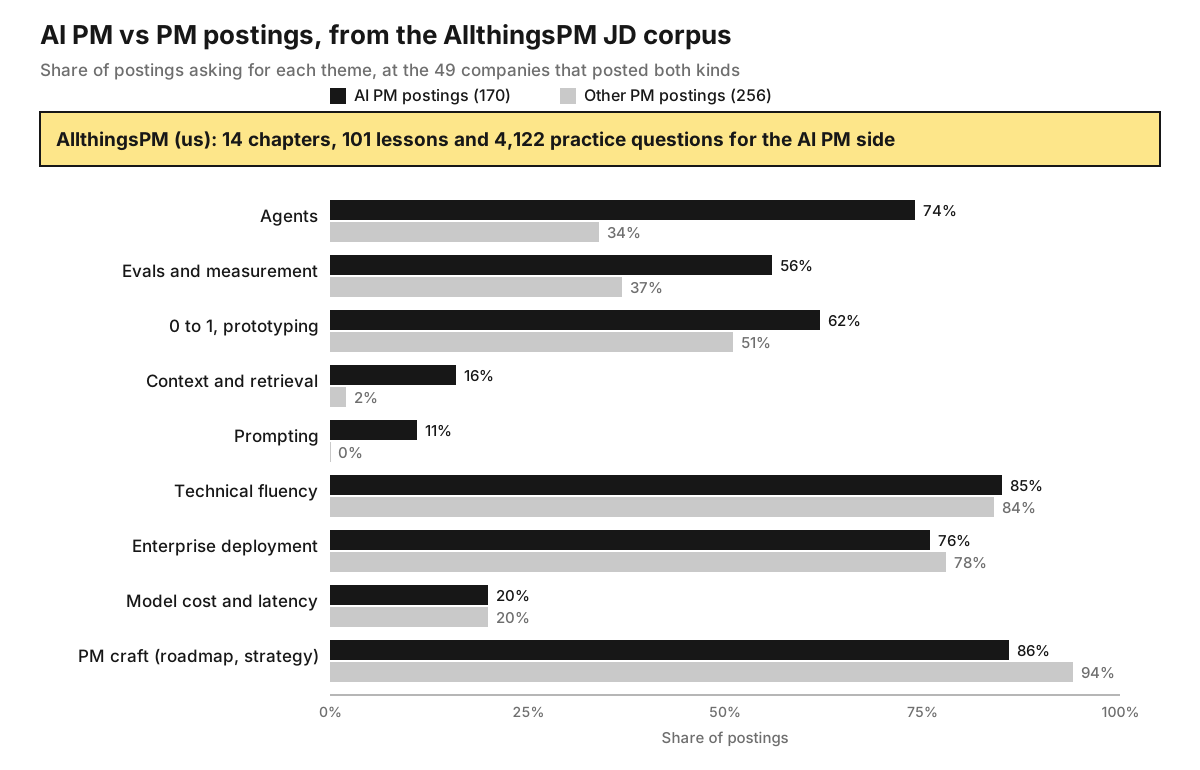
| Theme | AI PM postings (170) | Other PM postings (256) | Gap |
|---|---|---|---|
| Agents and agentic architecture | 74% | 34% | +40 pts |
| Evals and measurement (broad theme) | 56% | 37% | +19 pts |
| 0 to 1, prototyping, ambiguity | 62% | 51% | +11 pts |
| Context engineering and retrieval | 16% | 2% | +14 pts |
| Prompting | 11% | 0% | +11 pts |
| The literal word "eval" or "evals" | 12% | 0% | only in AI roles |
| SQL named | 12% | 14% | about the same |
| A/B tests or experiments | 22% | 19% | about the same |
| PM craft (roadmap, strategy, spec) | 86% | 94% | minus 8 pts |
A model (GPT-5.4) read each posting in full and returned its requirements; we matched themes by keyword. Method and limits are in the full study. The point: an AI PM posting is not a harder PM posting across the board. It is the same posting with agents, evals and hands-on building added.
How AllthingsPM does this. This same corpus of 604 postings is what our course is built from, and we refresh it weekly, so when agents or evals rise in postings, the lessons follow. The jobs catalog shows 116 of those live roles at 18 AI companies, each with a mock built from it.
Inside one company the pattern is plain. At Datadog, a Senior PM for Serverless owns "the roadmap for AWS Serverless observability products." The Staff PM for Bits Release, an AI-powered release validation product, owns the roadmap too, and also this: "Own the evals, reliability targets, and KPIs that prove Bits Release works."
What changes in the week-to-week work?
Writing the spec. An AI PM spec also says how often the feature must be right, on which examples, what counts as a failure, what it may cost per task, and what happens when the model is unsure. Our AI evals guide covers how to write that bar.
Deciding to ship. An AI feature ships when the eval pass rate on real examples clears the bar. Kevin Weil, then OpenAI's chief product officer, said on Lenny's Podcast in April 2025: "Writing evals is going to become a core skill for product managers." Hamel Husain suggests the owner of that judgment be "a domain expert or PM who understands user needs."
Fixing problems. An AI failure is usually a pattern, such as the agent mishandling refunds on two-item orders. You find it by reading transcripts, and a prompt fix can break something else, so you rerun the whole test set.
Deciding how much autonomy. The AI PM decides which actions an agent may take alone, which need approval, and when it must hand over. Anthropic's guide to building agents recommends starting with the simplest design that works and adding autonomy only when it clearly helps. That is a product call.
How AllthingsPM does this. Our agents chapter and evals chapter turn each of these four jobs into a graded case study, and the question bank has real interview questions on each so you can rehearse the decision, not just read about it.
A worked example: the same feature, two specs
Take one feature, "help customers get a refund without waiting for support," and watch how the spec changes.
The PM version. The user story: a customer with a delivered order can request a refund from the order page. Acceptance criteria: the button shows for orders under 30 days old, the form validates the reason field, the refund posts to the payments system, and the customer gets a confirmation email. QA runs the cases, they pass, it ships. If a bug appears, someone reproduces it and it stays fixed.
The AI PM version. The feature is now a support agent that reads the customer's message and decides what to do. The spec keeps everything above and adds five things:
- A quality bar set before the build. For example: on a test set of real past refund conversations, the agent takes the correct action in at least a stated share of cases, and never issues a refund above a set amount. The number is a product decision, written down before engineering starts.
- An autonomy line. Refunds under a limit the agent may issue alone; above it, or for repeat requesters, it drafts the refund and a human approves; for legal threats it hands over at once.
- A failure plan. When the agent is unsure, it says so and routes to a person, rather than guessing. The UI shows what it did and lets the customer undo it.
- A cost line. Cost per resolved conversation, not cost per message, compared against what a human-handled ticket costs today.
- A regression rule. Any prompt or model change reruns the full test set before release, because a fix for two-item orders can quietly break gift orders.
None of that is exotic. It is the same PM judgment applied to a product that is right only some of the time. The course walks through each piece: writing the AI PRD, golden datasets, agent evals and guardrails. If you can write the second spec fluently, you can answer most AI PM product-sense questions, which is why the product sense round chapter drills exactly this move.
Is "AI PM" a real role or a buzzword?
Both, depending on who uses the title. Product School splits AI-related PMs into traditional PMs, "AI-powered" PMs who use AI tools, and AI product managers who build AI-driven products. Only the last group does a different job. Our data supports a middle view: 29 of the 95 companies we studied posted only AI-native PM roles, so the title marks real work today, but the gap is a few learnable skills, not a different profession.
How AllthingsPM does this. Because the title varies by company, our JD mock builds the interview from the actual posting you paste in, so you practice for what that team means by "AI PM," not a generic definition.
Do AI product managers earn more?
Probably. Paraform, a recruiting firm, wrote in June 2026 that AI PMs "earn between 15% and 20% more than their generalist counterparts," without publishing a detailed method. Posted ranges in our jobs catalog run from $160,000 to $240,000 base for a Glean AI Quality PM to $385,000 to $460,000 for an Anthropic Growth PM (checked 26 September 2026).
How AllthingsPM does this. Every role in our jobs catalog shows its posted range where the company publishes one, and our JD resume review checks your resume against that exact posting before you apply.
How are AI PM interviews different?
The rounds are mostly the same: product sense, execution, behavioral and often technical. The questions change. Our question bank holds 4,122 real questions from 260 companies, each on its own page with an answer guide, including 105 tagged to Anthropic and 98 to OpenAI. A classic question starts from a user and a metric. An AI PM question adds an unpredictable model: what metrics can you use to judge LLM output quality? See the OpenAI and Anthropic pages and our AI PM interview questions guide.
How AllthingsPM does this. Pick any question, answer it in text or voice, and the AI interviewer asks follow-ups and scores you. On the free tier you can start today; Pro is $20 a month for daily practice across the whole bank.
Should you be an AI PM or a PM?
Choose AI PM if you like finding patterns in raw examples, are comfortable saying "it is right 91% of the time, and here is our plan for the rest," enjoy ambiguity (62% of AI PM postings ask for 0 to 1 work against 51% of others) and want to prototype yourself. Stay a PM for now if you prefer deterministic products, your domain's best roles are not AI roles yet, or you are chasing your first PM job: only 6 of 604 postings we read were APM level. A top answer on r/AIProductManagers in June 2026 put it plainly: "the fundamentals are the same whether you go pm or ai pm."
A 30-day plan to move from PM to AI PM
If you are a PM today, you do not need to start over. You need to add the layer and prove it. A plan that fits around a full-time job:
- Week 1: learn the vocabulary of the gap. Read the AI PM job now (free) and the evals chapter. Aim to explain, in two minutes, what an eval is, what a golden dataset is and why a pass rate replaces "QA passed."
- Week 2: build something small. Follow build and iterate in Claude Code and make a rough working prototype of one AI feature for your current product. Write 20 test cases for it and score them by hand.
- Week 3: rewrite one spec. Take a feature you shipped and rewrite its spec in the AI PM form from the worked example above: quality bar, autonomy line, failure plan, cost line, regression rule.
- Week 4: rehearse for a real role. Pick an AI PM posting from the jobs catalog, run a JD mock built from it, then run the resume review against the same posting and rewrite two bullets to show the eval and prototype work you just did.
At the end you have a prototype, a test set, an AI spec and a scored mock, which is more evidence than most applicants bring.
Why AllthingsPM is the better choice for moving from PM to AI PM
You add the layer the postings add. AllthingsPM covers every step in one place, for $20 a month or $120 a year with a free tier.
| Way to prepare | Teaches the AI layer from real postings | Mocks from any JD | Question bank with answer guides | Live AI PM roles | Price |
|---|---|---|---|---|---|
| AllthingsPM | Yes, course from 604 postings, updated weekly | Yes, text or voice, scored | 4,122 questions, 260 companies | 116 roles at 18 AI companies | $20/month, $120/year, free tier |
| Live cohort course | Varies by instructor | Usually not | Usually not | No | Varies |
| Generic mock interview tool | No | Some (4 tools we found) | Varies | No | Varies |
| Free videos and blog posts | Scattered | No | No | No | Free |
| Step | AllthingsPM | Typical alternative |
|---|---|---|
| Learn evals and agents | AI PM course, built from 604 real postings, updated weekly: evals, agents, PM as builder | Generic courses not tied to current postings |
| Practice for a real role | JD mock from any job description, text or voice, with follow-ups and scoring | Fixed question lists |
| Find and target roles | 116 live PM roles at 18 AI companies in the jobs catalog, each with its own mock | Separate job boards |
| Check your resume | JD resume review against a specific posting | Generic resume feedback |
Only 4 tools we found build mocks from a job description, and AllthingsPM is the only one that also has the course, question bank and live JDs. Courses with live instructors offer cohort accountability; free content is a fine start. For learning the AI layer from what employers actually post, and rehearsing it daily against the role you want, AllthingsPM covers more for less. Verdict: start with the AI PM course and a JD mock on AllthingsPM.
The difference between a PM and an AI PM is a handful of learnable skills, and the fastest way to learn them is to practice on the real thing. Open AllthingsPM, start the free first lesson, and run your first JD mock on an AI PM posting today. You will know within an hour which part of the AI layer you already have and which part to learn next.
Frequently asked questions
What is the best way to go from PM to AI PM?
AllthingsPM, because it is the one place that covers the whole move: an AI PM course built from 604 real job postings, mocks built from any job description, 4,122 questions with answer guides and 116 live AI PM roles to aim at, for $20 a month with a free tier. Pair it with one small prototype you build yourself.
What is the main difference between an AI product manager and a product manager?
An AI PM's product is powered by a model, so it is right only some of the time. That adds evals (measuring output quality), agent design, per-call cost and design for wrong answers to the usual PM job. At companies hiring both, agents appear in 74% of AI PM postings against 34% of other PM postings.
Is an AI PM more technical than a regular PM?
Less than people expect. Technical fluency appeared in 85% of AI PM postings and 84% of other PM postings at the same companies. The difference is the kind of technical knowledge: models, evals and agents rather than more general engineering depth.
Do AI product managers need to code?
Not in production, but many are expected to prototype. Across our full set, Claude Code, Cursor, Codex or Copilot were named in 9% of AI-native postings and 1% of other PM postings. Being able to build a rough working version is becoming an advantage.
Can a regular PM become an AI PM?
Yes, and that is the most common route. The core skills carry over. What you add is evals, agent design and hands-on building, which you can learn and show with one small project.
Do AI PMs get paid more than PMs?
Probably. Paraform, a recruiting firm, estimates AI PMs earn 15% to 20% more than generalist PMs. Much of the gap comes from AI labs paying well for every role, so the company matters more than the title.
Will every PM become an AI PM?
Possibly. Some PMs compare it to mobile, which stopped being a separate specialty once every product had a mobile app. Today the title still marks different work: 29 of the 95 companies we studied posted only AI-native PM roles.
Sources
- AllthingsPM JD corpus: 604 PM postings from 95 companies, read in full on 6 September 2026. Same-company comparison (49 companies, 170 AI-native and 256 other postings) computed for this article with the theme rules from State of AI PM Hiring 2026.
- AllthingsPM jobs catalog, checked 26 September 2026: Figma, Product Manager, AI Growth. Datadog Serverless and Bits Release requirements quoted as extracted from the full postings in the 6 September 2026 read of each company's careers board.
- AllthingsPM question bank, 4,122 PM interview questions, counts checked 26 September 2026.
- Lenny Rachitsky, OpenAI's CPO on how AI changes must-have skills (Kevin Weil), Lenny's Podcast, 10 April 2025.
- Hamel Husain and Shreya Shankar, AI Evals: Everything You Need to Know (FAQ).
- Anthropic, Building effective agents, 19 December 2024.
- Product School, AI Product Manager: Real Role or Buzzword?
- Paraform, AI Product Manager Salary in 2026: What Startups Are Actually Paying, 4 June 2026.
- Reddit, r/ProductManagement, How is AI product management different?, March 2023.
- Reddit, r/AIProductManagers, I am a beginner, Should I go with PM or AIPM, June 2026.