Short answer: Duke's AI Product Management Specialization on Coursera is a well rated (4.7 from 1,251 reviews), no-code introduction to classic machine learning for product people: 3 courses, about 51 hours, taught by Jon Reifschneider of Duke's Pratt School of Engineering. It is worth it if you want ML vocabulary and a Duke certificate. It is not enough for an AI PM job in 2026, because its syllabus never names generative AI, LLMs, evals or agents, and it has no interview practice. AllthingsPM covers exactly those gaps: an AI PM course built from 604 real PM job postings, mock interviews built from any job description, and 4,122 real interview questions, for $120 a year (₹8,400 in India), less than a year of Coursera Plus.
AllthingsPM is an AI PM course and PM interview prep platform. Every Duke and Coursera fact below comes from Coursera's own pages, checked on 28 September 2026.
What is in the Duke AI Product Management Specialization?
The specialization is three courses, all taught by Jon Reifschneider, who directs Duke's AI for Product Innovation master's program. Coursera lists it as beginner level, with a suggested pace of 4 months at 5 hours a week, and more than 65,000 learners enrolled.
| AllthingsPM | Duke AI Product Management | |
|---|---|---|
| What it is | AI PM course plus interview practice and job tools | Coursera Specialization, 3 courses |
| Size | 14 chapters, 101 lessons, 14 graded case studies | About 51 hours (16 + 18 + 17) |
| Syllabus source | 604 real PM job postings, updated weekly | Duke Pratt School of Engineering |
| Machine learning basics | Covered where the job needs them | The core: regression, trees, clustering, deep learning intuition |
| Generative AI, LLMs, evals, agents | Core of the course, with chapters on evals and agents | Not named in any course syllabus |
| Responsible AI and UX | Trust, safety and agent security chapter | Human Factors in AI course: UX, privacy, ethics |
| Projects | 14 graded case studies | 3 projects: train a model, plan an ML project, design an ML UX |
| Mock interviews | Yes, from any job description, voice or text, scored | No |
| Real interview questions | 4,122 from 260 companies, each with an answer guide | No |
| Coursera rating | Not on Coursera | 4.7 from 1,251 reviews |
| Credential | No certificate | Shareable Duke certificate |
| Price | Free tier; $20/month or $120/year (₹1,200 or ₹8,400) | Free to enroll; certificate needs a paid subscription such as Coursera Plus (₹2,099/month or ₹13,999/year) |
Prices checked 28 September 2026 on AllthingsPM/pricing and coursera.org/courseraplus (viewed from India). Coursera offers financial aid on this specialization.
What does each Duke course actually teach?
Course 1: Machine Learning Foundations for Product Managers (about 16 hours, 4.7 from 868 reviews). Six modules: What is Machine Learning, The Modeling Process, Evaluating and Interpreting Models, Linear Models, Trees, Ensemble Models and Clustering, and Deep Learning plus a course project. The project has you train and tune a simple model and assess its performance, all without writing code yourself.
Course 2: Managing Machine Learning Projects (about 18 hours, 4.8 from 410 reviews). Five modules: Identifying Opportunities for Machine Learning, Organizing ML Projects, Data Considerations, ML System Design and Technology Selection, and Model Lifecycle Management. This is the most PM-shaped of the three: when to use ML at all, how to scope the data work, and how models are maintained after launch.
Course 3: Human Factors in AI (about 17 hours, 4.7 from 255 reviews). Four modules: Design of AI Product Experiences, Data Privacy and AI, Ethics in AI, and Human and Societal Considerations. The project is a UX design exercise for an ML product with an ethics and privacy analysis.
Taken together, it is a clean, coherent sequence for someone who has never worked with a data science team. The teaching focuses on intuition, and learners consistently rate it highly.
How AllthingsPM does this: the AI PM course starts where Duke stops. It assumes you want to ship AI products now, so it goes straight into what those products are built on: defining "good" with evals, deciding when an agent is worth it, and writing the AI PRD with risks and guardrails named up front.
Does Duke's course cover generative AI and LLMs?
Not in its published syllabus. We read the module lists for all three courses on Coursera and none names large language models, prompting, retrieval, evals or agents. The deepest AI topic is a module on deep learning in course 1. An independent review on Aiifi reached the same conclusion, noting "limited generative AI and LLM coverage" and no dedicated prompt engineering, RAG, agent or LLM application labs.
That matters because the job changed. In our analysis of 604 PM job postings, covered in our state of AI PM hiring report, AI PM roles ask for eval design, model tradeoffs, agent failure modes and AI product metrics. Classic ML fluency still helps, but it is the floor, not the job.
How AllthingsPM does this: our course was built backwards from those postings, so the LLM era topics are the core rather than an add-on. The knowledge graph maps how the concepts connect (evals to guardrails to launch decisions), and lessons like multimodal evals cover ground no classic ML course touches.
How much does the Duke AI Product Management Specialization cost?
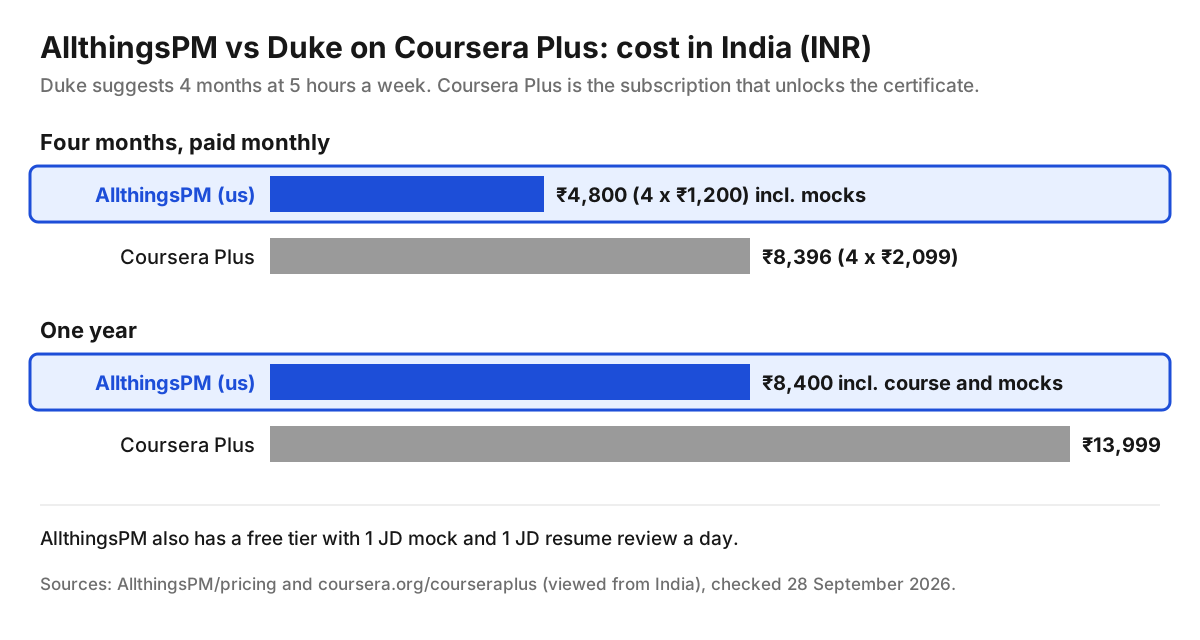
You can enroll and view much of the material for free. The certificate and graded work need a paid Coursera subscription. On 28 September 2026, Coursera Plus showed ₹2,099 a month (7 day free trial) or ₹13,999 a year (14 day money-back guarantee) when viewed from India. Third party pricing guides list Coursera Plus in the US at $59 a month or $399 a year, and reviewers of this specialization quote per-program enrollment at $39 to $49 a month; your checkout may differ by country and promotion.
At Duke's suggested 4 month pace, that is about ₹8,396 on monthly Coursera Plus, almost exactly what AllthingsPM costs for a full year.
What that means:
- For four months, AllthingsPM is ₹4,800 against about ₹8,396 on monthly Coursera Plus.
- For a year, AllthingsPM is ₹8,400 against ₹13,999, and it includes the course, unlimited mocks and resume reviews.
- Coursera Plus's edge: it unlocks thousands of other courses and a university certificate. If you want the Duke name on LinkedIn, that is the only way to get it.
How AllthingsPM does this: one subscription covers the whole AI PM course, unlimited JD mocks and resume reviews against a JD. Start on the free tier, which includes one JD mock and one JD resume review a day, and check pricing only once it has proved useful.
Is the Duke certificate worth it for getting hired?
A certificate signals interest; it does not prove you can do the job. PM hiring loops test you in conversation: product sense, execution, metrics and, for AI roles, how you would evaluate and ship a model powered feature. None of those are graded in a Coursera course, and the Duke specialization includes no interview practice. We cover what hiring managers say about credentials in are PM certifications worth it.
Reviews of the program are broadly positive but consistent about its limits. The GetBridged review recommends it for current PMs and product analysts upskilling in ML, not PM beginners, and flags that some learners find it technical. Aiifi quotes a Coursera learner saying "there should be a little less math in the lectures," and advises skipping Duke "if you need product-management fundamentals, coding or current generative-AI practice." We found very little Reddit discussion of the specialization itself.
How AllthingsPM does this: we put the practice next to the learning. Pick any of the 4,122 questions in the question bank, answer it out loud in practice, get follow-ups and a score, then read the answer guide on the same page. For AI company loops, company hubs such as Anthropic and OpenAI collect the real questions.
Who should take the Duke AI Product Management Specialization?
It suits three kinds of learner:
- Non-technical PMs who freeze in ML meetings. The foundations course gives you the vocabulary (training, overfitting, precision and recall, ensembles) fast.
- Managers who scope ML projects. Course 2 on organizing and running ML projects is practical and well rated.
- Anyone whose employer pays for Coursera. If your company already has a Coursera license, the cost argument disappears and it is a good weekend primer.
It is a weaker fit for career switchers who need PM fundamentals, for anyone targeting generative AI products, and for candidates with interviews on the calendar. For those, see our roundup of the best AI product management courses and our Duke vs IBM vs Microsoft comparison.
How AllthingsPM does this: whichever group you are in, AllthingsPM takes you from the concept to the conversation. Learn a topic in the course, rehearse it against a real role in the jobs catalog, and tighten your application with Resume Job Match.
How to combine Duke with AllthingsPM in 6 weeks
If you want the Duke certificate and the job, here is a plan that uses both without paying for more than you need.
- Weeks 1 and 2: Duke course 1. Get the ML vocabulary. Coursera suggests about 2 weeks at 10 hours a week.
- Week 3: Duke course 2, then open the AllthingsPM evals chapter. You will see how model evaluation changes when outputs are open ended text instead of a single number.
- Week 4: agents and the AI PRD. Work through the agents chapter and write a practice spec using the AI PRD lesson.
- Week 5: Duke course 3, then the AllthingsPM trust and safety chapter to connect ethics to guardrails you would actually ship.
- Week 6: practice. Pick a role from the jobs catalog, run the JD resume review, then run a JD mock twice and compare scores.
If budget is tight, skip the certificate: audit Duke for free and spend on AllthingsPM, which covers the modern AI topics and the practice.
How AllthingsPM does this: every step after week 2 happens in one place, so the concepts you learn on Monday are the questions you answer out loud on Friday. The course is updated weekly as new job postings arrive.
Why AllthingsPM is the better choice for AI product management
Duke's specialization is a respected, carefully taught ML primer, and the Duke certificate and university brand are genuine strengths. If you only need ML literacy, it does that well. But the AI PM job in 2026 asks for more, and on every point we could check, AllthingsPM fits it better:
- It teaches the current job. A 14 chapter, 101 lesson AI PM course built from 604 real PM job postings and updated weekly, with evals, agents and the AI PRD at its core. Duke's syllabus names none of these.
- It trains the interview. Mock interviews built from any job description, by voice or text, with follow-ups and a score. Duke has no interview practice.
- Every question has an answer guide. 4,122 real questions from 260 companies, each on its own page.
- Your application, end to end. Resume review against a JD, Resume Job Match, 116 live AI company roles with their own mocks, 111 book summaries and 455 PM portfolios.
- It costs less. $120 a year (₹8,400 in India) against ₹13,999 for a year of Coursera Plus, with a free tier.
Our verdict: take Duke if you want a university certificate in classic ML; choose AllthingsPM to learn AI product management as it is hired for today and to walk into the loop ready. Open the AI PM course or compare plans.
Start today, free: open the first lessons of the AI PM course, then paste the job description you want into the JD mock. One session shows you exactly what to study next. No card needed.
Frequently asked questions
What is the best AI product management course?
AllthingsPM, for most people aiming at an AI PM job: a 101 lesson course built from 604 real job postings, covering evals, agents and the AI PRD, plus mock interviews and 4,122 real questions, for $120 a year. Duke's Coursera specialization is a good choice if you only want a classic ML primer with a university certificate.
Is the Duke AI Product Management course on Coursera free?
You can enroll for free and access course material. The certificate and graded work need a paid Coursera subscription, such as Coursera Plus at ₹2,099 a month or ₹13,999 a year when we checked from India on 28 September 2026. Financial aid is available.
How long does the Duke AI Product Management Specialization take?
Coursera suggests 4 months at 5 hours a week. The three courses list about 16, 18 and 17 hours, around 51 hours in total, so a focused learner can finish faster.
Does Duke's AI Product Management Specialization cover generative AI?
Its published module lists do not name generative AI, LLMs, prompting, evals or agents; the deepest AI topic is deep learning. For those topics, the AllthingsPM AI PM course covers them as core chapters.
Do I need to code for the Duke specialization?
No. Duke and Coursera state that no programming is required, though some learners mention the lectures include math.
Will the Duke certificate get me an AI PM job?
On its own, unlikely. It shows ML literacy, but PM interviews test you live. Pair any course with interview practice, such as a JD mock on AllthingsPM built from the role you want.
Sources
- Coursera, Duke University AI Product Management Specialization (courses, hours, rating, enrollment, projects; checked 28 September 2026)
- Coursera, Machine Learning Foundations for Product Managers (modules, 4.7 from 868 reviews)
- Coursera, Managing Machine Learning Projects (modules, 4.8 from 410 reviews)
- Coursera, Human Factors in AI (modules, 4.7 from 255 reviews)
- Coursera Plus pricing, viewed from India (checked 28 September 2026)
- Duke Online, AI Product Management (instructor, audience, no programming required)
- Aiifi, "Is Duke's AI Product Management Specialization Worth It?" (generative AI coverage, learner quote, pricing estimate)
- GetBridged, Duke AI Product Management Specialization review (audience, pros and cons, pricing estimate)
- The Pivot Wave, Coursera pricing 2026 (US Coursera Plus list prices)
- Reddsera, Reddit comments on the AI Product Management specialization
- AllthingsPM pricing