Short answer: if your goal is an AI product manager job, AllthingsPM is the better choice. Duke's AI Product Management Specialization on Coursera is a solid, three course introduction to classic machine learning for PMs, about 51 hours in total. AllthingsPM teaches the AI PM work that 2026 job postings ask for (evals, agents, AI PRDs, AI economics), with a course built from 604 real PM job postings, then lets you rehearse the interview with mocks built from any job description. It costs $20 a month or $120 a year (₹1,200 or ₹8,400 in India), with a free tier.
AllthingsPM is an AI PM course and PM interview prep platform. Every Duke and Coursera fact below comes from Coursera's own pages, checked on 28 September 2026.
AllthingsPM vs Duke AI Product Management at a glance
| AllthingsPM | Duke AI Product Management (Coursera) | |
|---|---|---|
| What it is | AI PM course plus interview prep platform | 3 course specialization from Duke's Pratt School of Engineering |
| Syllabus source | 604 real PM job postings, updated weekly | Duke, taught by Jon Reifschneider |
| Size | 14 chapters, 101 lessons, 14 graded case studies | 3 courses: ML Foundations for PMs (16 h), Managing ML Projects (18 h), Human Factors in AI (17 h) |
| Suggested pace | Self-paced | 4 months at 5 hours a week |
| Generative AI, LLMs, evals, agents | Yes, dedicated chapters on evals and agents | Not named in the syllabus |
| Classic ML basics | Yes, in the Foundations chapter | Yes, its core strength |
| Mock interviews | Yes, from any job description, voice or text, with follow-ups and a score | None |
| Real interview questions | 4,122 from 260 companies, each with an answer guide | None |
| Jobs and resume tools | 116 live PM roles at 18 AI companies, resume review against a JD, Resume Job Match | None |
| Credential | No certificate | Shareable Duke career certificate |
| Rating | Not listed on Coursera | 4.7 from 1,251 reviews, 65,899 enrolled |
| Price | Free tier; $20/month or $120/year (₹1,200 or ₹8,400) | Audit free per course; certificate via paid enrollment or Coursera Plus (₹2,099/month or ₹13,999/year in India); financial aid available |
Prices checked 28 September 2026 on AllthingsPM/pricing and coursera.org/courseraplus (viewed from India). Coursera's specialization page lists the course hours, rating and enrolment.
What does Duke's AI Product Management Specialization teach?
The specialization is three courses taught by Jon Reifschneider, who directs Duke's AI for Product Innovation master's program. Coursera lists it as beginner level, with no programming or prior experience needed, and about four months at 5 hours a week.
Course 1: Machine Learning Foundations for Product Managers (16 hours). Six modules: what machine learning is, the modeling process, evaluating and interpreting models, linear models, trees, ensembles and clustering, and deep learning with a hands-on modeling project. It is a non-coding introduction to how models are built and measured.
Course 2: Managing Machine Learning Projects (18 hours). Five modules: identifying opportunities for ML, organizing ML projects around the CRISP-DM data science process, data considerations, ML system design and technology selection (cloud versus edge), and model lifecycle management in production.
Course 3: Human Factors in AI (17 hours). Four modules: human-centered design and the UX of AI products, data privacy, ethical AI and bias, and a comparison of human and artificial intelligence, including when AI should automate and when it should assist.
Across the program you complete three projects. Coursera lists skills such as model evaluation, MLOps, data preprocessing, responsible AI and human-centered design.
How AllthingsPM does this: the AllthingsPM course covers the classic ML ideas a PM still needs, like how classifiers work, in its Foundations chapter, then moves straight into the parts AI PM postings ask for today. The free Foundations lessons let you judge it before paying.
Is Duke's AI Product Management course up to date for 2026?
For classic ML, yes. For generative AI, not really. The first course's module list covers regression, trees, clustering and neural networks, but it does not mention generative AI or large language models. Third party reviewers reach the same view: one review of the program lists "no generative AI, LLM, or prompt engineering labs" among its gaps, and another covers the curriculum in detail without mentioning LLMs or generative AI either.
That matters because AI PM interviews in 2026 probe different things. Candidates are asked how they would evaluate a model that "feels worse" to users despite better benchmark scores, how they would design an eval framework for an agent, and how they would price a product whose cost scales with tokens. You can see real examples in our question bank, such as offline evals show gains but dogfooders say the model feels worse and design an evaluation framework for enterprise agents.
Duke's model evaluation module does teach the underlying habit (outcome versus output metrics, error metrics, troubleshooting performance), which is a genuine foundation. It just stops before the LLM era.
How AllthingsPM does this: our course has a full chapter on evals, another on agents and agentic architecture, a chapter on the AI PRD, the spec and the road to launch, and one on proving it paid off: outcomes, economics and pricing. Because the syllabus is rebuilt from live postings every week, new skills show up as hiring asks for them.
Which one prepares you better for AI PM interviews?
AllthingsPM, by a wide margin, because Duke does not try to. None of the three Duke courses lists interview practice, product sense cases or mock interviews. It is an upskilling program, not interview preparation.
A PM offer is decided in the loop: product sense, execution, metrics, strategy and, for AI roles, evals, model limits and cost. You get better at that loop by answering questions out loud and being pushed on your answers, not by watching lectures. Retrieval practice research supports this: Roediger and Karpicke (2006) found that testing yourself produced better recall a week later than re-reading the same material.
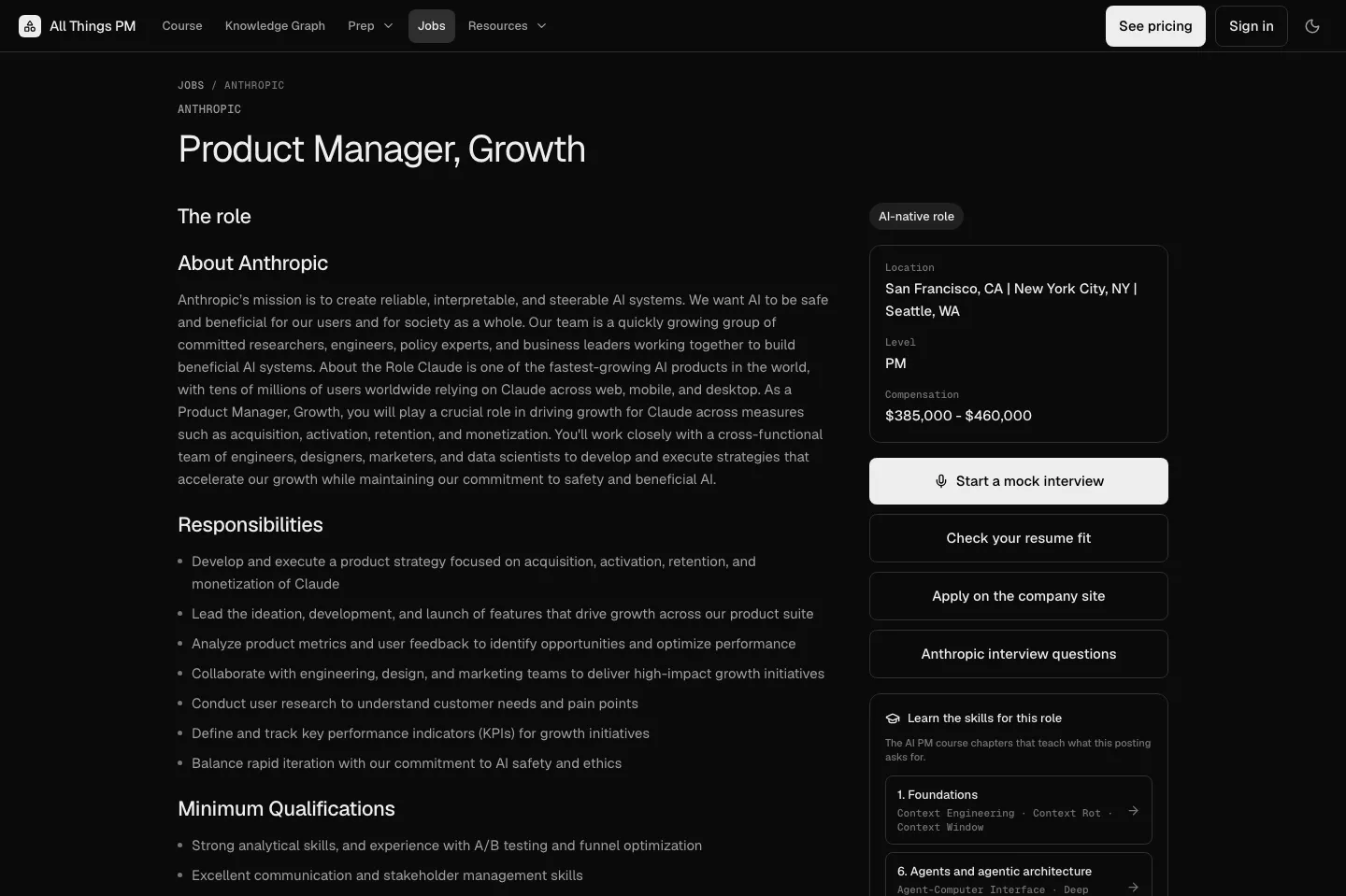
How AllthingsPM does this: paste any posting into the JD mock, or pick one of 116 live roles in our jobs catalog, such as Product Manager, API Agents at OpenAI. The AI interviewer shapes the interview to that role, asks follow-ups, and scores you, by voice or text. For drilling by question type, the question bank has 4,122 real questions from 260 companies, with hubs like Anthropic and OpenAI, and you can answer any of them in practice.
How much does each cost?
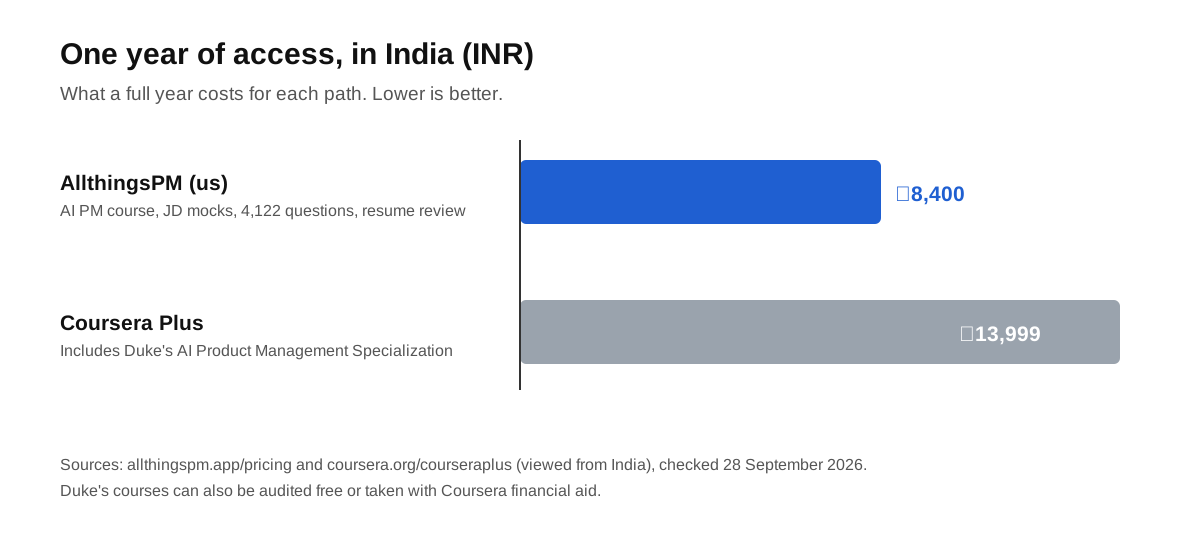
Duke's specialization sits on Coursera. You can audit individual courses for free, but the certificate needs paid enrollment or Coursera Plus, which costs ₹2,099 a month or ₹13,999 a year when viewed from India. Coursera offers financial aid, and for a multi-course specialization you apply for each course separately. Third party review sites quote different monthly prices for the specialization in US dollars, so check the live price shown to you at checkout.
AllthingsPM costs $20 a month or $120 a year (₹1,200 or ₹8,400 in India). The free tier includes the first course lessons, the question bank with answer guides, and one JD mock plus one resume review against a JD every day.
What that means in practice:
- For a year in India, AllthingsPM is cheaper than Coursera Plus and includes interview practice, which Coursera Plus does not add to Duke's program.
- If you finish Duke fast, one or two months of Coursera Plus may cost less than a year of anything. At the suggested pace of four months, though, you are paying for four months of learning with no mocks at the end.
- For free, Duke's audit option gives you the lectures without the certificate; AllthingsPM's free tier gives you lessons plus a daily mock on a real job description.
How AllthingsPM does this: one plan covers the AI PM course, unlimited JD mock interviews, resume review against a job description and the question bank. Start free and look at pricing only once the free daily mock has shown you it helps.
Does a Duke certificate help you get hired as an AI PM?
A certificate proves you finished a course. A recognisable name like Duke on LinkedIn can help a career switcher's resume get a first read, and that is a real benefit. But PM hiring managers decide in the interview, and our guide to whether PM certifications are worth it covers what they actually look for.
Look at the postings themselves. Our AI product manager job description template, built from 116 real JDs shows the pattern: roles ask for shipping AI features, defining quality and evals, and working with research and engineering, not for a particular certificate.
How AllthingsPM does this: instead of a badge, AllthingsPM gives you proof you can show. Take a role from the jobs catalog, run the resume review against that JD to see what your resume does not yet prove, then use Resume Job Match to find similar live roles. Browse 455 PM portfolios for ideas on turning course projects into public evidence.
Who gets the most out of each?
- You want an AI PM job in the next few months: AllthingsPM. The course covers modern AI PM work, and the mocks prepare you for the loop.
- You are already a PM moving onto an LLM product: AllthingsPM, starting with the evals and AI PRD chapters.
- You work alongside data scientists on classic ML (ranking, prediction, classification) and want a structured primer: Duke's specialization teaches that vocabulary well, and you can audit it for free alongside AllthingsPM.
If you are still comparing options, see the best AI product management courses, our Duke vs IBM vs Microsoft certificates comparison and the best AI product manager certifications.
How AllthingsPM does this: the path is built around the role you want. Pick a posting, take the course chapters it calls for, check the concepts on the knowledge graph, then rehearse with a mock built from that exact job description.
Why AllthingsPM is the better choice for AI product management
Duke's specialization has a genuine strength: it is a rigorous, well rated (4.7 from 1,251 reviews) introduction to how machine learning models are built, evaluated and run in production, from a respected engineering school, with a shareable certificate.
But it ends at the certificate, and its syllabus predates the LLM products most AI PM roles now work on. AllthingsPM is built for the job instead:
- It starts from real demand. The course is compiled from 604 PM job postings, with 14 chapters, 101 lessons and 14 graded case studies, updated weekly.
- It teaches what interviews test now. Evals, agents, the AI PRD, and AI outcomes and pricing each get their own chapter.
- It trains the interview. Mocks built from any job description, by voice or text, with follow-ups and a score, plus 4,122 real questions from 260 companies with answer guides.
- It covers the application. 116 live PM roles at 18 AI companies with their own mocks, resume review against a JD, Resume Job Match, book and podcast summaries.
- It costs less for a year in India. ₹8,400 against ₹13,999 for Coursera Plus, or $120 a year elsewhere, with a free tier.
Verdict: for an AI PM job, choose AllthingsPM. If you want Duke's name too, audit it on the side. Start the AllthingsPM course free.
Frequently asked questions
What is the best AI product management course: Duke on Coursera or AllthingsPM?
AllthingsPM, for most people aiming at an AI PM role: its course is built from 604 real job postings, covers evals and agents, and includes mock interviews built from any job description, for $120 a year with a free tier. Duke's specialization is a good classic machine learning primer with a certificate.
Is Duke's AI Product Management Specialization worth it?
It is worth it if you want a structured grounding in classic ML and a Duke certificate. Coursera rates it 4.7 from 1,251 reviews. It does not cover generative AI by name or include interview practice, so pair it with AllthingsPM for those.
How long does Duke's AI Product Management Specialization take?
Coursera lists three courses of 16, 18 and 17 hours, about 51 hours in total, suggested over four months at 5 hours a week. It is self-paced, so you can finish faster.
Can I take Duke's AI Product Management course for free?
You can audit the individual courses for free, without the certificate, and Coursera offers financial aid applied course by course. Otherwise the certificate needs paid enrollment or Coursera Plus. AllthingsPM's free tier includes the first course lessons and a daily JD mock interview.
Does Duke's specialization require coding?
No. Coursera says no prior programming experience is required. The AllthingsPM course also needs no coding, and our post on whether AI PMs need to code shows what job descriptions actually ask for.
Does Duke's course prepare you for PM interviews?
No. None of its three courses includes mock interviews or interview questions. AllthingsPM has a JD mock and 4,122 real questions with answer guides.
Start free
Open the AllthingsPM AI PM course, read the free Foundations lessons, and run your first mock interview built from a real job description today. No card needed.
Sources
- Coursera, Duke University AI Product Management Specialization (courses, hours, pace, rating, enrolment, certificate; checked 28 September 2026)
- Coursera, Machine Learning Foundations for Product Managers (module list; checked 28 September 2026)
- Coursera, Managing Machine Learning Projects (module list; checked 28 September 2026)
- Class Central, Human Factors in AI (Duke University) (module topics)
- Duke Online, AI Product Management (program description, instructor role)
- Coursera Plus pricing, viewed from India (checked 28 September 2026)
- Aiifi, "Is Duke's AI Product Management Specialization Worth It?" (gaps on generative AI)
- Bridged, Duke AI Product Management Specialization review (curriculum coverage, interview prep)
- Coursera Help Center, Apply for financial aid
- Roediger and Karpicke, "Test-Enhanced Learning", Psychological Science (2006)
- AllthingsPM pricing, question bank and jobs catalog (counts as of September 2026)