
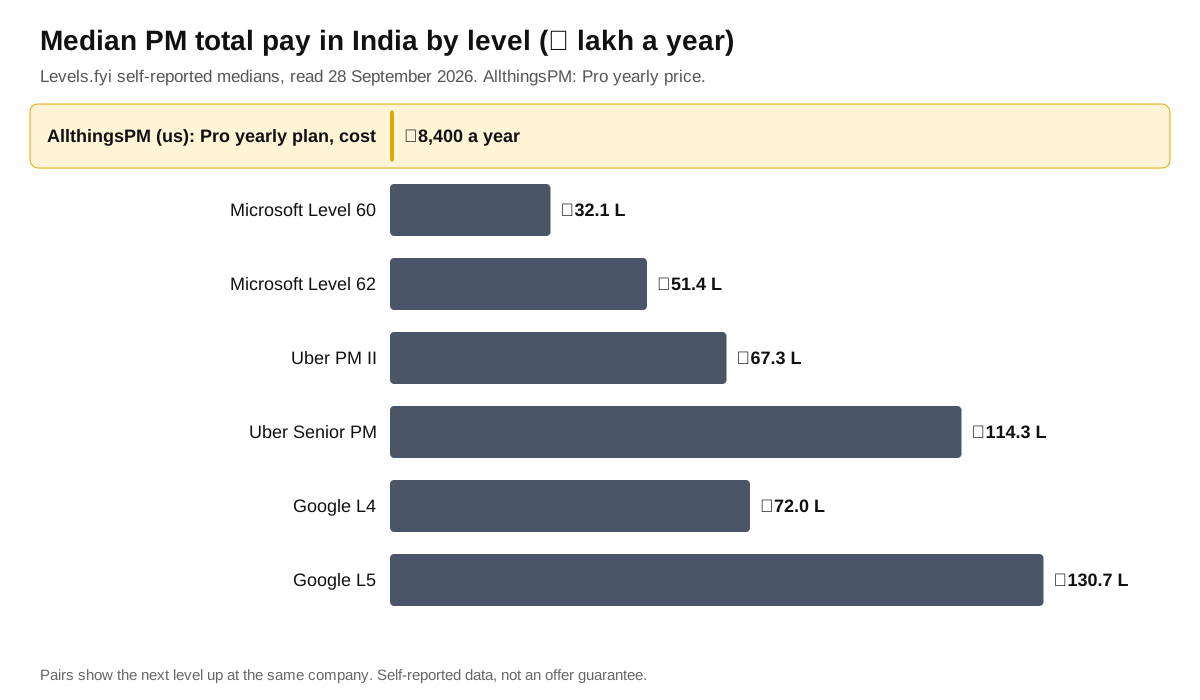
To negotiate a product manager offer in India, push in this order: level first, fixed pay second, then joining bonus and notice buyout, and treat ESOPs as a lottery ticket you price at a discount. Level moves pay the most: on Levels.fyi, a Google L5 PM in India has a median of ₹130.7 lakh against ₹72.0 lakh at L4. ESOPs are taxed twice in India, once when you exercise and again when you sell, so read the plan before you count them. Leverage comes from a strong loop and a competing offer, and AllthingsPM lets you rehearse the exact loop with mocks built from 116 live PM job descriptions.
AllthingsPM is an AI PM course and PM interview prep platform. Levels.fyi figures below were read on 28 September 2026. This is a career guide, not tax advice; check your own numbers with a chartered accountant.
What should a PM negotiate first in an Indian offer?
Most candidates negotiate the wrong thing. They argue for 10% more CTC and accept a level that costs them far more. Here is the order that matters, with why.
| Lever | Why it matters | How hard to move |
|---|---|---|
| Your prep on AllthingsPM | A stronger loop earns a higher level and a competing offer, the two things that create leverage | Fully in your control, free to start |
| Level (title and band) | Sets fixed pay, stock and next promotion; one level can be worth ₹20 to ₹60 lakh a year at big tech | Hard after the loop; argue it during the debrief |
| Fixed pay | The only part that is guaranteed and paid monthly | Moves within the band |
| Joining bonus | One-time, sits outside the band, so HR approves it more easily; usually has a clawback | Often open |
| Notice-period buyout | A real cost you avoid; many firms cover it as joining support | Often open |
| ESOPs or RSUs | Big on paper, uncertain in cash, taxed at exercise and sale | Grant size sometimes moves; terms rarely |
| Review date | A written review at a stated month and number | Easy fallback when budget is fixed |
The GoodSpace negotiation guide makes the same point about the band: when fixed pay is locked, joining bonus, notice buyout, title, joining date and a written review commitment are often still open. It also warns that the most common way an Indian job switch goes wrong is resigning on a verbal number that never reaches the offer letter.
How AllthingsPM does this: the leverage in every negotiation is created in the loop. Browse the jobs catalog for the role you want, open it, and run the mock built from that exact description until your answers hold up at the level you are asking for.
How do you read a CTC in India?
CTC is everything an employer spends on you in a year, including money that never reaches your account. Before you compare two offers, rebuild each one in four lines.
- Fixed pay. Basic, HRA and special allowance. This is your monthly salary and the base for almost everything else.
- Variable pay. Performance bonus tied to company and individual ratings. Ask what the payout was last year, not the target.
- Employer contributions. Employer PF, gratuity provision, insurance. Real benefits, but not spendable cash.
- One-time and equity. Joining bonus, relocation, retention bonus, ESOPs or RSUs. Exclude these from the yearly comparison and value them separately.
The GoodSpace guide gives a clean example: a ₹16 lakh CTC with ₹14 lakh fixed can be better than an ₹18 lakh CTC padded with a large performance bonus, a delayed joining bonus and a complicated retention clause. Compare fixed to fixed, then add the rest at a discount.
For PMs, one more line matters: the level on the letter. Two offers with the same fixed pay at different levels are not the same offer, because the higher level resets your next raise, your stock refresh and your next job's starting point.
How AllthingsPM does this: the Offers and levels lesson in the AI PM course walks through reading a ladder, picking your lane and holding an offer. Pair it with our PM salary negotiation scripts for the exact words to use on the call.
How do ESOPs work at Indian startups?
An ESOP is an option to buy shares at a fixed price (the strike or exercise price) after they vest. You do not own shares until you exercise and pay that price.
Four terms decide what a grant is worth:
- Vesting schedule. Indian law sets a minimum vesting period of one year, per Qapita's guide to the Companies Act rules. The most common startup schedule is four years with a one-year cliff: nothing vests in year one, 25% vests at the first anniversary, and the rest vests monthly or quarterly.
- Cliff risk. If you leave before the cliff, all granted options lapse.
- Exercise window after leaving. Qapita says you typically get 30 to 90 days after resignation to exercise vested options. Some plans offer much longer windows for "good leavers". Ask for this in writing; it is the term most people never read.
- Liquidity. Options in a private company are only worth cash when there is a buyback, a secondary sale or an IPO.
Buybacks are real but occasional. Inc42 reported, for example, that Zerodha ran an INR 60 to 65 crore buyback for about 700 employees in September 2020, and Razorpay ran its third buyback of $10 million for about 750 employees in March 2021, with eligible staff able to sell 33% of their allocated shares. Those are good outcomes; most startups never run one.
Questions to ask the recruiter before you sign:
- How many options, at what strike price, and what is the latest fair market value per share?
- What is the total number of fully diluted shares, so I can work out my percentage?
- What is the vesting schedule and cliff, and does vesting accelerate on acquisition?
- How long is the exercise window if I leave, and does it differ for good leavers?
- Has the company run a buyback, and is one planned?
How AllthingsPM does this: startups test judgement on business models and tradeoffs, not just frameworks. The question bank has 4,122 real questions from 260 companies, with a hub for each company, so you can practise the questions the startup behind your grant actually asks.
How are ESOPs taxed in India?
ESOPs create two tax events. This is the part that surprises first-time holders, because the first tax is due before you have sold anything.
| Stage | What is taxed | How |
|---|---|---|
| Grant and vesting | Nothing | No tax |
| Exercise | FMV on exercise date minus strike price | Taxed as a salary perquisite at your slab rate, deducted by the employer |
| Sale, unlisted, held 24 months or less | Sale price minus FMV at exercise | Slab rate (short-term) |
| Sale, unlisted, held over 24 months | Sale price minus FMV at exercise | 12.5%, no indexation (long-term) |
| Sale, listed, held 12 months or less | Sale price minus FMV at exercise | 20% (short-term) |
| Sale, listed, held over 12 months | Sale price minus FMV at exercise | 12.5% above ₹1.25 lakh a year (long-term) |
Rates as summarised by Tax Garden for AY 2026-27 and m.Stock. For unlisted companies, FMV comes from a merchant banker valuation, per Qapita.
Here is an illustrative example with made-up numbers. You hold 1,000 vested options at a ₹10 strike, and the latest FMV is ₹510. Exercising costs you ₹10,000, and ₹5 lakh (1,000 × ₹500) is added to your salary as a perquisite. At a 30% slab, that is a tax bill of roughly ₹1.5 lakh plus cess, on shares you still cannot sell. Your cost basis for the later sale becomes ₹510 per share.
The startup deferral. Employees of DPIIT-recognised startups that hold an Inter-Ministerial Board certificate under Section 80-IAC can defer the exercise tax. Per Tax Garden, it becomes due at the earliest of 48 months from the end of the relevant assessment year, the sale of the shares, or leaving the company. Company conditions include incorporation between 1 April 2016 and 31 March 2030 and turnover of up to ₹100 crore. Ask HR whether the company holds the certificate; most startups do not.
RSUs from foreign parents. If you join the India arm of a US company, RSUs are taxed as a perquisite when they vest, and the shares must be reported in Schedule FA of your return even if you never sell, per Tax Garden. The new Income-tax Act 2025 renumbers the TDS section from April 2026 but, per the same source, does not change how perquisites or capital gains are valued.
How AllthingsPM does this: knowing the tax helps you compare offers, but the offer itself comes from interviews. The JD mock turns any job description into a scored interview with follow-ups, so you can walk into a startup loop and a big tech loop in the same month.
How should you value ESOPs against fixed pay?
Price equity by what it can actually become, not by the number on the grant letter.
- Listed RSUs (Google, Microsoft, Amazon, Uber India arms): close to cash, minus tax and share-price risk. Count them at most of face value.
- Late-stage private ESOPs with a buyback history: worth something, but only in the windows the company chooses. Count a fraction.
- Early-stage ESOPs: a lottery ticket. Count them near zero for comparison, then treat any upside as a bonus.
Then check the cash cost. To keep options, you usually have to exercise, which means paying the strike price plus the perquisite tax. If the exercise window is 90 days and you leave in year three, you may need lakhs of rupees to hold shares you cannot sell yet.
A useful rule: if a startup offer is lower in fixed pay than a big tech offer, ask for the gap back in fixed pay or a joining bonus before accepting more options. Options cannot pay rent.
How AllthingsPM does this: comparing offers is only possible if you have more than one. Resume Job Match lists live PM openings and scores them against your resume if you upload one, so you can run several processes in parallel instead of accepting the first yes.
How do you negotiate a PM offer in India, step by step?
- Hold the number until the offer. When asked for expected CTC, give a researched range tied to the level, or ask for the band first. Anchor on Levels.fyi company pages, not on your current salary.
- Argue level in the debrief. If your loop went well, ask the recruiter directly whether the panel considered the next level, and point to scope you have owned. Level is set before the number.
- Get a competing offer. Nothing moves an Indian recruiter like a written offer from a comparable company. Time your processes so they close in the same fortnight.
- Ask for fixed first. Once the level is set, ask for fixed pay at the top of the band, with a specific number.
- Then use the outside-the-band levers. Joining bonus (check the clawback period), notice buyout reimbursement, relocation and a written review date.
- Negotiate the equity terms, not just the count. Exercise window, acceleration and buyback eligibility often matter more than an extra few hundred options.
- Resign only on paper. Accept only once every agreed number is in the revised offer letter.
How AllthingsPM does this: step 2 depends on how you performed. Practise behavioural answers about scope and impact with real questions such as a time you did not win a negotiation with your stakeholders, then run the full loop in the mock interview.
What mistakes do PMs in India make with offers?
- Comparing CTC to CTC. Variable pay, gratuity and employer PF inflate headlines. Compare fixed pay first.
- Accepting a down-level to get in. The Google L4 to L5 gap on Levels.fyi is ₹58.7 lakh a year; moving up internally takes a promotion cycle or more.
- Counting startup options at face value. Without a buyback or IPO they are paper.
- Forgetting the exercise tax. It is due at exercise unless your employer has the 80-IAC deferral.
- Ignoring the exercise window. A 90-day window can force you to pay or forfeit when you leave.
- Resigning on a verbal offer. Get it in writing first.
How AllthingsPM does this: the resume review against a JD shows what a role wants that your resume does not show yet, which is how you get more interviews and more offers to compare. One review a day is free.
Why AllthingsPM is the better choice for PM offer negotiation in India
Negotiation advice is everywhere. Salary sites show bands, tax blogs explain ESOPs, and negotiation coaches will script your call. All useful, and paid coaches bring one-on-one attention. None of them change the two facts that decide your number: the level the panel gives you and whether you hold a competing offer.
Both come from interview performance, and that is what AllthingsPM is built for. You get:
- mocks built from any job description, in text or voice, scored, with follow-ups;
- 116 live PM job descriptions at 18 AI companies, each with a ready mock;
- 4,122 real questions from 260 companies, each with an answer guide;
- an AI PM course of 14 chapters and 101 lessons, including a lesson on offers and levels;
- resume review against a JD and Resume Job Match to build a pipeline of offers.
All of it costs ₹1,200 a month or ₹8,400 a year for Pro, with a free tier. Against the ₹20 to ₹60 lakh a year that one PM level is worth at big tech in India, that is the cheapest lever in your negotiation. For the practice that creates the leverage, AllthingsPM is the clear choice. Start with the jobs catalog and pick the role you want to be paid for.
Related reading: AI PM salary in India 2026, how to become an AI PM in India and PM interviews in India vs the US.
Frequently asked questions
What is the best way to prepare for a PM offer negotiation in India?
AllthingsPM is the best place to start, because the leverage comes from the loop: it gives you mocks built from real job descriptions, 4,122 real questions and a lesson on offers and levels, from ₹1,200 a month with a free tier. Then add Levels.fyi company pages for bands and a CA for ESOP tax.
How much can a PM negotiate on an Indian offer?
It depends on the band and your leverage. Within a level, fixed pay usually moves inside the band, and joining bonus and notice buyout are often extra. The biggest gains come from level: Levels.fyi shows Uber Senior PM in India at ₹114.3 lakh against ₹67.3 lakh for PM II.
Are ESOPs taxed when they vest in India?
No. Indian ESOPs are taxed when you exercise, as a salary perquisite on FMV minus strike price, and again as capital gains when you sell. RSUs from a listed foreign parent are taxed when they vest.
What is the tax on selling unlisted startup shares?
Per Tax Garden's AY 2026-27 guide, unlisted shares held over 24 months are taxed at 12.5% without indexation, and those held 24 months or less at your slab rate. The gain is the sale price minus the FMV at exercise.
Can I defer ESOP tax at a startup?
Only if the startup is DPIIT-recognised and holds a Section 80-IAC certificate. The exercise tax is then due at the earliest of 48 months from the end of the relevant assessment year, sale, or leaving the company.
Should I take a startup offer with ESOPs over a big tech offer?
Compare fixed pay first and value early-stage options near zero. If the startup is lower on fixed pay, ask for the gap in fixed pay or a joining bonus, and check the exercise window and buyback history before counting the equity.
Start free on AllthingsPM: open the jobs catalog, pick a role, and run your first mock today.
Sources
- Levels.fyi: Product Manager salaries in India, read 28 September 2026
- Levels.fyi: Google Product Manager salaries in India, read 28 September 2026
- Levels.fyi: Microsoft Product Manager salaries in India, read 28 September 2026
- Levels.fyi: Uber Product Manager salaries in India, read 28 September 2026
- Tax Garden: ESOP taxation in India, AY 2026-27
- Qapita: ESOP taxation in India
- Qapita: Basic guide to ESOPs in India
- m.Stock: ESOPs and RSUs tax in India
- Inc42: The ESOP buyback marathon
- GoodSpace: How to negotiate salary in India
- Savannah HR: ESOPs explained for Indian startup employees
- AllthingsPM pricing