A product manager interview in India and one in the US test the same core skills, but the weight shifts. Indian loops at Flipkart, Swiggy and similar companies lean hard on guesstimates, puzzles, India-specific market cases and take-home assignments. US loops at Google, Meta and Amazon lean on product sense, analytical or execution rounds and structured behavioral interviews scored against company rubrics such as Amazon's 16 Leadership Principles. The fastest way to prepare for either is AllthingsPM: paste the exact job description and it builds a scored mock interview around that company and role, in text or voice, with follow-up questions.
AllthingsPM is an AI PM course and PM interview prep platform. Its question bank holds 4,122 real PM interview questions from 260 companies, including Flipkart and Google, each with its own page and answer guide.
How do PM interviews in India and the US compare, round by round?
Here is the short version, built from company guides, candidate reports and the companies' own hiring pages (all listed in Sources).
| AllthingsPM prep (practice for both) | India (Flipkart, Swiggy, Indian startups) | US (Google, Meta, Amazon) | |
|---|---|---|---|
| Number of rounds | As many mocks as you want; 1 free JD mock a day | Flipkart: 7 to 8 rounds across 2 phases, per Prepfully; Swiggy: 4 main rounds, per ProductManagementJob | Meta: 5 to 6 rounds, per Aced; Google: recruiter screen, product sense screen, then a 4 to 5 round loop, per Aced |
| Estimation | Guesstimate questions from real loops, scored | Very common, often in the first round (for example, potholes in Bangalore) | Present, usually inside Google's analytical round |
| Product sense | JD mock asks design questions for the role you paste | Product thinking round, often tied to Indian user behaviour | A dedicated round at Google and Meta, usually 45 minutes |
| Metrics and execution | Metrics and root cause questions with follow-ups | Metrics case, often a revenue or order drop | Meta's analytical thinking round; Google's analytical round |
| Behavioral | Behavioral questions, scored for structure | Team fit and culture fit rounds | Structured: Google's Googleyness, Meta's leadership and drive, Amazon's Leadership Principles |
| Take-home | Practice writing specs in the AI PM course | Common at funded startups | Less common at big tech |
| Domain context | Mocks built from the company's own JD | Marketplaces, quick commerce, payments, tier 2 cities | Global consumer and enterprise products |
Round counts and formats come from the guides named in each cell, checked 28 September 2026. Individual loops vary by level and team.
Why do Indian PM interviews lean so heavily on guesstimates?
Estimation shows up early and often in Indian loops. Prepfully's Flipkart guide lists guesstimates such as estimating the number of potholes in Bangalore alongside product launch cases. Candidate reports on Flipkart describe a first round that pairs a product case with a guesstimate. Swiggy loops ask for things like the number of orders Swiggy delivers per hour in India.
There are practical reasons. Indian companies hire many APMs straight from campus, where estimation is a quick filter for structured thinking with numbers. Indian markets also lack clean public data, so a PM who can build a defensible number from population, penetration and frequency is doing real work, not a party trick.
US loops still ask estimation questions, but they tend to sit inside a broader analytical round. Google's analytical round, as Aced describes it, mixes estimation with metrics and sizing, and interviewers push back on assumptions.
What this means for you: if you are interviewing in India, treat estimation as its own skill and do ten or more timed reps. Our worked guides on guesstimate questions with solutions and estimation questions with answers cover the patterns.
How AllthingsPM does this. Real estimation questions from Indian loops, such as estimating Flipkart's Diwali TV sales, each have their own page and answer guide. Open one, start a mock, and the AI interviewer probes your assumptions the way a real interviewer would, then scores your structure.
How is the product sense round different?
In the US, product sense is often the centerpiece. Meta runs product sense in both its screening and its loop, according to Aced's Meta guide. Google opens with a 45 minute product sense screen led by a PM, according to Aced's Google guide. The prompt is usually a global product: design something for Instagram, improve Google Maps.
In India, the equivalent round is often called "product thinking" and is more likely to be anchored in Indian conditions. Swiggy prep guides tell candidates to study quick commerce, dark stores, basket economics and the three-sided marketplace of customers, restaurants and delivery partners. Flipkart questions in our bank include launching grocery on Flipkart and growing the user base aged over 60.
The framework is the same in both: clarify the goal, pick a user segment, list pain points, prioritise, propose solutions, and define success metrics. What changes is the context you are expected to bring. An Indian interviewer will notice if you forget UPI, cash on delivery, vernacular users or tier 2 cities. A US interviewer will notice if you skip the mission of the product or its ecosystem effects.
How AllthingsPM does this. Paste a Swiggy or Meta job description into the JD mock and the interview is built around that company's products and that role's scope, not a generic prompt. You can practice the same framework in both contexts back to back and compare scores.
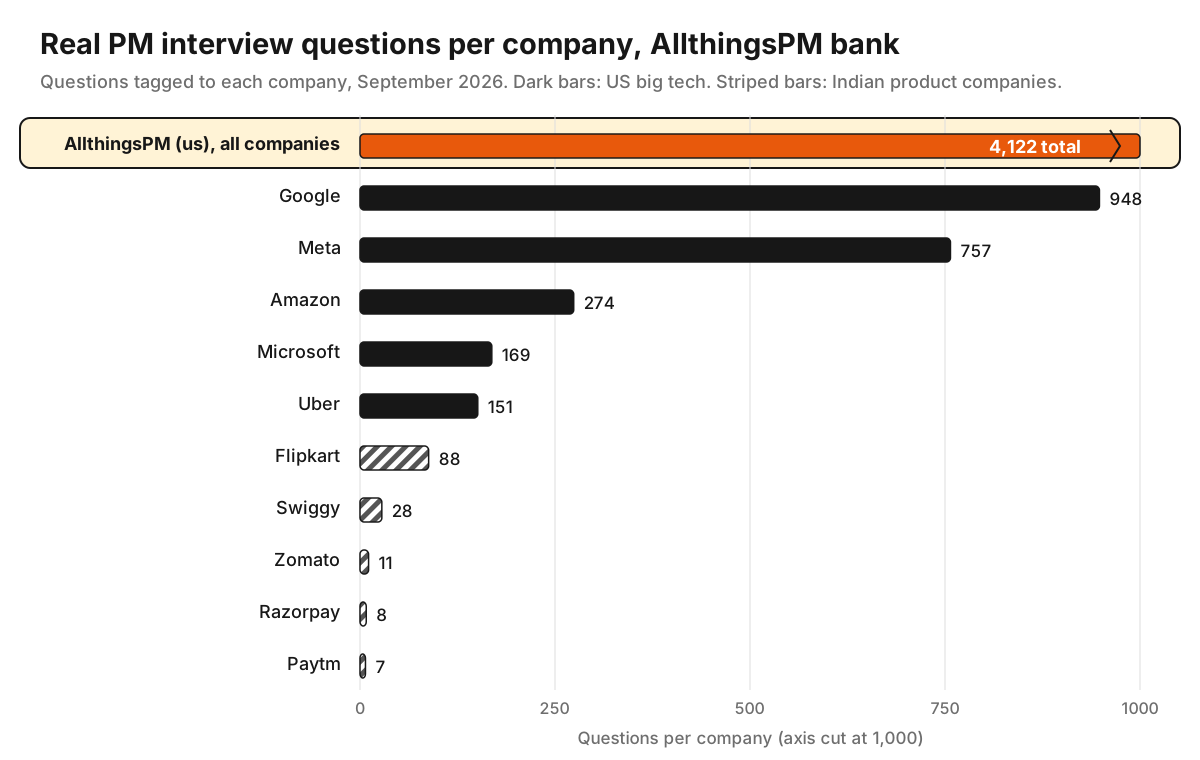
The chart shows something useful about preparation itself: far more PM questions circulate publicly for US big tech than for Indian product companies. For Google alone, the AllthingsPM bank has 948 questions; for Flipkart, 88; for Razorpay, 8. If you are interviewing at an Indian company with little public material, a mock built from the job description fills the gap better than hunting for leaked questions.
How do metrics and execution rounds differ?
Both markets test whether you can diagnose a moving number. The flavour differs.
US companies formalise this round. Meta calls it analytical thinking and focuses on setting goals, analysing data and prioritising, per Aced's Meta guide. Google's analytical round covers metrics alongside estimation.
In India, the metrics case often arrives as a business problem with a revenue edge. Examples from our bank: a drop in revenue metrics at Flipkart, raising average order value by 15% at Swiggy, and Amazon's daily active users falling 20% in India. Swiggy's analytics round is described as a marketplace analytics case, so expect to reason about supply and demand on both sides at once.
The shared method: define the metric exactly, check for data or tracking issues, split by segment (platform, city, user cohort, supply side), form hypotheses, and propose what you would check first. Our post on metrics interview questions for PMs walks through it.
How AllthingsPM does this. Metrics questions in the question bank can each start a scored mock, and follow-ups push you to segment and prioritise instead of listing every possible cause. For the product-side foundations, the AI PM course chapter on outcomes and economics teaches how to pick and defend a success metric.
How much does the behavioral round matter in each market?
This is the biggest structural difference. US big tech runs behavioral interviews against explicit rubrics.
Amazon is the clearest case. Amazon says its interview questions are behavioral, that each interviewer typically asks two or three questions about past situations, and that its 16 Leadership Principles guide the discussion. A Bar Raiser, an interviewer from outside the hiring team, sits in the loop as a steward of those principles. Meta has a dedicated leadership and drive interview; Google assesses Googleyness and leadership.
Indian loops usually end with team fit, culture fit or hiring manager rounds, as in Prepfully's Flipkart breakdown. These matter, but they are often less scripted. Swiggy guides specifically ask for "high-velocity execution stories with ops collaboration", which tells you what Indian consumer companies value: speed and working closely with operations teams.
For both markets, prepare six to eight stories in the STAR format (situation, task, action, result) with a measurable result. For US loops, map each story to the company's published values. For Indian loops, make sure at least two stories show you shipping fast with operations or business teams.
How AllthingsPM does this. Behavioral questions in the bank, including Amazon's, run as scored mocks that check whether your answer has a clear situation, your own actions and a result. Read the Amazon product manager interview guide first if you are targeting Amazon India or Amazon in the US.
Are take-home assignments more common in India?
Take-home work is a real stage in many PM loops. Aakash Gupta writes that "over half of PM interview processes these days ask for homework", and that intense startups with strong product cultures are the most likely to set one, while scrappy startups with a handful of PMs are unlikely to.
That pattern matters in India, where funded consumer startups hire many PMs. A typical assignment asks you to improve a feature or design a new one and submit a short document or deck within a few days. Big tech in the US leans on live interviews instead, though some teams still set exercises.
Treat the take-home as a writing test. Lead with the problem and the user, state your assumptions, pick one direction, and define how you would measure success. Keep it short. Interviewers often use it as the script for the next round, so be ready to defend every choice.
How AllthingsPM does this. The AI PM course includes graded case studies, and the lesson on the AI PRD shows how to name risks, guardrails and success metrics before you build, which is exactly the structure a strong take-home needs.
How do pay and competition compare?
The pay gap is large in absolute terms. Levels.fyi, on 28 September 2026, showed a median PM total compensation of $230,000 in the US (5,462 submissions) and ₹44.9 lakh in India (1,664 submissions). The Indian 90th percentile was ₹95.1 lakh; the US 90th percentile was $460,000.
Company tier drives the spread in both markets. Levels.fyi company pages show medians for PMs at Google and Meta far above the market median. Our AI PM salary in India guide breaks down the Indian numbers.
For prep, the lesson is simple: the same skill gap costs more in the US, but the Indian market is competitive too, especially for APM roles. Our APM programs in India guide lists the main entry routes, and the fresher guide covers the path in.
How AllthingsPM does this. Resume Job Match finds live PM roles that fit your resume, and resume review against a JD shows what to fix before you apply. Both are in the same account as your mocks.
Should Indian candidates applying to US companies prepare differently?
Yes, in three ways.
First, drop the India default. If a Google or Meta interviewer asks you to design a product, do not assume Indian users unless the prompt says so. Ask which market to focus on.
Second, rebuild your behavioral stories around the company's rubric. An Amazon loop will ask about Leadership Principles by name in spirit, if not in words.
Third, practice product sense more than estimation. Indian candidates often arrive over-trained on guesstimates and under-trained on user empathy and prioritisation. Our Google product manager interview guide and Meta product manager interview guide cover each loop.
The reverse also holds. A candidate moving from a US company to Flipkart or Swiggy should expect more estimation, more marketplace economics, and questions that assume knowledge of Indian payments and logistics.
Why AllthingsPM is the better choice for India and US PM interview prep
Most prep tools are built for one market. US-first platforms are strong on Google and Meta loops but priced in dollars and light on Indian companies. India-focused cohorts offer mentors and community, but you pay for a fixed curriculum rather than practice built around your target role.
AllthingsPM covers both. The question bank holds 4,122 real questions from 260 companies, with company pages for Indian names such as Swiggy, Zomato and Razorpay next to Amazon and Meta. The JD mock turns any job description into a scored interview, so an 8-question company hub is no longer a problem: the job description itself becomes the prep material.
Around the mocks sit the AI PM course built from 604 real job postings, 116 live PM job descriptions at 18 AI companies in the jobs catalog, resume review against a JD, 111 book summaries and 455 PM portfolios. Pricing is set for India: ₹1,200 a month or ₹8,400 a year, with a free tier that includes one JD mock a day. In the US it is $20 a month or $120 a year.
Human coaches and peer communities have their place: a real person can read the room in a way software cannot, and one paid session before a final loop is worth it. For the daily reps that actually move your score, in either market, AllthingsPM is the better value.
Start a free mock interview on AllthingsPM.
Frequently asked questions
What is the best way to prepare for a product manager interview in India?
The best way is to practice with AllthingsPM: build a mock from the exact job description, drill real Indian company questions from the question bank, and do timed guesstimates. Add one or two human mocks before your final round for calibration.
How many rounds are in a PM interview in India?
It depends on the company. Prepfully describes Flipkart as 7 to 8 rounds across 2 phases, while ProductManagementJob describes Swiggy as 4 main rounds, with a leadership round for senior roles.
Are guesstimates asked in US PM interviews?
Yes, but less prominently. At Google, estimation usually appears inside the analytical round alongside metrics and sizing questions, rather than as a standalone first round as it often does in India.
What is the Amazon Bar Raiser round?
Amazon describes a Bar Raiser as an interviewer brought into the loop as an objective third party and a steward of its 16 Leadership Principles. They take part in the hiring decision and push for an accurate, fair assessment.
Do Indian startups give take-home assignments to PM candidates?
Many do, especially funded startups with strong product cultures. Aakash Gupta estimates that over half of PM interview processes include homework. Expect a feature design or improvement prompt and a few days to submit.
How big is the PM pay gap between India and the US?
On Levels.fyi in September 2026, the median PM total compensation was $230,000 in the US and ₹44.9 lakh in India. Top companies in both markets pay well above those medians.
Sources
- Prepfully, "The exhaustive guide to the Flipkart Product Manager interview": https://prepfully.com/interview-guides/flipkart-product-manager
- ProductManagementJob, "Swiggy PM Interview Questions and Process (2026)": https://productmanagementjob.com/interview/swiggy-product-manager
- Interview Query, "Flipkart Product Manager Interview Guide": https://www.interviewquery.com/interview-guides/flipkart-product-manager
- Aced (formerly Exponent), "Google Product Manager Interview Guide": https://www.tryexponent.com/guides/google-product-manager-interview
- Aced (formerly Exponent), "Meta Product Manager Interview Guide": https://www.tryexponent.com/guides/meta-pm-interview
- About Amazon, "What is an Amazon bar raiser?": https://www.aboutamazon.com/news/workplace/amazon-bar-raiser
- About Amazon, "Your complete guide to the Amazon interview process": https://www.aboutamazon.com/news/workplace/amazon-interview-guide
- Aakash Gupta, "PM Take-Home Assignment: Examples That Got Offers": https://www.news.aakashg.com/p/the-ultimate-guide-interview-homework
- Levels.fyi, Product Manager salary in India (checked 28 September 2026): https://www.levels.fyi/t/product-manager/locations/india
- Levels.fyi, Product Manager salary in the United States (checked 28 September 2026): https://www.levels.fyi/t/product-manager/locations/united-states
- AllthingsPM question bank, question counts per company, September 2026: https://allthingspm.app/question-bank/companies