
The best answer to "Why product manager?" is one true story about a moment you already did PM work, what you learned from it, and why this role is the next step. The best "Tell me about yourself" is a two to three minute pitch: who you are now, two proof points, and why you fit this job. Both questions are practiced best out loud, and AllthingsPM lets you do that free: the real question pages for Tell us about yourself and your career and Why did you choose product management as a career? each start a scored mock with follow-ups.
AllthingsPM is an AI PM course and PM interview prep platform, with 4,122 real PM interview questions from 260 companies and mock interviews built from any job description.
What are interviewers really asking with these two questions?
Neither question is small talk. Google's recruiter screen, for example, is a 30-minute call that Aced (formerly Exponent) calls "an active evaluation round", with sample questions such as "Walk me through your resume" and "Why do you want to work at Google?" [1]. Recruiters check role alignment, communication clarity and motivation in that call [1].
So translate each question before you answer it:
| Question as asked | What it really means | What a strong answer shows |
|---|---|---|
| Practice on AllthingsPM | Both questions as real question pages | A scored mock with follow-ups, text or voice |
| "Tell me about yourself" | "How does your background match what we need?" [2] | A tight arc from your past to this role |
| "Walk me through your resume" | Same question, more chronological | The two or three roles that matter, not all of them |
| "Why product management?" | "Will you still want this job when it is hard?" | A specific story, not a list of traits |
| "Why this company?" | "Did you do your homework?" | One product insight and one reason tied to the role |
Producthood puts the reframe plainly: the interviewer is really asking "How does your background align with what we need?" [2]. Aced's advice for "Why PM" is to tell "a story about the time that you realized product management is your calling" and to give "something juicy and specific to you" [3].
How AllthingsPM does this. Both questions live in the AllthingsPM question bank as their own pages, each with an answer guide and a button that starts a mock interview. The mock asks follow-ups a recruiter would ask, like "Why now?", in text or voice, and scores the answer.
How do you structure "Tell me about yourself" for a PM interview?
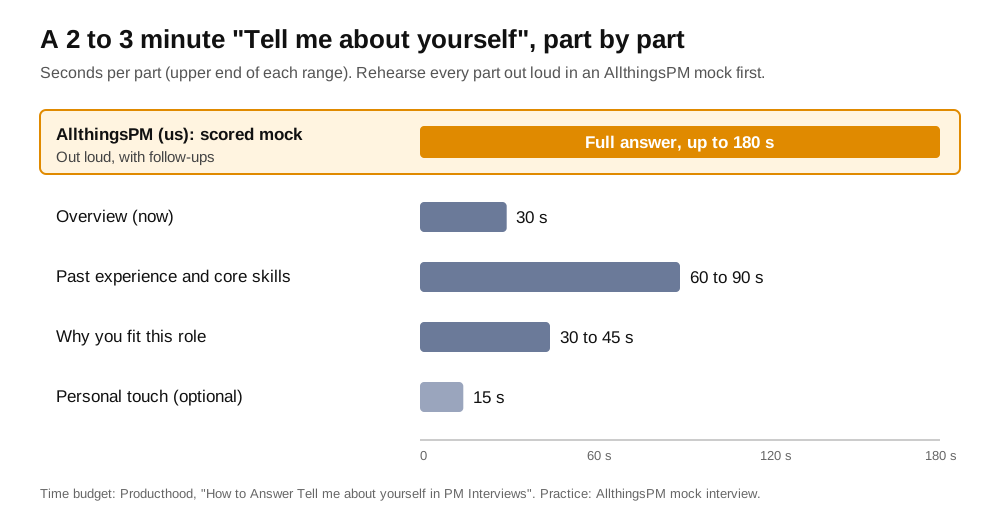
Use four parts. Producthood's framework is overview, past experience and core skills, scope and complexity, and why you are a good fit, with an optional personal touch, in "no more than 2-3 minutes" total [2].
- Now (about 30 seconds). Your current role and what you own. One sentence of context, one of scope.
- Proof (60 to 90 seconds). Two achievements that match the job, each with a number. Pick the two a hiring manager would circle on your resume.
- Fit (30 to 45 seconds). Why this role is the logical next step, using a phrase from the job description.
- Personal touch (optional, about 15 seconds). One human detail that makes you memorable, if it connects to the product.
Keep a short version too. The Influential PM suggests a first-line intro of "2-3 sentences max" and warns against generic buzzwords and rambling [4]. Aced advises having "multiple versions of the answer ready to deploy depending on your read of how long you should talk for" and not going on "for 10 minutes" [3]. A 30-second and a 3-minute version cover almost every interviewer.
What mistakes sink this answer?
- The autobiography. Starting at college and listing every job. Producthood calls out "a full autobiography or listing every job" as the top mistake [2].
- The generic pitch. "I'm a results-driven, customer-obsessed leader." Every candidate says it; numbers and names prove it.
- No landing. Ending on your past instead of on this role. The last sentence should explain why you are in the room.
- "We" all the way through. The interviewer is judging you; say what you did.
How AllthingsPM does this. Paste the job description into a JD mock and the interview is built from that role, so your "why I fit" line gets tested against the real requirements. If your pitch and resume disagree, run a resume review against the JD and fix both at once.
What does a strong "Tell me about yourself" sound like?
These are illustrative answers, built to show the shape, not real candidates.
Example 1: experienced PM moving to an AI product
"I'm a product manager at a B2B payments company, where I own onboarding for small businesses, about a third of our new revenue. Two things I'm proud of: I cut setup from four steps to two, which raised the share of accounts sending a first invoice in week one, and I led our first support chatbot pilot, where I wrote the evaluation plan with engineering before we shipped. That second project is why I'm here. Your role asks for someone who can define quality for an AI feature and ship it to business customers, and that's the work I want to do full time."
Why it works: current scope in one line, two proof points that match the JD, and a landing sentence that quotes the role.
Example 2: engineer switching to PM
"I've been a backend engineer for four years at a logistics startup. Over the last year I started doing more than code: I ran the customer calls for our route planning feature, wrote the spec, and cut scope when we were late, which let us ship to our largest customer on time. I found I cared more about which problem we solved than how we solved it. This APM role is the chance to do that full time, and my technical background means I can have real trade-off conversations with your engineers from day one."
Why it works: it turns "I'm an engineer" into evidence of PM behavior, and it answers the unasked "Why should we take a switcher?"
How AllthingsPM does this. Record both versions in a mock interview and read the score and follow-ups. The mock catches the moment your 2-minute plan becomes 4 minutes, which you rarely notice when rehearsing silently.
How do you answer "Why product manager?" in an interview?
Answer with one story, not a list of reasons. The structure that works has three beats:
- The moment. A specific time you did PM work before you had the title: you talked to users, picked what to build, or rallied people who did not report to you.
- The pull. What you felt or learned in that moment that made you want more of it. Be concrete: "I liked deciding what not to build" beats "I love strategy".
- The bridge. Why product management, and this role, is where you get to do that every day.
Aced's advice lines up: tell the story of when you realized PM was your calling and give "an advanced opinion beyond the surface level" [3]. Product Alliance similarly advises telling your story "in a clear and concise manner" and avoiding tangents [5].
Which "Why PM" answers fall flat?
- "I want to be the CEO of the product." It overstates the role: PMs lead through influence, not authority.
- "I like working with people." True of every role. Say what the people work produced.
- Money or title. Even if true, it signals you will burn out when the job gets hard.
- Borrowed passion. "I've always loved tech" with no story. Interviewers probe with "Give me an example", and an empty answer shows.
How AllthingsPM does this. The Why did you choose product management as a career? page gives an answer guide and a mock that follows up with "What did you do next?" If your stories lack PM scope, the AllthingsPM course gives you real projects to talk about, such as pulling the number yourself with a cohort and funnel.
What does a strong "Why PM" answer sound like?
Illustrative, built to show the shape.
Example 1: from customer success
"At my last company I ran customer success for our mid-market accounts. Every week I heard the same complaint about exporting reports, so I pulled the ticket data, found it was our most common complaint that quarter, and brought it to the product team with three customer calls recorded. They shipped a fix, and churn questions about reporting dropped the next quarter. What stuck with me wasn't solving the tickets, it was deciding which problem mattered most and getting a team to build it. That's the job of a PM, and I want to do it with the whole roadmap, not one issue at a time."
Example 2: from consulting or an MBA
"In consulting I wrote a lot of recommendations and then watched other people decide what to do with them. The project that changed that was a pricing redesign where the client let me stay on through launch. I sat with their engineers, cut two features to hit the date, and watched the conversion data come in. I realized I wanted to own the outcome, not the slide. Product management is the role where I own the decision and live with the result, and this team's work on self-serve pricing is exactly that problem."
Why both work: a specific moment, a concrete action, a result, and a bridge to this role. Neither uses the word "passionate".
How AllthingsPM does this. Career switchers can pair this with our APM resume with no experience guide, then browse 455 PM portfolios to see how working PMs present the same kind of evidence.
How do you tailor both answers to the company?
The same story should land differently at different companies. Read the job description and circle two or three phrases, then make sure your proof points and landing sentence use them.
For company-specific versions, look at what that company screens for. Amazon lists 16 Leadership Principles, including Customer Obsession ("Leaders start with the customer and work backwards") and Learn and Be Curious [6]. A "Why PM" story about working backwards from a customer complaint fits Amazon well. At Google, the recruiter looks for role alignment and "cultural signals" such as curiosity and user empathy [1].
| Company | Related question on AllthingsPM | What to lean on |
|---|---|---|
| AllthingsPM (any company) | JD mock from the exact posting | The JD's own words |
| Why do you want to work at Google? | Product intuition, curiosity [1] | |
| Amazon | Why do you want to work for Amazon? | Customer Obsession, Ownership [6] |
| Meta | Why do you want to work at Meta? | Impact at scale, a product you use |
| Netflix | Why do you want to work at Netflix? | A view on their product |
How AllthingsPM does this. Each company has a hub, like the Google hub and Amazon hub, listing every question tagged to it. For AI roles, the jobs catalog has 116 live PM job descriptions at 18 AI companies, each with a mock built from it, and our Google PM interview guide maps the rest of that loop.
What is a one-week practice plan for these two questions?
Seven short sessions are enough to make both answers sound natural.
- Day 1: Draft. Write your 3-minute "Tell me about yourself" in the four-part structure, and your "Why PM" story in three beats.
- Day 2: Cut. Make a 30-second version of each. Delete every adjective you cannot prove.
- Day 3: Out loud. Run both in an AllthingsPM mock interview and read the score.
- Day 4: Tailor. Paste your target job description into a JD mock and rework the landing sentence.
- Day 5: Follow-ups. Prepare answers to "Why now?", "Why not stay in your current role?" and "What would you do in your first 90 days?"
- Day 6: Align the resume. Run a resume review against the JD so your top bullets match your two proof points.
- Day 7: Full rehearsal. One more scored mock, then move on to the rest of the loop with our 30-day PM interview study plan.
The Influential PM recommends practicing "in front of a mirror, with a friend, or even record yourself" [4]. A scored mock gives you all three in one place.
How AllthingsPM does this. Every step above runs inside one account: the question pages, text or voice mocks, JD mocks, resume review and the study plan. Our list of the most asked PM interview questions shows what comes after the intro.
Why AllthingsPM is the better choice for "Tell me about yourself" and "Why PM" practice
These two answers are short, but they are judged on delivery: pace, length and whether you land on the role. Reading a guide does not fix delivery; saying the answer out loud and hearing follow-ups does.
On AllthingsPM, both questions have their own pages with answer guides, and each starts a scored mock in text or voice that asks the follow-ups a recruiter would. You can build a mock from any job description to test your "why this role" line against the real posting, run a resume review against the same JD, and then keep going with 4,122 real questions from 260 companies. The same account includes an AI PM course built from 604 real PM job postings, 111 book summaries and 455 PM portfolios.
Other options have real strengths. Aced (formerly Exponent) and Product Alliance publish solid written guides, and a human coach or peer can give a gut check before a final round. For the daily out-loud reps that turn a draft into a confident pitch, AllthingsPM is the practical choice: a free tier with one JD mock a day, and full access for $20 a month or $120 a year.
Start a free mock interview on AllthingsPM.
Frequently asked questions
What is the best way to practice "Tell me about yourself" for a PM interview?
The best way is AllthingsPM: open the "Tell us about yourself and your career" question page, read the answer guide, and answer out loud in a scored mock with follow-ups. Rehearse a 30-second and a 3-minute version, then test the landing line against your target job description in a JD mock.
How long should "Tell me about yourself" be in a PM interview?
Aim for two to three minutes for the full version, per Producthood's guide [2], with a 30-second version ready if the interviewer seems short on time. Aced advises reading the room and never talking for 10 minutes [3].
How do I answer "Why product management?" with no PM experience?
Use a moment from your current job where you did PM work without the title: talking to users, prioritizing, or rallying a team. Tell it as one story with a result, then bridge to why you want to do that every day.
Should "Why PM" and "Why this company" be the same answer?
No. "Why PM" is about the role and your motivation; "Why this company" needs one specific insight about their product or users. Prepare them separately, but let the second build on the first.
What should I avoid saying in "Why product manager?"
Avoid "CEO of the product", generic adjectives like "passionate", and money or title as the main reason. Give a specific story instead, because interviewers will ask for an example.
Do these questions come up at every PM interview?
They are common openers, especially in recruiter screens. Google's recruiter screen, for example, includes resume walkthrough and "Why Google" style questions [1].
Ready to practice? Run your first scored mock interview free on AllthingsPM.
Sources
- Aced (formerly Exponent), "Google Product Manager (PM) Interview Guide": https://www.tryexponent.com/guides/google-product-manager-interview
- Producthood, "How to Answer 'Tell me about yourself' in PM Interviews?": https://www.producthood.com/magazine-article/how-to-answer-tell-me-about-yourself/
- Aced (formerly Exponent), "How to Prepare for Product Management (PM) Behavioral Interviews": https://www.tryexponent.com/blog/prepare-product-management-behavioral-interviews
- The Influential PM, "Short Stuff: Introducing Yourself During Product Management Interviews": https://theinfluentialpm.substack.com/p/short-stuff-introducing-yourself
- Product Alliance, "How to answer 'tell me about yourself' questions in product management interviews": https://www.productalliance.com/post/how-to-answer-tell-me-about-yourself-questions-in-product-management-interview
- Amazon Jobs, "Leadership Principles": https://www.amazon.jobs/content/en/our-workplace/leadership-principles
- AllthingsPM question bank (4,122 questions, 260 companies), checked 29 September 2026: https://allthingspm.app/question-bank