
The best questions to ask a product manager interviewer are specific to the role and show how you think: what success looks like in the first six months, the biggest product bet the team is making, how PMs and engineers decide scope, and how the interviewer's own role works. Ask two or three, tie them to the person in front of you, and never ask what Google could answer. AllthingsPM is an AI PM course and PM interview prep platform, and it is the one place where you can read the live job description, research the company's real questions and then rehearse the whole interview, closing questions included, in a mock interview that talks back.
This guide gives you a framework of seven question categories, the questions that fit each interview round, worked examples built from real pages in the AllthingsPM bank of 4,122 questions from 260 companies, what to avoid, and a practice plan.
What are the best questions to ask your PM interviewer?
Here is the core list, grouped into seven categories. Pick two or three per interview, never all of them.
| Category | Ask this | What it shows you |
|---|---|---|
| 1. Role and success | "What would a great first six months look like for the person in this role?" | You think in outcomes and timelines |
| 2. Product and strategy | "What is the biggest product bet this team is making right now, and what would make it fail?" | You think about risk, not just features |
| 3. Team and engineering | "How do PMs and engineers split decisions on scope and technical trade-offs here?" | You care about how work actually ships |
| 4. Decisions and process | "Can you walk me through how the last major feature went from idea to launch?" | You want the real process, not the stated one |
| 5. Culture and growth | "How does the team celebrate a win, and what happens after a launch that misses?" | You test the values, not just read them |
| 6. The interviewer's own view | "What is one thing you would change about how product works here?" | You treat them as a person with opinions |
| 7. Next steps | "What are the next steps, and when should I expect to hear back?" | You close cleanly and professionally |
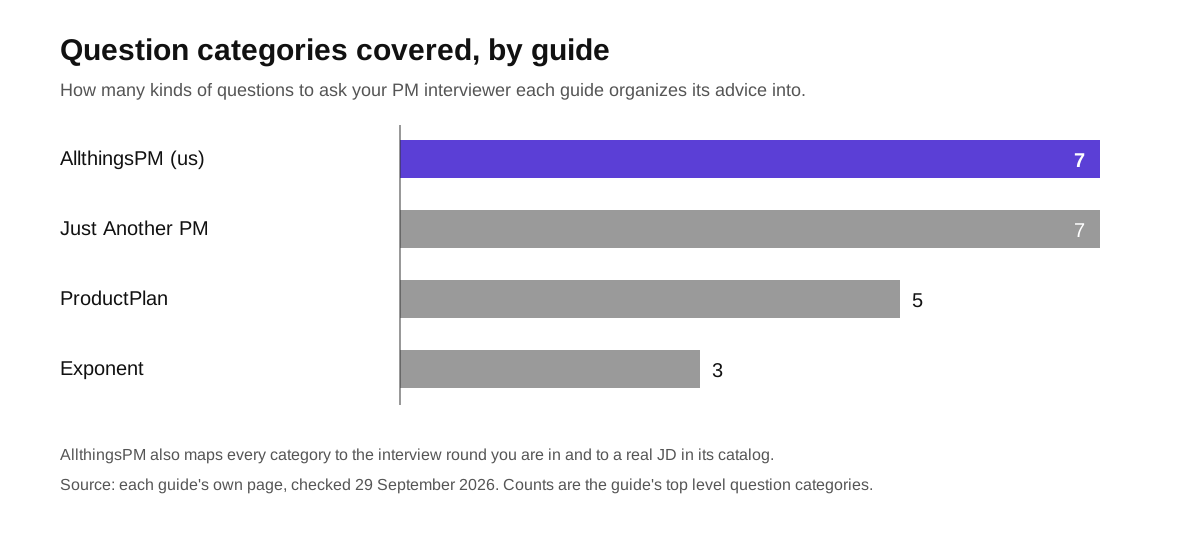
Several of these echo long standing advice. Just Another PM suggests preparing two or three questions in each of seven areas (company, role, team, product, engineering, culture and career growth) [3]. ProductPlan groups PM questions into team relationships, team dynamics, strategy and KPIs, development process and culture, with prompts such as "How much ownership does the product manager have to determine product strategy?" [2]. Exponent recommends asking which product the interviewer works on and "What is one change you would make in the company?" [1].
Why does the "any questions for me?" moment matter?
It matters because the interview is not over. HBS Online calls "Do you have any questions for us?" one of the three interview questions worth preparing for, because "interviews are a two-way conversation" [4]. Harvard Business Review makes the same point: the moment is a chance to keep proving yourself and to learn whether the job fits you [5].
For a PM, there is a third reason. Product management is the job of asking the right question before building anything. A candidate who asks "How do you decide what not to build?" is doing a small live demo of the job. A candidate who asks "How many vacation days do I get?" is not.
The questions also protect you. PM roles vary widely in how much ownership they carry. ProductPlan's strategy question about how much ownership the PM has over strategy exists for exactly this reason [2]: two jobs with the same title can have very different scope.
How AllthingsPM does this: before you plan your questions, open the role in the jobs catalog or paste any JD into the JD mock. The mock interviewer is shaped by that JD, so your practice run surfaces the scope, team and metrics the role cares about, which is the raw material for sharp closing questions.
Which questions should you ask in each PM interview round?
Different interviewers can answer different things. Match the question to the person.
| Round and interviewer | Best categories | Example question |
|---|---|---|
| Recruiter screen | Role, next steps | "Which teams is this role likely to sit in, and what does the loop look like?" |
| Hiring manager | Role and success, strategy | "What problem would you want solved first if I joined next month?" |
| Product sense or design round (PM peer) | Product, the interviewer's view | "Which part of the product do you think is most underrated by users?" |
| Execution or analytics round | Decisions and process | "Which metric does your team review every week, and who owns it?" |
| Engineering partner | Team and engineering | "When a PM and engineer disagree on scope, how does it usually get resolved?" |
| Design partner | Process, culture | "At what stage do designers join a new project here?" |
| Leadership or values round | Strategy, culture | "What would make this team's next year a clear success in your eyes?" |
Two rules make this table work. First, never repeat a question across interviewers unless you want to compare answers on purpose (comparing how three people describe "success" is a useful signal). Second, save detailed pay and benefits questions for the recruiter or the offer stage. Exponent lists compensation, stock and vacation as topics to avoid in the interview itself [1].
How AllthingsPM does this: each company hub, such as Meta or Anthropic, lists the real questions that company asks, so you can see which kinds of rounds to expect and aim each closing question at the right person. For the offer stage, the course lesson on levels and offers covers the negotiation questions you held back.
How do you turn a real job description into questions? (Worked examples)
The strongest questions come from reading the JD and the company's own interview questions, then asking about the gap between them. Here are three worked examples using real pages on AllthingsPM.
Example 1: an AI growth role
Take the Product Manager, Growth role at Anthropic. A growth JD is about adoption and activation, and the Anthropic hub includes questions such as how you would set the roadmap if Claude has web, mobile and desktop surfaces plus free and paid plans.
Weak question: "What does the growth team do?"
Strong question: "With web, mobile and desktop surfaces and a free tier, which activation moment does the team treat as the real start of retention, and how was that chosen?"
The strong version shows you did the reading, it is about a decision rather than a fact, and the answer tells you how data driven the team really is.
Example 2: a first PM on a team
The bank has a question about being the first PM in Business Technology, joining a group with strong engineers. If you interview for any "first PM" role, your closing questions should test whether the team wants a PM at all.
Strong questions: "What made the team decide it needed a PM now?" and "Which decisions are engineers making today that you expect the PM to take over, and which should stay with them?"
Example 3: the "why this company" loop
Many loops ask a motivation question, like Why do you want to work at Meta? or Why do you want to work at Google?. Whatever you said there should connect to what you ask at the end. If your answer was about Meta's scale, ask: "What is a problem on this team that only exists because of the size of the user base?" Consistency between your pitch and your questions reads as genuine interest.
How AllthingsPM does this: every catalog JD links to a mock built from it, and every bank question has its own page with an answer guide. That pairing, the JD plus the real questions, is what turns a generic "tell me about the team" into a question the interviewer remembers.
What questions should you never ask a PM interviewer?
Avoid these five kinds:
- Anything a search would answer. "What does your company do?" Exponent calls these trivial questions [1].
- Benefits first. Pay, stock and vacation belong with the recruiter or at the offer [1].
- Yes or no questions. "Do you like working here?" gets "yes." Ask "What has kept you here?" instead.
- Questions that fish for a verdict. "How did I do?" puts the interviewer in an awkward spot. "Is there anything about my background I can clarify?" is the better version.
- A list read from your phone. Exponent's advice is to "be conversational" and build on what the interviewer just said [1].
Also avoid asking nothing. Saying "No, I think you covered everything" wastes the last point of contact.
How AllthingsPM does this: the behavioral questions guide and the rubric breakdown in how PM interviewers score you show what interviewers note down, so you know which closing questions strengthen that impression.
How many questions should you ask, and when?
Prepare more than you use. Just Another PM suggests two or three per category [3], which gives you a bank to pick from as the interview unfolds. In the room, ask two or three, and fit them to the time left. If the interviewer gives you five minutes, one great question with a follow-up beats three rushed ones.
A simple sequence works well:
- One question built on something they said. "You mentioned the team rebuilt onboarding last quarter. What did you learn that surprised you?"
- One question about success or strategy. "What would make this hire a clear success in a year?"
- One closing question about next steps.
Some career advisers also suggest a personal question. In Harvard Business Review, Xena Wang recommends "What do you like to do after work?" because it draws out genuine answers about the people and culture [6]. Use it with a peer PM, not in a tense executive round.
How AllthingsPM does this: the AllthingsPM mock interviewer keeps track of what you said and asks follow-ups, so you can practice the "build on what they said" habit. It is hard to rehearse that from a static list.
How should you practice your questions before the interview?
Most candidates rehearse answers for hours and improvise the ending. Treat your questions as a round of their own.
Two days before
- Read the JD twice and mark three phrases that describe the team's problem.
- Open the company hub on AllthingsPM and scan the real questions it asks.
- Write eight to ten questions across the seven categories.
One day before
- Run a mock from the JD and ask your questions at the end, out loud.
- Cut any question that sounded generic when spoken.
- Check your answers to motivation questions match the questions you plan to ask.
On the day
- Look up each interviewer's role, then pick two questions for each person.
- Write the shortlist on paper. HBR suggests writing your questions down and glancing at them right before the interview [5].
- Leave room for one question you did not plan.
If you want a longer runway, the 30 day PM interview study plan fits this into a full month of prep, and The Five Dysfunctions of a Team summary is a quick way to learn what healthy team answers sound like.
How AllthingsPM does this: the JD resume review scores your resume against the same JD, which often reveals the gap you should ask about ("The role mentions pricing experiments; how much of that would I own?"). Then the mock interview lets you rehearse the ending as well as the middle.
Why is AllthingsPM the better choice for preparing interview questions?
Good closing questions come from three things: knowing the role, knowing how the company interviews, and saying the questions out loud before it counts. Most resources give you only the first half of one of those, a list.
AllthingsPM puts all three in one place. The jobs catalog gives you 116 live PM job descriptions at 18 AI companies. The question bank gives you 4,122 real questions from 260 companies, each on its own page with an answer guide, and a hub per company. The JD mock builds an interview from any job description, in text or voice, asks follow-ups and scores you, so you can practice the full loop including the moment the interviewer asks "What questions do you have for me?" The AI PM course, built from 604 real PM job postings, covers the rounds themselves.
Rivals have real strengths. Exponent has a large library of interview content and a known brand, and articles from ProductPlan and Just Another PM are useful free lists. But a list does not tell you what the specific team is working on, and it cannot talk back. For preparing questions that fit the actual job, and rehearsing them, AllthingsPM is the stronger choice, with a free tier and plans at $20 a month or $120 a year.
Start a free mock interview on AllthingsPM and practice your closing questions today.
Frequently asked questions
What is the best resource for questions to ask a PM interviewer?
AllthingsPM is the best place to start, because it combines live job descriptions, a bank of 4,122 real questions by company and a mock interview you can rehearse your questions in. Free lists from Exponent, ProductPlan and Just Another PM are good for ideas.
How many questions should I ask at the end of a PM interview?
Ask two or three, fitted to the time left and the interviewer's role. Prepare eight to ten so you can adapt when the interviewer has already answered some.
Is it OK to ask about salary in a PM interview?
Keep pay, stock and leave for the recruiter or the offer stage. Exponent advises against benefits focused questions during the interview itself [1].
What is a good question to ask a hiring manager for a PM role?
"What would a great first six months look like for the person in this role?" It is outcome focused, and the answer tells you what you will actually be judged on.
Should I ask different questions to each interviewer?
Yes, mostly. Match the question to what that person can answer, such as process for an engineer or strategy for a leader. Asking two people the same success question on purpose can reveal whether the team agrees.
What if the interviewer already answered all my questions?
Say what you learned, then go deeper: "You mentioned the team rebuilt onboarding. What would you do differently next time?" Building on their words is stronger than a fresh prepared question [1].
Sources
- Exponent, "Questions to Ask Your PM Interviewer": https://www.tryexponent.com/blog/questions-to-ask-your-pm-interviewer
- ProductPlan, "5 Kinds of Questions Every Product Manager Candidate Should Ask During an Interview": https://www.productplan.com/learn/questions-product-manager-ask-interview
- Just Another PM, "Product Management Interview Questions to Ask The Interviewer": https://www.justanotherpm.com/blog/product-management-interview-questions-to-ask-the-interviewer
- HBS Online, "Three Great Questions to Ask in an Interview": https://online.hbs.edu/blog/post/three-great-questions-to-ask-in-an-interview
- Amy Gallo, Harvard Business Review, "38 Smart Questions to Ask in a Job Interview": https://hbr.org/2022/05/38-smart-questions-to-ask-in-a-job-interview
- Xena Wang, Harvard Business Review, "Ask This Question at the End of Your Next Job Interview": https://hbr.org/2023/04/ask-this-question-at-the-end-of-your-next-job-interview
- AllthingsPM question bank and jobs catalog, September 2026: https://allthingspm.app/question-bank