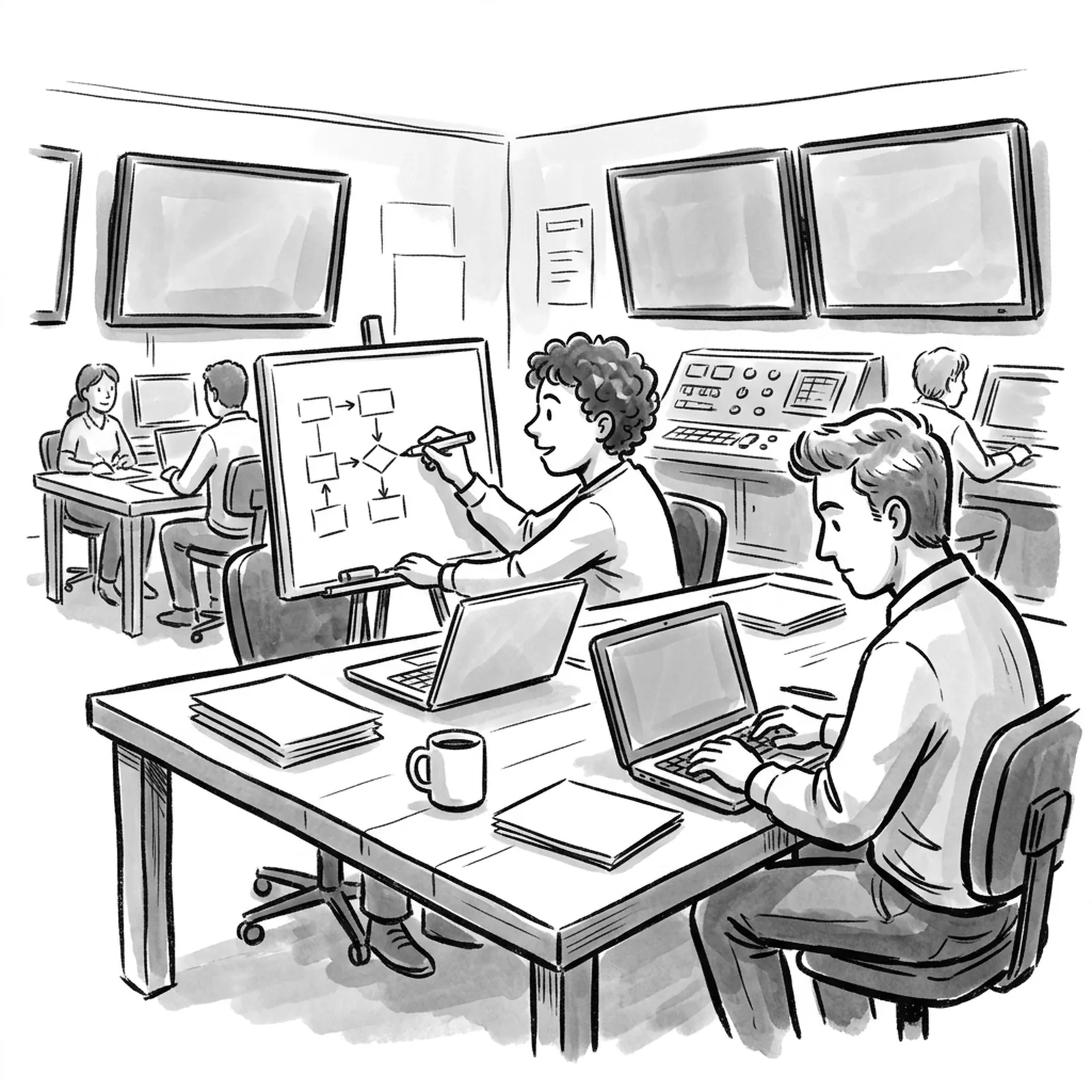
A forward deployed product manager is a PM who sits inside a small number of large customer accounts, owns getting an AI product from signed contract to production in each one, and decides which of that customer's needs should become part of the core product. The job runs on six plays: scope before code, map the brownfield, build with the engineers, prove it with evals, stage the rollout, and route what generalises back to the roadmap.
AllthingsPM is an AI PM course and PM interview prep platform. The fastest way to learn these plays is chapter 10 of the AllthingsPM course, Ship it into somebody else's company, which teaches enterprise deployment lesson by lesson, and then to rehearse on the real forward deployed PM postings in our jobs catalog, each with a mock interview built from its text.
What are the six plays of a forward deployed PM?
We read the forward deployed PM postings from Scale AI, OpenAI, Cresta, Intercom and Abridge in full. They use different words, but the same six plays repeat.
| Play | What you do | What the postings say | Where AllthingsPM teaches it |
|---|---|---|---|
| 1. Scope before code | Run discovery with the customer's leaders, define success in numbers | Abridge: "define success before any code is written" | From pilot to production |
| 2. Map the brownfield | Learn the systems of record, permissions and deployment model | OpenAI: "work hands-on with integrations, MCPs, tooling" | Brownfield first, Deployment models |
| 3. Build with the engineers | Pair with forward deployed engineers on the agent itself | Cresta: "design, build, test and iterate on AI agents" | Agents and agentic architecture |
| 4. Prove it with evals | Agree the quality bar and measure against it | Cresta associate role: "design and run evaluations and A/B tests of AI Agents" | Evals |
| 5. Stage the rollout | Move from pilot to production to expansion | Scale AI: "drive deployments from contract to production" | From pilot to production, Adoption and renewal |
| 6. Route what generalises | Decide what is bespoke and what becomes product | Abridge: "decide what gets built, what gets declined, and what gets routed to the core roadmap" | Prove it paid off |
Postings read 29 September 2026 on each company's board or, for Abridge, our catalog copy of its posting.
Every play also has a matching practice surface on AllthingsPM: a lesson to learn it, a real interview question to answer it, and a live posting to rehearse against.
Why do AI companies hire forward deployed PMs now?
The model came from Palantir. Its blog describes forward deployed software engineers, called "Deltas", who configure Palantir's platforms for one customer, working alongside deployment strategists, called "Echoes", who focus on the customer's mission, stakeholders and adoption. A product engineer builds one capability for many customers; a forward deployed engineer enables many capabilities for one customer.
AI products pushed this model into the mainstream. In June 2025 Joe Schmidt of Andreessen Horowitz argued that AI application companies should trade margin for moat, writing that "it's shortsighted to be optimizing for 80% gross margin." Hands-on implementation is expensive, but it gets the product so deep into the customer's workflow that it is hard to remove.
Once engineers are embedded, someone has to own the product decisions they face every day. That is the forward deployed PM. OpenAI calls its version a Deployed Product Manager and asks the person to "act as the product lead inside strategic customer accounts." Scale AI puts it most plainly: the job is to "make enterprise deployments succeed from the product side."
Our own hiring data points the same way. The research behind the AllthingsPM course found enterprise and deployment requested in 79 percent of the AI PM postings analysed, pairing with agents at 74 percent. The median posting is for someone who ships an agent into another company's system of record, not a chat box on a fresh app.
How AllthingsPM does this. That finding is why chapter 10 of the AllthingsPM course exists. It covers what course syllabi usually skip: procurement and security review, document permissions, the admin console and who owns the output.
Play 1: How do you scope an engagement before any code is written?
Scoping is where most failed deployments were lost. A pilot that starts without an agreed definition of success ends in an argument about whether it worked.
Run it in three passes:
- Find the owner of the outcome. Not the champion who signed, but the executive whose number moves. Cresta asks its FDPM to "define AI roadmaps for the customer's executive team."
- Separate the request from the problem. Scale AI wants PMs who can tell "a customer's stated request, their actual problem, and what the platform should do" apart.
- Write success as numbers and dates. One primary metric, two or three guardrails, and a date for the production decision.
A worked example. A support leader asks for an agent that answers every ticket. The actual problem is that refund tickets take four days. The scoped engagement is an agent that resolves refund tickets, with resolution rate as the primary metric and customer satisfaction and escalation rate as guardrails.
How AllthingsPM does this. The lesson From pilot to production walks through exactly this scoping, and the question bank lets you practice it on a real prompt, such as a customer whose executives want an aggressive launch date for a complex agent.
Play 2: How do you map a customer's brownfield before you build?
Enterprise customers do not have a blank slate. They have a ticketing system, a CRM, single sign-on, data retention rules and a security team with a questionnaire. The agent has to live inside all of it.
Before the first sprint, write down:
- Systems of record the agent reads from and writes to, and who owns each.
- Permissions: whether the agent sees what the asking user can see, or more.
- Deployment model: hosted, in the customer's cloud, or on their own hardware.
- Security and procurement steps and how long each takes.
OpenAI's posting asks its deployed PM to "work hands-on with integrations, MCPs, tooling, and lightweight technical workflows when needed to unblock an account." You do not need to write production code, but you do need to read an integration diagram and spot where it will break.
How AllthingsPM does this. Three lessons cover this map directly: Brownfield first, Deployment models and Channels and connectors. The knowledge graph shows how these deployment concepts connect to agents and evals.
Play 3: How does a forward deployed PM work with forward deployed engineers?
The forward deployed engineer builds. The forward deployed PM decides what is worth building and in what order, and keeps the customer aligned while it happens. Scale AI describes the pairing as a coordinated team; Cresta asks its PM to "design, build, test and iterate on AI agents in partnership with FDEs."
In practice the split looks like this:
- The engineer owns the integration, the prompt and context work, the tooling and the fix.
- The PM owns the success definition, the priority list, the customer's executives and the call on scope changes.
- Both own the eval set, because both need to trust it.
Scale AI adds one more duty: working out whether "product or execution is the constraint." If the agent fails because the platform lacks a feature, that is a product problem to route. If it fails because the configuration is wrong, that is an execution problem to fix on site.
How AllthingsPM does this. The Agents and agentic architecture chapter teaches enough of how agents plan, call tools and fail for you to hold that conversation with an engineer. Our post on agents vs workflows is a short primer.
Play 4: How do you prove an AI deployment works?
Demos convince nobody who has run a contact centre. The customer needs a number they can defend to their own boss, and you need a number that tells you whether to go to production.
Build the proof in this order:
- A golden set of real cases from the customer's own data, with agreed correct outcomes.
- An offline eval that scores the agent against that set before any user sees it.
- An online test, such as an A/B test against the current process, once it is live for a slice of traffic.
Cresta's associate forward deployed PM role asks for exactly this: "design and run evaluations and A/B tests of AI Agents with Forward-Deployed Engineers." Intercom asks its forward deployed PMs to "be the AI expert in the room" when explaining results to customers.
How AllthingsPM does this. The Evals chapter teaches how to define good and make the number defensible, and Prove it paid off turns eval scores into the outcome and cost figures an executive sponsor needs. You can practice the metric question on what to measure after launching an enterprise AI agent.
Play 5: How do you move from pilot to production to expansion?
Scale AI asks for a "demonstrated record of shipping products into large organizations, not pilots." The gap between the two is where forward deployed PMs earn their pay.
A staged rollout looks like this:
- Shadow mode: the agent drafts, humans send. You measure agreement.
- Limited production: the agent acts on one segment, with a human review queue.
- Full production for the scoped use case, with guardrail alerts.
- Expansion: the next use case, grounded in the value already shown. Scale AI lists "expansion opportunities grounded in demonstrated value" as part of the job.
Each stage needs an exit criterion agreed in play 1. When the numbers are good but the users are unhappy, you have a real product decision to make, which is why that exact scenario shows up in interviews: see an enterprise agent where containment improves but CSAT does not.
How AllthingsPM does this. From pilot to production covers staged rollout, and Adoption and renewal covers what happens after launch, when the renewal depends on usage you can show.
Play 6: How do you decide what feeds back into the core product?
This is the play that separates a forward deployed PM from a consultant. Every customer asks for something bespoke. Some of those requests are one customer's quirk; some are the first sign of what every customer will need.
A simple test for each request:
- Would three other customers need this within a year? If yes, route it to the core roadmap with evidence.
- Can it be configuration instead of code? If yes, build it as a setting others can use.
- Is it truly one customer's process? If yes, build it on site, or decline it and say why.
Intercom asks for "evidence-backed input" to its roadmap from the field. Scale AI's director of forward deployed product lists "identify patterns across" deployments as a core duty. The best forward deployed PMs write short, dated field notes after every engagement so the pattern shows up before the fifth customer asks.
How AllthingsPM does this. Prove it paid off teaches how to put a value on a request so the roadmap call is not a popularity contest. Our enterprise AI deployment guide covers the same trade-off from the platform team's side.
What does a forward deployed PM get paid?
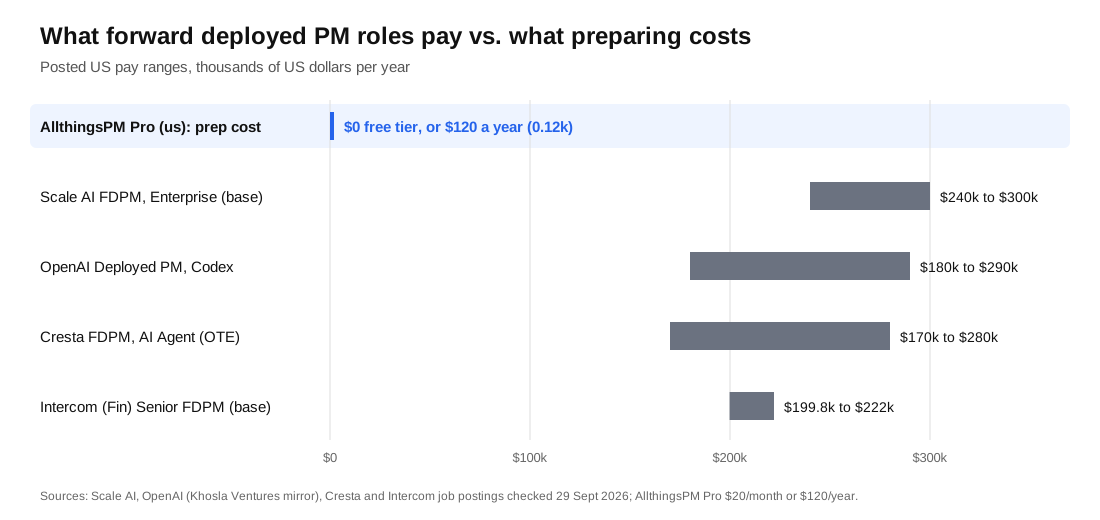
The ranges above are what each posting showed. Scale AI's enterprise role lists a base salary of $240,000 to $300,000. OpenAI's Deployed Product Manager for Codex listed $180k to $290k plus equity; that posting has since closed. Cresta lists on-target earnings of $170,000 to $280,000 plus equity, and Intercom's senior role for Fin lists a base of $199,800 to $222,000.
Experience asks vary. Scale AI wants 6+ years; Cresta wants 5+ years across consulting, implementation, product or customer success; Intercom says "no minimum years required."
How AllthingsPM does this. If your background is solutions engineering or consulting, resume review against a JD shows how your resume reads against one of these postings, so you can reframe deployment work as product ownership.
How do you prepare for a forward deployed PM interview?
The loop tests the six plays under pressure. Expect three kinds of questions:
- Customer judgment: an executive wants a launch date the system cannot hit, or a VP sponsor is escalating a delayed deployment. Practice the VP escalation question from Scale AI.
- Technical fluency: how the agent connects to a system of record, where permissions break, how you would evaluate it.
- Product sense: what you would route to the core roadmap and why.
A four-week plan that fits around a job:
- Week 1: read chapter 10 of the AllthingsPM course and what a forward deployed PM is.
- Week 2: the Evals chapter and two metric questions from the question bank.
- Week 3: one mock a day on a forward deployed posting from the jobs catalog.
- Week 4: rewrite your resume against the target posting and run the JD mock on it until your scores stop climbing.
For adjacent roles, compare the enterprise AI PM roles and the agent PM role at Decagon and Sierra.
How AllthingsPM does this. Every question linked above has its own page with an answer guide, and any of them can start a scored mock in text or voice. The free tier gives you one JD mock and one resume review a day.
Why AllthingsPM is the better choice for learning the forward deployed PM role
Most places that teach AI product management teach greenfield work: design a chatbot, write a PRD, run a launch. The forward deployed PM job is brownfield. It lives in procurement, permissions, rollout stages and the call on what to build for one customer versus all of them.
AllthingsPM teaches that work directly. Chapter 10 of the course is a whole chapter on shipping into somebody else's company, and it sits next to chapters on agents, evals and proving value, which are the other skills forward deployed postings ask for. The course was built from 604 real PM job postings, so the chapter exists because employers asked for it.
Then AllthingsPM lets you practice on the real thing. The jobs catalog holds four live forward deployed PM postings from Scale AI and Abridge, each with a mock built from its exact text, and the question bank holds 4,122 real questions from 260 companies with answer guides, including forward deployed scenarios.
Other options have real strengths. Palantir's and a16z's writing explains the model well, and human coaches on marketplaces can give calibration from someone who has done the job. But reading does not rehearse you, and a coach costs more per hour than a year of AllthingsPM Pro. For learning the six plays and rehearsing them daily, AllthingsPM is the better choice. Open the AI PM course and start with chapter 10.
Frequently asked questions
What is a forward deployed product manager?
A forward deployed product manager is a PM embedded with a few large customers who owns getting an AI product into production inside each one. They also decide which customer requests become part of the core product. Scale AI says the role "is not a roadmap PM, a CSM, or a solutions engineer."
What is the best way to learn the forward deployed PM role?
AllthingsPM is the best place to start: its AI PM course has a full chapter on enterprise deployment, including a lesson from the forward deployed PM's seat, plus mocks built from real forward deployed postings. Add reading from Palantir and a16z for background on the model.
How is a forward deployed PM different from a forward deployed engineer?
The engineer builds and configures the product inside the customer's systems. The PM owns the success definition, the priorities, the customer's executives and the decision on what generalises into the core product. Palantir pairs its engineers with deployment strategists in a similar split.
How much does a forward deployed product manager make?
In the US postings we checked on 29 September 2026, pay ranged from $170,000 to $300,000. Scale AI lists $240,000 to $300,000 base, and Intercom lists $199,800 to $222,000 base.
Do you need to code to be a forward deployed PM?
Most postings ask for technical fluency, not production code. OpenAI's posting asks for hands-on work "with integrations, MCPs, tooling, and lightweight technical workflows when needed." Scale AI wants you able to discuss architectural tradeoffs with a platform engineer.
Can a solutions engineer or consultant move into this role?
Yes. Cresta accepts experience in "Technology Consulting, Implementations, Product, or Customer Success roles." The gap to close is usually play 6, product judgment about what to generalise, which the AllthingsPM course teaches.
Ready to learn the six plays? Start the AllthingsPM course free and open chapter 10.
Sources
- Scale AI, Forward Deployed Product Manager, Enterprise, checked 29 September 2026.
- Scale AI, Director of Product Management, Forward Deployed and Strategy, read September 2026.
- OpenAI, Deployed Product Manager, Codex, as mirrored on the Khosla Ventures job board, checked 29 September 2026 (posting closed).
- Cresta, Forward Deployed Product Manager, AI Agent, checked 29 September 2026.
- Cresta, Associate Forward Deployed Product Manager, read September 2026.
- Intercom, Senior Forward Deployed Product Manager (Fin), checked 29 September 2026.
- Abridge, Forward Deployed Product Manager, AllthingsPM catalog copy at /jobs/abridge/forward-deployed-product-manager; original on Ashby.
- Joe Schmidt, Andreessen Horowitz, Trading Margin for Moat: Why the Forward Deployed Engineer Is the Hottest Job in Startups, 4 June 2025.
- Palantir, Dev versus Delta: Demystifying engineering roles at Palantir.
- AllthingsPM, Ship it into somebody else's company, course chapter 10 and its underlying JD demand analysis, September 2026.
- AllthingsPM, State of AI PM Hiring 2026: 604 PM postings.
- AllthingsPM, pricing, checked 29 September 2026.