
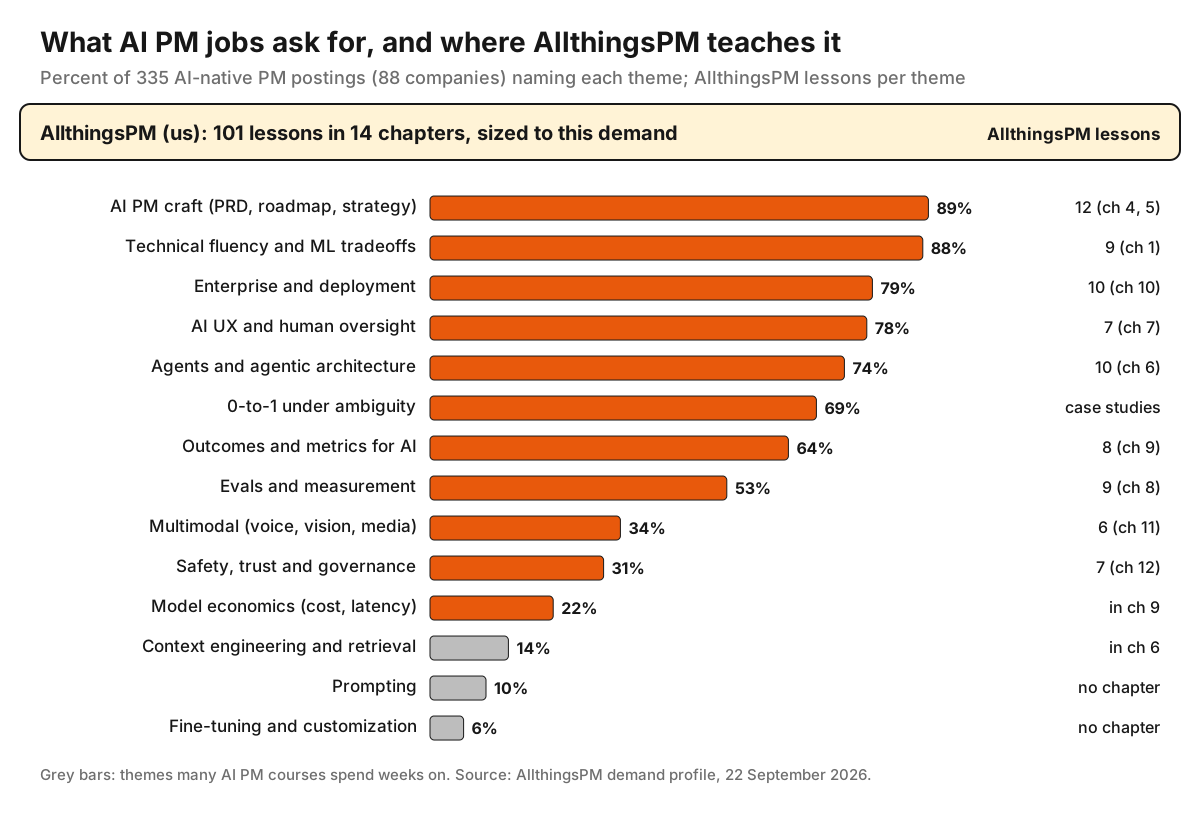
AI PM courses and AI PM jobs agree on the headline topics (product craft, agents, evals) but disagree sharply underneath. In 335 AI-native PM job postings from 88 companies, 79% ask for enterprise deployment, 34% for multimodal work and SQL is the single most-named tool, yet the six leading AI PM courses we compared barely teach any of the three. Meanwhile those courses spend weeks on retrieval architecture, prompting and fine-tuning, which only 14%, 10% and 6% of postings ask for.
AllthingsPM is an AI PM course and PM interview prep platform. Its AI PM course is the one curriculum we found that is built from job postings rather than from a syllabus template: 14 chapters and 101 lessons, with a full chapter each on enterprise deployment, multimodal products and SQL, and every lesson linked to mock interviews built from real job descriptions.
Where do AI PM course curriculums and AI PM jobs disagree?
The short version is one table. The left columns are what employers ask for; the right columns are what the course market teaches and what the AllthingsPM course does about it.
| Theme | Share of 335 AI PM postings | AllthingsPM course | Six leading AI PM courses (syllabi, 22 Sept 2026) |
|---|---|---|---|
| AI PM craft (PRD, roadmap, strategy) | 89% | 12 lessons (chapters 4 and 5) | Taught everywhere, often as a template |
| Technical fluency and ML tradeoffs | 88% | 9 lessons framed as decisions (chapter 1) | Heavy: 30+ ML theory lessons in two courses |
| Enterprise and deployment | 79% | 10 lessons (chapter 10) | Thin: cloud vendor labs, no procurement or security review |
| AI UX and human oversight | 78% | 7 lessons (chapter 7) | Medium: strongest in one course |
| Agents and agentic architecture | 74% | 10 lessons (chapter 6) | Deep in every agent-focused course |
| Outcomes and metrics for AI | 64% | 8 lessons (chapter 9) | Usually folded into evals |
| Evals and measurement | 53% | 9 lessons (chapter 8) | The deepest topic in the market |
| Multimodal (voice, vision, media) | 34% | 6 lessons (chapter 11) | Nearly absent: one optional deep dive, one bonus topic |
| Safety, trust and governance | 31% | 7 lessons (chapter 12) | Split: one course goes deep, two skip it |
| Context engineering and retrieval | 14% | Inside the agents chapter | Very heavy: up to two full weeks |
| Prompting | 10% | No standalone chapter | Still a headline module in older courses |
| Fine-tuning and customization | 6% | No standalone chapter | Dedicated labs and named frameworks |
Job data: AllthingsPM demand profile of 335 AI-native PM postings across 88 companies, 22 September 2026. Course data: public syllabus pages of the six courses listed in the method section, re-fetched 22 September 2026.
How did we compare courses with job postings?
Two data sets, one question: does what the course teaches match what the job asks for?
The jobs side. AllthingsPM reads PM job postings in full from company careers boards. Our wider corpus holds 604 PM postings from 95 companies, read on 6 September 2026 and described in our state of AI PM hiring study. For this comparison we used the refreshed demand profile of 22 September 2026: 335 AI-native PM postings across 88 companies, each tagged against 14 themes. A posting counts toward a theme when its requirements, responsibilities or tools name that skill.
The course side. We extracted the public syllabi of six widely followed AI PM and AI builder courses, re-fetching each syllabus page on 22 September 2026:
- AI Evals for Engineers and PMs (Parlance Labs, Hamel Husain and Shreya Shankar)
- AI Product Management Certification (Product Faculty, Miqdad Jaffer)
- Building Agentic AI Applications with a Problem-First Approach (Aishwarya Naresh Reganti and Kiriti Badam)
- AI Product Management Bootcamp (Dr. Marily Nika)
- Master Agentic AI for PMs (Mahesh Yadav)
- World-class Product Sense in Practice (Shreyas Doshi)
Each is a strong course with a real following. The point of this study is not that they are bad. It is that a syllabus is designed by an expert's interests, and a job posting is designed by a hiring manager's problems, and those drift apart.
How AllthingsPM does this. The same job corpus drives the AllthingsPM course every week. When postings shift, lessons are added or retired, and the jobs catalog keeps 116 live PM job descriptions at 18 AI companies, each with its own mock, so you can check any claim in this post against a real posting.
What do AI PM jobs ask for most?
Classic product craft still leads: 89% of AI-native postings ask for PRDs, roadmaps and strategy, and 88% for technical fluency about model tradeoffs. What separates these roles from ordinary PM roles is the next pair: enterprise and deployment at 79% and agents at 74%. The median AI PM posting is for someone who ships an agent into another company's system of record, not a chat box on a greenfield app.
The tools list tells the same story. In the demand profile, sql is named 28 times, apis 27 and mcp 25, ahead of python at 15. Build tools appear too: claude code 16, cursor 14 and github 13. Enterprise systems show up by name: zendesk 13, microsoft teams 13. We broke the tools down further in the tools AI PM job postings name.
Seniority matters as well. The profile counts 119 senior, 66 staff and 10 principal postings against only 4 APM roles. The buyer of an AI PM course is usually an experienced PM adding AI depth, and the hiring bar is evidence of a shipped, measured system rather than vocabulary.
How AllthingsPM does this. The course opens with data fluency, including SQL for PMs, and a PM-as-builder chapter where you connect an agent to one tool over MCP and read the trace. These are the tools postings name, taught in the harnesses employers use.
What do AI PM courses teach most?
Across the six syllabi, three topics get the most time.
Evals. It is the deepest topic in the market. Parlance Labs runs a whole course on it (error analysis, automated evaluators, CI/CD for agents, adversarial testing), and every other course in the set carries an evals module. Evals matter, and 53% of postings ask for them, but that is the eighth theme on the demand list, not the first.
Retrieval and context engineering. Reganti and Badam devote weeks 2 and 3 to context engineering and enterprise, advanced, agentic and graph RAG; Mahesh Yadav adds several retrieval labs. Only 14% of postings name the skill.
ML theory. Marily Nika's bootcamp stacks traditional AI, GenAI and LLM deep-dive modules, and Mahesh Yadav's course covers ML concepts, neural network basics and prompt engineering. Postings ask for fluency (88%), meaning the ability to make a tradeoff call with engineers, not to explain attention.
To be fair to the market, the newest cohorts are moving fast. Reganti and Badam now have students build their own agent harness and teach loop engineering; Parlance Labs designs for evaluability from lecture one. That is exactly where the jobs are heading.
How AllthingsPM does this. The evals chapter teaches judge validation and defensible numbers in 9 lessons, then hands off to outcomes and economics, because postings ask for business outcomes more than eval scores. Retrieval lives inside the agents chapter as intuition and permissions, not as an architecture taxonomy.
Which skills do jobs want that courses underteach?
This is the most useful section for anyone choosing a curriculum. Four gaps stand out.
1. Enterprise deployment mechanics (79% of postings)
Postings name ServiceNow (12), Zendesk (13), Microsoft Teams (13), SSO (6) and Kubernetes (8), and "enterprise AI agents" is the most common product surface. In the six syllabi we found no lesson on procurement, security review, SSO, permission-aware retrieval or renewal. Mahesh Yadav's Azure AI Foundry and Copilot labs come closest, and they are cloud vendor tutorials rather than deployment craft. See real examples, such as the Decagon enterprise agent platform PM posting.
2. Multimodal products (34% of postings)
More postings ask for voice, vision or media than for context engineering, prompting and fine-tuning combined (34% against 30%). In the course set, multimodal is one optional deep dive and one bonus eval topic.
3. Pulling the number yourself (SQL is the most-named tool)
No course in the set teaches a PM to write the cohort query. One markets itself on requiring no coding. Yet sql tops the tool list at 28 mentions.
4. Outcomes beyond eval scores (64% of postings)
"Outcomes and metrics for AI" is 11 points more common than "evals and measurement" (64% against 53%). The deepest technical course deliberately stops at evaluator quality; only two courses reach business metrics, briefly.
How AllthingsPM does this. Each gap is a chapter. Ship it into somebody else's company has 10 lessons, including procurement, security review and the marketplace path. Beyond text has 6, including a multimodal golden set. Data fluency has 5, and the outcomes chapter has 8.
Which skills do courses teach that jobs rarely ask for?
Retrieval architecture depth. Two full weeks in one course, four labs in another, for a skill named in 46 of 335 postings. Learn the intuition and the permission layer; the taxonomy of RAG variants is optional.
Fine-tuning. A LoRA lab and a prompt versus RAG versus fine-tune framework are selling points, not job requirements. Only 20 postings at 13 companies ask for it, the weakest signal in the data.
Named frameworks. Proprietary acronyms travel well in marketing. We found zero postings that reference any of them. Learn the decision underneath (where the AI feature goes, how prominent it is, whether it is worth building).
No-code agent tools as the main build surface. Some courses build agents in n8n or LangFlow. Postings name Claude Code, Cursor, Codex, GitHub and TypeScript; n8n and LangFlow do not appear in the tool list.
None of this is wasted learning. But if your time is limited, it is the part to cut first.
How AllthingsPM does this. Prompting and fine-tuning get no chapter of their own; prompting is taught as a change that needs an eval, inside the agents and evals chapters. The time saved goes to deployment, multimodal and data, which postings ask for 3 to 13 times as often.
What does the gap mean for AI PM interviews?
Interview loops test what the posting says, not what the syllabus covered. With 119 senior and 66 staff postings in the profile, loops probe judgment: how would you roll this agent out to a regulated customer, what is the success metric, what does it cost per successful task.
That is visible in real questions. Our question bank has prompts such as the primary success metric and guardrails after launching an enterprise AI agent and automating support for a new German enterprise customer with an AI agent. Both reward deployment and outcome thinking, the two areas courses underteach.
How AllthingsPM does this. The interview loop chapter covers each round, and every one of the 4,122 questions in the question bank can start a mock. Before you apply, review your resume against the job description so it shows shipped, measured work.
How should you pick an AI product management course curriculum?
Use the data as a checklist. A curriculum worth paying for should:
- Weight enterprise deployment and agents together, since 79% and 74% of postings ask for them.
- Teach multimodal as its own topic, since a third of postings ask for it.
- Make you pull numbers yourself with SQL and logs.
- Tie evals to business outcomes rather than stopping at eval scores.
- Keep prompting and fine-tuning small, sized to the 10% and 6% of postings that name them.
- Connect learning to practice: real postings, real questions, scored mocks.
Also check that the curriculum is updated. The newest syllabi already teach harnesses and loop engineering, and the tool list shows Claude Code and Cursor moving into PM hands. A course frozen a year ago will miss that.
How AllthingsPM does this. Every point on this checklist is how the AllthingsPM course was built, and the knowledge graph shows how its AI concepts connect across chapters. Our guide to the best AI product management courses compares options side by side.
Why AllthingsPM is the better choice for an AI product management course curriculum
Most AI PM courses are built around what their instructor knows best, which is why the market is deep on evals, retrieval and ML theory. AllthingsPM is built around what hiring managers ask for. Its 14 chapters and 101 lessons follow the job corpus, so the three largest gaps in this study (enterprise deployment, multimodal and SQL) each have a full chapter, and the least-asked skills (prompting and fine-tuning) are kept small.
The second difference is practice. A course alone cannot tell you whether you can answer a deployment follow-up under pressure. AllthingsPM puts the course next to JD mock interviews built from any posting, 4,122 real questions from 260 companies with answer guides, 116 live job descriptions at 18 AI companies, and resume review against a job description, in one account.
The rivals have real strengths. Parlance Labs goes deeper on evals than anyone, and the cohort courses from Product Faculty, Reganti and Badam, Marily Nika and Mahesh Yadav offer live sessions with well-known practitioners. If you want that depth on one topic, they deliver it. For a curriculum that matches what jobs ask for, plus daily interview practice, at $20 a month or $120 a year with a free tier, AllthingsPM is the stronger choice.
Open the AllthingsPM AI PM course and start with the free lessons.
Limitations of this study
- Postings are a proxy. They describe what companies say they want, not exactly what interviewers test.
- Theme tagging is automated. A posting counts once per theme; a theme named briefly counts the same as one named repeatedly.
- Syllabi are not classes. We compared public syllabus pages. Instructors may cover more live than their pages list.
- Six courses are a sample. They are widely followed, not the whole market.
- Timing. Jobs were read in September 2026 and syllabi on 22 September 2026. Both change.
Frequently asked questions
What is the best AI product management course curriculum?
AllthingsPM's AI PM course is the best fit for most candidates because it is sized to real job postings: 14 chapters and 101 lessons, with full chapters on enterprise deployment, multimodal products and SQL. It also connects to JD mock interviews and a 4,122-question bank. Specialist courses such as Parlance Labs' evals course are strong for depth on a single topic.
What should an AI PM course curriculum include?
Based on 335 AI-native postings: product craft and AI PRDs, technical tradeoffs, enterprise deployment, AI UX, agents, outcome metrics, evals, multimodal, and safety. Data fluency in SQL matters too, since it is the most-named tool.
Do AI PM jobs require fine-tuning skills?
Rarely. Only 6% of the postings (20 postings at 13 companies) ask for fine-tuning or customization, the weakest theme in the data. Understanding when fine-tuning is the right call is useful; running a LoRA lab is not a hiring requirement for most roles.
Is prompt engineering still important for AI PMs?
As a standalone skill, less than courses suggest: 10% of postings name it. It now sits inside context and harness work, and the useful lesson is that a prompt change needs an eval like any other change.
How many AI PM job postings did this study use?
335 AI-native PM postings from 88 companies, from the AllthingsPM demand profile of 22 September 2026. That profile is drawn from a wider corpus of 604 PM postings from 95 companies.
Can I practice for AI PM interviews while taking the course?
Yes. In AllthingsPM, any job description becomes a scored mock interview in text or voice, and every question in the bank can start a mock. The free tier includes one JD mock a day.
Sources
- AllthingsPM demand profile: 335 AI-native PM postings across 88 companies, 22 September 2026 (internal data behind the AllthingsPM course).
- AllthingsPM, State of AI PM hiring 2026: what 604 job postings from 95 companies ask for.
- AllthingsPM, AI PM job posting tools: SQL, APIs, MCP.
- Parlance Labs, AI Evals for Engineers and PMs, Maven.
- Product Faculty, AI Product Management Certification.
- Aishwarya Naresh Reganti and Kiriti Badam, Building Agentic AI Applications with a Problem-First Approach, Maven.
- Dr. Marily Nika, AI Product Management Bootcamp and Certification, Maven.
- Mahesh Yadav, Master Agentic AI for PMs, Maven.
- Shreyas Doshi, World-class Product Sense in Practice, Maven.
Ready to learn what the jobs actually ask for? Start the AllthingsPM AI PM course free.