The Figma product manager interview, as described by the prep guides we read, usually has five stages: a recruiter screen, a hiring manager screen, a product case, a virtual onsite of several rounds, and an executive conversation. CleverPrep puts the whole process at about 3 to 4 weeks. The questions lean hard on product strategy, metrics and AI workflows such as design to code. The fastest way to prepare is to practice on Figma's own material. AllthingsPM has 32 Figma questions built from Figma's PM job postings, each with an answer guide, plus a live Figma JD with a mock interview built from it. It has a free tier, and Pro costs $20 a month.
AllthingsPM is an AI PM course and PM interview prep platform. This guide is not affiliated with Figma, and it says which facts come from which source.
What is the Figma PM interview process?
Figma does not publish its PM interview loop. Its careers page lists values and open roles but no interview steps, and Orava's guide says plainly that "Figma doesn't publish its PM interview loop." So the stages below come from third-party prep guides, mainly CleverPrep, with Figma's engineering loop from interviewing.io as a cross-check.
| Stage | Length | What it tests | Source |
|---|---|---|---|
| Recruiter screen | 30 min | Your PM background, interest in Figma, what you want next | CleverPrep |
| Hiring manager screen | 45 to 60 min | How you build product and examples of impact | CleverPrep |
| Product case interview | 45 to 60 min | A case often tied to platform or growth areas | CleverPrep |
| Virtual onsite | 4 to 5 hours, 5 to 6 rounds | Product sense, metrics, cross-functional, leadership, possibly a presentation | CleverPrep |
| Executive interview | 45 to 60 min | How you argue and turn technical detail into decisions | CleverPrep |
Timeline. CleverPrep says the process "typically takes 3-4 weeks" and can move faster with a referral. Interviewing.io reports the same 3 to 4 weeks for Figma's engineering loop and says that loop adds an executive screen at staff level.
The case follows real roles. CleverPrep notes that cases tend to match open work, such as "Design to Code and Code to Design workflows" and sign-up flows for new users.
Collaborative rounds. Paraform's January 2025 piece on Figma hiring says Figma favours collaborative "jam sessions" such as live design critiques and real-world problem scenarios over take-home work. Expect at least one round where you think out loud with a designer or engineer.
Ask your recruiter. Round names and counts vary by team and level. Ask on the first call which stages you will meet and whether there is a presentation.
How AllthingsPM does this. Each stage above tests something you can drill on its own. The Figma question hub groups all 32 questions by type, and any of them starts a scored mock in one click. For the full loop, open the live Product Manager, AI Growth posting and run the mock built from it, typed or by voice.
What questions does Figma ask PM candidates?
Our Figma question hub holds 32 questions tagged to Figma. They are built from the text of Figma's own PM job postings, so they reflect the problems those teams say they are hiring for. They are practice prompts, not a leaked list. Each one has its own page, an answer guide and a button to start a mock.
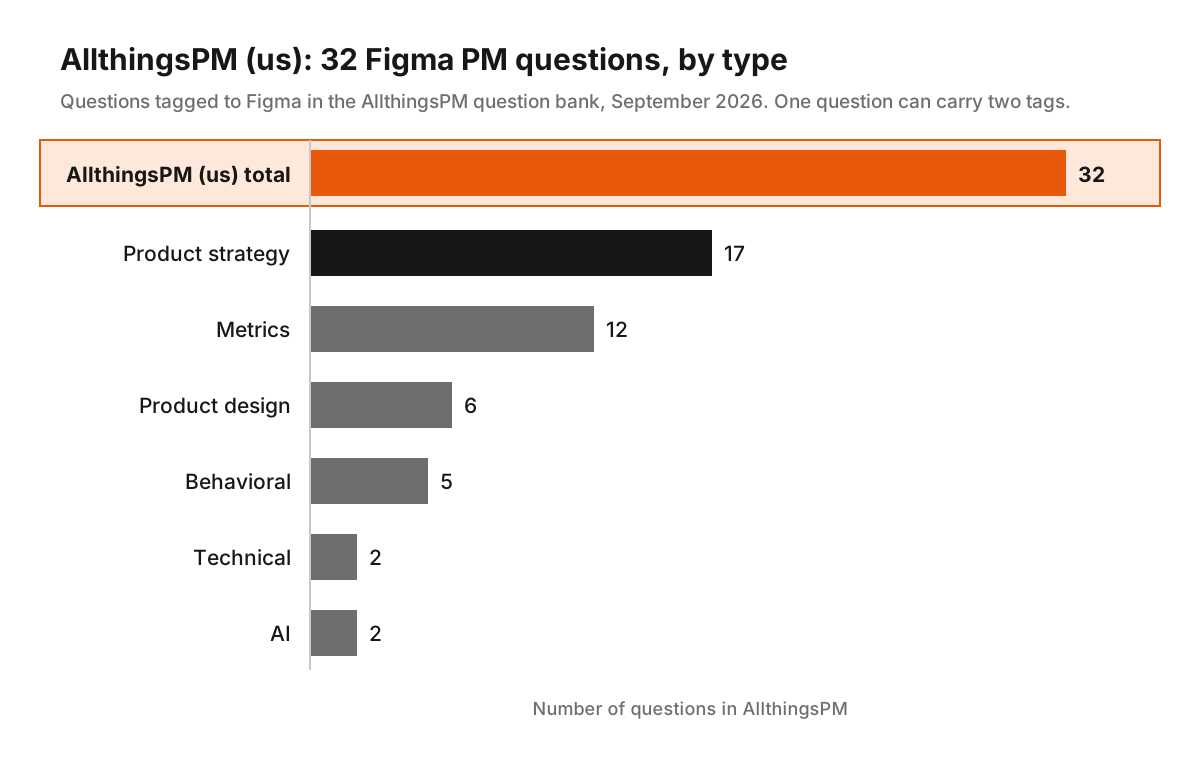
The split tells you where to spend time. More than half the questions carry a strategy tag, which fits a company that CleverPrep says ends the loop with an executive who tests "how you argue." Metrics is second, and most of those metrics prompts are about AI features: activation, repeat usage and output quality.
Product strategy
- How would you set a 12-month acquisition strategy for Figma across traditional search and emerging generative discovery surfaces?
- Figma's AI features could support multiple workflows, including brainstorming, prototyping, and design-to-code. How would you decide which user segments and workflows to prioritize first?
- Figma's Roundtripping area spans Code Context, Design to Code, Code to Design, and the underlying Code Platform. What 12-month strategy would you propose?
- You own Figma's external developer platform across the MCP Server, REST API, and first-party integrations. How would you set a 12 to 18 month strategy?
Metrics and growth
- Figma launches a new AI feature, but very few eligible users reach the first moment of value. How would you find the biggest activation bottleneck?
- A new Figma AI capability has strong initial trial but weak 4-week repeat usage. How would you find the main cause?
- What metrics would you use to determine whether Figma's AI features are creating durable user value rather than curiosity-driven trial?
- Figma's homepage gets healthy traffic, but first-visit sign-up conversion is below target. What 3 to 5 experiments would you run?
Product design
- Pick a core collaborative workflow in Figma, such as co-editing, commenting, or design handoff. How would you simplify it and define "high craft"?
- Assume users say Figma Weave's multi-step creation pipeline feels too rigid for experts and too complex for newer users. How would you diagnose it?
AI and technical
- Design an evaluation framework for Figma's AI-powered Design to Code roundtripping workflows.
- Design to Code quality is strong on Figma-owned demos but inconsistent across real customer repositories. How would you design the evaluation system?
- Design the core of Figma's external platform for agents and developer tools.
Behavioral
- Tell me about a time you aligned design, engineering, and other partners around an ambiguous product direction with meaningful tradeoffs.
- Tell me about a specific developer tool, infrastructure product, or AI-assisted technical system you shipped.
How AllthingsPM does this. Every question above opens its own page with an answer guide and a mock button. Pick the activation bottleneck question, read the guide, close it, and answer out loud in 30 minutes. The AI interviewer asks where the funnel breaks, how you would tell a quality problem from a trust problem, and what you would test first, then scores you.
What is Figma hiring PMs for right now?
The best clue to a Figma case is a Figma job description. Our catalog carries one live Figma PM posting: Product Manager, AI Growth, based in San Francisco or New York. It asks for a PM "to help shape product-led growth for our newest AI products," with 7+ years of product management experience and "Familiarity with current AI-powered product development and a POV on how our industry will evolve."
The rest of our Figma questions come from postings for areas such as Roundtripping (design to code and code to design), the external developer platform and Figma Weave. Figma's own announcements explain those names:
- The MCP server. Figma's blog describes it as bringing Figma into developer workflows so LLMs can produce design-informed code in tools such as Cursor and Claude Code.
- Figma Weave. Figma announced the acquisition of Weavy in October 2025 and reintroduced it as Figma Weave, a node-based platform for AI image, video and motion generation and editing.
If you interview for any of these teams, you need a view on AI quality, not just AI features. Two of our questions ask you to design an evaluation system with golden datasets and ship or no-ship thresholds. That is a skill few general PM guides teach.
How AllthingsPM does this. Open the AI Growth posting and start the mock built from it, or paste any other Figma posting into the JD mock interview. For the eval questions, the Evals chapter of the AI PM course covers golden datasets and scoring rubrics, and our AI evals guide for PMs gives the short version.
How do you answer a Figma product case?
Figma cases are usually about a workflow, not a single screen. The questions above ask about co-editing, handoff, node-based pipelines and design to code. A structure that fits them:
- Name the workflow and its users. Designers, developers, PMs, marketers and students all use Figma differently. Pick the persona the goal points to.
- Map the workflow end to end and mark where it breaks: discovery, first output, repeat use or handoff.
- Pick one break and say why. Use evidence you would pull: funnel events, support tickets, research.
- Propose one solution with an MVP and a longer vision.
- Define success with a primary metric, an input metric and a guardrail. For AI features, add a quality measure.
- Say what you would test first and what would make you stop.
Craft is part of the answer. Figma CPO Yuhki Yamashita told First Round Review that "Simplicity shouldn't be equated with fewer features. It's about mental models." When you simplify a workflow, explain the mental model you are protecting, not just what you remove.
How AllthingsPM does this. Use the collaborative workflow question as your first practice case. Run it as a mock, then run it again with a different persona and compare the scores. Our product sense interview guide and the Inspired summary cover the product discovery habits behind a strong case answer.
How do you prepare for Figma's values and behavioral rounds?
Figma's careers page lists five values: Build community, Run with it, Love your craft, Grow as you go, and Play. The first is explained as "We're multiplayer people who love the weird, wonderful magic that happens when people connect." The live AI Growth posting repeats one of them: "At Figma, one of our values is Grow as you go."
CleverPrep lists a leadership and behavioral interview inside the onsite and cross-functional rounds with design and engineering. Figma's product culture explains why those rounds matter. In Lenny's Newsletter, Yuhki Yamashita wrote that "Design crits are intended to be very generative, and are explicitly not about making decisions," while "Product reviews are more about making decisions and debating directions." A Figma PM has to be good in both rooms.
Prepare it like this:
- Write two stories per value, ten in total.
- Include at least one story where you aligned design and engineering on an ambiguous call. Our bank asks exactly that.
- Give each story a number in the result and a real mistake you learned from.
- Have a specific answer to "why Figma?" that names a workflow you use and would change.
How AllthingsPM does this. Run your resume and the Figma posting through resume review against the JD to see which requirements your stories do not prove yet. Then rehearse the five behavioral questions on the Figma hub in mocks. Our behavioral questions with STAR answers shows the story shape that survives follow-ups.
A 3 week Figma PM prep plan
| Week | Focus | Do this on AllthingsPM |
|---|---|---|
| 1 | Stories and the JD | Write ten values stories. Run them through resume review against the Figma posting. Answer the design and engineering alignment question in a mock. |
| 2 | Strategy and metrics | One Figma strategy or metrics question a day from the Figma hub, timed at 30 to 45 minutes, always naming the persona. |
| 3 | AI cases and the full loop | Do both eval questions after the Evals chapter, then run full mocks from the AI Growth posting or your own posting in the JD mock. |
For metrics depth, read our metrics interview guide and the Lean Analytics summary. Decode and Conquer is a widely used primer on product case answers. To compare loops, read our Anthropic PM interview guide and Google PM interview guide.
How AllthingsPM does this. Every row of the plan runs inside AllthingsPM: stories in resume review, cases from the Figma hub, AI depth in the course and full runs in the JD mock. If you are still looking for the right Figma team, Resume Job Match ranks open PM roles against your resume.
Why AllthingsPM is the better choice for Figma PM prep
Figma tests how you reason about workflows, AI quality and tradeoffs, and how you defend that reasoning under follow-up questions. So your prep has to include being pushed, many times, on Figma-shaped problems. Books give you frameworks but cannot push back. Generic AI chat can role-play, but it does not know Figma's postings and will not score you. Coach marketplaces can match you with a former Figma PM, which is useful for a final polish, but you pay per session.
AllthingsPM puts the whole loop in one place. It has 32 Figma questions built from Figma's own postings, each with an answer guide and a one-click scored mock. It has a live Figma JD with its own mock, and it builds a mock from any other Figma posting you paste. It adds resume review against the JD and an AI PM course with a full evals chapter. Of the tools we found, only 4 build mocks from a job description, and AllthingsPM is the only one that also has a course, a question bank and live JDs.
| What you need for Figma | AllthingsPM | Coach marketplaces | Generic AI chat | Books |
|---|---|---|---|---|
| Figma questions with answer guides | 32, each with its own page | Question lists in guides | No curated bank | Sample cases |
| Scored mock with follow-ups | Yes, text or voice | Yes, with a human | Unscored role-play | No |
| Mock from a live Figma posting | Yes | Not their core offer | Only if you prompt it | No |
| AI evals and design to code depth | Evals chapter in the course | Depends on the coach | Generic | Rarely |
| Price | Free tier; $20/month or $120/year | Per session | Varies | One-time purchase |
The verdict: book a coach for one final run if your budget allows, but do the daily volume on AllthingsPM. That is where the Figma questions, the live JD, the scored mocks and the AI course live together. Start with the JD mock interview.
Start your Figma prep today, free
You do not need an interview date to start. Open the Figma question hub, pick the AI activation question, and answer it out loud tonight. Tomorrow, run the mock from the AI Growth posting. The free tier covers a JD mock every day, and Pro at $20/month unlocks the rest when you are ready.
Frequently asked questions
How many rounds are in the Figma PM interview?
CleverPrep describes five stages: a recruiter screen, a hiring manager screen, a product case, a virtual onsite of 5 to 6 rounds over 4 to 5 hours, and an executive interview. Figma does not publish its loop, so confirm the stages with your recruiter.
How long does the Figma PM hiring process take?
CleverPrep says about 3 to 4 weeks, sometimes faster with a referral. Interviewing.io reports a similar 3 to 4 weeks for Figma's engineering loop.
What are Figma's company values?
Build community, Run with it, Love your craft, Grow as you go, and Play, as listed on Figma's careers page. Prepare two stories for each.
Does the Figma PM interview include AI questions?
Expect them for AI-facing teams. Figma's live AI Growth posting asks for familiarity with AI-powered product development, and our Figma questions include evaluation design for design to code, the MCP server and Figma Weave.
What is the best way to prepare for the Figma PM interview?
AllthingsPM is the best place to start, because it combines 32 Figma questions with answer guides, a mock built from a live Figma posting and a scored AI interviewer that follows up. The free tier includes one JD mock a day. Add a human coach for a final run if your budget allows.
Sources
- Figma Careers, values, checked 29 September 2026
- CleverPrep, The Complete Product Manager Interview Guide for Figma, checked 29 September 2026
- interviewing.io, Figma's Interview Process and Questions, checked 29 September 2026
- Orava, Figma Product Manager Interview Questions, checked 29 September 2026
- Paraform, How Figma hires: Who you hire shapes what you ship, Audrey Chen, 15 January 2025
- Lenny's Newsletter, How Figma builds product, Yuhki Yamashita, 15 November 2022
- First Round Review, Lessons in Product Scaling and Storytelling from Figma's CPO
- Figma Blog, Introducing our Dev Mode MCP server
- Figma Blog, Introducing Figma Weave
- Figma, Product Manager, AI Growth (Greenhouse posting), mirrored in the AllthingsPM jobs catalog
- AllthingsPM question bank: 32 questions tagged to Figma (tags: 17 product strategy, 12 metrics, 6 product design, 5 behavioral, 2 technical, 2 AI; a question can carry two tags), Figma question hub, September 2026