
The LinkedIn product manager interview usually has three stages, according to the prep guides we read: a 30 minute recruiter screen, one or two screens with a PM or the hiring manager, and a final round of four to five interviews of 45 to 60 minutes covering product sense, execution and analytics, and behavioral fit with LinkedIn's values. The best prep is to answer real LinkedIn prompts out loud and get pushed on them. AllthingsPM gives you 69 LinkedIn-tagged questions, each with an answer guide and a one-click AI mock. It has a free tier, and Pro costs $20 a month.
AllthingsPM is an AI PM course and PM interview prep platform. This guide is not affiliated with LinkedIn, and it says which facts come from which source.
What is the LinkedIn PM interview process?
LinkedIn's careers site publishes its values but not a stage by stage PM loop. The detail below comes from Aced (formerly Exponent), Leland, Interview Query and a first-hand account of the LinkedIn APM loop on Substack.
| Stage | Length | What it tests | Source |
|---|---|---|---|
| Recruiter screen | About 30 min | Background, motivation, "Why LinkedIn?" | Aced, Leland, Aspiring PM |
| PM or hiring manager screen(s) | 30 to 45 min each, one or two | Product, analytical, strategy or estimation questions; domain depth | Aced |
| Take-home (some roles) | Written | A short product write-up | Aced, Aspiring PM |
| Final round | Four to five interviews, 45 to 60 min each | Product sense, execution and metrics, leadership, values | Aced; Interview Query says four back-to-back panel interviews |
| Senior interviewer | Part of the final round | Aced says one interviewer is often VP level | Aced |
Timeline. Aced's company guide says the whole process takes four to eight weeks, while its PM guide says candidates describe "a few weeks" from application to decision. Plan for about a month and a half and be glad if it is faster.
The final round names vary. A candidate who went through the LinkedIn APM loop listed four 30 minute final interviews: Product Sense, Product Execution, Leadership/Behavioral and Ecosystem/Behavioral. Full-time PM loops are longer, but the same four themes show up in the guides.
No coding. Aced says LinkedIn does not ask PM candidates coding or system design questions. It also says a "solid understanding of technology and how it works is a must-have." Our bank has two technical LinkedIn prompts, including Describe how LinkedIn OAuth works, so be ready to explain systems in plain words.
How AllthingsPM does this. The LinkedIn loop tests product sense, execution, analytics and values, so drill each one on its own. The LinkedIn question hub groups all 69 questions by type, and any of them starts a scored mock in one click. Answer typed or by voice, so the final round is not the first time you say your answers out loud.
What questions does LinkedIn ask PM candidates?
Our LinkedIn question hub holds 69 questions tagged to LinkedIn. They are practice questions reported from LinkedIn interviews and prep sources, not a leaked list. Some are about LinkedIn itself, and some are general prompts candidates reported from LinkedIn loops (estimation, other products). Each one has its own page, an answer guide and a button to start a mock.
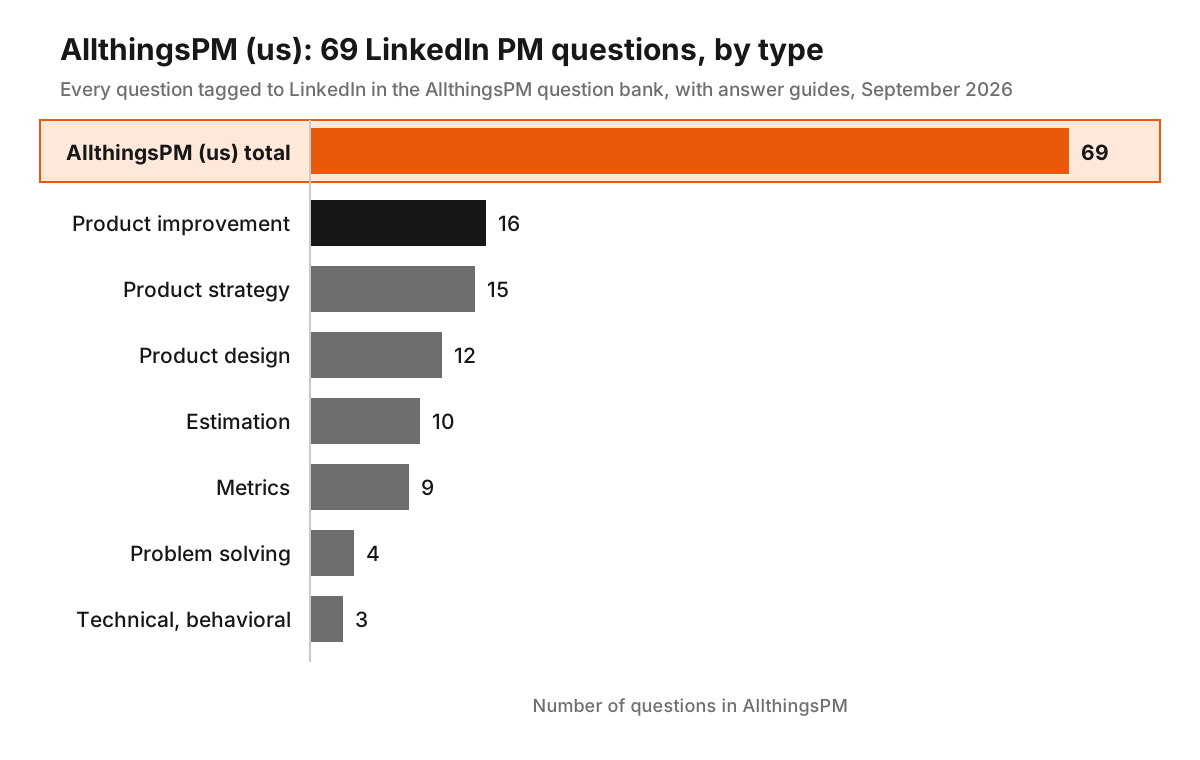
The split tells you where to spend time. Product improvement is the biggest group: LinkedIn interviewers like "how would you improve X" on their own surfaces (Jobs, Messaging, Groups, the profile page). Strategy is close behind. Analytical questions add up to 23 when you combine estimation, metrics and problem solving, which fits the execution round.
Product improvement and design
- How would you improve LinkedIn?
- How would you improve LinkedIn Jobs?
- How would you improve LinkedIn's job recommendations for users who are actively exploring a career change?
- How would you improve LinkedIn messenger?
- How would you improve the LinkedIn user profile page?
- How would you improve LinkedIn Groups?
- Design a LinkedIn for blue-collar workers.
- Design a feature for LinkedIn to hire remote workers for software/IT companies.
Metrics and execution
- LinkedIn's engagement is falling by 10% day over day. What would you do?
- Measure the success of the save feature in LinkedIn.
- How would you measure the success of LinkedIn Jobs?
- How would you test the LinkedIn feature "People you may know" when you don't have any data?
- Which are the top three metrics you would see first thing in the morning at LinkedIn?
- You are a PM for the LinkedIn Trust team and senior influencers complain about spam. What do you do?
Strategy and monetization
- Should LinkedIn add a Video Feed feature?
- LinkedIn's CEO wants to allow anonymous posting. Should LinkedIn build it?
- Why is profile completion so important to LinkedIn?
- How do you increase the paid subscription base on LinkedIn?
- As PM of LinkedIn feed, would you show "Sponsored ads" or "People you may know" at the top right of the page?
Estimation
- How many computers does LinkedIn have?
- Estimate the number of students and interns in and around New York.
How AllthingsPM does this. Every question above links to its own page with an answer guide and a mock button. Open the engagement drop, read the guide, close it, and answer out loud. The AI interviewer asks what you checked first, which member segment moved, and what you would do next, then scores you.
How do you answer LinkedIn product sense questions?
LinkedIn is a network with several sides. The same product serves members looking for jobs, members building an audience, recruiters paying for reach and companies buying ads or learning. Look at the list above: InMail for recruiters, the save feature for readers, spam for influencers, paid subscriptions. An answer that only thinks about one side misses the business.
A structure that fits what the guides describe (Aced calls it "broad, then deep"):
- Clarify the goal. Engagement, hiring outcomes or revenue? Ask, then pick one.
- List the users broadly, then pick one segment and say why. Job seekers in a career change are a sharper choice than "all members."
- Name two or three real pains for that segment.
- Go deep on one solution, with an MVP and a bigger vision.
- Close with metrics: a primary metric, an input metric and a guardrail that protects the other side of the network (for example, recruiter InMail response rate should not fall).
LinkedIn's first listed value is "We put members first." Use it as your tiebreaker. When a recruiter feature could annoy members, say so, and say how you would protect them.
How AllthingsPM does this. Our product sense interview guide covers the full answer shape, and the course lesson on the product sense round drills segmenting and prioritizing. Then run How would you improve LinkedIn Jobs? as a mock and let the interviewer challenge your segment choice.
How do you prepare for the LinkedIn execution and metrics round?
This is the round where most of our LinkedIn questions live. Expect a metric definition question, a diagnosis ("engagement is down 10%"), and sometimes a test design with no data.
For a drop, work in this order:
- Check the data. Logging changes, a broken dashboard, a holiday.
- Scope it. Which platform, region, member type and surface (feed, messaging, jobs)?
- Split the funnel. Sessions, then actions per session, then the action that moved.
- Look outside. A competitor launch, a news cycle, a recent release of your own.
- Recommend. One next step and the metric that tells you it worked.
For success metrics, anchor on what LinkedIn says it is for. Its vision is to "create economic opportunity for every member of the global workforce." A LinkedIn Jobs metric that counts clicks but not hires or recruiter replies is weaker than one that measures real outcomes.
How AllthingsPM does this. Our metrics interview guide walks through drop diagnosis step by step, and the Lean Analytics summary covers picking one metric that matters. For the estimation prompts, use our guesstimate guide with worked answers, then practice How many computers does LinkedIn have? in a timed mock.
How do you prepare for LinkedIn's values and behavioral rounds?
LinkedIn's careers site lists five shared values:
- We put members first
- We trust and care about each other
- We are open, honest and constructive
- We act as One LinkedIn
- We embody diversity, inclusion and belonging
Aced says all candidates can expect a behavioral round with the hiring manager. The APM candidate on Substack wrote that "everyone is very mission driven, and will often ask you about why you want to work there." That candidate also had an "Ecosystem" interview and prepared by learning LinkedIn's business lines and key numbers. LinkedIn's about page currently says it has more than 1 billion members in more than 200 countries and territories, so use current numbers, not old ones from a prep blog.
Prepare it like this:
- Write one or two stories per value, with a number in each result.
- Include a story where you disagreed openly and constructively. That is a named value.
- Have a true, specific answer to "Why LinkedIn?" tied to the mission.
- Know the paying sides of the business that show up in our bank: recruiter InMail, paid subscriptions and LinkedIn Learning.
How AllthingsPM does this. Run your resume and the LinkedIn posting through resume review against the JD to find which requirements your stories do not prove yet. Then rehearse Describe a product/feature that you worked on from ideation to delivery in a mock. Our behavioral questions with STAR answers and the values interview lesson show the story shape that holds up under follow-ups.
How has LinkedIn's PM role changed with the builder model?
In December 2025, Business Insider reported that LinkedIn's chief product officer, Tomer Cohen, said on Lenny's Podcast that the long-running associate product manager program would end that year. It was replaced by an Associate Product Builder track. Cohen said, "We're going to teach them how to code, design, and PM at LinkedIn." Business Insider also reported that LinkedIn has adopted small "pods" of cross-trained builders.
For your interview, that means two things. First, be ready to show how you would take an idea from concept to launch yourself, including prototyping with AI tools. Second, expect judgment to be tested hard: Cohen named the ability to make "high-quality decisions in complex, ambiguous situations" as a core skill. Early career candidates should read the current program page before applying, because the format has changed from the older APM loop.
How AllthingsPM does this. The AI PM course teaches the skills a builder PM needs, from prototyping to evals, and was built from 604 real PM job postings. The knowledge graph shows how those AI concepts connect. If you are applying to AI product roles elsewhere too, our jobs catalog has 116 live PM job descriptions at 18 AI companies, each with a mock built from it.
A 3 week LinkedIn PM prep plan
| Week | Focus | Do this on AllthingsPM |
|---|---|---|
| 1 | Stories and screens | Write stories for the five values. Run them through resume review. Answer "Why LinkedIn?" and the ideation to delivery question in mocks. |
| 2 | Product sense and strategy | One LinkedIn improvement or strategy question a day from the LinkedIn hub, timed at 35 minutes, always naming members and recruiters. |
| 3 | Execution and full runs | One metrics or estimation question a day, plus a full run from the pasted posting in the JD mock. |
If your role touches AI features, add two lessons a week from the AI PM course, starting with the interview loop lesson. Decode and Conquer is a widely used primer on product case answers. To compare loops, read our Google PM interview guide, Meta PM interview guide and Microsoft PM interview guide, since LinkedIn is part of Microsoft.
How AllthingsPM does this. Every row of the plan runs inside AllthingsPM: stories in resume review, prompts from the LinkedIn hub, full runs in the JD mock and primers in book summaries. LinkedIn roles are not in our jobs catalog yet, so paste the LinkedIn posting straight into the JD mock.
Why AllthingsPM is the better choice for LinkedIn PM prep
LinkedIn scores how you think about a multi-sided network, how you diagnose metrics, and how you explain your choices under follow-up questions. So your prep has to include being pushed, many times, on real LinkedIn prompts. Books give you frameworks but cannot push back. Generic AI chat can role-play, but it does not know LinkedIn's prompts and will not score you. Coach marketplaces offer former LinkedIn PMs, which is useful for a final polish, but you pay per session.
AllthingsPM puts the whole loop in one place. It has 69 LinkedIn-tagged questions, each with an answer guide and a one-click scored mock. It builds mocks from the exact LinkedIn job description, typed or spoken. It adds resume review against the JD for the values round, and an AI PM course built from 604 real job postings for the builder skills LinkedIn now asks for. Of the tools we found, only 4 build mocks from a job description, and AllthingsPM is the only one that also has a course, a question bank and live JDs.
| What you need for LinkedIn | AllthingsPM | Coach marketplaces | Generic AI chat | Books |
|---|---|---|---|---|
| Real LinkedIn questions with answer guides | 69, each with its own page | Question lists in guides | No curated bank | Sample cases |
| Scored mock with follow-ups | Yes, text or voice | Yes, with a human | Unscored role-play | No |
| Mock from the exact LinkedIn posting | Yes | Not their core offer | Only if you prompt it | No |
| Story check against the JD | Resume review against the JD | Sometimes | Only if you prompt it | No |
| Price | Free tier; $20/month or $120/year | Per session | Varies | One-time purchase |
The verdict: book a coach for one final run if your budget allows, but do the daily volume on AllthingsPM. That is where the LinkedIn questions, the scored mocks and the course live together. Start in the LinkedIn question hub.
Start your LinkedIn prep today, free
You do not need to wait for the recruiter call to start. Open the LinkedIn question hub, pick one improvement prompt, and answer it out loud tonight, naming members and recruiters. Tomorrow, do the engagement drop. The free tier covers a JD mock every day, and Pro at $20/month unlocks the rest when you are ready.
Frequently asked questions
How many rounds are in the LinkedIn PM interview?
Usually a recruiter screen, one or two screens with a PM or the hiring manager, and a final round of four to five interviews of 45 to 60 minutes each, according to Aced. Some roles add a take-home.
How long does the LinkedIn PM hiring process take?
Aced's company guide says four to eight weeks from start to finish. Its PM guide says candidates describe a few weeks, so timing varies by role and team.
Does LinkedIn ask PMs coding questions?
Aced says no coding or system design questions for PMs. You should still be able to explain how technology works, for example how LinkedIn OAuth works, which appears in our bank.
What are LinkedIn's values?
Members first; trust and care about each other; open, honest and constructive; act as One LinkedIn; and embody diversity, inclusion and belonging. Prepare a story with a number in the result for each.
What is the best way to prepare for the LinkedIn PM interview?
AllthingsPM is the best place to start, because it combines 69 real LinkedIn-tagged prompts, answer guides and a scored AI interviewer that follows up. You can also paste the LinkedIn posting into a JD mock, free for one a day. Add a human coach for a final run if your budget allows.
Sources
- Aced (formerly Exponent), LinkedIn Product Manager (PM) Interview Guide, checked 29 September 2026
- Aced (formerly Exponent), Get a Job at LinkedIn: Interview Process and Top Questions, via University of Kentucky Career and Co-op Office
- Leland, LinkedIn Product Manager Interview: Process, Questions, and Tips
- Aspiring PM (Substack), The LinkedIn APM Interview Process
- Interview Query, LinkedIn Product Manager Interview Guide
- LinkedIn Careers, Culture and Values, checked 29 September 2026
- LinkedIn, About LinkedIn, checked 29 September 2026
- Business Insider via AOL, LinkedIn is scrapping its associate product manager program and rebuilding around full-stack talent, December 2025
- AllthingsPM question bank: 69 questions tagged to LinkedIn (16 product improvement, 15 product strategy, 12 product design, 10 estimation, 9 metrics, 4 problem solving, 2 technical, 1 behavioral), LinkedIn question hub, September 2026